Why Users Talk to AI Differently Than They Type in Search Boxes
Search queries strip context: \\\"NYC LAX June 15.\\\" Conversations preserve it: \\\"I need to get to LA for my sister's wedding mid-June.\\\" Both mean the same.

Two inputs. Same person. Same trip.
Search box: "NYC LAX June 15 nonstop"
AI agent: "I need to get to LA for my sister's wedding mid-June. Probably fly out Thursday evening and come back Sunday."
Both of these describe the same trip. But look at what the second one contains that the first one doesn't. A reason for the trip. Flexibility on the exact date. A preference for evening departure. A return timeframe. An implicit emotional context (family event, probably wants things to go smoothly).
The search query has five data points. The conversational message has at least twelve, half of which are implicit rather than explicit.
This isn't a minor difference. It fundamentally changes what the product can do for the user.
Search queries are keyword-based
When users type into a search box, they unconsciously adopt keyword language. They strip their thoughts down to the minimum structured information the form requires. Origin code. Destination code. Date. Modifier.
This compression happens because search boxes trained us to do it. Twenty-five years of Google taught everyone that shorter, more structured queries get better results. "Best Italian restaurant downtown" works better than "I'm looking for somewhere nice to eat Italian food tonight, maybe in the center of town, nothing too fancy."
Travel search boxes amplify this compression. They literally have separate fields for each piece of information. Origin: NYC. Destination: LAX. Date: June 15. The interface demands structured data, so users provide structured data. All the other information in their head, the reason for the trip, their flexibility, their preferences, their concerns, gets discarded because there's no field for it.
The result is that search engines operate on an impoverished version of the user's actual intent. They get the skeleton of the trip but none of the flesh. And they return results based on that skeleton, which means the results are technically correct but often miss what the user actually cares about.
Conversations are intent-based
When users talk to an AI agent, the compression disappears. They speak in natural language, which preserves the richness of their actual thoughts.
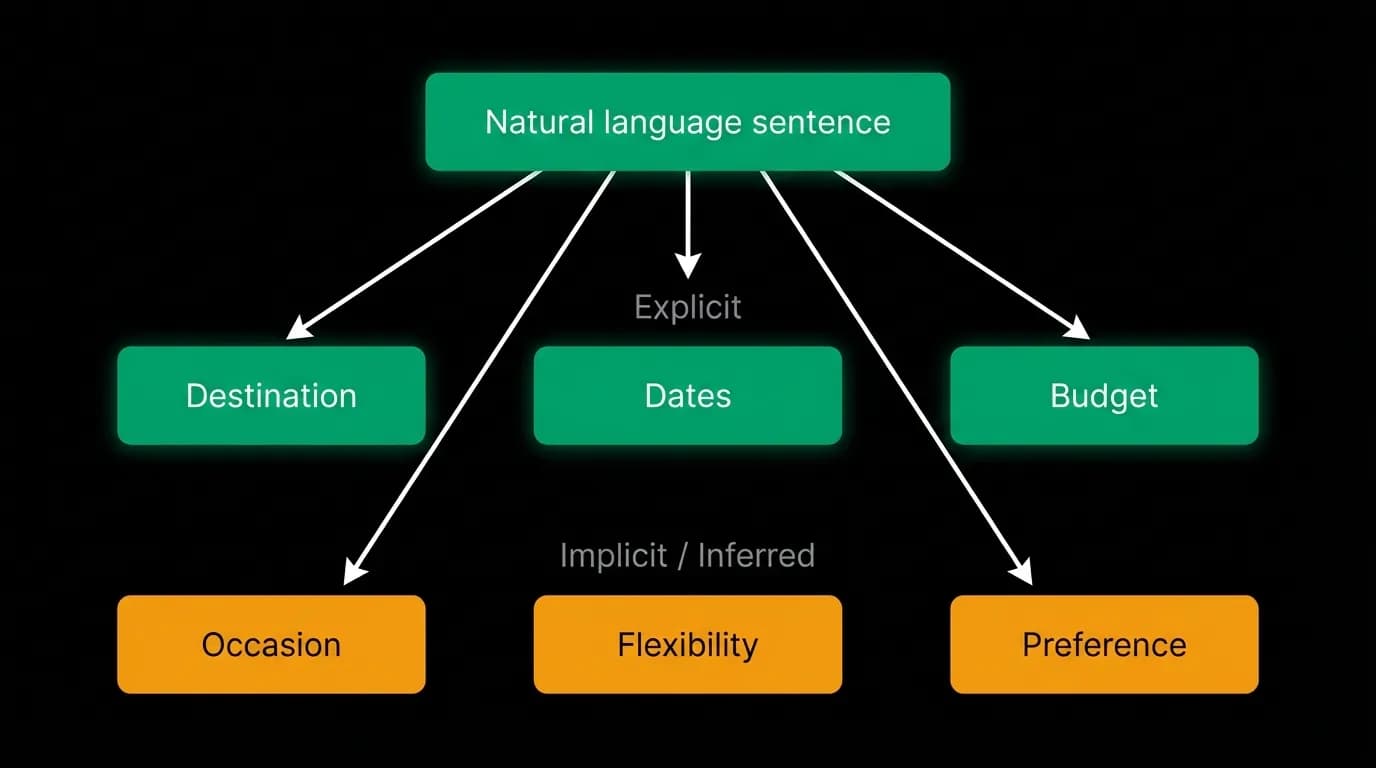
"I need to get to LA for my sister's wedding mid-June" is not a search query. It's a statement of intent with embedded context. Let's unpack what the AI can extract from this single sentence:
Explicit information:
- Destination: Los Angeles
- Timing: mid-June
- Purpose: attending a wedding
Implicit information:
- This is a family obligation, not a leisure trip (reliability matters more than price)
- The user probably needs to arrive before the wedding and might have specific date constraints
- The user might need to look presentable on arrival (red-eye might be undesirable)
- The user is probably traveling alone (they said "I need to get" not "we need to get")
- The user might need a hotel near the wedding venue (if the AI asks, they'd probably share)
- The event is emotionally significant (wedding), so disruptions would be particularly stressful
Inferred information:
- If the AI knows the user's location, it can determine the origin airport
- If the AI knows the user's booking history, it can apply typical preferences
- "Mid-June" suggests flexibility of a few days, opening up date-range search
- A wedding suggests a weekend event, which helps narrow the travel dates
One sentence. At least a dozen extractable data points. A search form would have captured three of them.
What conversation preserves that search strips
The information that gets lost in search compression falls into four categories.
Emotional context. "For my sister's wedding" tells the AI this trip matters. "Just want to get away for a few days" tells the AI this is low-stakes leisure. "Work conference I can't miss" tells the AI reliability is paramount. These emotional signals change what "best" means for this specific booking. The best option for a wedding trip is different from the best option for a casual getaway, even if the origin, destination, and dates are identical.
Flexibility signals. "Mid-June" is more flexible than "June 15." "Probably Thursday evening" is more flexible than a specific date and time. "Around $500" is more flexible than "$500 max." These signals tell the AI how much room it has to optimize. A rigid constraint limits the search. A flexible one opens up options the user might prefer, like a cheaper flight a day earlier or a better-timed flight a day later.
Implicit constraints. "Coming back Sunday" implies a short trip. Short trips imply that travel time matters more (spending 12 hours in transit out of a 72-hour trip is different from spending 12 hours in transit out of a 14-day trip). "Sister's wedding" implies the user might need a hotel near a venue, not just "in LA."
Trade-off willingness. "Probably fly out Thursday evening" tells the AI the user prefers evening but might accept other times. This is different from "I must fly Thursday evening." The word "probably" signals that this is a preference, not a constraint. An AI can act on this distinction. A search form can't even capture it.
The AI extracts richer information from natural language
Here's a concrete example of what more information enables.
Search box input: "NYC LAX June 15"
The search engine returns flights from all NYC-area airports to all LA-area airports on June 15, sorted by price. The user sees 150+ options and starts filtering.
Conversational input: "I need to get to LA for my sister's wedding mid-June. Probably fly out Thursday evening and come back Sunday."
The AI determines:
- Origin: NYC area (from user profile)
- Destination: LAX preferred over other LA airports (if the AI knows the wedding is in West LA)
- Outbound: Thursday June 12 evening, with flexibility to June 11 or 13
- Return: Sunday June 15, with some flexibility
- Priority: schedule reliability over price (family event)
- Preference: evening departure (allows working Thursday, comfortable arrival)
- Party size: 1 (inferred from language)
- Trip length: 3 days (implies carry-on only is likely)
The AI searches with all of these parameters and returns three options, each selected with the full context in mind. The cheapest reliable evening option. The most convenient option. The best overall given the user's history and this trip's context.
The difference in recommendation quality is dramatic. The search engine returned everything and let the user sort it out. The AI returned what the user actually wants based on a rich understanding of their intent.
Designing for conversational input
Building a product that accepts conversational input requires different design thinking than building a product that accepts search queries.
Handling ambiguity. Conversational input is inherently ambiguous. "Mid-June" could mean June 10-20 or June 13-17. "Evening" could mean 5 PM or 9 PM. The product must make reasonable assumptions while flagging significant ambiguities. "I'm searching for Thursday evening flights June 12. If you had a different Thursday in mind, let me know."
Handling implicit information. When the user says "my sister's wedding," the AI should recognize this as an event that implies specific date constraints, emotional significance, and possibly group coordination. Not every AI product needs to be this contextually aware, but a travel AI should be, because these contexts directly affect the quality of recommendations.
Handling evolving intent. In a conversation, intent changes. "Actually, can my wife come too?" The search goes from one passenger to two. "What if we stayed an extra day?" The return date shifts. Traditional search requires starting over. Conversation handles evolution naturally, updating the search parameters while preserving everything that hasn't changed.
Handling what users don't say. Sometimes the most useful information is what the user omits. If they don't mention budget, it might mean they're flexible. If they don't mention class, they probably want economy. If they don't mention airline, they don't have a loyalty preference. The AI should act on these omissions as signals, not as missing required fields.
How this changes what the product can do
Understanding "why" the user is traveling enables recommendations that go beyond logistical optimization.
A user traveling for a wedding might appreciate a recommendation for a hotel near the venue, a reminder to check dress code and weather for the location, and a flight that arrives with enough time to rest before the event.
A user traveling for a work conference might appreciate a flight that arrives the night before, a hotel near the conference venue, and a return flight that allows attending the last session without rushing.
A user traveling for a relaxation getaway might appreciate flexible date suggestions that optimize for price, a hotel with spa facilities, and a flight that doesn't require a 4 AM wake-up.
None of these contextual recommendations are possible from a search query. "NYC LAX June 15" triggers a flight search. "I need to get to LA for my sister's wedding mid-June" triggers a trip planning-trip-planning-ai-shines) experience that understands the human context.
The future: understanding travelers, not just queries
The shift from search queries to conversational input is the first step in a larger evolution. Today, the AI understands what the user says in the conversation. Tomorrow, it understands the user as a person.
This is where memory comes in. After multiple conversations, the AI builds a model of the traveler. Not just their explicit preferences (aisle seat, nonstop flights) but their patterns (they always book 3-4 weeks out, they tend to spend more on leisure trips than business trips, they prefer cities over beach destinations).
With this model, the AI doesn't need the user to explain themselves every time. "I want to go to Japan" is enough, because the AI already knows when they typically travel, how long they stay, what they're willing to spend, and what kind of experience they prefer.
This is fundamentally different from search personalization, which adjusts results based on past searches. It's traveler understanding, which adjusts the entire experience based on a holistic model of who the user is and what they value.
Search boxes capture queries. Conversations capture intent. Memory captures identity. Each layer adds depth to the product's understanding, and each layer enables better recommendations. We're building all three at Nowah, and the compounding effect of queries plus intent plus identity is what makes AI travel booking not just faster than the old way, but genuinely, qualitatively better.
Nowah is an AI travel agent that searches and books real flights and hotels through conversation — no filters, no thirty open tabs. Plan your next trip.