Why Background Jobs Are the Backbone of AI Travel Booking
The invisible infrastructure that makes booking confirmations, emails, and notifications reliable — queue design, retry strategies, and dead letters.
The traveler sees "Booked!" in the chat. Three seconds have passed since they said "book it." From their perspective, it's done. They screenshot the confirmation and text it to their partner.
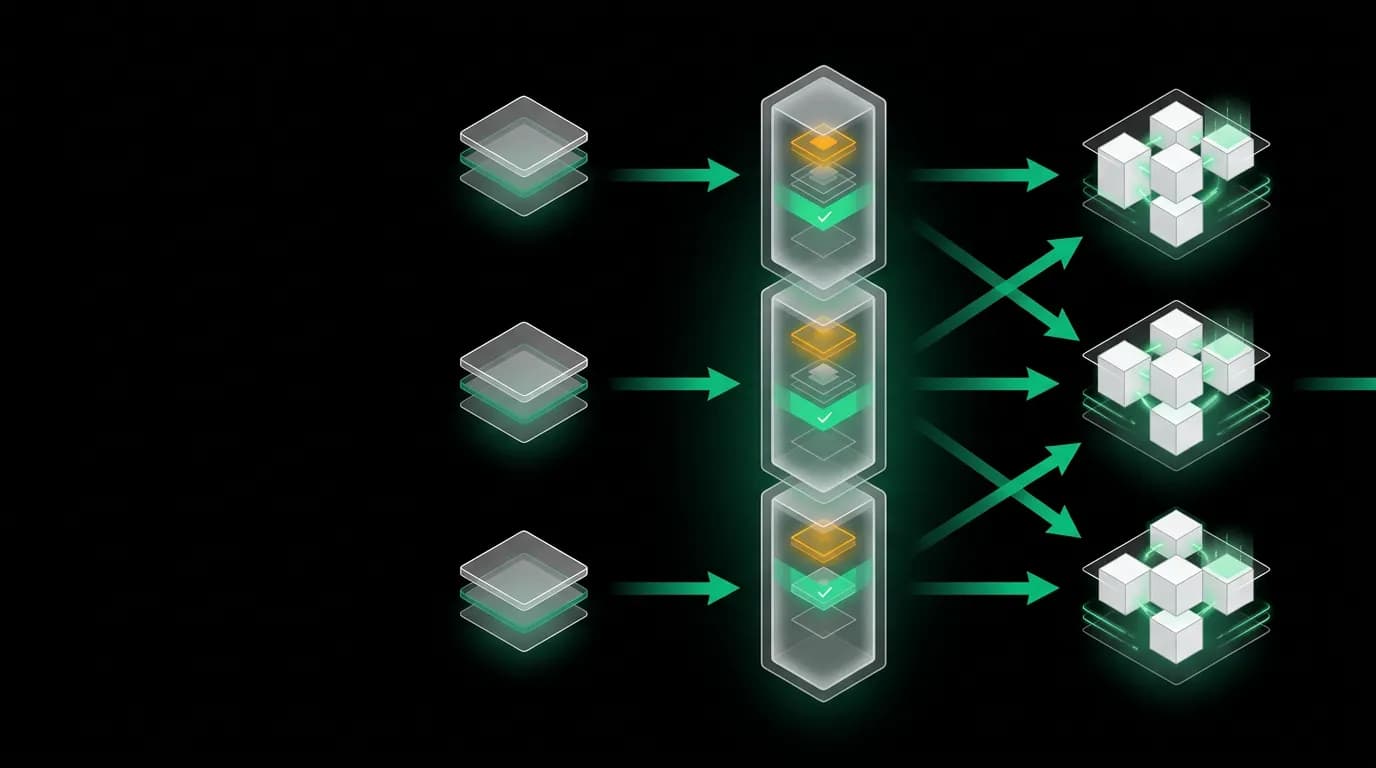
But from our perspective, the work just started. That confirmed booking triggers a cascade of operations that will run over the next few minutes: a confirmation email gets assembled and sent, a push notification fires to every registered device, a PDF itinerary gets generated and stored, the trip record gets updated with the new booking, co-travelers get notified, and analytics events get recorded. Five to ten separate jobs, each with their own failure modes, retry logic, and latency requirements.
None of this can run synchronously in the booking request. If we waited for the email service to deliver, the push notification to fire, and the PDF to generate before responding to the traveler, that "Booked!" message would take 15 to 30 seconds instead of 3. That's unacceptable.
Background jobs let us split the experience. The traveler gets instant confirmation. The side effects happen reliably behind the scenes.
Why synchronous processing fails here
Let me be specific about what goes wrong when you try to do everything in the request-response cycle.
Email delivery involves an external service. That service might respond in 200 milliseconds or 3 seconds. Sometimes it's slow. Occasionally it's down. If email delivery is in the critical path of the booking response, a slow email service makes the booking feel slow. A down email service makes bookings fail entirely, even though the booking itself succeeded.
PDF generation is CPU-intensive. Rendering a rich itinerary document takes real compute time. Running that in the booking handler ties up a request worker that should be free to serve other travelers.
Push notification delivery fans out to multiple devices across multiple platforms. Each device registration might be stale, requiring token refresh or failure handling. That fan-out complexity doesn't belong in a synchronous flow.
The core principle: the booking response should depend only on things that are essential to the booking itself: payment capture and travel provider confirmation. Everything else is a side effect that should succeed eventually, not immediately.
Queue design: priority and isolation
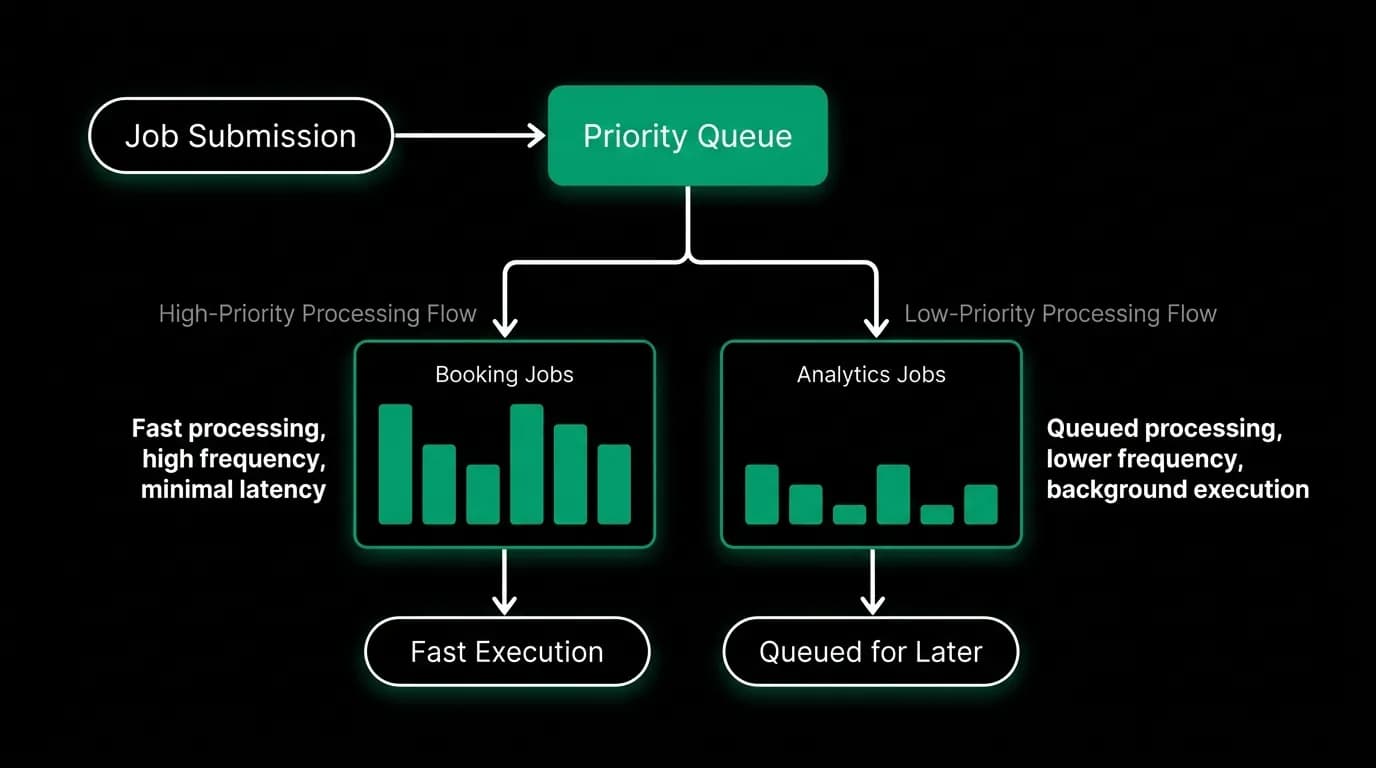
We run seven named queues, each handling a different category of work. This isn't arbitrary. Different job types have different priorities, different failure modes, and different scaling requirements.
Booking-related jobs (updating trip records, confirming reservation status) run on a high-priority queue. These have real impact on the traveler's experience. If the trip record doesn't update promptly, the traveler opens their trips list and doesn't see the booking they just made. That's confusing.
Notification jobs (emails, push notifications) run on a medium-priority queue. These are important but tolerant of a few seconds of delay. A confirmation email that arrives 30 seconds after booking is fine. Thirty minutes is annoying but not catastrophic.
Analytics and telemetry jobs run on a low-priority queue. These are important for us as operators, but invisible to the traveler. If analytics processing runs a few minutes behind, nobody notices.
The queue isolation matters because it prevents starvation. Without separate queues, a spike in analytics events (maybe we shipped a new tracking event and it's generating high volume) could delay notification delivery. With isolated queues and dedicated worker pools, a burst in one category can't starve another.
Retry strategies
External services fail. Networks hiccup. Timeouts happen. Our retry strategy has to handle all of these without creating worse problems.
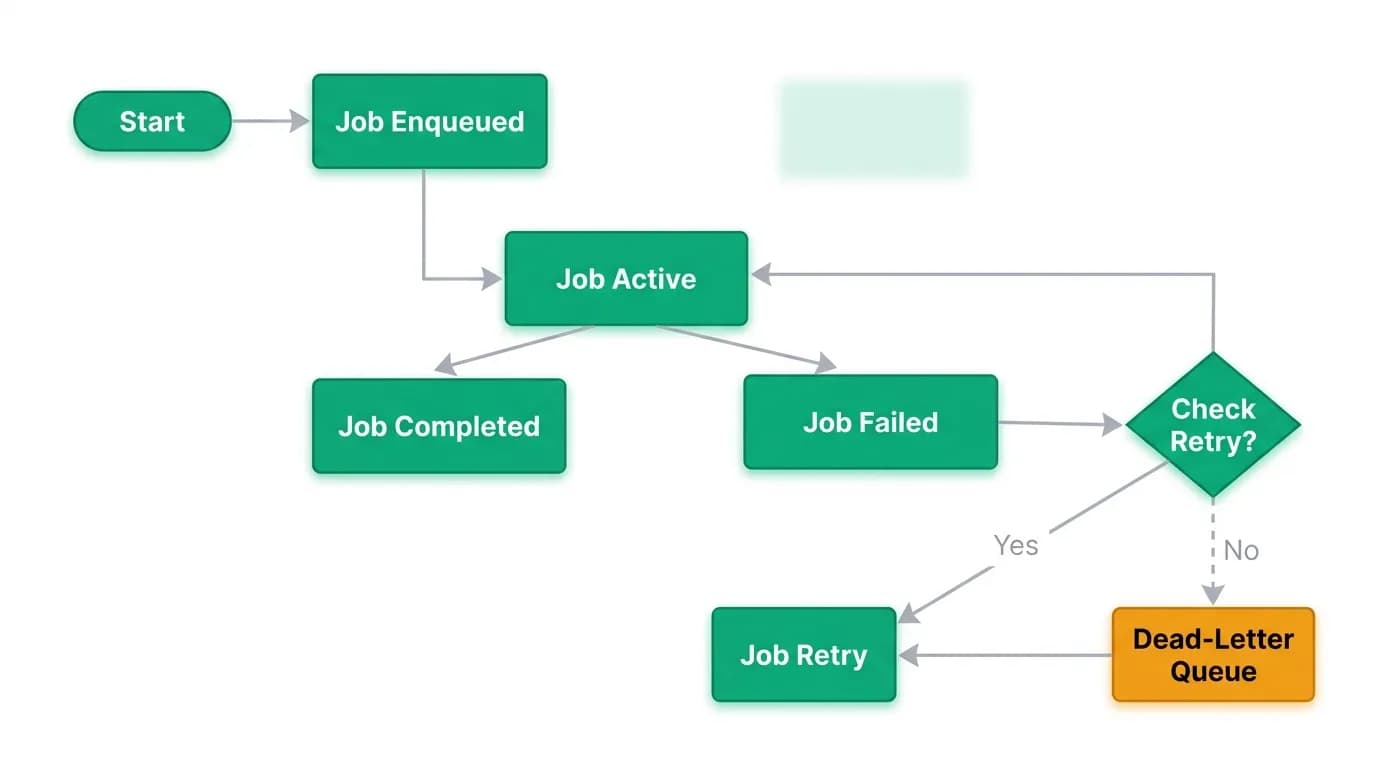
Every job handler is idempotent. If a job runs twice, the result is the same as running it once. This is non-negotiable because retries are inevitable. An email job that isn't idempotent might send the same confirmation twice. A trip update job that isn't idempotent might create duplicate records.
Retries use exponential backoff. First retry after 1 second, then 4 seconds, then 16, then 60. The backoff prevents hammering a service that's already struggling. If the email service is overloaded, retrying every second makes things worse. Backing off gives it time to recover.
We cap retries at a configurable limit per job type. Notification jobs get more retries than analytics jobs. After exhausting retries, the job moves to a dead letter queue.
Dead letter queues and human recovery
A dead letter queue is where jobs go when they've failed all their retry attempts. It's the "we tried everything, this needs a human" bucket.
We monitor dead letter queue depth as a critical metric. A few jobs per day is normal, maybe an edge case payload or a temporarily unreachable external service that was down longer than our retry window. A sudden spike means something systemic is broken.
For each job in the dead letter queue, we store the original payload, the error from each attempt, and the timestamp of each failure. An engineer can inspect the job, understand why it failed, fix the underlying issue, and replay the job.
Some jobs are safe to abandon. If an analytics event fails to record, the impact is a small gap in our data. We log it and move on. Other jobs require intervention. If a booking confirmation email never sent, the traveler doesn't have their itinerary. We have alerts that distinguish between these cases.
Scheduled jobs for travel operations
Not all background jobs are triggered by immediate events. Some need to run at specific future times.
Departure reminders go out 24 hours and 2 hours before a flight. These are scheduled when the booking is created. The job queue supports delayed execution, so we enqueue a job with a "run at" timestamp. The queue holds it until the scheduled time, then delivers it to a worker.
Check-in notifications fire when the airline opens check-in, typically 24 hours before departure. We calculate the check-in window from the departure time and schedule the notification accordingly.
Booking expiration checks run for bookings that are in a pending state. If payment wasn't completed within the window, the booking needs to be released.
All of these require time zone awareness. A departure reminder for a 9 AM flight in Tokyo needs to account for the traveler's current time zone, not the server's. We store all times in UTC and convert at notification delivery time based on the traveler's known location.
Monitoring queue health
We track several metrics per queue:
Queue depth is the number of jobs waiting to be processed. A growing queue means workers can't keep up with producers. This is a leading indicator of problems.
Processing rate is jobs completed per minute. A sudden drop means workers are stuck or crashing.
Error rate is the percentage of jobs that fail on first attempt. A rising error rate usually means an external dependency is degrading.
Wait time is how long a job sits in the queue before a worker picks it up. This directly impacts the traveler's experience for time-sensitive jobs like notifications.
Dead letter rate is how many jobs exhaust all retries per day. This should be close to zero.
We set alerts on each of these with thresholds tuned to the queue's priority level. The booking queue gets tighter thresholds than the analytics queue because the impact of delays is higher.
Building reliable background processing
If you're setting up background job infrastructure for a booking platform, here is what I'd prioritize.
Make every job handler idempotent from day one. Retrofitting idempotency is painful. Designing for it from the start is easy and pays off immediately when retries start happening.
Separate queues by priority. Don't let low-priority work compete with high-priority work for the same workers.
Monitor the dead letter queue actively. It's not a black hole. It's a signal that something needs attention.
Schedule with time zones in mind. If your users span multiple time zones, your scheduled jobs need to account for that. Store everything in UTC, convert at execution time.
Push notification delivery should target under 10 seconds from the triggering event. Travelers notice when notifications are slow. Make notification workers responsive by keeping the queue depth low and the concurrency appropriate.
Nowah is an AI travel agent that searches and books real flights and hotels through conversation — no filters, no thirty open tabs. Plan your next trip.