Multi-Environment Strategy for Travel Platforms
Development, staging, production — and why the differences between them matter more than you think for a platform where bugs cost real money and real trips.
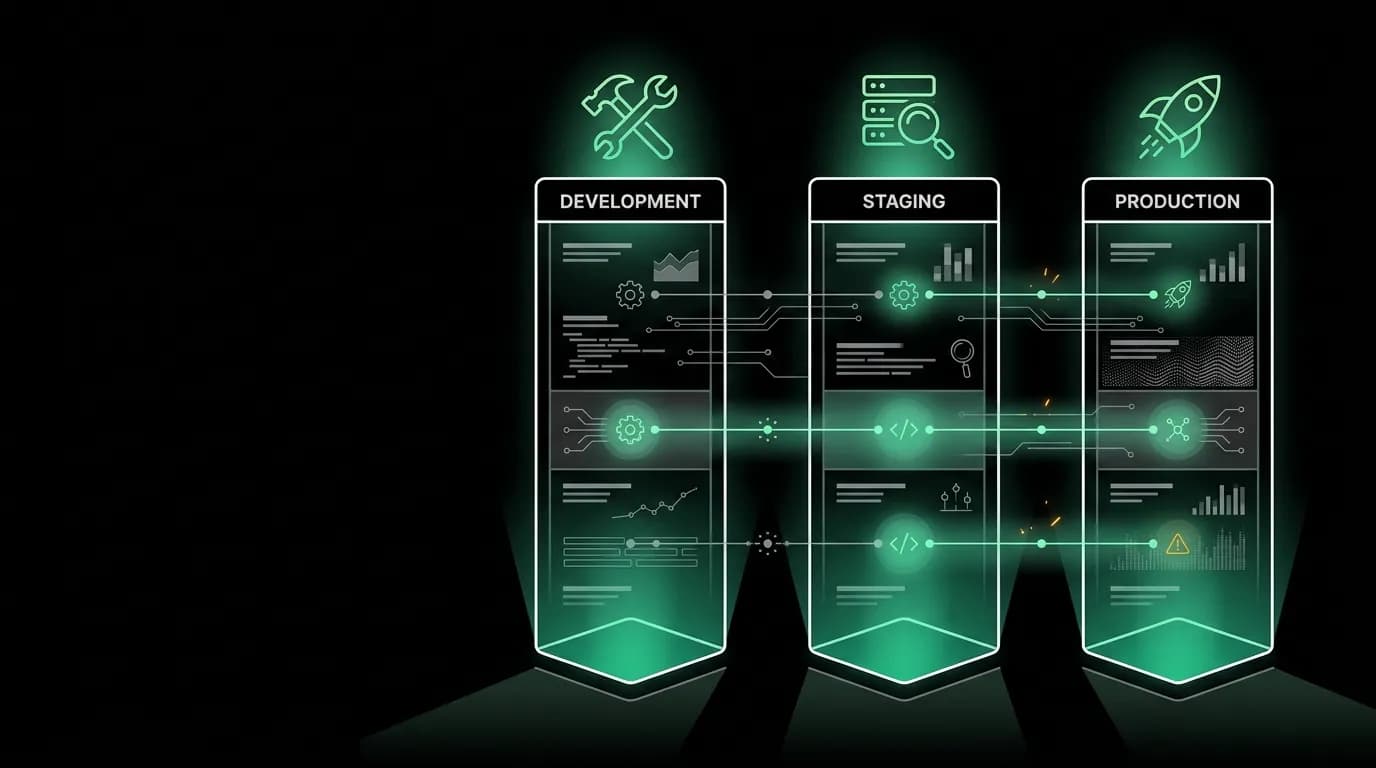
A test booking hit the production payment API. A developer was testing a new booking flow locally. Their environment variables pointed to the production payment processor instead of the sandbox. They created a real payment intent for $1,200. The payment was captured against a test card number that happened to be valid.
This kind of environment leak is how real money gets lost, real bookings get created where they shouldn't exist, and real customer data ends up in test systems. For a travel booking platform, environment separation isn't a best practice. It's a survival requirement.
Environment parity: closer than you think
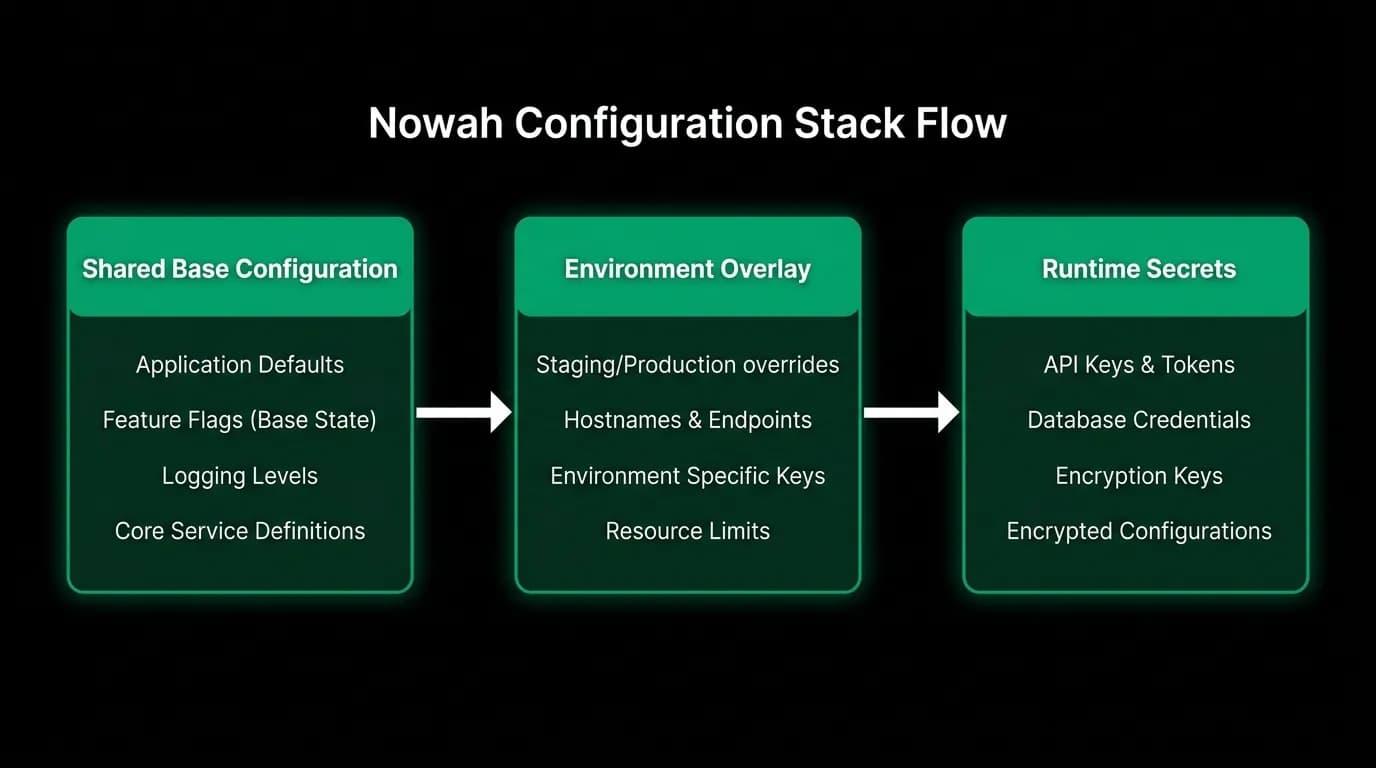
Our staging environment mirrors production as closely as possible. Same container orchestration. Same database engine and version. Same cache layer. Same queue system. Same monitoring and logging infrastructure. Same network topology.
The only things that differ are credentials and scale.
Credentials. Staging uses sandbox API keys for payment processing, test keys for the travel data provider, and test credentials for the identity provider. These sandbox environments are designed by the respective services to behave identically to production, just with test data.
Scale. Staging runs fewer instances of each service, a smaller database, and less cache memory. This keeps costs manageable. The trade-off is that staging can't replicate production-level concurrency or load patterns. We accept this because load testing has its own separate infrastructure.
Parity matters because the bugs that escape testing are almost always environmental. The code works fine, but the specific version of the database engine in production handles a query differently. Or the production cache layer has a different eviction policy than the development cache. Or the production load balancer routes a bidirectional socket connections differently.
The closer staging is to production, the more of these environmental bugs get caught before they reach travelers.
Test data strategies
Staging needs realistic data without real personally identifiable information. We seed staging with synthetic travelers, mock bookings, and fabricated trip itineraries that exercise the same code paths as real data.
Our seeding scripts create a representative dataset: travelers with different numbers of trips (from first-time users to frequent travelers with dozens of bookings), trips in various states (planning, confirmed, in-progress, completed, cancelled), and bookings with different configurations (one-way, round-trip, multi-city, single traveler, group).
Airport and airline reference data is real, not synthetic. We seed staging with the same airport and airline data that production uses (`npm run sync:airports` and `npm run sync:airlines`). This ensures that flight search results in staging look realistic and that airport codes resolve correctly.
Payment processing in staging uses the sandbox. Test card numbers that trigger specific scenarios: successful payments, declined cards, 3D Secure challenges, expired cards. This lets us test every payment path without moving real money.
Configuration management
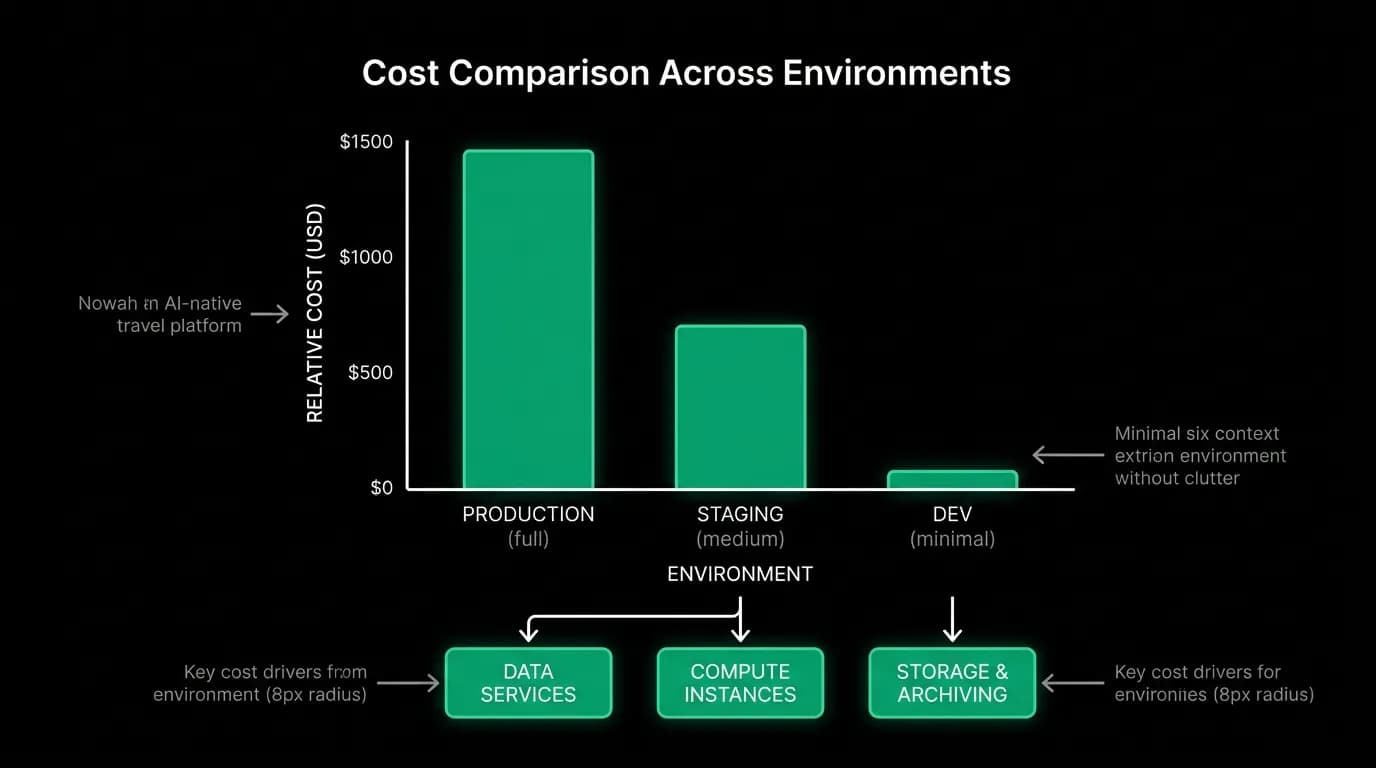
Same code, different credentials. That's the goal. Our configuration management follows a layered approach:
Base configuration is shared across all environments. Default timeouts, retry counts, feature flag defaults, rate limit thresholds. These are baked into the application code.
Environment overrides are specific to each environment. Database connection strings, API keys, service URLs. These come from environment variables, never from code.
Runtime secrets are sensitive credentials that can't be checked into version control or baked into container images. Payment API keys, database passwords, signing secrets. These are injected at deployment time from a secrets manager.
The layering means we never have environment-specific code paths. The same code runs in development, staging, and production. The behavior differs only because the configuration values differ.
We validate configuration at service startup. If a required environment variable is missing, the service fails to start with a clear error message. This catches misconfiguration immediately rather than letting the service run with missing values and fail unpredictably later.
Development environments
Local development uses a different strategy than staging. Developers need a fast, self-contained environment that works offline and doesn't depend on external services being available.
The local database runs in a container alongside the application. Schema is identical to production, managed by the same migration tooling. Data is seeded with a minimal dataset that exercises the main code paths.
External services (payment processing, travel data provider, email delivery) run against sandbox or mock endpoints locally. For development, we prioritize speed over fidelity. A mock that returns canned flight search results in 50 milliseconds is more useful for local development than a sandbox API call that takes 2 seconds.
The local-to-staging gap is where we invest the most validation effort. Code that works locally should work in staging. When it doesn't, it's usually a configuration difference or a dependency version mismatch, and we fix the root cause rather than adding environment-specific workarounds.
Cost optimization for non-production
Staging mirrors production in structure but not in scale. We don't need a production-sized database for staging. We don't need the same number of worker instances. We don't need the same cache capacity.
We right-size non-production environments to their actual usage patterns. Staging gets enough resources to handle automated test suites and manual QA, which is a fraction of production load. Development environments are even smaller.
The cost savings are significant. If production costs $X per month, staging costs roughly $X/5 and development costs roughly $X/20. The savings come from smaller instances, fewer replicas, and lower storage allocation. The architecture remains identical; only the resource allocation changes.
Audit your environment strategy
If you're managing multiple environments for a booking platform, here's a parity checklist:
Are you using the same database engine and version across all environments? Not just "a relational database" but the same major and minor version?
Are your migrations tested in staging before running in production? Not just validated, but actually executed against a staging database?
Are your payment integrations in sandbox mode for all non-production environments? Verified, not assumed?
Can a developer run the full application locally without access to production credentials?
Are environment variables validated at startup, not at first use? A missing API key that crashes the service on startup is better than one that crashes when the first traveler tries to book.
Is it possible to accidentally route non-production traffic to production APIs? What prevents it?
Each "no" answer is a gap in your environment strategy. Each gap is a potential incident.
Nowah is an AI travel agent that searches and books real flights and hotels through conversation — no filters, no thirty open tabs. Plan your next trip.