Multi-City Flight Booking: Why AI Agents Handle Complexity Better
Rome, Barcelona, Lisbon in two weeks — multi-city itineraries take hours on OTAs and minutes with AI agents. Here is why complexity favors agents.
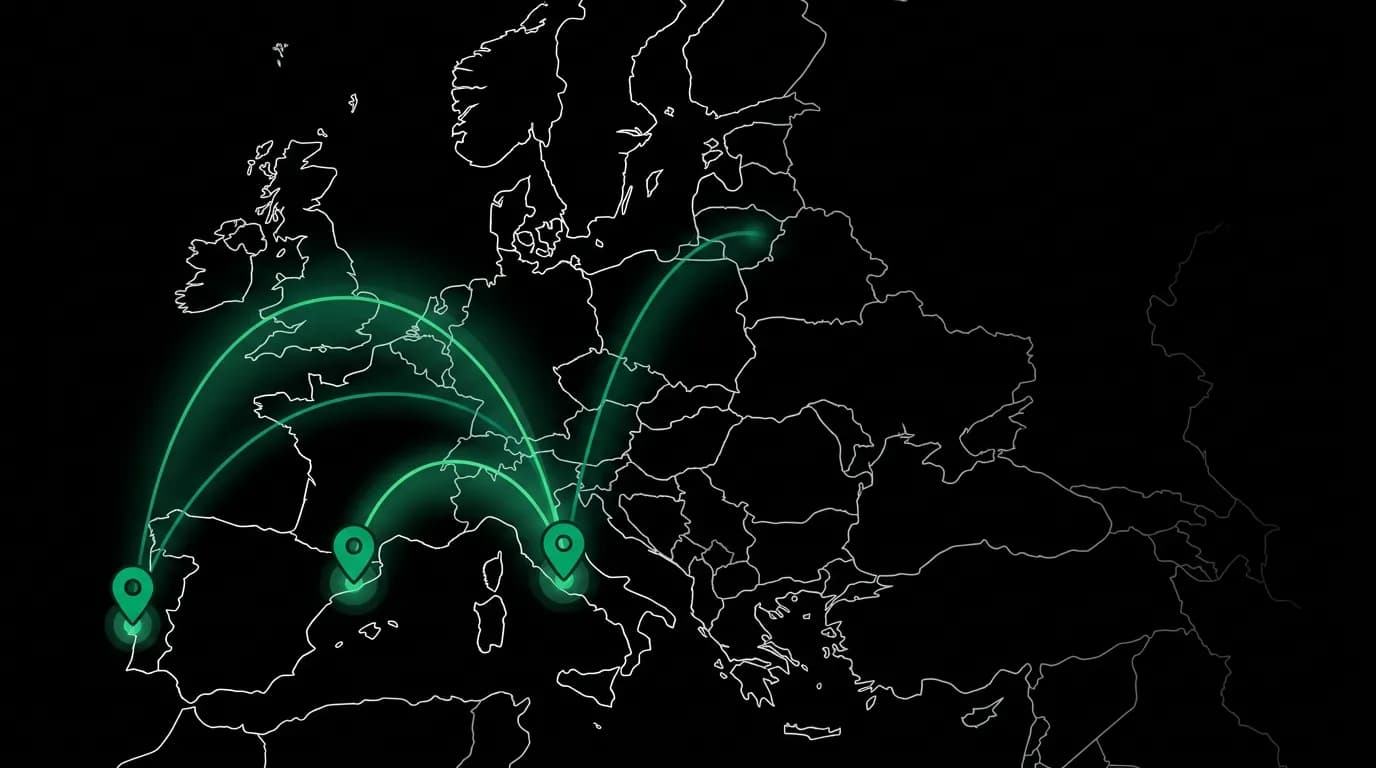
You want to visit Rome, Barcelona, and Lisbon over two weeks. On a traditional OTA, this means three separate flight searches, each ignorant of the others. You search New York to Rome, then Rome to Barcelona, then Barcelona to Lisbon, then Lisbon to New York. Four search sessions, each returning dozens of results you have to compare manually, with no coordination between legs on timing, total cost, or routing optimization.
An hour later, you have a fragmented collection of browser tabs and a growing suspicion that the itinerary you have cobbled together is neither the cheapest nor the most convenient option.
With an AI agent, you send one message: "I want to visit Rome, Barcelona, and Lisbon over two weeks starting March 15, flying from New York." Five to eight minutes later, you have a fully optimized multi-city itinerary.
The gap between these two experiences is the most dramatic demonstration of why complexity favors AI agents over search-based platforms.
Why OTAs fail at multi-city
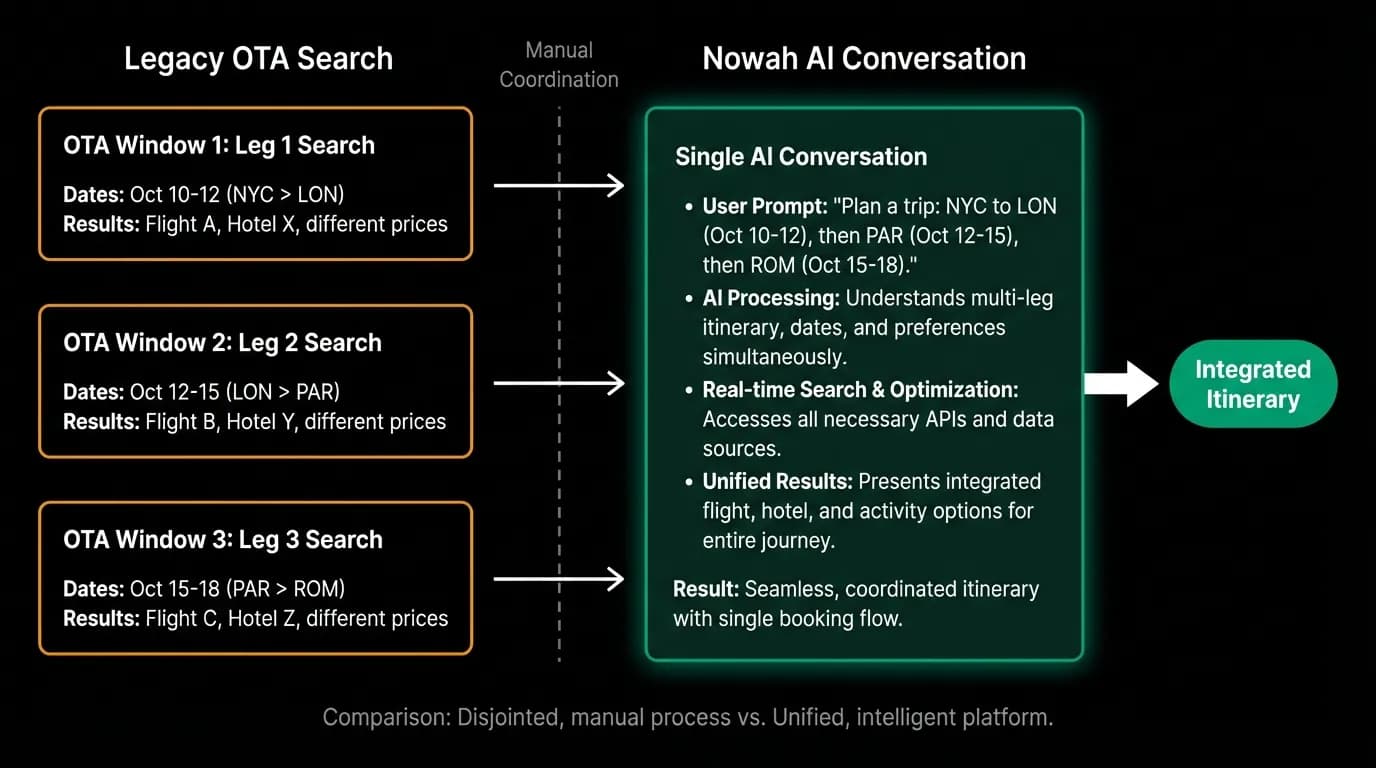
Traditional platforms were built for point-to-point search. Origin, destination, dates. The architecture assumes you know exactly where you are going from and to. Multi-city support exists on some platforms but is limited.
Each leg is searched independently. The Rome-to-Barcelona search does not know when your Rome hotel checkout is. The Barcelona-to-Lisbon search does not consider whether an afternoon flight would let you enjoy a morning in the Gothic Quarter. The platform has no concept of your overall itinerary — it is running isolated queries against a flight database.
This independence means no routing optimization. You search the cities in the order you thought of them, not the order that minimizes travel time or cost. Maybe Barcelona-Rome-Lisbon is a better routing than Rome-Barcelona-Lisbon because of how airline hub networks connect those cities. You would never know without searching every permutation — which, for three cities, means six different orderings.
Open-jaw intelligence
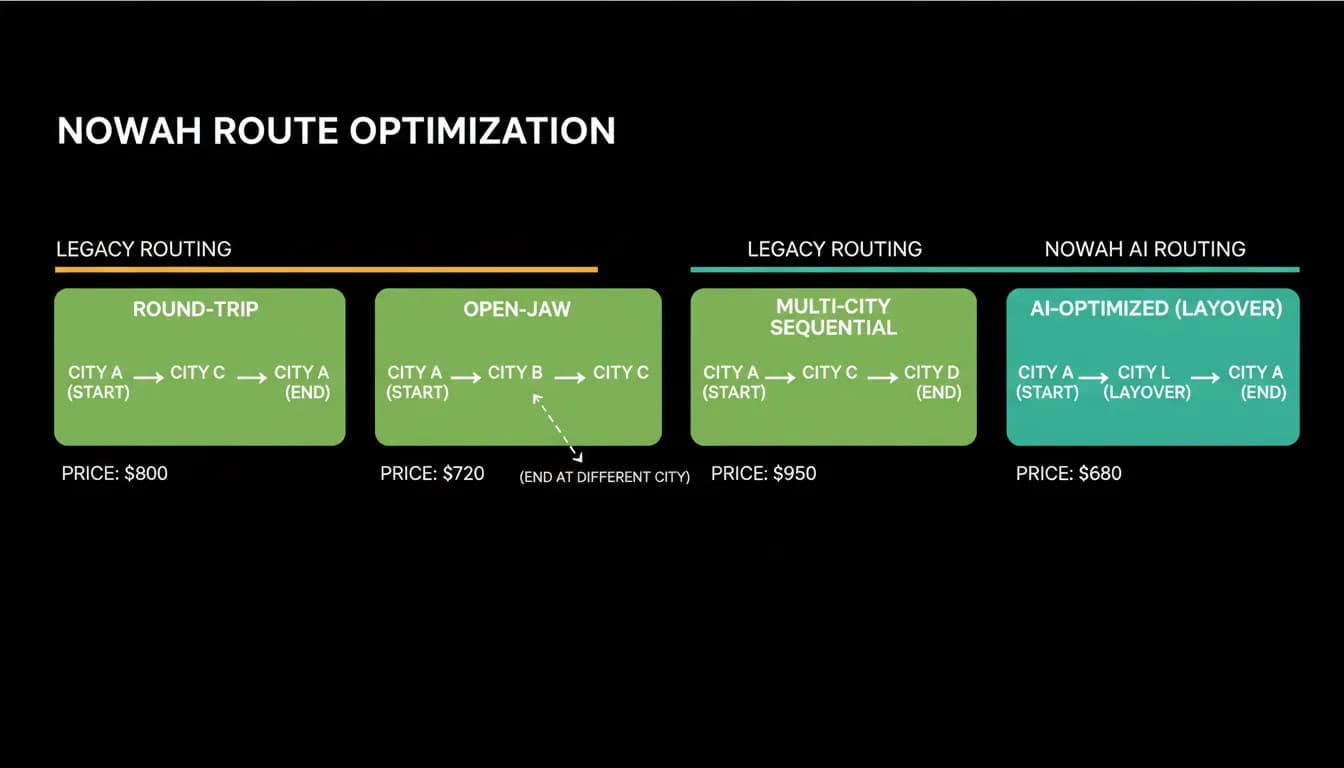
One of the most valuable optimizations AI agents perform is open-jaw routing — flying into one city and out of a different one.
Instead of returning to your origin from the last city (Lisbon to New York), the agent evaluates whether flying into Rome and out of Lisbon is cheaper than round-trip to Rome with internal flights back. On European multi-city trips, open-jaw routing saves an average of $200 compared to returning to the origin city, because it eliminates one positioning flight entirely.
This optimization is simple in concept but nearly impossible to discover manually. You would need to search round-trip to Rome, then separately search one-way to Rome plus one-way from Lisbon, compare the totals, and repeat for every possible open-jaw combination. AI agents do this automatically as part of the initial search.
Mixed-carrier routing
Traditional OTAs default to showing results from single carriers or alliance partners. This makes sense for simple round-trips where booking on one carrier gives you better fare rules and loyalty earning. For multi-city trips, it is often a terrible default.
A budget carrier might offer the best fare between Barcelona and Lisbon at $45. A legacy carrier has the best transatlantic options. Combining them saves 25 to 40 percent compared to booking all legs on a single carrier's network.
AI agents evaluate carriers independently per leg and combine them for the optimal total. They factor in the trade-offs: mixed-carrier means separate check-in for each leg, no through-checked baggage, and independent cancellation policies. The agent presents these trade-offs clearly rather than hiding them.
Layover optimization
Connecting flights have layovers. Most travelers view layovers as dead time to be minimized. AI agents recognize that some layovers can be turned into mini-stops.
A 14-hour layover in Istanbul costs nothing extra on a through-fare but gives you enough time to leave the airport, see the Blue Mosque, have dinner, and return for your connecting flight. The agent identifies these opportunities by analyzing connection times, airport-to-city transit options, and visa requirements for transit.
Instead of "your connection in Istanbul is 14 hours," you get "your connection in Istanbul is 14 hours — Turkey allows visa-free transit for your passport. The city center is 45 minutes from the airport by train. You could spend 8 hours exploring. Want me to suggest a mini-itinerary?"
Real scenario: three-city Europe trip
One message: "Visit Rome, Barcelona, and Lisbon over two weeks starting March 15 from New York. Two people. Budget around $3,500 total for flights."
The agent evaluates: all city orderings, open-jaw vs. round-trip to origin, mixed carriers vs. single carrier, direct vs. connecting for each leg, and date flexibility within the two-week window.
Result: Fly New York to Rome on Day 1 (nonstop, arriving morning). Budget carrier Rome to Barcelona on Day 5. Budget carrier Barcelona to Lisbon on Day 9. Nonstop Lisbon to New York on Day 14.
Total: $2,800 for two people. The same itinerary booked as four separate searches on an OTA totaled $3,600 to $4,200 depending on carrier choices and the lack of open-jaw optimization.
Savings: $800 to $1,400. Time spent: 6 minutes versus 45 to 90 minutes.
Describe your next multi-city trip in plain English
The beauty of conversational booking for multi-city trips is that you describe the trip the way you think about it — as a journey with multiple destinations — not the way a search form requires it — as a series of isolated origin-destination pairs.
"I want to see Tokyo, Kyoto, and Osaka in two weeks." "Three cities in South America — Buenos Aires, Lima, and Bogota — flexible order." "Visit friends in London, then a few days in Paris, then fly home from Amsterdam."
The agent handles the routing, the optimization, and the booking. You handle the packing.
Nowah is an AI travel agent that searches and books real flights and hotels through conversation — no filters, no thirty open tabs. Plan your next trip.