Right-Sizing Infrastructure for Seasonal Travel Patterns
How we scale up for summer and holiday booking surges without overspending the rest of the year — auto-scaling, burst handling, and load testing.
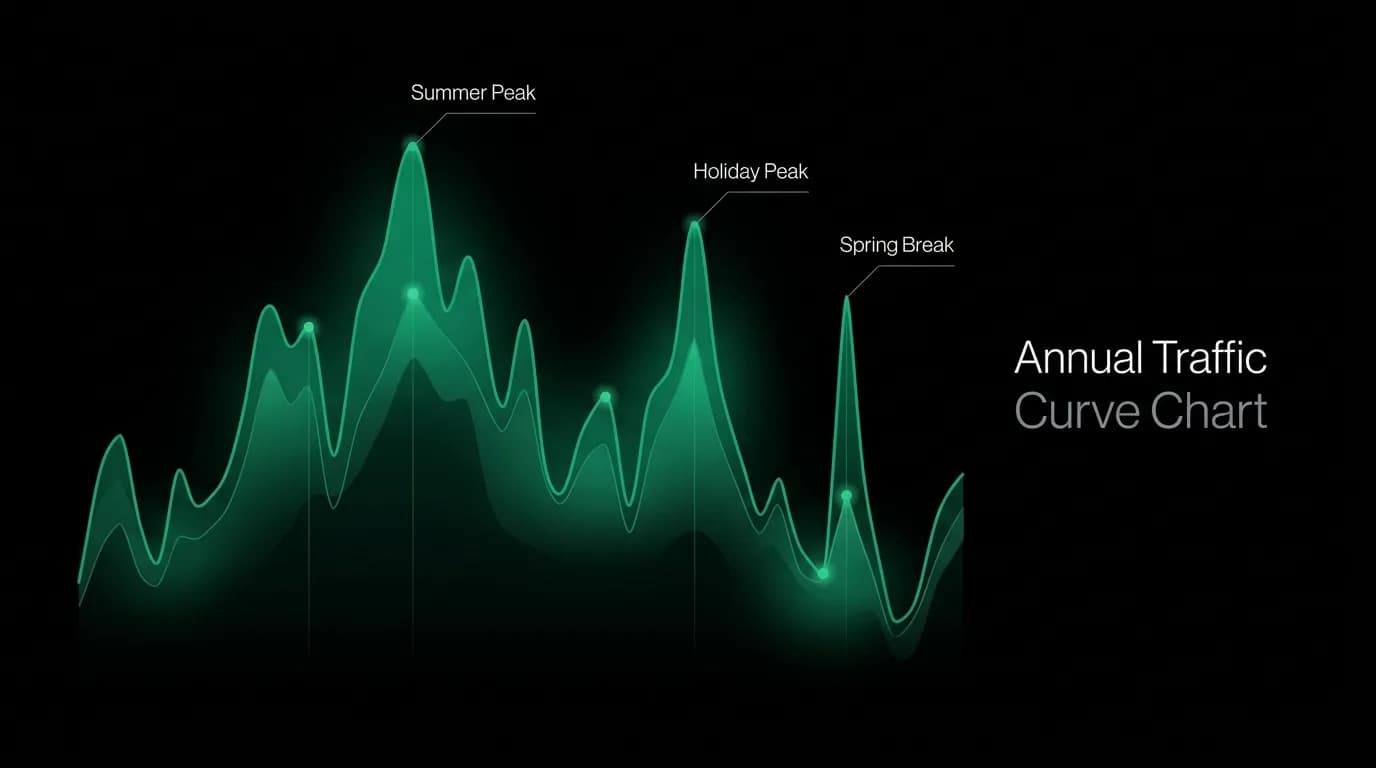
December 26th. Everyone who received holiday gift money or travel vouchers opens the app to book their spring vacation. Traffic goes up 4x in a single afternoon. If your infrastructure is sized for normal traffic, you're down. If it's sized for peak traffic year-round, you're burning money 11 months of the year.
Travel booking has among the most pronounced seasonal patterns of any consumer product. The peaks are predictable (we know summer planning starts in March), the valleys are deep (January is quiet), and the spikes can be sharp (a flash fare sale, a viral social media post about a destination).
Right-sizing means matching capacity to demand at every point in the year, not just the average.
The annual rhythm
Travel booking follows a remarkably consistent annual pattern.
January-February. Quiet. Post-holiday budget recovery. Low booking volume. This is when we do infrastructure maintenance, load testing, and capacity planning.
March-April. Summer planning begins. Traffic ramps 2-3x. Families book summer vacations. Couples plan anniversary trips. This is our first scaling event of the year.
May-June. Sustained high volume. Bookings are active. Last-minute summer trips. Travel is happening, so post-booking features (notifications, documents, trip updates) see high usage.
July-August. Booking volume decreases slightly (most summer trips are booked), but active-trip features peak. Travelers are on the road. Push notifications, offline access, and real-time updates are heavily used.
September. Brief quiet period. School starts. Travel slows.
October-November. Holiday planning. Traffic ramps 3-5x. Thanksgiving, Christmas, New Year travel. This is our peak and our most critical scaling period.
December. Mixed. Early December is heavy booking. Late December is travel execution. December 26th is often the single highest-traffic day for new bookings.
Predictive pre-scaling
For predictable peaks (summer planning, holiday booking), we scale preemptively. We don't wait for traffic to arrive and then react. We increase capacity before the known demand arrives.
This means adding API server instances, increasing worker pool sizes, expanding database connection pools, and ensuring the cache has enough memory headroom for elevated load. These changes happen on a schedule, triggered by calendar events rather than real-time metrics.
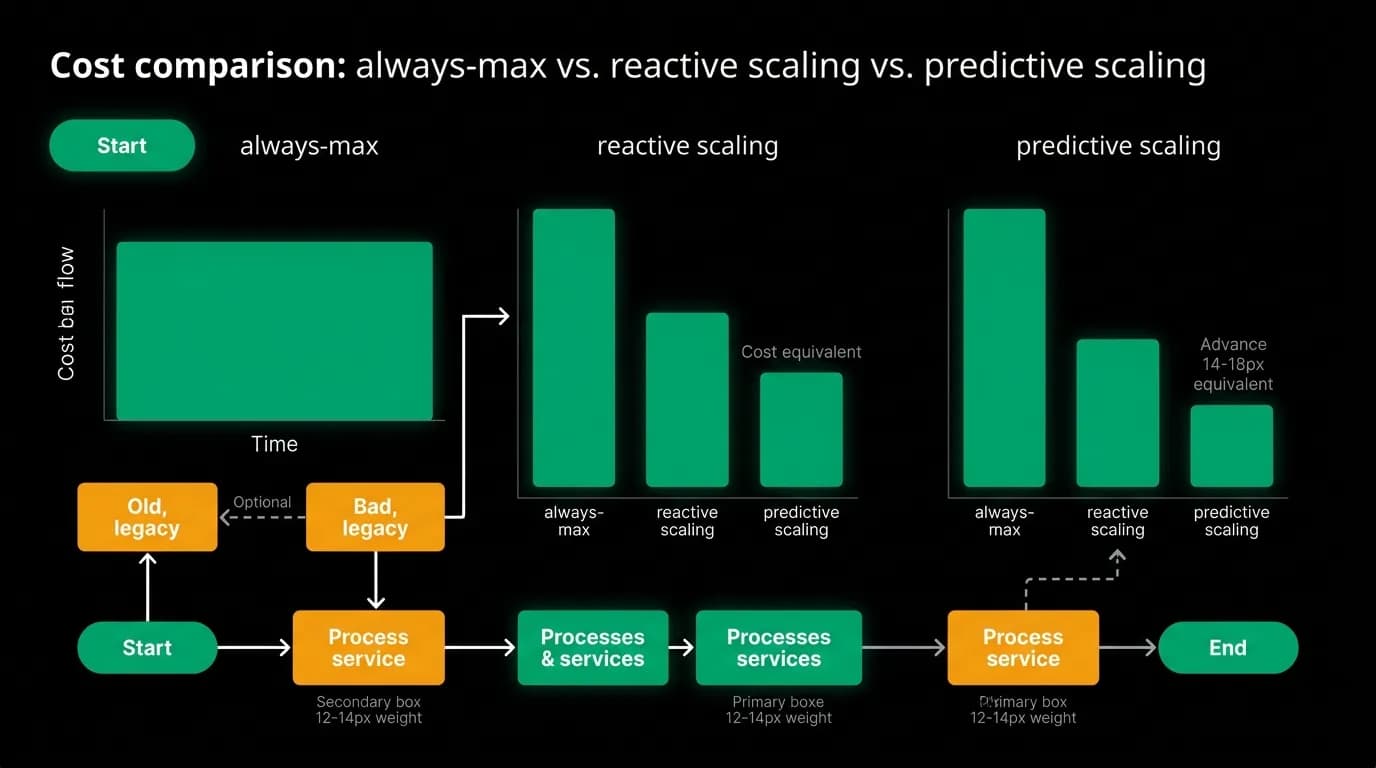
Pre-scaling is cheaper than reactive scaling because it avoids the performance degradation during the scaling window. Reactive scaling takes minutes. During those minutes, travelers experience slow responses and failed requests. Pre-scaling means the capacity is already there when traffic arrives.
The cost of pre-scaling slightly early (running extra capacity for a few days before the peak) is small compared to the cost of under-provisioning during the peak (lost bookings, degraded experience, potential cascading failures).
Reactive scaling for unpredictable spikes
Not all traffic spikes are predictable. A travel influencer posts about a destination. An airline announces a flash fare sale. A news event makes a destination suddenly popular.
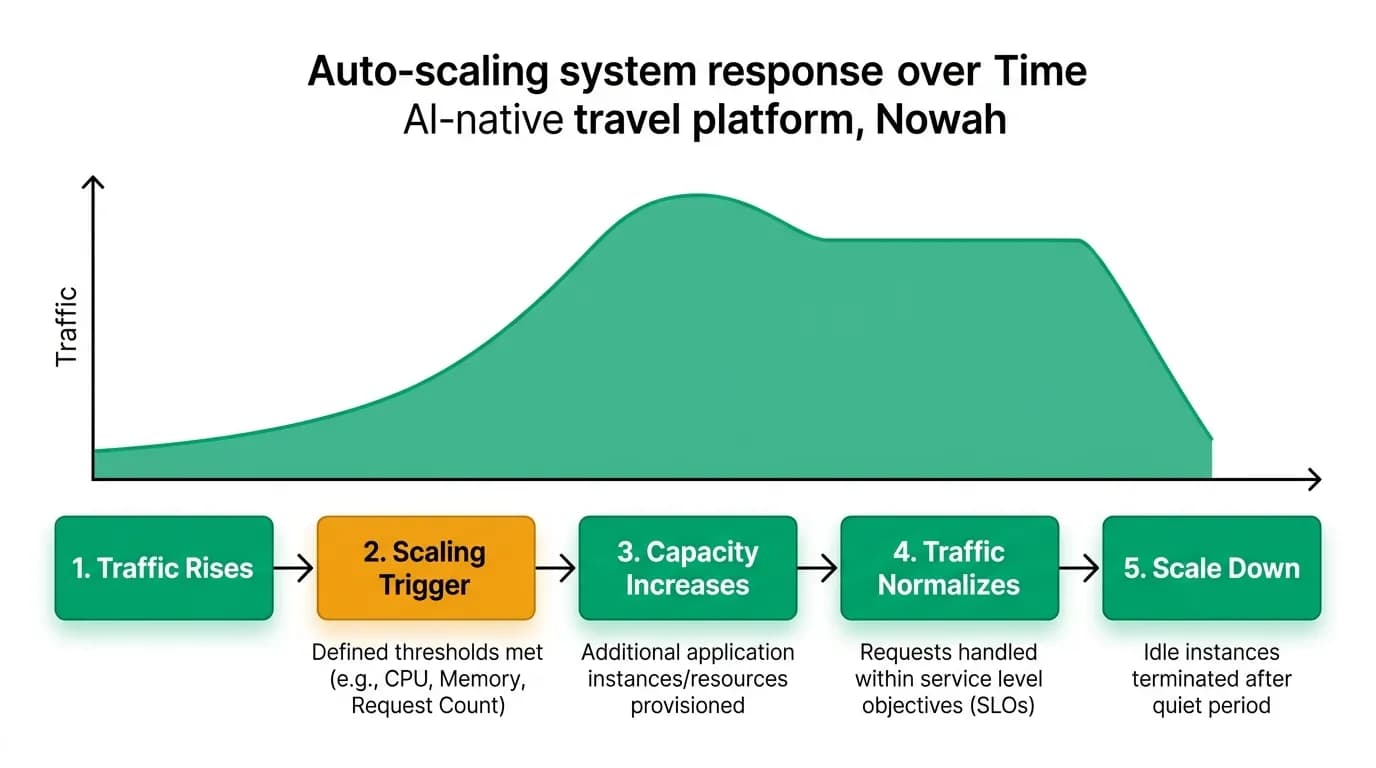
For these, we use auto-scaling based on real-time metrics. Queue depth is our primary scaling signal (as discussed elsewhere): when queue depth stays elevated for more than 2 minutes, we add workers. When API response time degrades beyond a threshold, we add API instances.
The auto-scaling is configured with asymmetric speeds: scale up fast (2 minutes of elevated metrics triggers scaling), scale down slow (5 minutes of reduced metrics before removing capacity). The asymmetry prevents oscillation and ensures we don't remove capacity during a brief lull in a sustained spike.
Scaling down without losing readiness
During quiet periods, running peak-level infrastructure is wasteful. But scaling down too aggressively creates risk. If a surprise spike happens during a low-traffic period, the system might not scale up fast enough.
We maintain a minimum capacity floor that can handle 2x normal traffic without scaling. This floor absorbs routine variations and small spikes. Above the floor, capacity scales reactively.
The floor is set based on historical data. If normal January traffic is X, the floor is 2X. This handles most day-to-day variation. A genuine spike (above 2X) triggers auto-scaling, but the floor buys time for the scaling to take effect.
Load testing
We load test before every expected peak season. The test simulates peak traffic plus 50% headroom and validates that the system handles it without degradation.
The load test exercises the full stack: AI chat messages, flight searches, booking attempts (against sandbox APIs), and post-booking job processing. We measure response times, error rates, queue depth, connection pool utilization, and overall throughput.
Load testing reveals bottlenecks that monitoring doesn't. A system that handles normal traffic comfortably might have a connection pool that exhausts at 3x, a job queue that backs up at 4x, or a rate limiter that incorrectly blocks legitimate traffic at 5x. These issues are invisible during normal operation and catastrophic during peaks.
We run load tests in a dedicated environment that mirrors production configuration. Testing in production is tempting (it's the most realistic) but risky for a booking platform where test traffic could create real bookings.
Capacity planning calendar
We maintain a capacity planning calendar that maps the year to expected traffic levels and the corresponding infrastructure configuration.
For each month, the calendar specifies: expected traffic level (relative to baseline), infrastructure configuration (instance counts, pool sizes, scaling thresholds), scheduled maintenance windows, and load testing dates.
The calendar is reviewed quarterly and updated based on actual traffic patterns. If March turned out to be busier than expected (because summer planning started earlier), we adjust the next year's calendar.
This calendar is the bridge between infrastructure engineering and business planning. Product launches, marketing campaigns, and promotional events get added to the calendar with expected traffic impact. The infrastructure team plans capacity accordingly.
Your seasonal scaling strategy
If you're running a consumer product with seasonal patterns:
Identify your annual rhythm. Every product has one. Map the peaks and valleys over the last 12 months.
Pre-scale for predictable peaks. Don't wait for traffic to tell you it's summer. You already know.
Auto-scale for unpredictable spikes. Metrics-based scaling with asymmetric up/down speeds.
Load test before peak seasons. Not during. Before. Find the bottlenecks when there's time to fix them.
Maintain a capacity floor. Don't scale to zero in quiet periods. Some minimum capacity should always be ready.
Track the cost of scaling decisions. Over-provisioning costs money. Under-provisioning costs bookings. Measure both and find the balance.
Nowah is an AI travel agent that searches and books real flights and hotels through conversation — no filters, no thirty open tabs. Plan your next trip.