Safety Guardrails for Autonomous Booking Agents
AI agents that book flights need guardrails. Confirmation tokens, spending limits, session budgets, audit trails, and rollback capabilities prevent costly autonomous mistakes.

An agent booked a $12,000 first-class ticket to Singapore. Autonomously. The user had asked for "flights to Singapore next week." The agent found options, picked what its ranking model scored highest (a business-class fare that happened to be first class on the connecting leg), and completed the booking without asking for confirmation.
The user expected economy. They got first class. And the booking had a no-refund policy.
This is why guardrails are not optional for AI agents that interact with payment systems and booking APIs. An agent without guardrails is not a helpful assistant — it is a liability with your credit card number.
Confirmation tokens
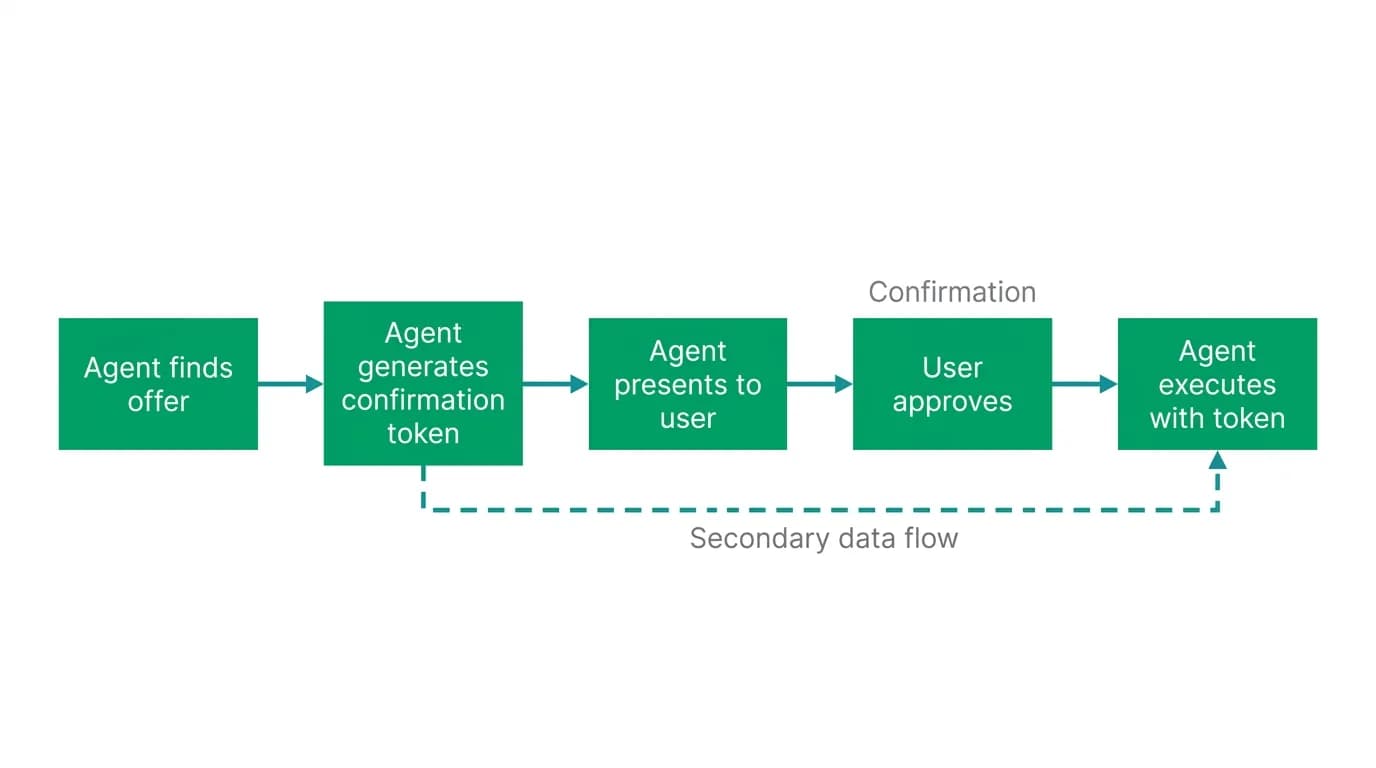
The first and most important guardrail: agents cannot book anything without a confirmation token, and confirmation tokens can only be generated through a user-facing action.
The flow works like this:
- The agent searches for flights and presents options to the user.
- The user selects an option (taps a button, types "book option 2," etc.).
- The API generates a confirmation token — a time-limited, single-use cryptographic token tied to the specific offer, the specific user, and the specific session.
- The user reviews the booking summary (price, itinerary, cancellation policy) and confirms.
- The agent submits the booking request with the confirmation token.
- The API validates the token and processes the booking.
The token has a short validity window — typically ten minutes. After that, it expires and the user must re-confirm. The token is single-use: once used for a booking, it cannot be reused. It is tied to the specific offer, so it cannot be applied to a different flight.
The critical design point: the agent cannot generate the token through an API call. The token is generated through a user interaction pathway that requires the user to see and acknowledge the booking details. This is the hard boundary between agent autonomy and human control.
Spending limits
Confirmation tokens prevent unauthorized bookings. Spending limits prevent authorized-but-expensive bookings from going through without extra scrutiny.
Each API key has a configurable spending limit per session and per transaction. If an agent tries to book something that exceeds the limit, the API rejects the request with a `BOOKING_SPENDING_LIMIT_EXCEEDED` error and requires human escalation.
The limits are configured in the developer dashboard:
- Per-transaction limit: Maximum amount for a single booking. Prevents accidentally booking first class when the user expected economy.
- Per-session limit: Maximum total spend within a single agent session. Prevents a runaway agent from making multiple expensive bookings.
- Daily limit: Maximum total spend per calendar day per API key. A backstop against compromised keys or agent bugs.
The limits are intentionally separate from the confirmation flow. Even if the user confirms a booking, the spending limit provides a second check. A user who accidentally confirms a $12,000 booking (perhaps they did not read the details carefully) is still protected by the transaction limit.
Audit trails

Every action the agent takes is logged. Every tool call, every parameter, every result, every decision point. The audit trail creates a complete record of how the agent arrived at a booking decision.
The audit record for a booking includes:
- The user's original message that initiated the search.
- Every search the agent performed (parameters and results).
- The ranking and filtering the agent applied.
- The options the agent presented to the user.
- The user's selection.
- The confirmation flow (token generation, review, confirmation).
- The booking request and response.
- Timestamps for each step.
This audit trail serves two purposes. First, it enables post-incident analysis. When something goes wrong (wrong flight booked, unexpected charge), the trail shows exactly what happened and why. Second, it supports dispute resolution. If a user disputes a charge, the audit trail proves whether they confirmed the booking or the agent acted without confirmation.
We store audit records independently from the booking data. Even if a booking is cancelled and eventually purged, the audit trail persists for the retention period.
Rollback capabilities
Mistakes happen even with guardrails. A user confirms a booking and immediately realizes they selected the wrong date. Or an agent correctly books what the user asked for, but the user changes their mind seconds later.
We build in a grace period after booking confirmation. During this window (configurable per API key, typically 15-30 minutes), the booking can be cancelled at no cost regardless of the fare's cancellation policy. This is our safety net for agent errors caught quickly.
The grace period is implemented at the platform level, not the airline level. Our system holds the booking for the grace period before confirming with the travel provider. During the grace window, cancellation is free because no external commitment has been made.
After the grace period, cancellation follows the fare's standard policy. Some fares are refundable, some are not. The agent should communicate the cancellation policy to the user before they confirm.
Three-layer idempotency for agents
The multi-layer idempotency checks we built for general API safety is especially important for agents. Agents retry aggressively. An agent that submits a booking request, receives a timeout, and retries should not create a duplicate booking.
Our idempotency layers (application, payment, provider) each independently catch duplicate requests. The application layer is the first line of defense, catching most duplicates before any downstream work happens. The payment layer prevents double charges. The provider layer prevents duplicate tickets.
For agents specifically, we generate idempotency keys from the combination of the confirmation token and the session ID. Two requests with the same token in the same session are guaranteed to be duplicates. This makes the idempotency detection both reliable and automatic — the agent does not need to manage keys.
Practical implementation checklist
If you are building an agent that books travel (or any API that agents use for financial transactions):
- Require human confirmation for every financial action. No exceptions.
- Implement spending limits per transaction, per session, and per day.
- Log every agent action with enough detail to reconstruct the decision chain.
- Provide a cancellation grace period for quick corrections.
- Make all booking endpoints idempotent with automatic key generation.
- Test with adversarial scenarios: what happens if the agent tries to book without confirmation? What if it exceeds the spending limit? What if it retries five times?
The goal is not to restrict what agents can do. It is to ensure that what they do is always authorized, traceable, and reversible when it needs to be. Trust between users and AI agents is built one safe interaction at a time. Guardrails are how you earn that trust.
Nowah is an AI travel agent that searches and books real flights and hotels through conversation — no filters, no thirty open tabs. Plan your next trip.