Why Speed Is Our Most Important Feature
We obsess over milliseconds because response time directly impacts trust in AI. Streaming is not a nice-to-have — it is the core UX that makes AI feel alive.

Speed is not a feature. It is the foundation that makes every other feature trustworthy.
A fast AI agent feels reliable. A slow one feels broken. The difference between those perceptions can be as little as three seconds.
The psychology of waiting
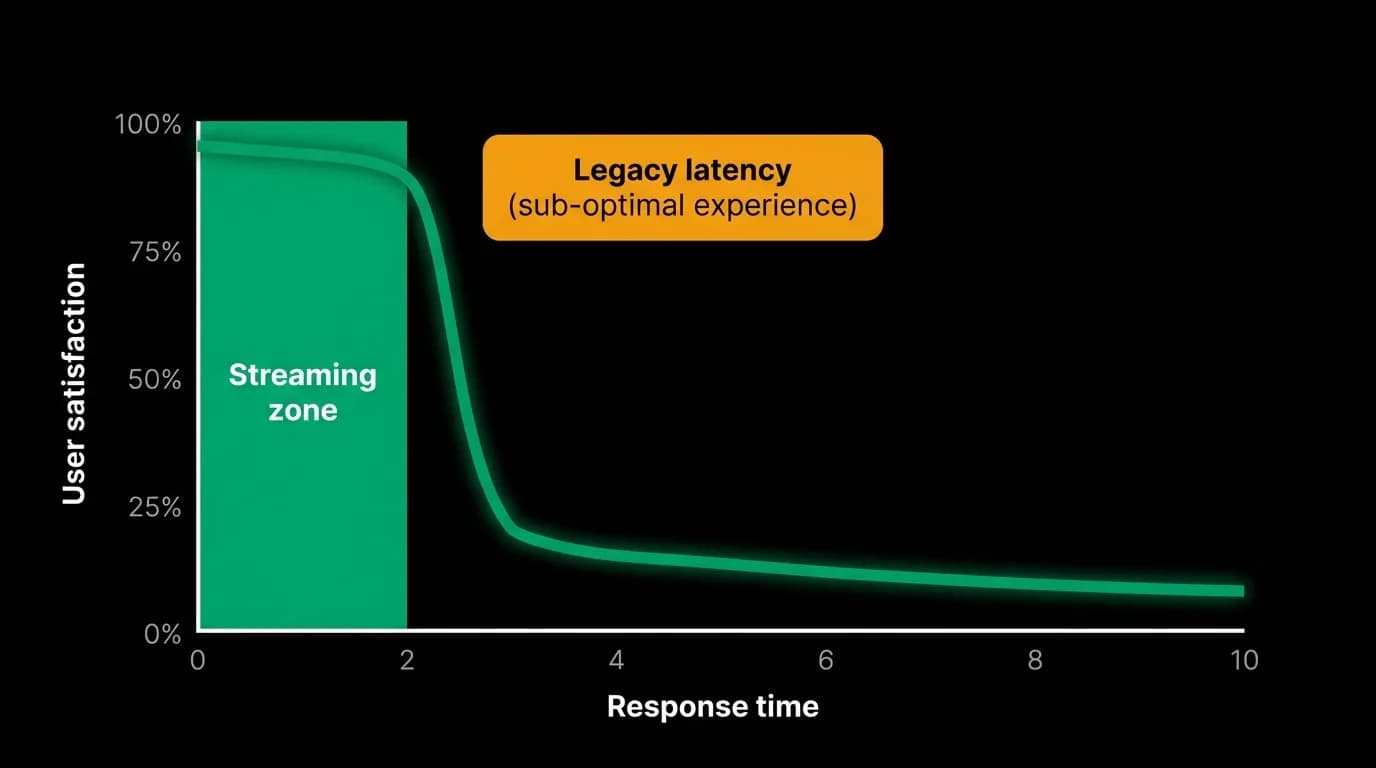
Two seconds feels fine. Five seconds feels slow. Ten seconds feels like the app crashed. This is true regardless of how complex the underlying operation is. Users do not grant mental credit for computational difficulty. They experience speed as a quality signal.
In travel, the stakes amplify this perception. When you ask about a three-thousand-dollar flight, every second of silence amplifies anxiety. Is it working? Did it understand me? Is something wrong?
Streaming as a perception breakthrough
The solution is not making everything faster, though we do that too. The solution is making everything visible.
When the agent responds to your message, you see it working within one to two seconds. "Searching flights on your route..." Then progress: "Comparing 147 options..." Then reasoning: "Ranking by your preferences..." Then the recommendation streams in, word by word.
The full response might take twenty to thirty seconds. But it does not feel like thirty seconds because you are watching it happen. Visible progress creates a perception of speed that a loading spinner never can. Studies and our own user testing confirm this: streaming thirty seconds feels faster to users than a static loading spinner for ten seconds.
This is not a psychological trick. It is honest communication about what the AI is doing. The agent really is searching. It really is comparing. Streaming shows the truth, which builds trust, which makes the wait tolerable.
Speed across every layer
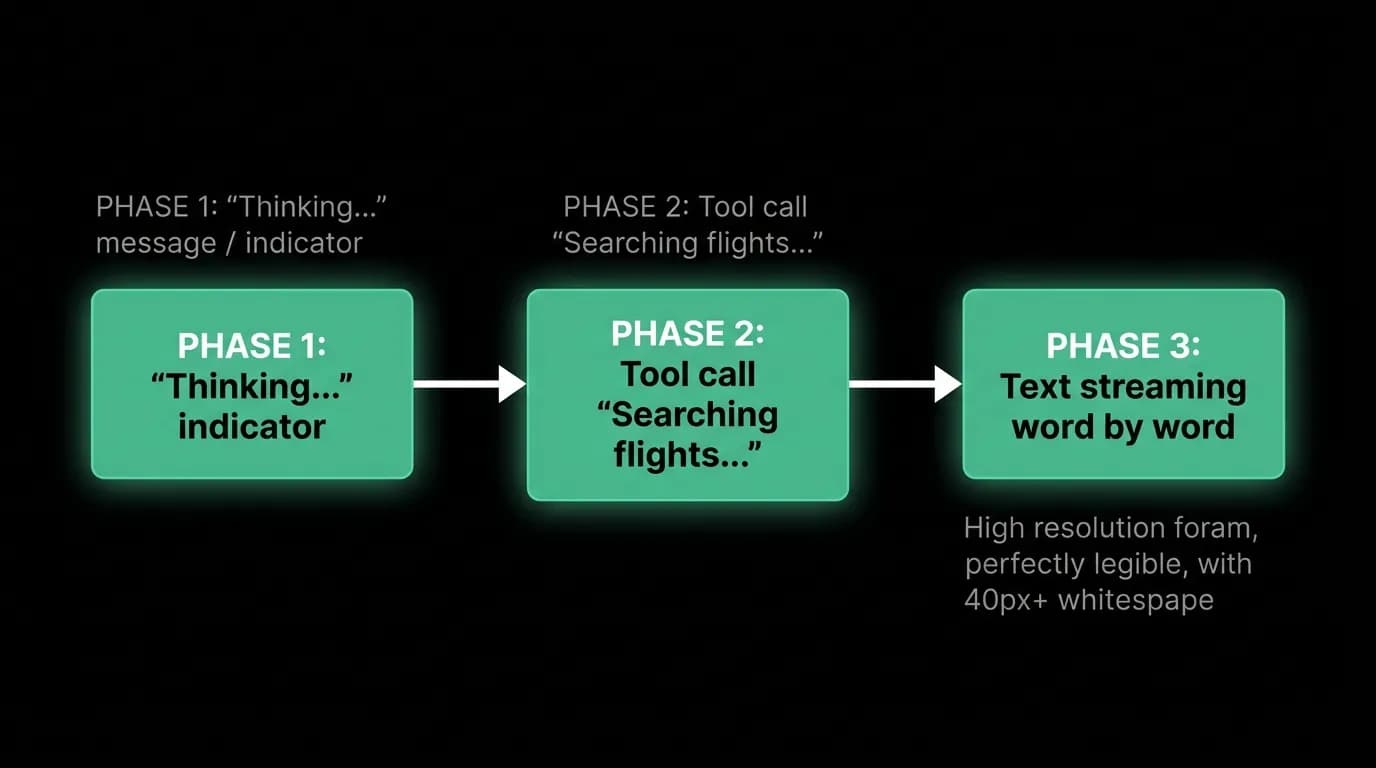
We optimize for speed at every level of the stack.
The streaming architecture delivers response chunks as they are generated, not batched. The moment the AI produces a token, it arrives on the user's screen. There is no buffering step between generation and display.
Travel data API calls, which can take three to fifteen seconds each, are executed while the agent streams status updates to the user. The user knows a search is happening because they can see it happening.
Background processing handles everything the user does not need to wait for: confirmation emails, document generation, analytics. The booking confirmation appears instantly. The email arrives seconds later. The user never waits for something they cannot see.
Speed as a moat
Consistently fast AI at scale is genuinely hard to replicate. It requires architectural decisions that are baked in from the beginning, not bolted on later. Streaming, efficient caching, parallel tool execution, and optimized API routing all compound into a speed advantage that is difficult for competitors to match without rebuilding their stack.
Send a message and watch the agent work in real time. That is the experience we are optimizing for. Every millisecond we eliminate is trust we build.
Nowah is an AI travel agent that searches and books real flights and hotels through conversation — no filters, no thirty open tabs. Plan your next trip.