When Booking Goes Wrong: Failure Modes We Guard Before Launch
How a wrong booking can happen, the guardrails we are building, and the support playbook we will run if an agent error reaches a traveler.
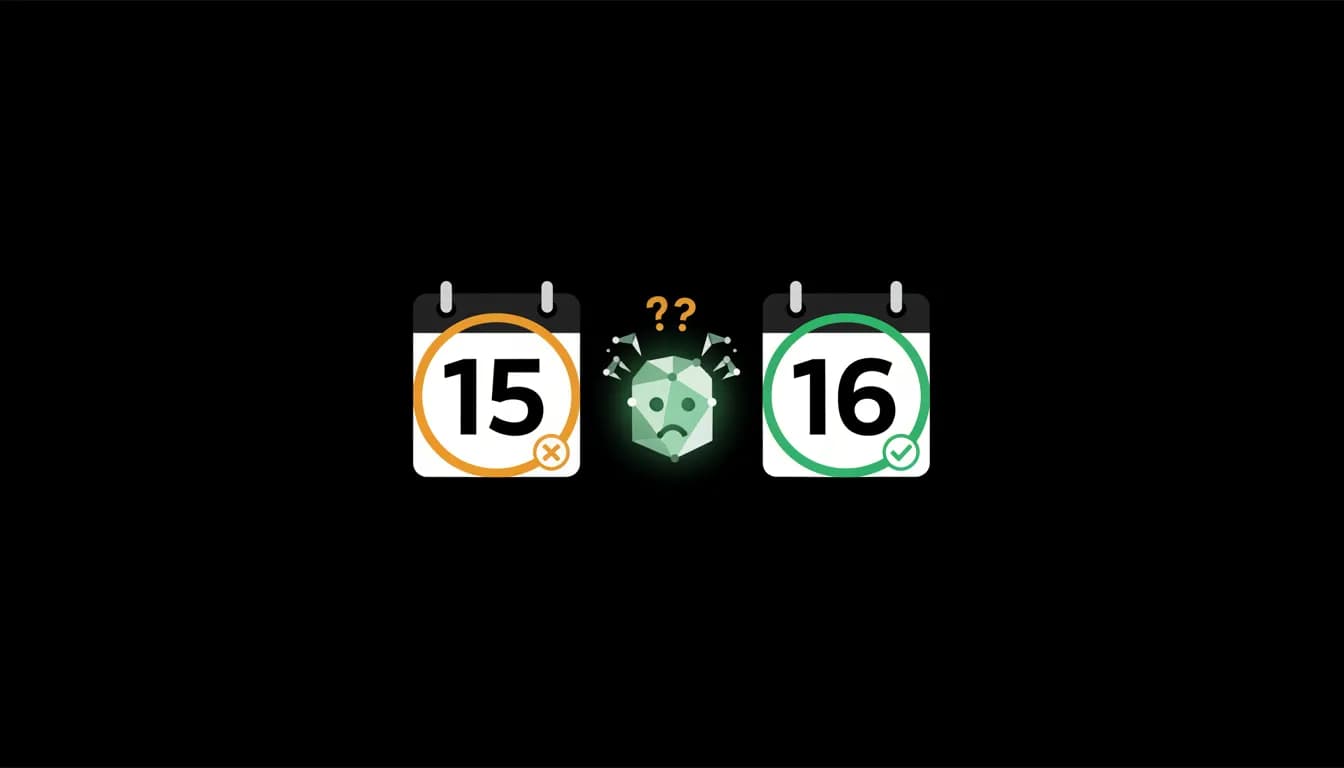
A wrong booking is the nightmare case for an AI travel agent. We treat it as a pre-launch design problem, not a story we wait to experience in production. Confirmation surfaces, human approval before money moves, and a support path that can reverse damage are launch blockers — not post-mortems we write later.
Root cause
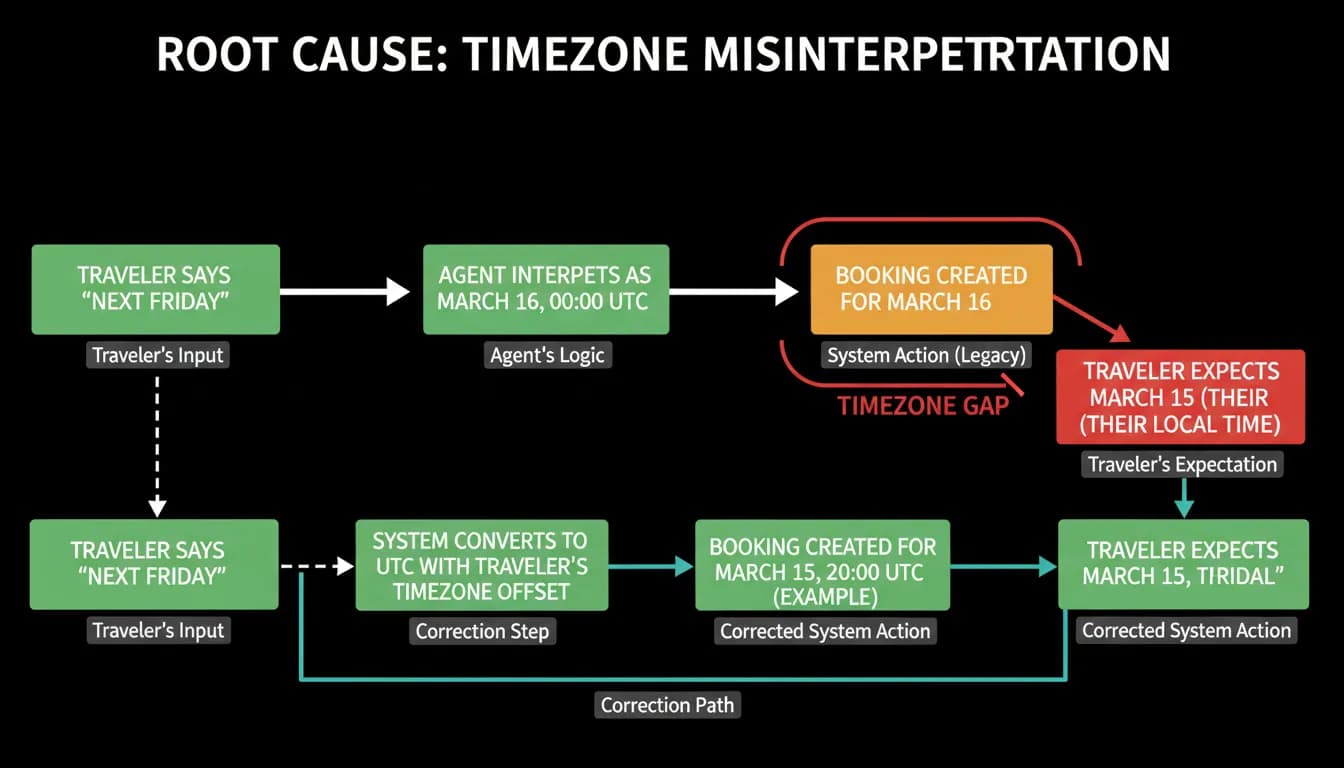
The traveler said "next Friday" at 11:23 PM in their local timezone on a Thursday evening. The agent processed the message and interpreted "next Friday" relative to its own processing time, which was in UTC. In UTC, it was already Friday. So "next Friday" became the Friday after the one that had just started in UTC, which was one day later than the Friday the traveler meant.
The interpretation was not random. It followed a consistent logic. But the logic did not account for the traveler's timezone. The agent had access to the traveler's timezone through their profile, but the date parsing module resolved relative date references against server time rather than the traveler's local time. It was a one-line bug with cascading consequences.
The flight search returned results for the wrong date. The agent presented those results. The traveler saw a flight that matched their route and general time preferences. The date was displayed in the booking review, but the one-day difference between "Friday March 15" and "Saturday March 16" did not register because the traveler was looking at the flight details, the price, and the departure time, not re-verifying a date they believed they had already specified correctly.
The detection gap
The booking review modal is specifically designed to give travelers a final chance to verify details before committing. It displays the date, the route, the times, the airline, and the price. The traveler must explicitly confirm before the booking proceeds. This is our human-in-the-loop safeguard.
The safeguard failed because it relied on the traveler to catch the error. The date was displayed, but it was one field among many on a screen that the traveler was scanning for confirmation, not verification. The traveler trusted that the agent had interpreted their request correctly, so they were confirming that the details looked reasonable rather than independently verifying each field.
This is a fundamental challenge in human-AI interaction. Confirmation screens work when the user is independently verifying information they provided directly, like reviewing a form they filled out themselves. They work less well when the user is confirming information that an AI derived from natural language, because the user's mental model of what they requested may not match what the AI interpreted.
Resolution with the traveler
When the support ticket arrived, we escalated immediately. The on-call engineer identified the root cause within thirty minutes. The traveler was contacted by a team member, not a templated response, within an hour.
The resolution was comprehensive. The incorrect booking was cancelled. The full amount was refunded to the traveler's payment method. The correct flight was searched for the date the traveler actually intended. The correct booking was made at no additional cost to the traveler. The price difference, since the correct date's flight was slightly more expensive, was absorbed by us.
The traveler received a personal apology that explained exactly what went wrong in plain language. Not "a technical issue occurred." An honest explanation: "The agent interpreted your timezone incorrectly and booked a flight for the wrong date. Here is specifically what happened and what we are doing to ensure it never happens again."
The traveler's response was understanding and appreciative. They said the transparency was more reassuring than the refund. Knowing what went wrong and that it was being fixed mattered more than the financial resolution.
The systemic fix: date confirmation
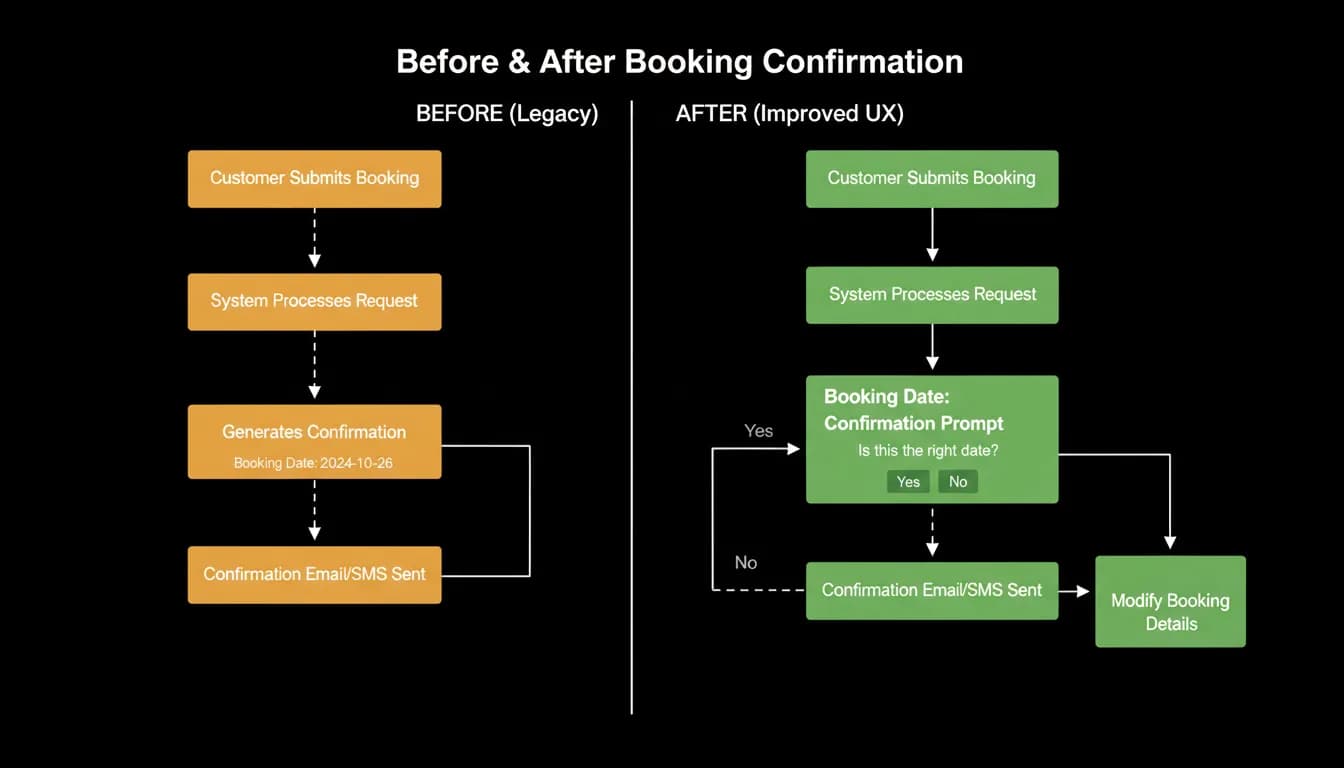
The most impactful fix was adding an explicit date confirmation step to the booking flow. Before the full booking review, the agent now presents the interpreted date back to the traveler in a clear, prominent format and asks for explicit confirmation.
The interaction looks like this: the traveler says "book me a flight next Friday." The agent responds with "I'll search for flights on Friday, March 15. Is that the right date?" The traveler confirms or corrects. Only after date confirmation does the search proceed.
This adds one conversational turn to the booking flow. We debated whether the added friction was worth it. The answer was unambiguous. A single confirmation question takes seconds. A wrong booking takes hours to resolve, costs money, and damages trust. The math was not close.
The systemic fix: timezone-aware parsing
The date parsing module was updated to resolve all relative date references against the traveler's local timezone rather than server time. This required propagating the traveler's timezone from their profile through to the date interpretation layer, a change that touched multiple components but was architecturally straightforward.
We also added explicit timezone labeling in the agent's responses. When the agent mentions a date or time, it now includes the timezone context. "Friday, March 15 (your local time)" removes ambiguity even if the underlying parsing were somehow wrong.
Relative date references like "next Friday," "this weekend," "tomorrow morning," and "in two weeks" are now resolved with timezone awareness and tested against a comprehensive set of scenarios. The evaluation dataset gained over fifty new test cases specifically covering date interpretation across timezone boundaries, including edge cases like travelers in timezones that cross the international date line.
What this changed about human-in-the-loop design
The incident exposed a weakness in how we thought about human-in-the-loop confirmation. We had assumed that showing correct information was sufficient. In reality, showing information is necessary but not sufficient. The information must be presented in a way that makes errors impossible to miss.
Our booking review modal was redesigned with this principle. The date is now displayed in a larger format, with the day of the week spelled out, the month spelled out, and the year included. No abbreviations. No ambiguity. The date field is visually distinct from other fields, with a different background color and a dedicated section header.
For information that the AI derived from natural language, as opposed to information the traveler entered directly, the review modal now adds a subtle indicator: "The agent understood your request as [interpreted detail]." This framing shifts the traveler from confirmation mode to verification mode. They are not confirming that the details look right. They are verifying that the agent understood them correctly. The psychological shift is small but the behavioral impact is significant.
Publishing this story
We considered not publishing this story. It is not a great look for an AI travel platform to admit that the agent booked the wrong flight. But the alternative, silence, is worse for two reasons.
First, travelers who use AI products know that errors are possible. They are not naive. What they need to know is how the company responds when errors happen. A company that publishes its mistakes and explains its fixes demonstrates accountability. A company that hides its mistakes demonstrates that it prioritizes image over honesty.
Second, every team building AI booking products will eventually face a similar incident. The timezone-aware date parsing issue is not unique to our platform. By publishing the root cause and the fix, we help other teams avoid the same mistake. The industry gets better when companies share their failures, not just their successes.
The agent booking the wrong flight was our most consequential launch day incident. It was also our most instructive. Every systemic fix it drove made the product meaningfully better. The date confirmation step, the timezone-aware parsing, the redesigned review modal, and the presentation of AI-interpreted information all improved the experience for every traveler, not just the one who was affected by the original error.
The traveler who filed that support ticket is still an active user. They told us that the way we handled the incident made them trust the platform more, not less. Trust is not built by never making mistakes. It is built by how you respond when you do.
Nowah is an AI travel agent that searches and books real flights and hotels through conversation — no filters, no thirty open tabs. Plan your next trip.