Building an AI Agent That Handles Real Money
When your AI processes real payments, reliability is not optional. Here is how we built financial-grade idempotency into every booking transaction.
There's a moment in every AI product's life when it stops being a cool demo and starts being a real business. For us, that moment was when we connected the AI agent to a payment processor and let it initiate real charges on real credit cards for real flight bookings.
Everything changed. The tolerance for errors dropped to zero. The engineering rigor needed to jump by an order of magnitude. And an entire category of problems we'd never dealt with before, financial reliability, idempotency, audit trails, atomicity, became the most important things we worked on.
Here's what we learned building financial-grade AI.
When AI touches money, the rules change
A chatbot that occasionally gives a wrong answer is annoying. A booking agent that double-charges you is a regulatory violation. The stakes are categorically different, and the engineering needs to reflect that.
Consider the failure modes that become possible when an AI agent handles money.
The user taps "Book this flight." The AI agent processes the request and calls the payment tool. The payment goes through. Then the booking API call to the travel provider fails. Now the user has been charged but has no booking. Their money is gone and they have nothing to show for it.
Or: the network drops mid-transaction and the agent retries, creating two payment charges for one booking. The user gets double-charged. They have to notice the duplicate, contact support, wait for a refund, and deal with the temporary cash flow impact.
Or: the booking succeeds but the confirmation message never reaches the user because the streaming connection dropped. The user panics, thinks the booking failed, tries again, and now has two identical bookings on two different charges.
Or: the agent misinterprets which option the user selected. "Book the second one" is ambiguous if the agent's internal ordering doesn't match what the user saw on screen. The user gets charged for the wrong flight.
Every one of these scenarios has happened at some travel company. Average booking abandonment rates on traditional OTAs hit 80 to 90 percent, and part of that is users who don't trust the system to handle their money correctly. They've been burned before. We decided early that if we were going to let an AI agent handle payments, we needed to eliminate these failure modes entirely. Not reduce them. Eliminate them.
The multi-layer idempotency approach
Idempotency means that performing the same operation multiple times produces the same result as performing it once. In payment terms: if a booking request is accidentally sent twice, the user gets charged once and gets one booking.
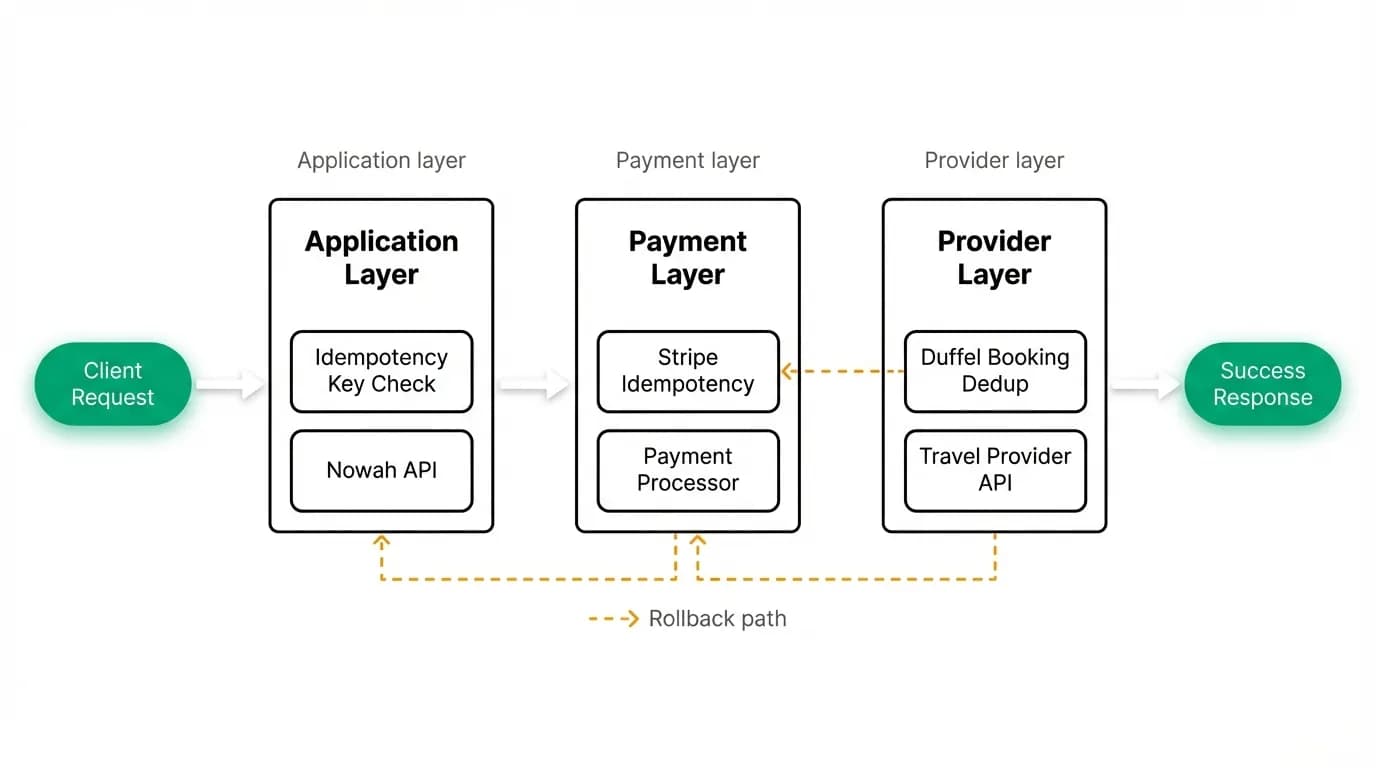
We implement idempotency at three separate layers, because no single layer is trustworthy enough on its own. Defense in depth isn't paranoia when money is involved. It's engineering discipline.
Layer 1: Application idempotency. Every booking request from the AI agent includes a unique idempotency key generated at the start of the booking flow. This key is a hash of the user ID, the selected flight option identifier, and a session-specific nonce. The same user booking the same flight in the same session always generates the same key.
Our application server checks this key before processing any booking. If a request with the same key has already been processed, it returns the existing result without re-executing. No new payment, no new booking, no new side effects. The keys are stored with their associated results and expire after a configurable window (a few hours). After expiration, the same logical booking could be intentionally re-executed, which is correct behavior: if a user genuinely wants to book the same flight tomorrow, that's a new booking.
Layer 2: Payment processor idempotency. Our payment processor supports native idempotency keys. We pass through our application-level key, so even if our application layer somehow fails its check (race condition, database hiccup, deployment overlap), the payment processor won't process a duplicate charge. This is a safety net, not a primary mechanism, but safety nets save lives. In financial systems, they save money and trust.
Layer 3: Travel provider deduplication. Before creating a new booking with the travel provider, we check for existing bookings that match the same passengers, flight, and date combination. If a matching booking exists and was created within a recent window, we return it instead of creating a new one. This catches the edge case where both previous layers fail (extremely unlikely but not impossible in distributed systems).
Three layers. Each one independently prevents duplicates. The probability of all three failing simultaneously is negligible. And we monitor each layer independently. If the application layer reports an idempotency hit (a duplicate was caught), that's a data point. We investigate why the duplicate was generated in the first place. The safety nets shouldn't need to catch things frequently; if they are, something upstream needs fixing.
Payment atomicity in a distributed system
A booking transaction spans at least three systems: our application, the payment processor, and the travel provider. These are separate services with separate databases and separate failure modes. Making them behave as a single atomic transaction is one of the classic hard problems in distributed systems.
We use a saga pattern with explicit compensation. The booking flow proceeds in ordered steps:
- Create a booking attempt record in our database (status: initiated). This is our local record that a booking is in progress.
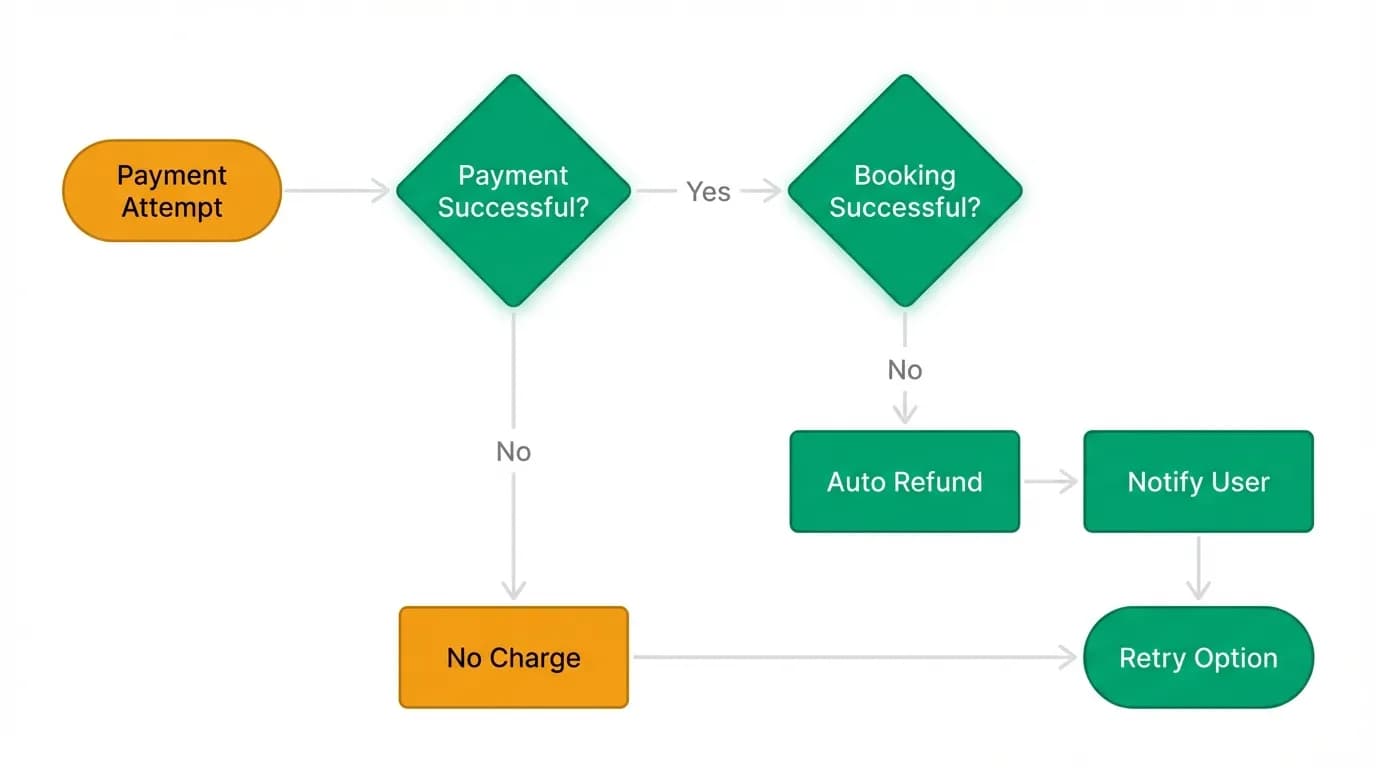
- Authorize payment (status: payment_authorized). The user's card is held but not charged. If this fails, we stop here and no money moves.
- Create booking with travel provider (status: booking_confirmed). The actual flight reservation is made. If this fails, we void the payment authorization.
- Capture payment (status: payment_captured). The hold becomes a charge. If this fails, we cancel the booking with the provider.
- Send confirmation to user and process side effects (status: complete). Emails, push notifications, trip record creation. If any of these fail, the booking still exists; we retry the side effects asynchronously.
If any step fails, the preceding steps are compensated. If booking creation fails after payment authorization, we void the authorization and the user's card is never charged. If payment capture fails after booking creation, we cancel the booking and void the authorization.
The critical insight is that we authorize payment before booking and capture after booking. This means the user's card is held but not charged until we have a confirmed booking. If the booking fails, the hold is released automatically. No money moves until we're certain the booking exists.
Every transition is logged. Every compensation path is tested. We run chaos tests that simulate failures at each step and verify that compensation happens correctly. A booking that partially fails should leave the user in the same state as if the booking was never attempted: no charge, no orphaned reservation, no confusion.
Audit trails for AI-initiated transactions
When a human customer service agent books a flight for you, there's a person who can explain what happened and why. When an AI agent books a flight, we need an equivalent trail. The audit trail is that equivalent, and it needs to be more thorough than a human agent's memory because it needs to be provable, not just recollected.
Every AI-initiated transaction in our system gets a comprehensive audit record. This includes: the conversation context that led to the booking decision (what the user asked for, what options were presented, which one they selected), the search results the agent evaluated, the ranking scores for each option, the user's explicit selection and confirmation, the exact parameters sent to the payment processor, the exact parameters sent to the travel provider, every response received at each step, and timestamps for the entire sequence.
If a customer questions a charge, we can reconstruct the complete chain from "user said X" through "agent decided Y" to "systems executed Z." This isn't just for customer support. It's a regulatory requirement for financial services in many jurisdictions, and it's table stakes for earning user trust in AI-managed transactions.
Average customer service calls in travel cost $6 to $12 each. Our audit trail resolves most questions automatically. A support agent can pull up the full transaction history, including the AI's reasoning and the user's explicit confirmations, in seconds. Most inquiries that would require a ten-minute investigation at a traditional company are resolved by showing the user their own confirmation chain.
The AI agent's unique financial risks
AI agents create financial risks that traditional software doesn't. These are specific to the nature of how agents work, and ignoring them is dangerous.
Retry risk. AI agents have built-in retry logic for tool calls. If a tool call times out, the agent may retry it. If the tool call was a payment operation, a naive retry could double-charge. Our idempotency layer handles this, but only because we designed for it from the start. If you bolt a payment tool onto an agent without idempotency, retries will eventually cause a double-charge.
Context confusion risk. In a long conversation with multiple trip options discussed, the agent might confuse which option the user selected. "Book the second one" is clear when there are three options on screen. It's ambiguous if the user discussed six options across twenty turns, with some options from yesterday's conversation. We mitigate this with explicit confirmation steps where the agent presents the exact booking details (flight number, time, price, passengers) before proceeding.
Hallucination risk in pricing. The agent might quote a price from a cached or remembered search result that's since changed. We do a real-time price check at booking time and present any price change to the user before charging. "The price increased by $23 since your search. The current price is $847. Want to proceed?" This transparency prevents surprise charges and gives the user agency over price changes.
Scope creep risk. An agent that's too proactive might add services the user didn't request. An extra bag, trip insurance, an airport transfer, a seat upgrade. We require explicit user confirmation for every line item that costs money. The agent can suggest ("Would you like to add checked baggage? It's $35.") but never charge without consent.
Timeout risk. AI inference takes time. Travel API calls take time. If a user's session times out mid-booking because the total operation takes too long, the system needs to handle the partial state correctly. We never leave a booking in a state where the user can't see what happened. If a timeout occurs, the saga's compensation logic kicks in.
Each of these risks is manageable with the right engineering, but you have to know they exist. Teams that bolt a chatbot onto an existing booking flow often miss these because the existing flow was designed for human-driven interactions where these risks don't arise. When a human clicks through a checkout flow, there's no retry risk (they see the confirmation page), no context confusion (the page shows what's being booked), and no scope creep (they chose each line item). An AI agent doesn't have these natural guardrails, so we have to build them.
What financial-grade AI means for the next generation
The patterns we've built for Nowah, layered idempotency, saga-based atomicity, comprehensive audit trails, explicit confirmation gates, timeout handling, aren't specific to travel. They're the foundation for any AI agent that handles money.
AI agents booking restaurant reservations, purchasing products, managing subscriptions, investing money, paying bills. All of these need the same infrastructure. The difference is that travel booking has high transaction values (a family vacation can easily exceed $5,000), complex multi-party transactions (airlines, hotels, payment processors), and high emotional stakes (messing up someone's vacation is personal in a way that messing up a grocery delivery isn't).
That combination forced us to build financial reliability to a standard that most AI products haven't needed yet. As AI agents expand into more domains that involve real money, these patterns will become standard practice. The teams that figure them out early will have a significant advantage.
AI agent interactions cost a fraction of human support calls. But that cost advantage only holds if the agent handles transactions correctly. One double-charge that requires human intervention, customer communication, refund processing, and trust repair wipes out the savings from dozens of successful automated bookings. Financial-grade reliability isn't a nice-to-have. It's the foundation everything else stands on.
Nowah is an AI travel agent that searches and books real flights and hotels through conversation — no filters, no thirty open tabs. Plan your next trip.