AI Travel Booking vs Traditional OTAs: Why We Are Building Different
Comparing Nowah's AI-first approach with traditional online travel agencies — the UX gap, personalization gap, and efficiency gap that define the opportunity.
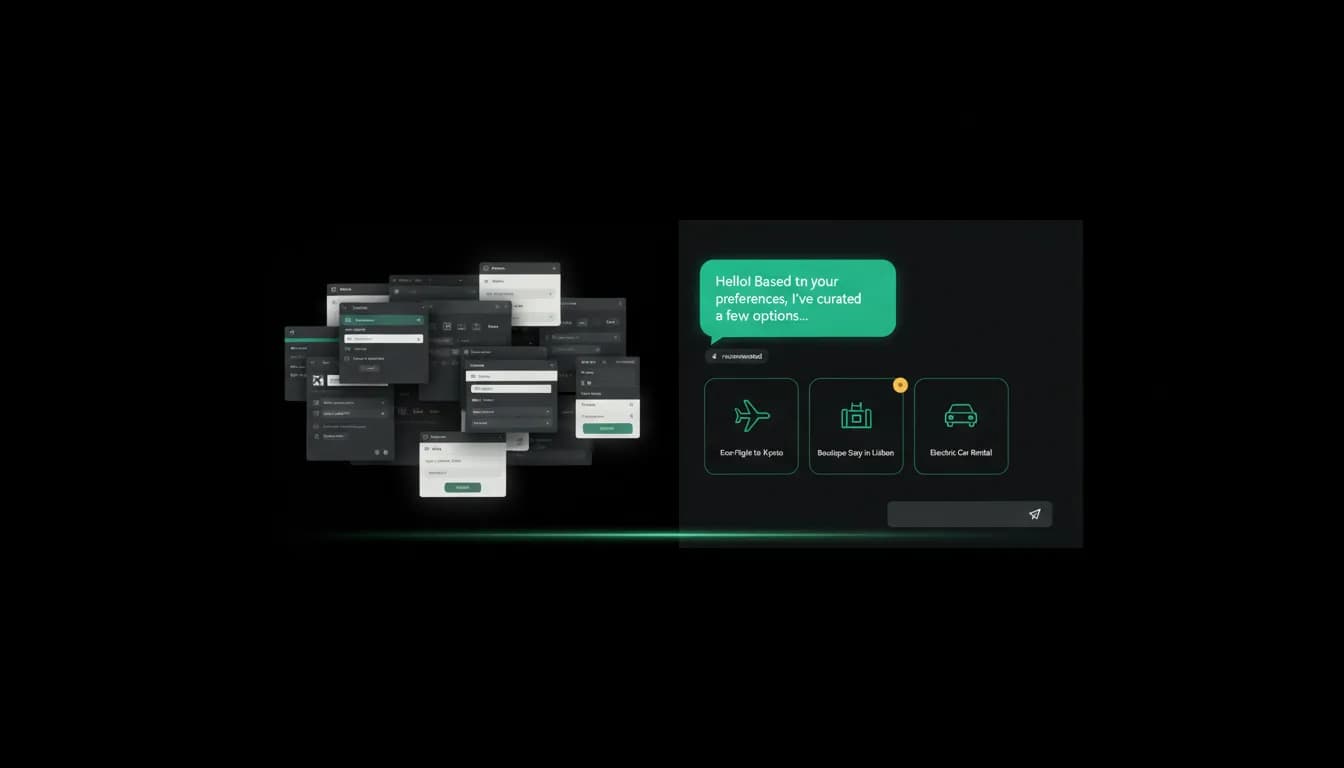
A traveler timed herself booking a round-trip flight to London through a traditional online travel agency. Forty-seven minutes. She entered departure and arrival cities, selected dates, applied filters for nonstop flights, sorted by price, opened six options in new tabs, compared departure times against her schedule, checked baggage policies on each airline's website separately, went back to the OTA, and finally booked. Forty-seven minutes of mechanical work.
She then booked a similar trip through our AI agent. Three minutes. She told the agent what she needed, the agent presented three curated options with relevant details already summarized, and she selected one. The outcome was the same. The experience was categorically different.
The UX gap
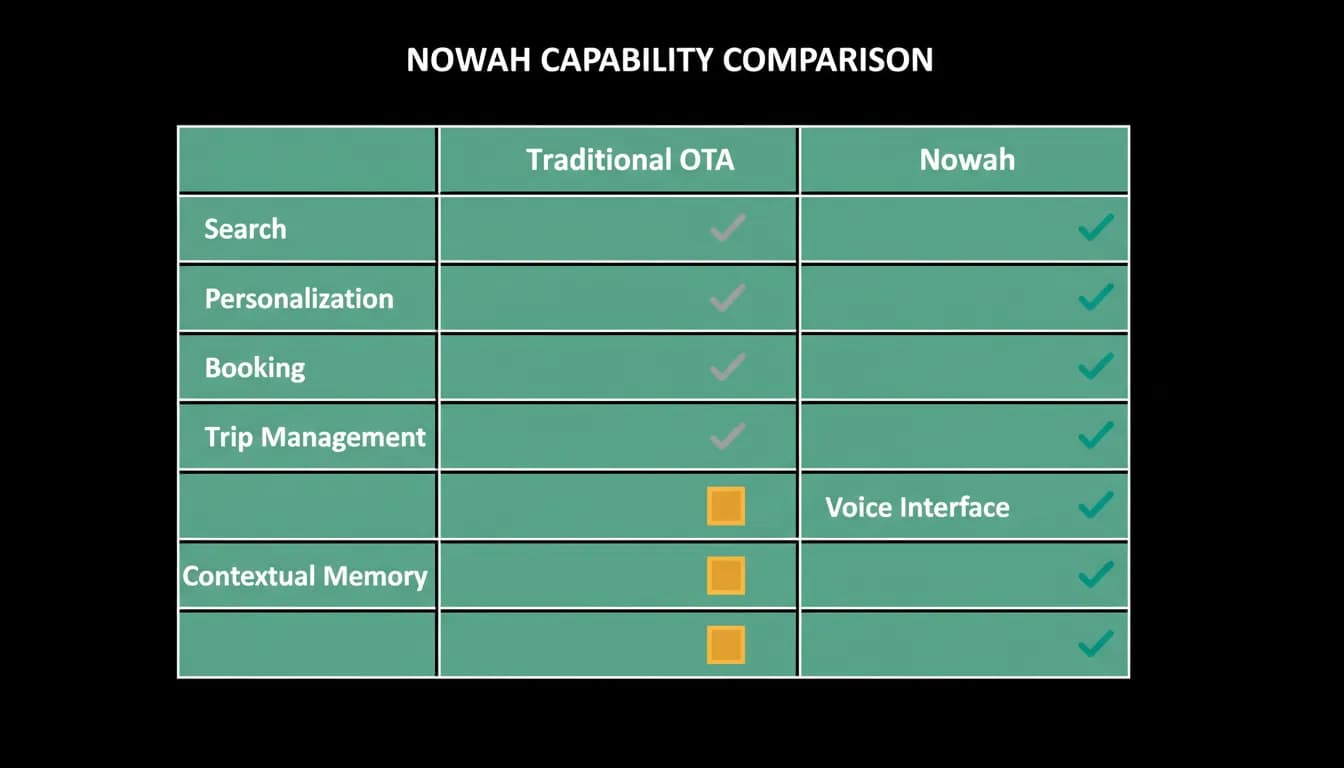
Traditional OTAs are built around forms and filters. The traveler fills in a search form, receives hundreds of results, and applies filters to narrow them down. The interface assumes the traveler knows exactly what filters to use and how to evaluate the results. The complexity of the decision is imposed on the traveler.
An AI-first travel platform inverts this. The complexity is absorbed by the agent, not imposed on the traveler. The traveler expresses what they want in natural language. The agent handles the translation from intent to structured search parameters, the evaluation of results, and the presentation of relevant options. The traveler makes decisions. The agent handles logistics.
The difference is not cosmetic. It is structural. A form-based interface can only capture the dimensions that the form designer anticipated. A natural language interface can capture any dimension the traveler expresses. "I want a flight that arrives early enough to make a dinner reservation at 7 PM" is trivial to say and nearly impossible to express through dropdown menus and checkboxes.
The personalization gap
Traditional OTAs personalize through account preferences: saved payment methods, frequent traveler numbers, and past searches. This is shallow personalization. It remembers data you entered. It does not learn from your behavior.
Our agent uses a memory system that maintains context across sessions. It remembers that you preferred the boutique hotel over the chain last time, that you always choose aisle seats, that you dislike layovers longer than two hours, and that you tend to book trips three weeks in advance. This memory is not a preference form. It is learned behavior that the agent uses to provide better recommendations over time.
The personalization gap widens with usage. A traditional OTA treats your hundredth search the same as your first, aside from basic account data. An AI agent treats your hundredth conversation with accumulated knowledge from the previous ninety-nine. The more you use it, the better it gets at understanding what you want. This creates a positive feedback loop that traditional platforms cannot replicate.
The efficiency gap
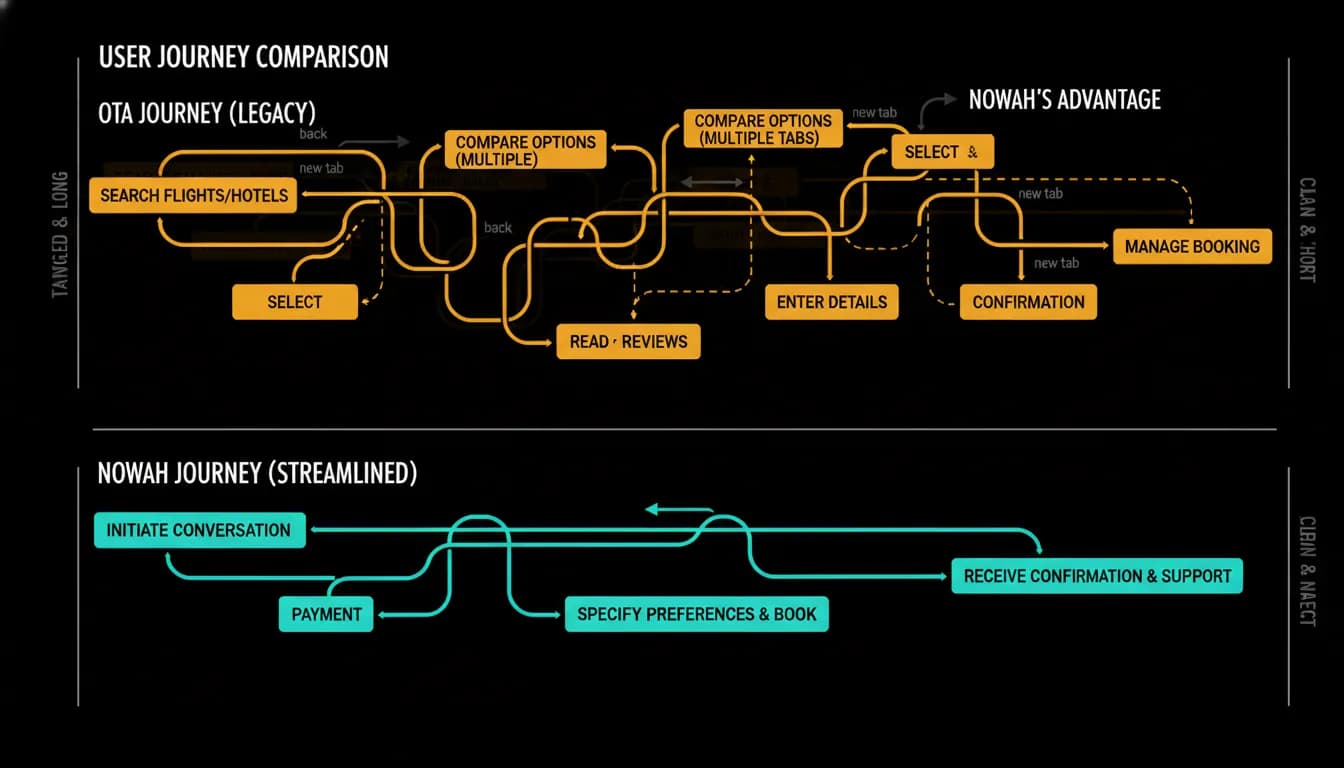
The average traveler visits dozens of websites before booking a trip. They spend 45 to 60 minutes on the process. They make three to five separate sessions before completing a booking. These numbers represent the inefficiency of the current booking paradigm: abundant information with inadequate tools for making sense of it.
Our target is a single conversation, under ten minutes, in one or two sessions. The efficiency gain comes from the agent's ability to synthesize information that the traveler would otherwise need to gather manually. The agent searches multiple sources, compares options, evaluates tradeoffs, and presents a curated set of results. The traveler's role shifts from researcher to decision-maker.
One-third of travelers abandon bookings due to complexity. They start the process, get overwhelmed by options, and give up. The AI approach reduces abandonment because the agent manages the complexity on the traveler's behalf. The traveler is never confronted with two hundred undifferentiated options. They are presented with three to five relevant choices, each with a clear explanation of why it was selected.
What traditional OTAs do well
Intellectual honesty requires acknowledging what the incumbents do well. Traditional OTAs have massive inventory breadth. They have years of accumulated trust and brand recognition. They have customer service infrastructure that handles millions of interactions. They have relationships with airlines and hotels that took decades to build.
These advantages are real. They are also insufficient. Inventory breadth matters less when the traveler cannot efficiently find what they need within that inventory. Trust matters, but trust can be built by a new platform that delivers consistently good experiences. Customer service infrastructure matters, but an AI agent that prevents problems is better than a support team that resolves them.
The traditional OTA advantages are defensive. They protect market position. They do not drive innovation. The traveler who spends forty-seven minutes booking a flight is not satisfied with the process. They tolerate it because the alternatives were not meaningfully better. Until now.
The convergence question
Traditional OTAs are adding AI features. Chatbots, recommendation engines, and natural language search are appearing across the major platforms. The question is whether bolt-on AI can match AI-native design.
Our position is that it cannot. A traditional OTA adding a chatbot is layering a conversational interface on top of a form-based architecture. The underlying system was designed for filter-based search. The data models, the ranking algorithms, the booking flows, and the user experience were all designed around forms and filters. Adding a chat interface does not change the underlying architecture.
An AI-native platform is designed from the ground up around conversational interaction. The data models store conversation context. The ranking algorithms incorporate natural language preferences. The booking flows are designed for conversational confirmation, not form-based review. The entire stack is optimized for the paradigm, not adapted to it.
The difference shows in edge cases. When a traveler asks a bolt-on chatbot something the underlying form-based system cannot handle, the chatbot either fails or redirects the traveler to the traditional interface. When a traveler asks our agent something complex, the agent reasons through it using seventy-plus tools designed for natural language interaction. There is no fallback to a form because the form was never the primary interface.
A new category
We are not building a better OTA. We are building a different category of travel platform. The distinction matters because it shapes every decision we make.
A better OTA would optimize forms, improve filters, and add features within the existing paradigm. We are building a platform where the traveler talks to an intelligent agent that handles the entire process. The interface is a conversation. The intelligence is an AI that learns and improves. The outcome is a booked trip with less effort, better personalization, and higher satisfaction.
The category difference is why direct feature comparisons with OTAs are misleading. We do not have 47 filter options because we do not need them. We do not have a multi-tab comparison view because the agent does the comparison. We do not have a complex fare class matrix because the agent translates fare information into plain language relevant to the specific traveler.
The traveler who booked in three minutes did not use a better version of the tool that took forty-seven minutes. She used a fundamentally different tool. That difference is what we are building.
Nowah is an AI travel agent that searches and books real flights and hotels through conversation — no filters, no thirty open tabs. Plan your next trip.