The Cold Start Problem: Onboarding Users Who've Never Talked to AI
Most users have only interacted with basic chatbots. Their expectations are low, their behavior is formal. The first message must reset everything.
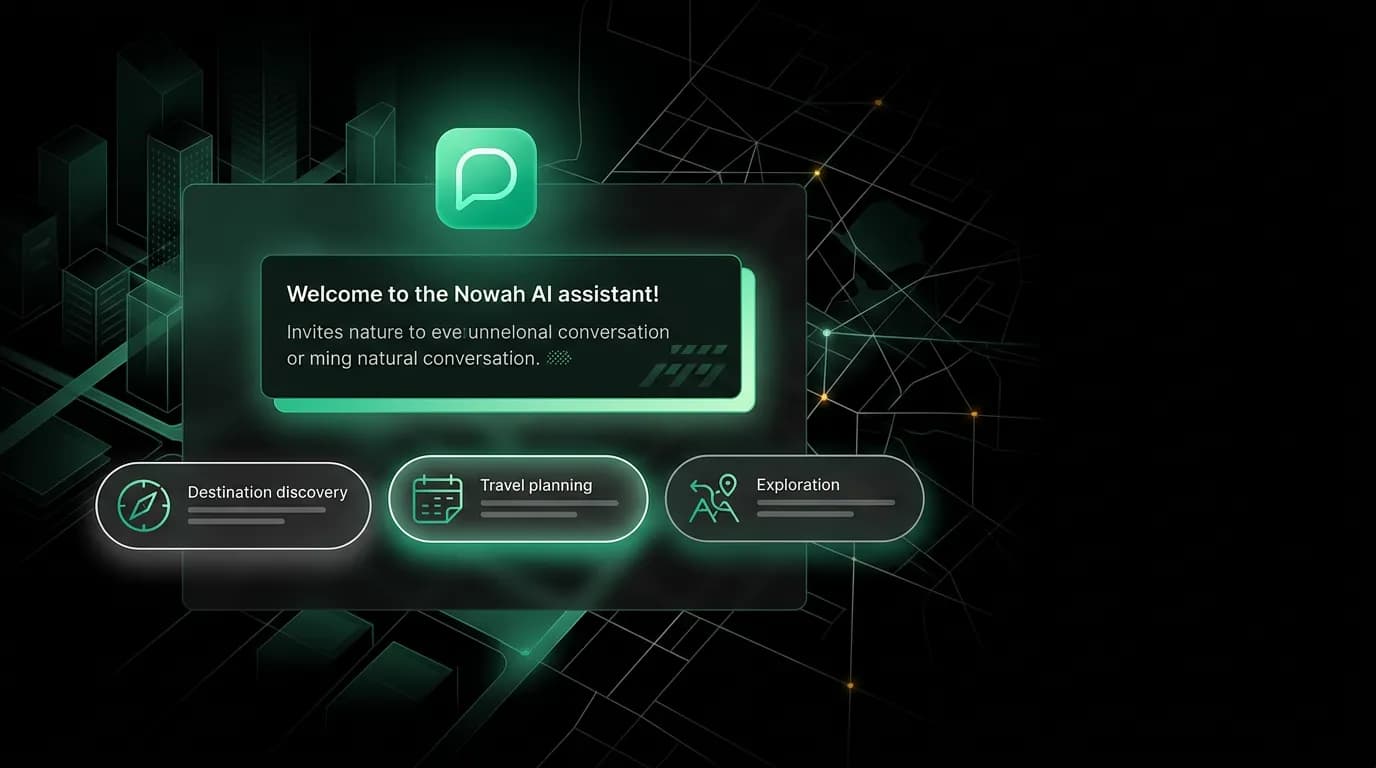
The first message a user sends to Nowah tells us everything about their expectations. Most people type something like this:
"Hello. I would like to search for flights to London please."
Formal. Polite. Structured like a form submission. This is what years of terrible chatbots have trained people to do: treat AI like a stiff customer service form that happens to accept text input instead of dropdowns.
Our job is to break that pattern in the first 30 seconds. Because the gap between what users expect from an AI chatbot (frustration, limited capability, eventually talking to a human) and what Nowah actually does (find real flights, compare them intelligently, book them end-to-end) is the biggest product opportunity and the biggest product risk we face.
If we do not close that gap immediately, users leave thinking they have used another bad chatbot. If we do close it, we have a user for life. The cold start problem is not about loading data or training the model. It is about resetting human expectations.
Most users have only met basic chatbots
Let me be specific about what we are up against.
The average consumer's experience with AI assistants in 2026 falls into three buckets:
Corporate chatbots. The "how can I help you?" popup on every e-commerce site that can handle "where's my order" and "what's your return policy" and nothing else. These have trained people to expect narrow capability, scripted responses, and eventual escalation to a human. About 73% of consumers have used these and most describe the experience as "frustrating."
General AI assistants. Siri, Google Assistant, Alexa. These handle simple tasks (set a timer, play a song, check the weather) but fall apart with complex requests. People have learned to keep queries simple and specific because anything ambitious gets a "I'm not sure about that" response. The learned behavior is: use short, simple commands and do not expect much.
AI chatbots in apps. The ChatGPT-powered features that every company added in 2023-2024. These can generate text and answer questions, but they usually cannot take actions. You can ask "what are the best hotels in Paris?" and get a nice text response, but you cannot actually book anything. The expectation they set is: AI can talk about things but not do things.
Each of these experiences has deposited a mental model that works against us. Users come to Nowah expecting limited capability, scripted behavior, and an inability to take real action. Their first message reflects these expectations. It is formal, constrained, and hedged.
The user typing "Hello. I would like to search for flights to London please" is not being polite. They are being cautious. They do not believe the AI can handle anything more complex, so they start with the simplest possible request.
The first message that resets expectations
We have exactly one chance to show users that Nowah is different. That chance is the response to their first message.
A bad first response confirms their low expectations: "I can help with that! What dates would you like to travel? Where will you be flying from?" This is a form disguised as a conversation. It asks exactly the same questions a search form would ask, one at a time. The user thinks: "great, another chatbot that makes me fill out a form by typing instead of clicking."
A good first response demonstrates capability that exceeds expectations. When a user says "I would like to search for flights to London please," the agent responds:
"I would love to help with London. Before I search, a few quick things: are you thinking Heathrow or could Gatwick work too? And what dates are you considering? If you have any flexibility, I can check across a few days to find the best prices. Also, just for me to know: do you have a preference on airlines or would you rather I just find the best overall option?"
This response does several things at once. It treats London as a real destination with specific airports, signaling domain knowledge. It introduces the concept of flexible date search, which most users do not expect from a chat interface. It asks about preferences, signaling that the agent can do more than just return a price list. And the tone is casual and helpful, not robotic.
The goal is to provoke a reaction along the lines of: "Wait, it actually knows about airports? It can search flexible dates? This is not what I expected."
That surprise is the most valuable emotion we can generate in onboarding. It cracks open the user's mental model and makes them willing to engage more naturally.
Teaching through example
You cannot tell users how to interact with an AI agent. You have to show them.
We use conversation starters, suggestion chips displayed below the agent's greeting, to model the kind of natural language input the agent can handle:
- "Find me a beach trip for under $2,000 in April"
- "I need to fly to Tokyo next month, preferably direct"
- "Help me plan a week in Europe for two people"
These starters are deliberately more casual and complex than what most users would type on their own. They demonstrate by example that the agent can handle natural language, multi-variable queries, and vague preferences.
The starters are not static. For returning users, they reflect the user's context: "Continue planning your Barcelona trip" or "Check on your upcoming flight to Paris." For new users, they showcase breadth of capability. We rotate them to avoid the stale feeling of the same three suggestions every time.
The psychological mechanism is anchoring. When users see "Find me a beach trip for under $2,000 in April" as a suggested input, it anchors their mental model of what kind of input is acceptable. Their next typed message is more likely to be natural and complex than it would have been if the first thing they saw was a blank text field.
We tested this. Users who saw rich conversation starters sent first messages that were 40% longer and 60% more likely to include preferences (budget, dates, specific requests) than users who saw a blank text field with "Type a message." The starters do not just suggest what to ask. They teach users how to talk to an AI agent.
Preference collection disguised as conversation
Traditional apps front-load onboarding with a preferences survey. "Select your preferred airlines. Choose your budget range. Pick your travel style." These surveys take 2-5 minutes, have high abandonment rates, and collect answers that are often inaccurate because users do not know their preferences in the abstract.
We do not have a preferences survey. Instead, the agent learns preferences through conversation.
When a user says "find me flights to Rome," the agent might ask: "Economy or business class?" Whatever the user answers becomes a preference. When the agent presents three hotels and the user picks the boutique option over the chain, that is a preference signal. When the user says "I never want to connect through Miami," that gets stored.
This approach is slower than a survey. After one conversation, the agent knows maybe three things about you. After five conversations, it knows a dozen. After ten, it has a fairly complete picture. But the preferences are real. They come from actual decisions, not abstract self-reporting.
The conversion advantage is significant. We do not lose users to a survey they do not want to complete. The first interaction is immediately valuable (they are actually searching for a trip, not filling out forms). And the preferences we collect are tied to real behavior rather than hypothetical answers.
There is a bootstrapping challenge here. The first conversation has zero preference data. The agent has to rely on intelligent defaults and questions. By the third or fourth conversation, the experience is noticeably more personalized. The user gets faster, more relevant results because the agent knows their patterns.
We are transparent about this. The agent might say: "I noticed you have picked direct flights both times we have searched. Want me to default to direct flights going forward?" This surfaces the preference learning and gives the user control over it. It also builds trust: the user sees that the agent is paying attention and getting smarter.
The first booking as the real onboarding
Every tutorial, walkthrough, and onboarding flow in software is a poor substitute for actually using the product. For Nowah, the real onboarding is the first completed booking.
When a user goes from "find me flights to London" through search results, option selection, booking review, and payment to a confirmed booking, they have experienced the core value proposition end-to-end. They have seen the agent search, curate, present options, handle payment, and create a trip. After that, they understand what the product does in a way that no tutorial could convey.
This is why time-to-first-booking is our north star onboarding metric. Not time-to-first-message. Not time-to-registration-complete. Time-to-first-booking. Because that is the moment when the user's mental model permanently shifts from "chatbot" to "travel agent."
We optimize everything in the early experience toward reducing this metric. The first search should return great results. The first booking flow should be frictionless. Any question or concern during the first booking should be handled instantly by the agent. We do not upsell during the first booking. We do not push notifications settings. We do not ask for a review. We get out of the way and let the product speak for itself.
Our data shows a clear inflection point. Users who complete their first booking within the first session have a 68% retention rate at 30 days. Users who search but do not book in the first session have a 23% retention rate. The first booking is the trust moment. Everything before it is setup. Everything after it builds on the established trust.
Measuring cold start success
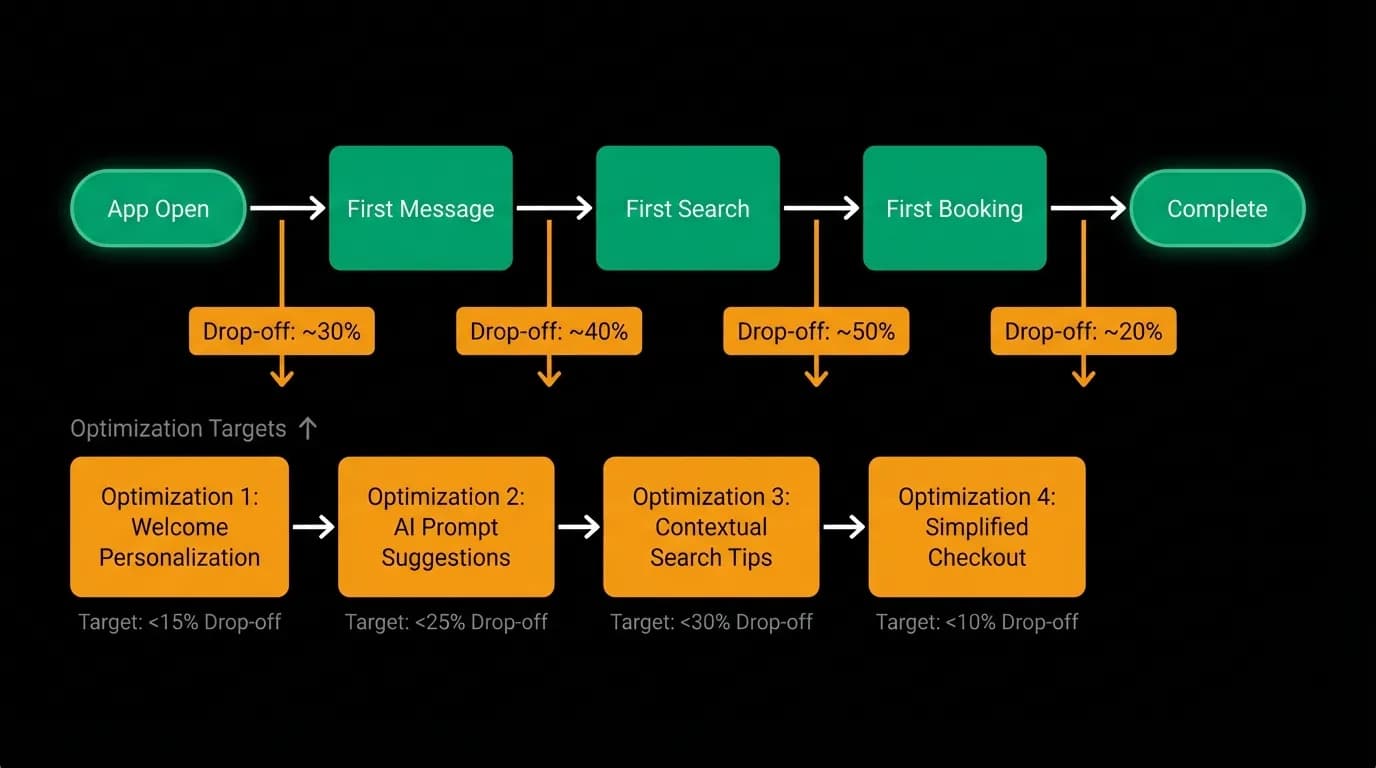
We track the cold start funnel as a distinct product metric, separate from overall conversion:
App open to first message: What percentage of new users send a message? This measures whether the first screen is inviting enough to start a conversation. Current: 72%.
First message to first search: Of users who message, what percentage trigger a search (flights or hotels)? This measures whether the agent successfully engages them and moves toward a useful action. Current: 58%.
First search to option selection: Of users who see search results, what percentage select an option? This measures curation quality for first-time users who have no preference history. Current: 41%.
Option selection to completed booking: Of users who select an option, what percentage complete the booking? This measures the booking flow's friction for new users. Current: 52%.
End-to-end: From app open to first booking, a small share of new users complete a booking in their first session. That might sound low, but for a travel booking product (where the industry average for OTA first-visit conversion is low-single-digit), it is strong. And users who do not book in the first session but return within a week have a 35% eventual booking rate.
Each stage of this funnel has specific optimization efforts. The conversation starters improve first-message rate. The agent's follow-up behavior improves first-search rate. Curation quality improves selection rate. Booking UX improves completion rate.
How Duolingo and Spotify handle cold start
We study the best consumer onboarding in the market. Two stand out.
Duolingo's genius is that onboarding and usage are the same thing. There is no tutorial. There is no settings configuration. You open the app and immediately start a lesson. The lesson is your onboarding. By the time you finish your first lesson (about 5 minutes), you have learned how the app works, experienced the core value, and established the habit loop.
We borrowed this principle. Opening Nowah and starting a conversation with the agent is both onboarding and usage. There is no separate tutorial. The first conversation teaches you how the product works while also providing real value.
Spotify solves the cold start preference problem differently than us but with the same philosophy. Instead of asking users to select favorite genres from a list (the survey approach), Spotify asks users to pick a few artists they like and then immediately plays a personalized station. The first listen is personalized, even if lightly, and it gets better from there.
Our equivalent is the agent's intelligent defaults. Even with zero preference data, the agent makes reasonable assumptions (economy class, moderate budget, departure from the closest major airport) and presents results immediately. The first search is useful even without personalization, and each subsequent interaction adds a layer of personalization that the user can feel.
The common thread: do not make users configure the product before they can use it. Let them use the product, learn from their usage, and improve the experience as you learn. Configuration is the enemy of activation.
Breaking the chatbot expectation
The cold start problem is really an expectations problem. Users arrive with a mental model shaped by bad chatbots, limited assistants, and AI features that cannot take action. Our job is to replace that model with a new one: AI as a capable, knowledgeable, action-taking travel agent that gets better every time you talk to it.
The first message is the first impression. The first search is the first demonstration. The first booking is the first proof. Each of these moments either reinforces the old "this is just a chatbot" model or replaces it with "this is something genuinely different."
We optimize relentlessly for those moments because the compound effect of getting them right is enormous. A user whose expectations are reset in the first minute becomes a user who books trips, who refers friends, who comes back monthly. A user whose expectations are confirmed in the first minute (yep, another chatbot) is gone forever.
The cold start is not a problem you solve once. Every new user arrives with the same low expectations, and every new user needs the same moment of surprise. We build for that moment every day.
Nowah is an AI travel agent that searches and books real flights and hotels through conversation — no filters, no thirty open tabs. Plan your next trip.