Preference Drift: How Travel Tastes Change Over Time
The backpacker of five years ago might prefer boutique hotels today. See how the AI detects preference drift and why memory systems need graceful forgetting.

Five years ago, you slept in hostels, ate street food, and booked the cheapest flight regardless of departure time. Today you want a king bed, room service, and a flight that arrives before noon. Nothing is wrong with either version of you. But if an AI travel agent still thinks you are the hostel person, its recommendations are going to miss badly.
This is preference drift, and handling it well is one of the hardest problems in personalization. The AI needs to remember what you like while also recognizing that what you like has changed.
What preference drift looks like
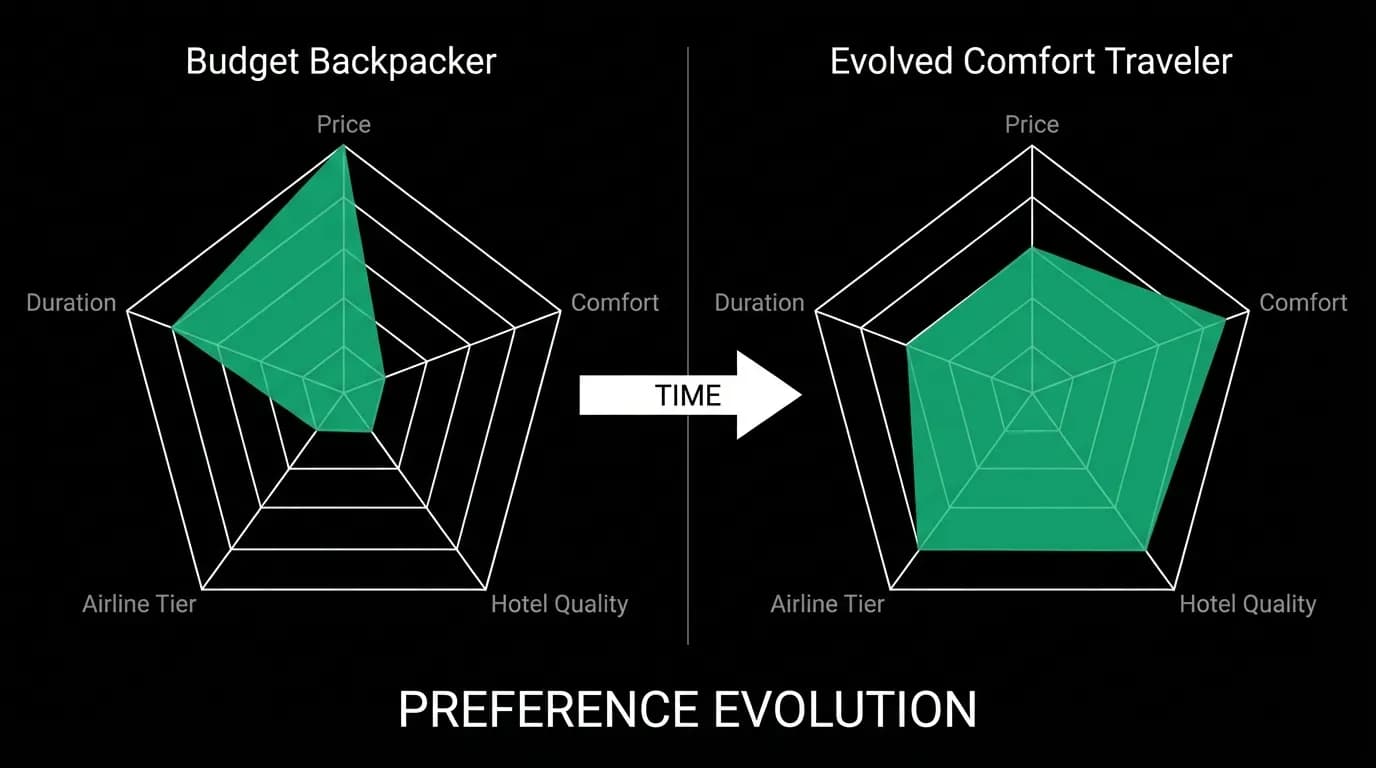
Preference drift is rarely dramatic. Most travelers do not wake up one morning and suddenly want first class instead of economy. It happens gradually. Your budget creeps up as your income grows. You start valuing sleep more, so red-eye flights go from acceptable to unthinkable. You discover you care about hotel breakfast quality because you traveled somewhere with an exceptional one.
The data shows these shifts happening across several dimensions simultaneously. Budget tolerance tends to increase 5 to 10% per year for frequent travelers. Comfort preferences tend to ratchet upward — once someone experiences premium economy on a long-haul flight, the probability of booking basic economy on the same route drops significantly. Destination preferences evolve from popular tourist destinations toward less obvious choices as travelers accumulate experience.
The challenge for any recommendation system is that old data does not become irrelevant overnight. Your preference for aisle seats over window seats might be stable across a decade. Your budget range from three years ago is probably outdated. The system needs to distinguish between stable preferences and drifting ones.
How the AI detects drift
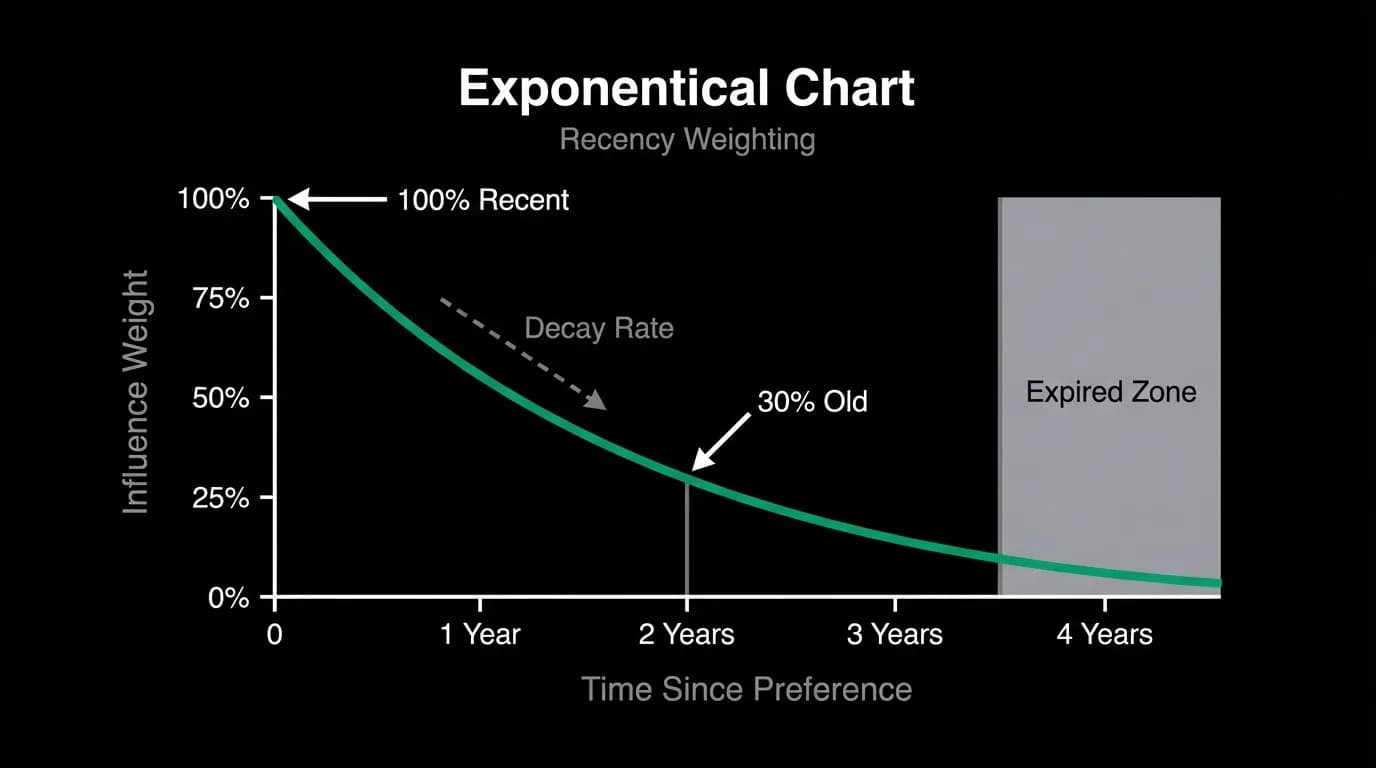
The key mechanism is temporal weighting. Recent interactions carry more influence than older ones. A hotel booking from last month tells the system more about your current preferences than a hotel booking from two years ago. The weighting is not binary — it is a gradual decay. An interaction from six months ago still matters, but it matters roughly half as much as one from last week.
This weighting operates across all five personalization layers. Explicit preferences you stated during onboarding are treated as the baseline, but they get updated whenever your behavior contradicts them. If you said you prefer budget hotels but your last three bookings were mid-range boutique properties, the system recognizes the drift and adjusts.
Conversational signals are especially rich for detecting drift. When you tell the AI "I used to not care about legroom, but I really need it now," that is an explicit update to a preference that the system applies immediately. The AI does not need to wait for behavioral data to confirm it — you stated the change directly.
The problem with perfect memory
Counterintuitively, a memory system that remembers everything perfectly can produce worse recommendations than one that strategically forgets. The reason is straightforward: outdated preferences dilute current ones.
Imagine a traveler who booked 20 budget flights over three years, then spent the last six months booking premium economy exclusively. A system that weights all 25 data points equally would still skew toward budget recommendations because the historical data overwhelms the recent signal. That system is technically accurate about the past but wrong about the present.
This is why memory systems need what researchers call graceful forgetting. Old data does not get deleted — it decays. Its influence on the scoring model decreases over time unless the traveler reinforces it with current behavior. The decay rate is calibrated so that foundational preferences (aisle vs. window, dietary needs, passport nationality) persist while transient preferences (budget range, hotel style, airline brand loyalty) remain responsive to change.
Life events that trigger rapid shifts
Most preference drift is gradual, but some life events cause preferences to change overnight. Marriage or a new relationship introduces a second set of preferences that need to be reconciled. Having children fundamentally restructures every aspect of travel planning, from flight times to hotel amenities to destination safety requirements. A job change might shift budget constraints or travel frequency dramatically.
The AI handles rapid drift by paying close attention to the first few bookings after a detected shift. If your travel pattern changes abruptly — say, you go from booking solo trips to booking for two, or from economy-only to business class — the system enters a faster learning mode where recent signals carry even more weight than usual. Once the new pattern stabilizes, the weighting returns to normal.
Owning your preference evolution
The most important design principle here is transparency. You can view, edit, and delete anything the AI remembers about your preferences. If the system is wrong about something — maybe it inferred that you dislike layovers when you actually just dislike short layovers — you can correct it directly.
You can also let the system detect drift naturally. Over time, your behavior teaches the AI who you are now, not who you were. Every booking, every search, every piece of feedback adjusts the model. The backpacker who now wants a king bed does not need to declare the change. The AI will figure it out.
Update your preferences anytime, or let Nowah detect the shift naturally. The AI adapts to who you are today, not who you were three years ago.
Nowah is an AI travel agent that searches and books real flights and hotels through conversation — no filters, no thirty open tabs. Plan your next trip.