When the AI Agent Should Ask vs. Act
Book autonomously or confirm first? The stakes-based framework that decides when your AI travel agent asks permission.
Every unnecessary confirmation adds friction. Every missing confirmation risks trust. The entire design challenge of an AI travel agent lives in this tension.
When you tell an agent "find me flights to Tokyo," should it search immediately or ask you to confirm the search? Obviously it should just search. Now what about "book that flight"? Obviously it should confirm before charging your card. But what about everything in between? Should it ask before applying your loyalty program number? Before filtering out red-eye flights based on your preferences? Before selecting seats?
We spent a lot of time on this problem at Nowah because getting it wrong in either direction creates a bad product. Too much asking and the agent feels like a broken form wizard. Too little asking and users feel out of control.
Here is the framework we use.
The stakes-based autonomy framework
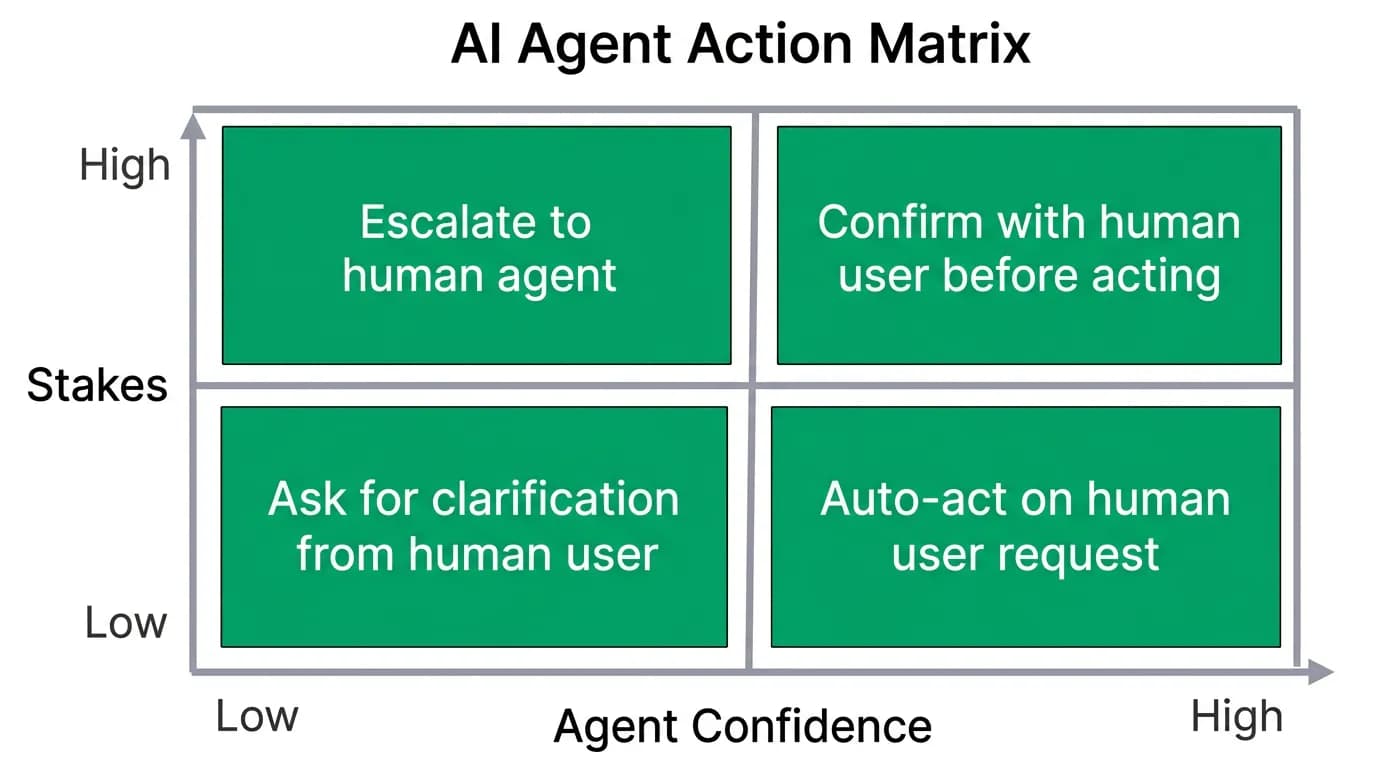
We map every agent action along two axes: stakes and confidence.
Stakes measures the cost of getting it wrong. A wrong search query costs the user a few seconds. A wrong booking costs hundreds of dollars. A wrong cancellation might be irreversible. Stakes range from trivial (filtering results) to severe (financial transactions).
Confidence measures how certain the agent is about what the user wants. If the user explicitly said "book option B," confidence is high. If the agent is inferring intent from ambiguous language, confidence is low.
These two axes create four quadrants:
Low stakes, high confidence: auto-execute. The agent acts without asking. Searching for flights. Applying known preferences. Checking availability. These actions add value and their downside is negligible. Confirming them would just slow things down.
Low stakes, low confidence: ask for clarification. The agent is unsure what the user wants, but getting it wrong is not costly. "Did you mean San Jose, California or San Jose, Costa Rica?" The agent asks because clarity is cheap and assumptions might waste time.
High stakes, high confidence: confirm before acting. The agent is fairly sure what the user wants, but the action is irreversible. Booking a $600 flight. Canceling a reservation. The agent presents the full details and waits for explicit approval. Even when confidence is high, the cost of being wrong on a financial transaction demands confirmation.
High stakes, low confidence: escalate. The agent does not have enough information to act and the consequences of guessing are severe. Unusual routing requests. Ambiguous passenger information. Policy edge cases. The agent flags these and asks for guidance rather than attempting to figure it out.
The cost of over-asking
Most AI products err on the side of over-asking. This feels safe from an engineering perspective but it creates a real UX cost.
Decision fatigue is well-documented in psychology. Every confirmation prompt depletes the user's decision-making capacity. An agent that asks "should I search now?" then "should I filter by direct flights?" then "should I apply your preferred airline?" then "should I rank by your preferences?" has turned what should be a 30-second automated sequence into a four-step approval chain.
Ninety-five percent of trips can be handled by AI without human escalation. That means for the vast majority of interactions, the agent has the information and capability to act. Excessive confirmation makes the agent feel incompetent even when it is not.
We track the ratio of agent actions to user confirmations. A good conversation has the agent performing many actions autonomously (searching, filtering, ranking) with only one or two confirmation points (booking, payment). If the user is confirming more than 20% of agent actions, we consider the autonomy calibration too conservative.
The booking bright line
Today, every financial transaction at Nowah requires explicit user confirmation. No exceptions. The agent will never charge your card without showing you exactly what it is booking, at what price, for which travelers, on which dates.
This is our bright line. We believe it is the right line for 2026.
The reasoning is straightforward. Trust in AI recommendations sits at roughly 30% without transparency mechanisms. Even with our transparency features (showing reasoning, citing sources, giving users control), trust reaches about 65%. That means roughly a third of users are not fully confident in the agent's recommendations. Autonomous purchasing would alienate them.
Three percent of flights experience significant disruptions daily. In disruption scenarios, speed of rebooking directly determines outcome. Alternatives sell out quickly. An agent that detects a cancellation and rebooks you in 2 minutes gets a better result than one that waits 90 minutes for you to notice and call a helpline.
This creates a tension: the one scenario where autonomous action is most valuable (disruption rebooking) is also the one where stakes are highest. We are building toward a model where users can opt in to autonomous rebooking for disruptions, with guardrails (price limits, preference constraints, notification requirements). But this is opt-in, not default.
Progressive autonomy
The framework is not static. An agent should earn more latitude as it demonstrates competence with a specific user.
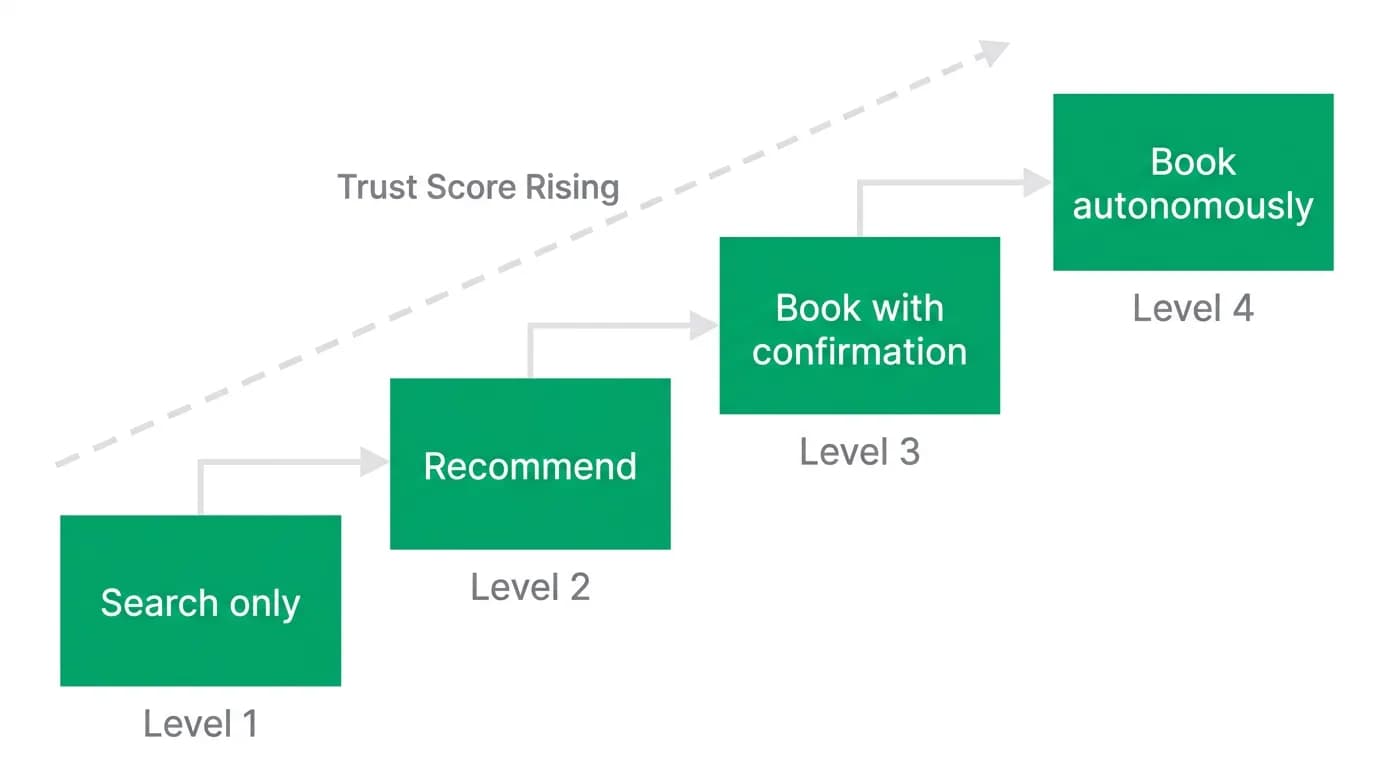
We think about this as a trust ladder with four levels.
Level 1: Search only. The agent searches and presents. The user makes all decisions. This is the starting point for new users.
Level 2: Recommend. The agent searches, ranks, and recommends a specific option with explanation. The user still decides, but the agent has an opinion.
Level 3: Book with confirmation. The agent handles the entire flow and presents a booking ready to confirm. One tap to approve. This is where most active users operate today.
Level 4: Autonomous action. The agent books, rebooks, and manages without explicit approval for routine actions. This is the future state, available only to users who have opted in after sufficient interaction history.
The progression through these levels is not time-based. It is competence-based. If the agent's recommendations are consistently accepted, it earns more latitude. If a recommendation is rejected, the agent recalibrates. The system tracks confirmation accept rate as a trust proxy: users who accept 90%+ of recommendations have high trust. Users who frequently modify or reject recommendations need more confirmation.
Practical examples
Here is how this plays out in real conversations.
User says: "I need to fly to London next week." Agent action: immediately searches flights for next week. No confirmation needed. Low stakes, high confidence. The user clearly wants a search.
User says: "Hmm, maybe [somewhere warm](/blog/ai-handles-somewhere-warm-cheap) instead." Agent action: asks clarifying question. "Are you thinking beach destinations? Any region preference?" The user changed direction and the agent is not confident enough to guess. Low stakes, but clarification is free.
User says: "Book option B." Agent action: presents booking summary with price, dates, passenger info, fare rules. Waits for explicit "confirm." High stakes, high confidence. The user stated clear intent, but the agent shows its work before executing.
User says: "Handle it however you think is best." Agent action: this is where it gets interesting. The user is expressing trust. But the agent still confirms the specific booking. Blanket delegation does not override the booking bright line. The agent might say "I recommend option B for $520, direct morning flight. Here are the details. Shall I book?"
The goal is an agent that does maximum work with minimum interruption while never making an irreversible decision without consent. That is a hard line to walk. We are still refining it. But the framework of stakes and confidence gives us a principled way to make these decisions rather than guessing.
Nowah is an AI travel agent that searches and books real flights and hotels through conversation — no filters, no thirty open tabs. Plan your next trip.