How AI Collapses the Travel Search Funnel
50 sessions across 30 days to book one trip. AI compresses that entire funnel into a single conversation. Here is how.
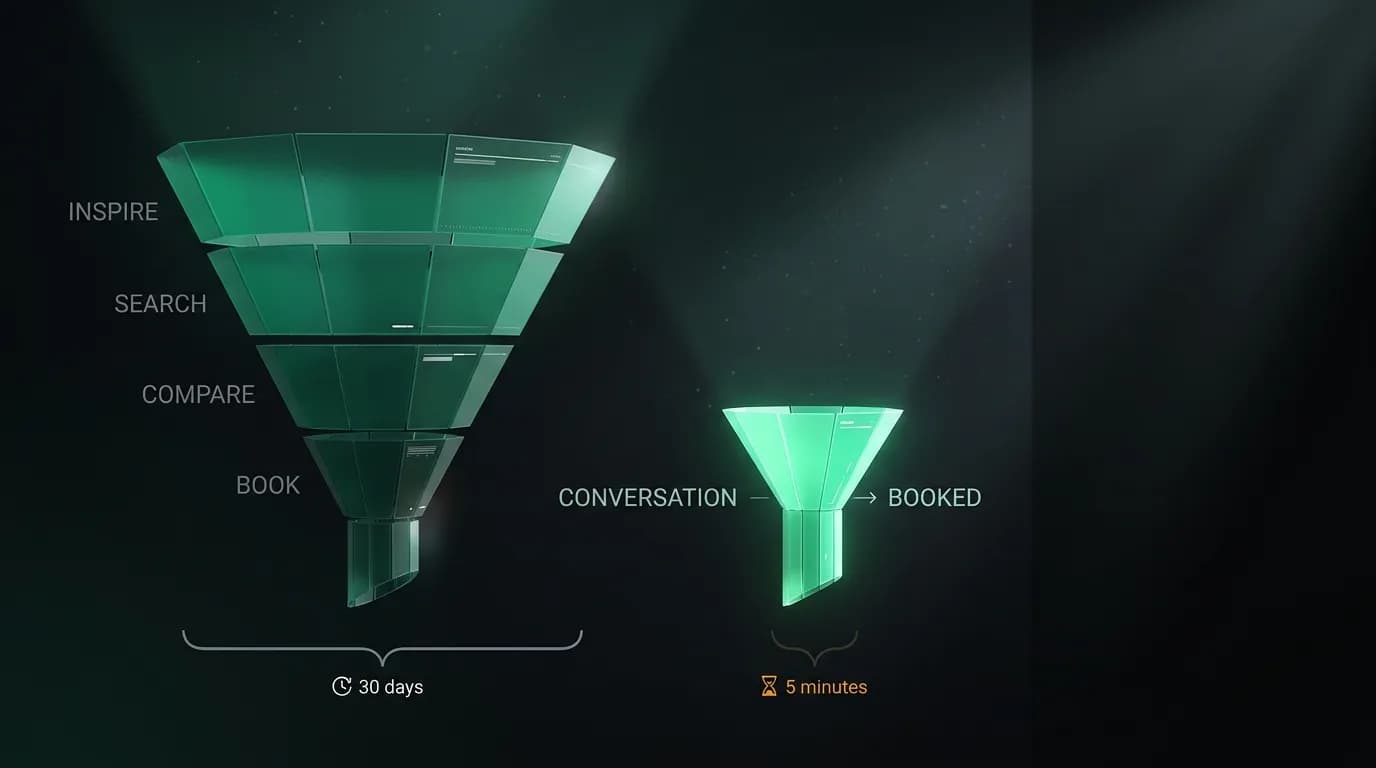
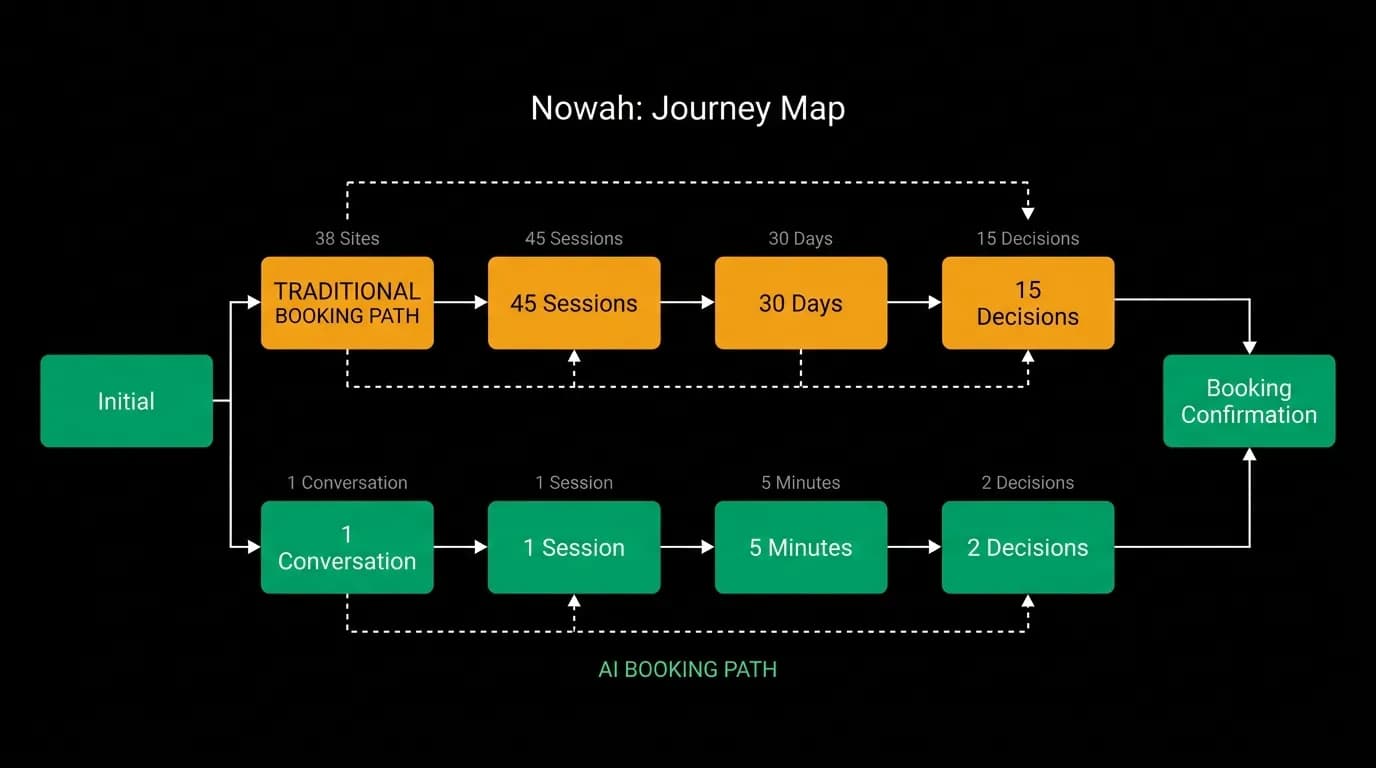
The traditional travel booking funnel looks like this: a person gets inspired to travel, spends days or weeks researching destinations, compares options across dozens of platforms, narrows their choices, and eventually books. The entire process takes many websites, 45 sessions, and 30 or more days.
The AI travel booking funnel looks like this: a person tells an agent where they want to go, the agent finds and ranks options, the person confirms, the booking happens. One conversation. A few minutes.
That compression is not a minor efficiency gain. It is a structural transformation of how travel is purchased. And it has implications that go well beyond user experience.
The old funnel
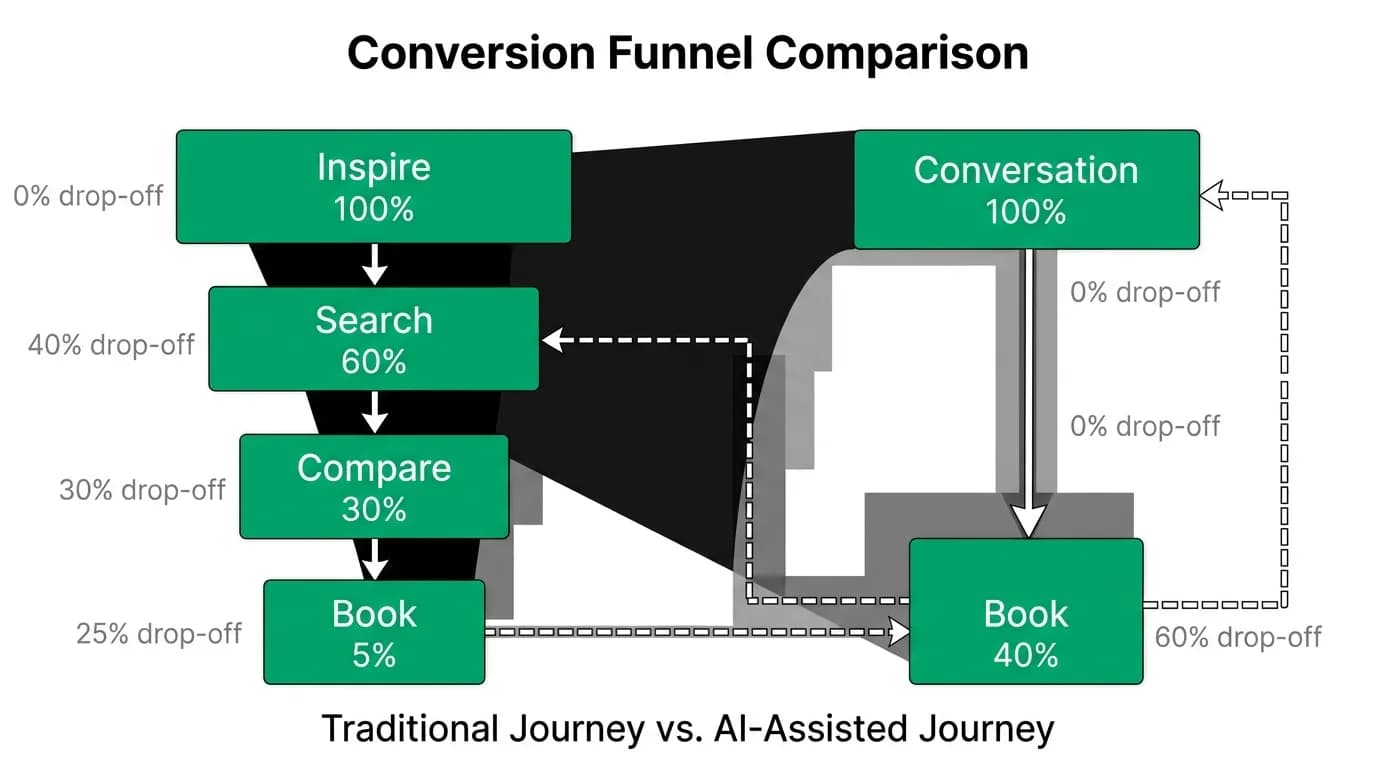
The traditional travel purchase funnel has four stages, each with massive drop-off.
Inspire (100% enter). The traveler gets the idea. Maybe they saw a friend's Instagram post from Bali. Maybe they have a week off in April. The interest exists but the intent is unformed.
Search (60% continue). They start researching. Google "best beaches in Southeast Asia." Browse destination guides. Check flight prices casually. Many people stall here because the volume of information is overwhelming. About 40% of inspired travelers never make it past casual browsing.
Compare (30% continue). The committed ones start comparing specific options. They check prices across platforms, read hotel reviews, evaluate flight schedules. This is where the 38-website phenomenon lives. It is exhausting. Roughly half of searchers drop off during comparison, either postponing the decision or deciding the trip is too much effort.
Book (few convert). The survivors complete a booking. OTA conversion rates have been stuck in the low single digits for over a decade. That means 95-98% of people who enter the funnel do not come out the other end with a reservation.
Those numbers should alarm anyone in the travel industry. The funnel is not narrowing because people do not want to travel. It is narrowing because the process of buying travel is too painful.
Why the funnel exists
The funnel exists because traditional search interfaces create an information problem.
At the inspire stage, the traveler has vague intent but no structured parameters. Traditional search requires structured input (origin, destination, dates, travelers). The mismatch between unstructured intent and structured search means the traveler has to do mental work to formulate a query. Many give up.
At the search stage, the platform returns hundreds of options. The traveler has to evaluate them using limited filters. The cognitive load is high. The research spans multiple sessions because no single session is productive enough to reach a decision.
At the compare stage, the traveler is cross-referencing across platforms. Each platform shows slightly different information. Prices change between sessions. The traveler is doing manual work that a computer should handle.
At the book stage, the traveler commits despite persistent uncertainty. Did they find the best option? Should they have waited for a better price? The 40% post-booking regret rate suggests many travelers commit without full confidence.
The AI compression
An AI agent compresses the funnel because it addresses the root cause of each stage's drop-off.
Inspire and search merge. The traveler says "I want to go somewhere warm in April." No structured parameters needed. The agent processes vague intent, suggests destinations, and searches simultaneously. There is no gap between inspiration and search. They happen in the same conversation turn.
Compare is automated. The agent searches, ranks, and compares on behalf of the user. The traveler does not visit many websites. The agent visits the equivalent of 38 data sources and presents 3 curated options with explanations. The comparison is done. The traveler evaluates a short list, not a haystack.
Book follows naturally. When the traveler is ready, booking happens within the same conversation. No navigating to a separate checkout flow. No re-entering information. "Book option B" and the agent handles the rest.
The traditional funnel: 30 days, 45 sessions, 15-20 decisions, low conversion. The AI funnel: 1 conversation, 1 session, 1-2 decisions, dramatically higher conversion.
How memory eliminates research
The compression is even more dramatic for returning users.
A first-time user still needs to communicate their preferences, budget, and constraints. This takes a few conversational turns. It is still faster than traditional search, but the agent is learning about a new person.
A returning user with 5+ trips in their history barely needs to research at all. The agent already knows their preferences, budget range, travel patterns, and past experiences. The conversation might be:
User: "I need a trip in April, probably Asia." Agent: "Based on your past trips, I think you'd love Kyoto during cherry blossom season. Last year you mentioned wanting to see it. Flights from SFO are running $580 round trip right now, which is below your usual range. Want me to find options?"
The research phase that takes traditional travelers 30 days takes the AI agent one conversational turn. The memory system has already done the research over the course of previous trips.
AI-native platforms report customer acquisition costs 3 to 5 times lower than traditional OTAs. This is partly because the compressed funnel means less marketing spend per conversion. But it is mostly because returning users convert at dramatically higher rates. Memory creates a flywheel: better personalization leads to faster conversions leads to more data leads to better personalization.
Measuring the new funnel
The traditional funnel is measured in sessions, page views, and conversion rate. These metrics do not apply to a conversational booking model.
We measure:
Turns to booking. The number of conversational turns from first message to confirmed reservation. Lower is better, within reason.
Intent-to-booking rate. The percentage of conversations where a user expresses travel intent that end with a confirmed booking. This is the equivalent of conversion rate.
Time to booking. Wall-clock minutes from first message to confirmation. AI conversational booking averages 3-5 minutes versus 45-90 minutes traditional.
Return rate. What percentage of users come back for their next trip? This measures whether the compressed funnel delivers satisfaction, not just speed.
What this means for the industry
The funnel collapse has consequences beyond user experience.
Marketing spend shifts. Traditional travel marketing is designed to capture travelers at each funnel stage: SEO for the inspire phase, paid search for the search phase, retargeting for the compare phase. If the funnel compresses to a single conversation, much of this spend becomes irrelevant. The marketing challenge shifts from "capture attention at every stage" to "get the user into the first conversation."
Metasearch dies. The entire metasearch category (platforms that compare prices across OTAs) exists because travelers need help at the compare stage. When an AI agent handles comparison automatically, metasearch loses its reason to exist.
[Content marketing](/blog/content-marketing-travel-ai-seo-strategy) changes. Destination guides, hotel reviews, and "best time to visit" articles are research tools for the search phase. When the agent has this knowledge built in, the role of travel content shifts from decision support to inspiration.
Loyalty economics change. Traditional loyalty programs keep users returning to a specific platform for the search-and-compare phase. AI agents create loyalty through personalization and memory, which is a fundamentally different retention mechanism.
The travel search funnel as we know it is a product of the search-and-filter interface paradigm. When the interface changes to conversation, the funnel changes with it. The best travel app is the one that makes the funnel so short that the traveler barely notices it exists.
Nowah is an AI travel agent that searches and books real flights and hotels through conversation — no filters, no thirty open tabs. Plan your next trip.