How AI Is Making Luxury Travel More Accessible
Luxury travel planning used to require a $500/hour advisor. AI agents democratize expert-level trip curation, making luxury-quality planning free for everyone.

A high-end travel advisor charges $200 to $500 per hour. A full bespoke trip — flights, hotels, dining reservations, private transfers, curated experiences — runs $2,000 to $5,000 in planning fees alone, before a single flight is booked. For that investment, you get someone who knows the best suite at the Aman Tokyo, which table to request at a Michelin three-star, and exactly when to visit Angkor Wat to avoid the crowds.
After three trips together, that advisor knows your preferences by heart. Your preferred room temperature. Your wine region obsession. Your hatred of poolside noise. The relationship compounds and the recommendations get better.
An AI agent learns most of those preferences in a single conversation. It accesses the same inventory. It processes the same property details. And it is available to everyone, not just the traveler who can afford $5,000 in planning fees.
This is the most significant democratization event in luxury travel since the internet made pricing transparent. Expert-level trip curation, which was the exclusive privilege of the wealthy for a century, is becoming universally accessible.
The luxury planning barrier
Luxury travel has never been just about spending more money. The difference between a good luxury trip and a great one is knowledge — knowing which properties actually deliver on their promise, which experiences are worth the premium, and which seemingly expensive options are actually the best value.
This knowledge was locked behind a paywall. High-end travel advisors accumulated it over years of property visits, client feedback, and industry relationships. Their clients paid handsomely for access to that accumulated expertise.
The result: two classes of luxury travelers. Those who could afford advisors got expertly curated trips with hidden gems, insider access, and seamless logistics. Those who could not afford advisors got the same search results everyone else got — filtered by price and star rating, with no curation, no insider knowledge, and no personalization.
The luxury travel market is $1.5 trillion globally, growing at 7 percent annually. But the number of high-end travel advisors worldwide is roughly 50,000 to 100,000. Each manages 50 to 100 clients. The math does not work. There are far more people who want and can afford luxury experiences than there are advisors to plan them.
What luxury advisors actually do
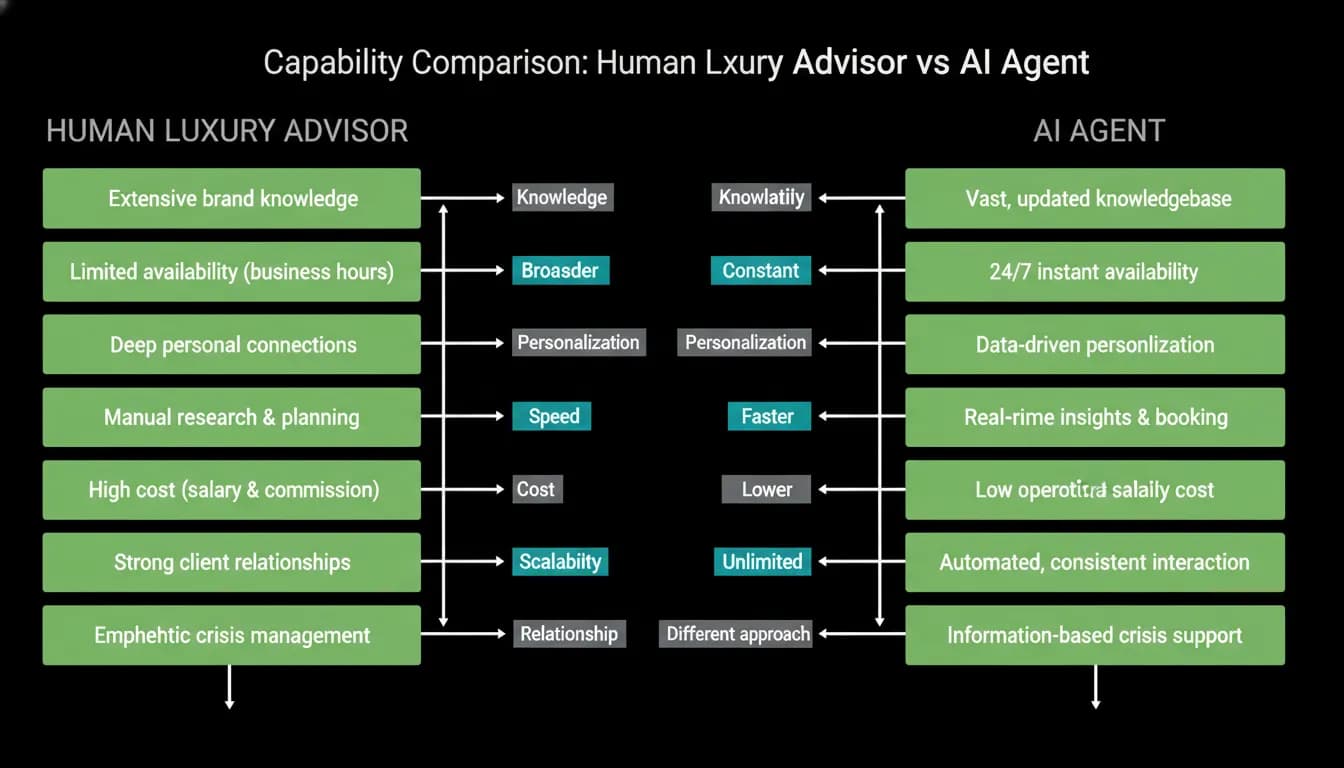
To understand how AI replicates the value of a luxury advisor, you need to understand what advisors actually do. It is not just booking expensive hotels.
Property expertise. A great advisor has visited hundreds of properties and knows the difference between the hotel's marketing and the actual experience. Room 412 has a better view than Room 415 even though they are the same category. The restaurant's tasting menu is better than the a la carte. The spa is worth it but the pool area is crowded after 2 PM. This granular knowledge comes from experience and feedback.
Preference matching. Luxury is deeply personal. One traveler's dream hotel is another's nightmare. The advisor maps your specific preferences — aesthetic, service style, noise tolerance, dining priorities, activity level — to properties that match. This is a high-dimensional matching problem that advisors solve through intuition and experience.
Experience curation. The best luxury trips are not about the hotel room. They are about the moments: a private dinner in a vineyard, a helicopter tour at sunrise, a cooking class with a local chef in their home. Advisors know these experiences exist because they have networks and relationships.
Logistics orchestration. Luxury travel involves complex logistics: private transfers, restaurant reservations timed to jet lag recovery, activities sequenced to minimize travel time, contingency plans for weather. The advisor handles all of this invisibly.
AI agents replicate roughly 90 percent of these functions. They process property data, reviews, and traveler feedback at a scale no human can match. They perform preference matching computationally, evaluating thousands of properties against your specific criteria. They access experience databases and curate based on your interests. They optimize logistics mathematically.
Democratized curation
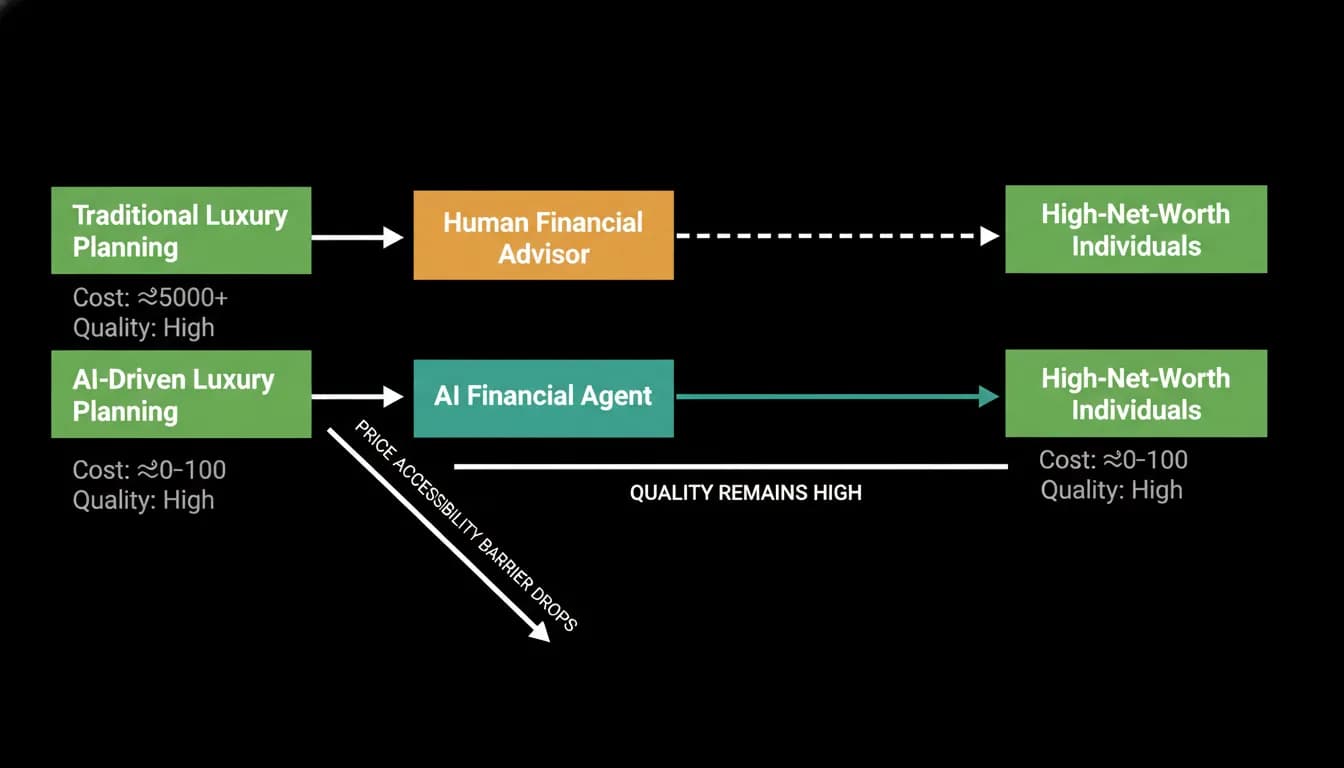
The practical impact is that a traveler with a $3,000 hotel budget now gets the same quality of recommendation as a traveler with a $30,000 budget working with a top advisor.
Tell an AI agent: "I want a boutique hotel in Kyoto during cherry blossom season. Maximum 30 rooms. Walking distance to temples. Onsen on-site. Quiet neighborhood. Traditional Japanese aesthetic but modern comfort."
That query contains seven specific constraints. An OTA search form gives you: location, dates, and price. Maybe star rating. The seven-constraint query is impossible to execute on a traditional platform. You would need to search, click into dozens of properties, read reviews, check maps, and manually evaluate each one.
The AI agent evaluates every available property against all seven constraints simultaneously and presents the three to five best matches with explanations for why each was selected. This is the service a luxury advisor provides. The AI delivers it in 30 seconds.
Seventy-eight percent of luxury travelers say personalization is more important than price. The AI agent delivers hyper-personalization as a default, not as a premium service.
Where human advisors still lead
Honesty requires acknowledging that AI does not yet replicate everything a great human advisor provides.
Crisis management with empathy. When things go seriously wrong — a medical emergency abroad, a natural disaster, a political crisis — the best human advisors are extraordinary. They make phone calls, pull strings, and solve problems with a personal touch that current AI cannot match. The emotional support component of crisis management remains distinctly human.
Relationship depth. A human advisor who has planned your trips for a decade knows things that are hard to articulate in a preference profile. They remember that your anniversary trip to Amalfi was life-changing and that you mentioned wanting to return. They sense when you are stressed and need a low-key trip versus when you are celebrating and want extravagance.
Ultra-bespoke arrangements. The dinner on a private island. The after-hours museum tour. The meeting with a local artisan. These require human relationships, negotiation, and sometimes favors called in. AI cannot yet replicate the personal network of a well-connected luxury advisor.
The closing gap
The remaining 10 percent gap is narrowing. AI memory systems improve the relationship depth with every interaction. Natural language processing gets better at detecting emotional context. And the network of bookable luxury experiences expands as more providers digitize their inventory.
The trajectory is clear: within three to five years, AI agents will handle 95 percent or more of what luxury advisors do, at a fraction of the cost, available to anyone. The top 5 percent — the ultra-bespoke, relationship-driven, crisis-management layer — will remain human for longer. But that means 95 percent of luxury travel planning, which was previously reserved for those who could afford $500 per hour, becomes universally accessible.
High-end advisors will not disappear. They will evolve, focusing on the highest-touch, highest-value segments where human relationships are irreplaceable. But the vast middle of luxury travel — the $500 to $2,000 per night segment that represents the bulk of the market — will be planned primarily by AI agents within the decade.
Describe your dream luxury trip to an AI agent. Be specific. Be demanding. See what comes back. The quality of the recommendation will likely surprise you — and it will cost you nothing.
Nowah is an AI travel agent that searches and books real flights and hotels through conversation — no filters, no thirty open tabs. Plan your next trip.