AI Travel Agents — Market Map 2026
AI-native startups, incumbent features, consumer vs enterprise, end-to-end vs point solutions. The comprehensive landscape of who is building what.

The AI travel market in 2026 is messy, fast-moving, and harder to map than it looks. Dozens of startups have launched AI travel products. Every major incumbent has added AI features. The boundaries between categories are blurry. And the market is still early enough that the eventual winners are far from determined.
I am going to attempt a comprehensive mapping of the landscape, not as a neutral observer but as someone building in this space who has opinions about which approaches will win and which will not.
The landscape overview
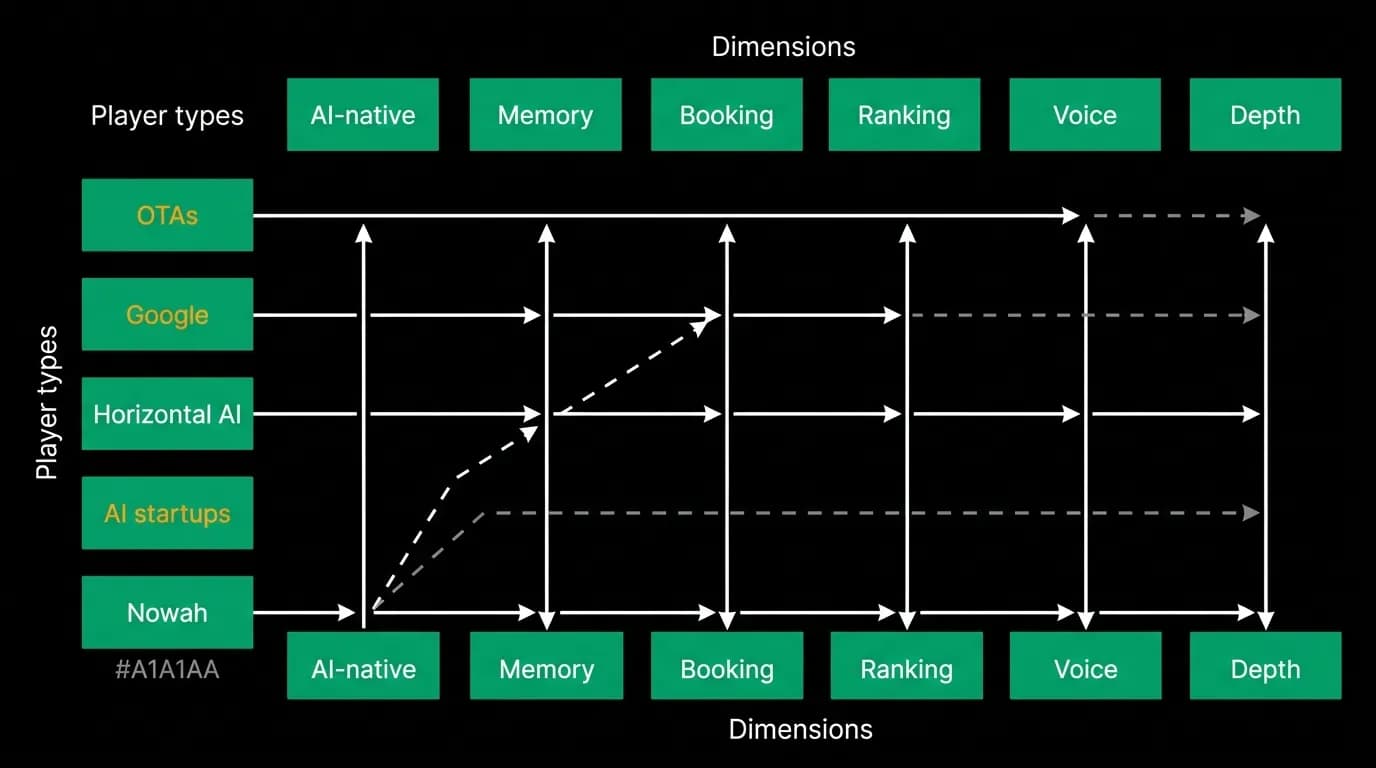
The AI travel market can be categorized along two axes:
AI-native vs. AI-augmented. AI-native companies built their product around AI from scratch. The AI is the product. Remove it and nothing works. AI-augmented companies added AI features to an existing product. The AI is a layer. Remove it and the product still functions, just less conveniently.
Consumer vs. enterprise. Consumer products serve individual travelers booking leisure and personal trips. Enterprise products serve corporate travel departments managing employee travel, policy compliance, and expense management.
These two axes create four quadrants, and each quadrant has different dynamics, different economics, and different winners.
AI-native startups
The most interesting quadrant is AI-native consumer. These are the companies building travel booking products from scratch around conversational AI. There are roughly a dozen serious players in this space as of early 2026.
The common characteristics of AI-native startups:
- Conversation-first interface (no traditional search form)
- Persistent memory and personalization
- End-to-end booking within the conversation
- Direct API access to travel inventory
- Mobile-first design
The differentiation is in execution quality. How good is the ranking? How deep is the personalization? How complete is the booking flow? How well does the agent handle complex multi-city trips? How gracefully does it recover from errors?
Consumer willingness to use AI for travel has risen from roughly 25% to roughly 55% in two years. The market demand is real and growing. The question is which AI-native startup captures the largest share.
I think the winners will be the ones that solve the full lifecycle, not just search or just itinerary generation, but search, ranking, booking, payment, management, and support. Point solutions will struggle because travel is inherently a multi-step process and users do not want to switch products mid-trip.
Incumbent AI features
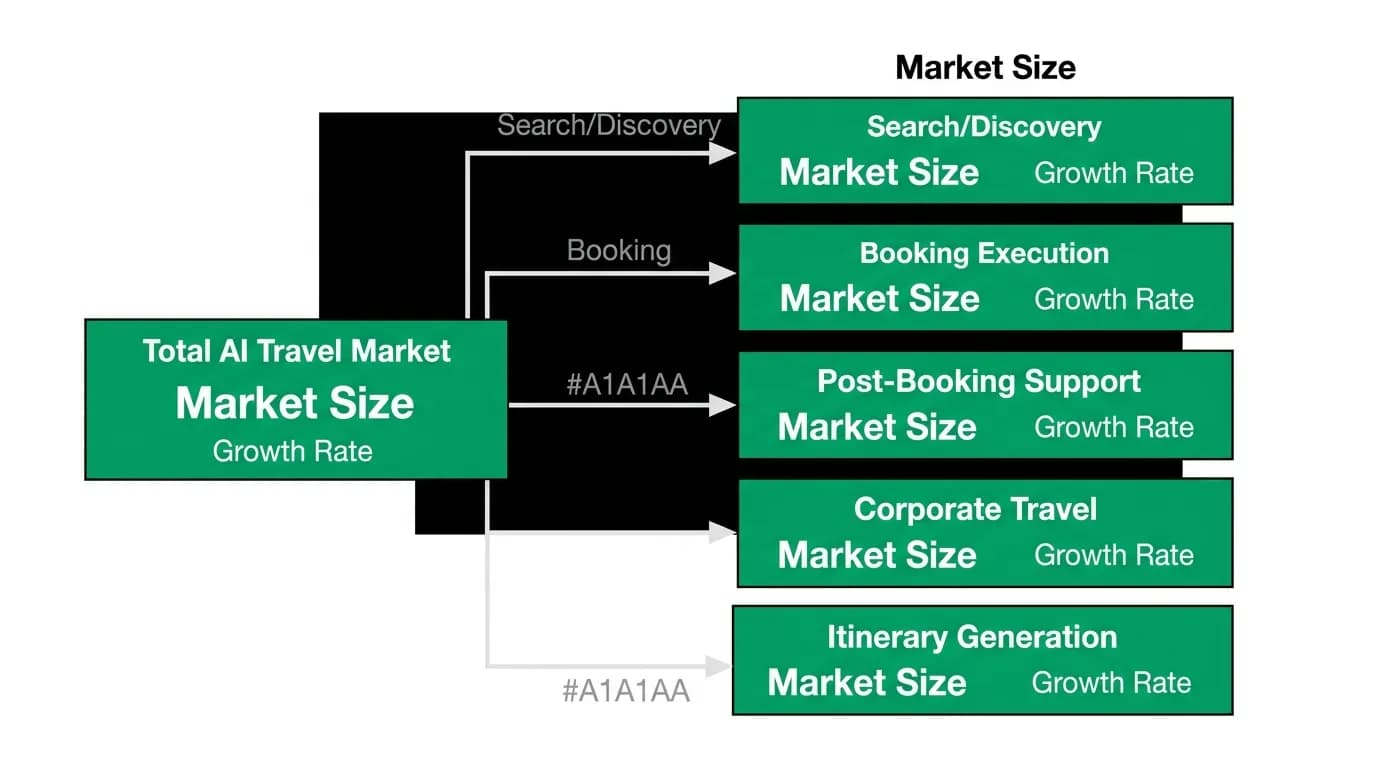
Every major travel company has shipped AI features. The large OTAs have chatbot assistants. Airlines have AI-powered customer service. Hotels have AI-driven pricing and recommendation engines.
The quality varies enormously. Some are genuinely useful, like AI-powered price prediction or smart rebooking during disruptions. Others are thinly-veiled search interfaces with a chatbot skin. The user types a question, the chatbot extracts the search parameters, and the same old results page appears.
The structural limitation for incumbents is that they are adding AI to products designed around browse-and-compare. The AI is a feature, not the architecture. This limits what it can do. The chatbot can help you search, but the booking still happens through the traditional multi-page flow. The AI can answer questions, but it cannot act autonomously on your behalf.
Some incumbents will successfully transition to AI-first products. Most will not. The ones that succeed will be those willing to cannibalize their existing product to build something fundamentally different.
Consumer vs. enterprise
Consumer and enterprise travel have different AI requirements.
Consumer travel is high-ambiguity, high-emotion. Users often do not know exactly what they want. They explore. They change their mind. They need inspiration and guidance. The AI agent needs to handle vague requests, offer creative suggestions, and manage an unpredictable conversation.
Enterprise travel is low-ambiguity, high-structure. Employees usually know where they need to go and when. The AI agent needs to enforce travel policies, route approvals, optimize preferred vendor usage, and generate expense reports. The conversation is more procedural but the integration requirements are more complex.
These different requirements produce different product architectures. Consumer agents prioritize personality, creativity, and flexibility. Enterprise agents prioritize compliance, integration, and auditability.
The market sizes are both large. Consumer leisure travel is the larger market by volume. Enterprise travel has higher willingness to pay per user and longer contract cycles. Both are underserved by current AI products.
End-to-end vs. point solutions
Most AI travel startups focus on a single vertical within the travel lifecycle:
- Itinerary generation: AI creates a trip plan from a prompt. Does not book anything.
- Flight search: AI-powered flight comparison. Does not handle hotels or activities.
- Customer support: AI handles post-booking issues. Does not help with planning.
- Price tracking: AI monitors prices and alerts on drops. Does not handle booking.
Each of these is a real product with real users. But none of them captures the full value of an AI travel agent. A user who plans their trip with one product, searches flights with another, books through a third, and manages changes with a fourth is barely better off than the 38-website problem that AI was supposed to solve.
The few companies building end-to-end solutions (search to booking to management) face higher technical complexity but capture more value per user and create stronger retention through memory and personalization.
Geographic and regulatory factors
AI travel is not a monolithic global market. Geography shapes the landscape in several ways.
Payment infrastructure. North American and European markets have standardized card payment infrastructure. Southeast Asian markets rely on different payment rails. The AI agent needs to support the local payment ecosystem.
Regulatory environment. The EU has more aggressive consumer protection and data privacy regulation than other regions. AI travel agents operating in Europe need GDPR-compliant memory systems, transparent recommendation disclosure, and clear liability frameworks.
Supplier landscape. Different regions have different airline and hotel ecosystems. A product optimized for US domestic travel is not automatically useful for Southeast Asian travel, where low-cost carriers, different booking conventions, and different hotel categories dominate.
The AI in travel market is expected to reach $80+ billion by 2028 at roughly 30% CAGR. But that number hides regional variation. Growth rates in Asia-Pacific and Latin America are higher than in mature Western markets.
Where the market is heading
My predictions for the next 2-3 years:
Consolidation among AI-native startups. There are too many players and not enough differentiation. Expect acquisitions and failures to reduce the field. The survivors will be the ones with the best agent quality, the deepest memory systems, and the most complete booking capabilities.
Incumbents will acquire, not build. Building an AI-native travel product from scratch while maintaining a legacy product is nearly impossible organizationally. The smart incumbents will acquire AI-native startups and migrate their user base.
Enterprise AI travel will explode. The enterprise market is currently underserved and the ROI for corporate travel AI is straightforward: lower costs, faster bookings, better compliance. Expect several enterprise-focused startups to emerge and grow quickly.
End-to-end wins over point solutions. Users do not want to assemble a travel tech stack from multiple products. The companies that cover the full lifecycle will capture disproportionate market share.
The market map in 2026 is crowded and confusing. The market map in 2029 will be clearer: a few dominant AI-native platforms, a handful of incumbents that successfully transitioned, and a long tail of niche products serving specific segments.
Nowah is an AI travel agent that searches and books real flights and hotels through conversation — no filters, no thirty open tabs. Plan your next trip.