The Anatomy of an AI Travel Query: From Prompt to Boarding Pass
A step-by-step walkthrough of every infrastructure system involved when a traveler says 'Book me a flight' — from auth to confirmation email.
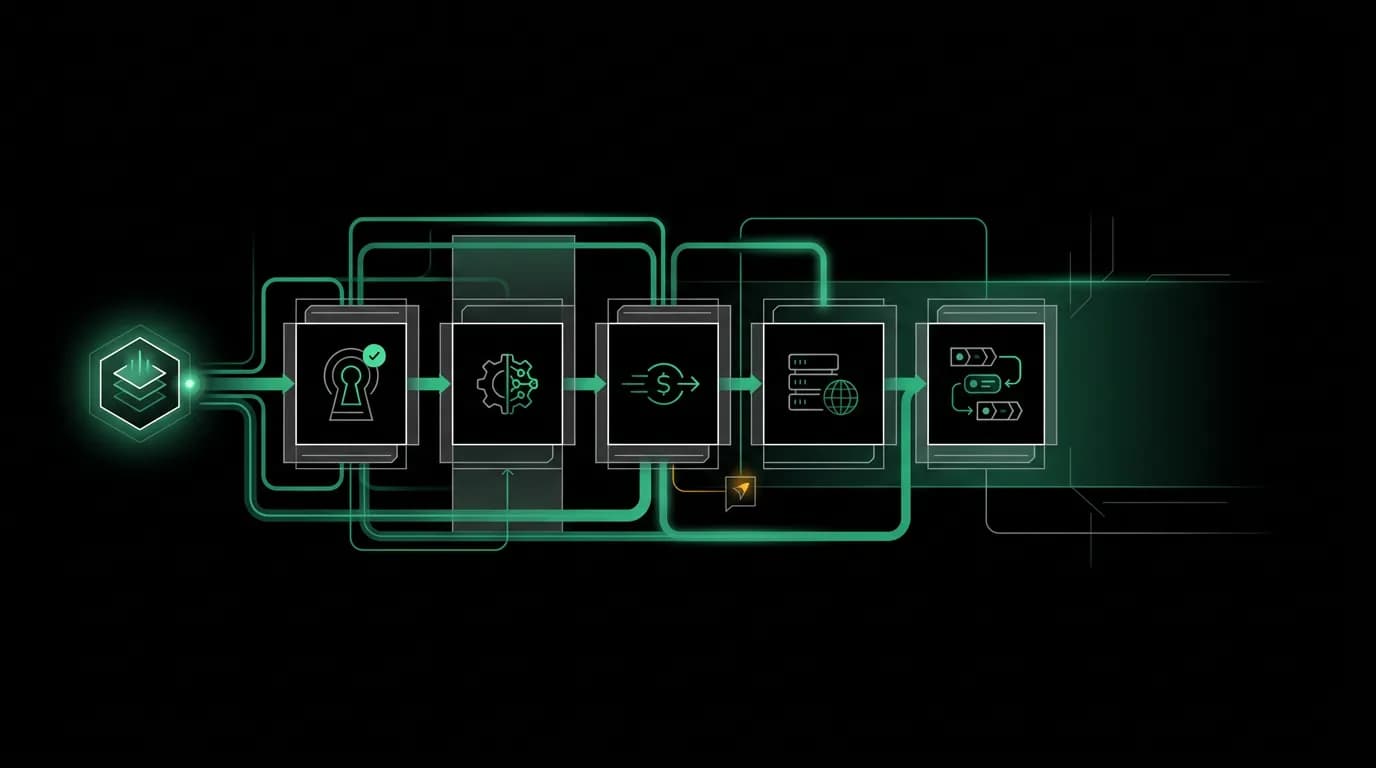
"Book me a flight to Tokyo next Thursday."
Seven words. One sentence. It sounds simple. But between the moment that message leaves the traveler's phone and the moment a confirmation email lands in their inbox, that sentence touches every system we've built. Authentication. Rate limiting. AI reasoning. Live inventory search. Fare comparison. Payment processing. Booking confirmation. Email delivery. Push notifications. Document generation. Trip synchronization.
I want to walk through all of it. Not at a hand-wavy architecture diagram level, but at the "here's what actually happens and in what order" level.
Second 0: the message leaves the client
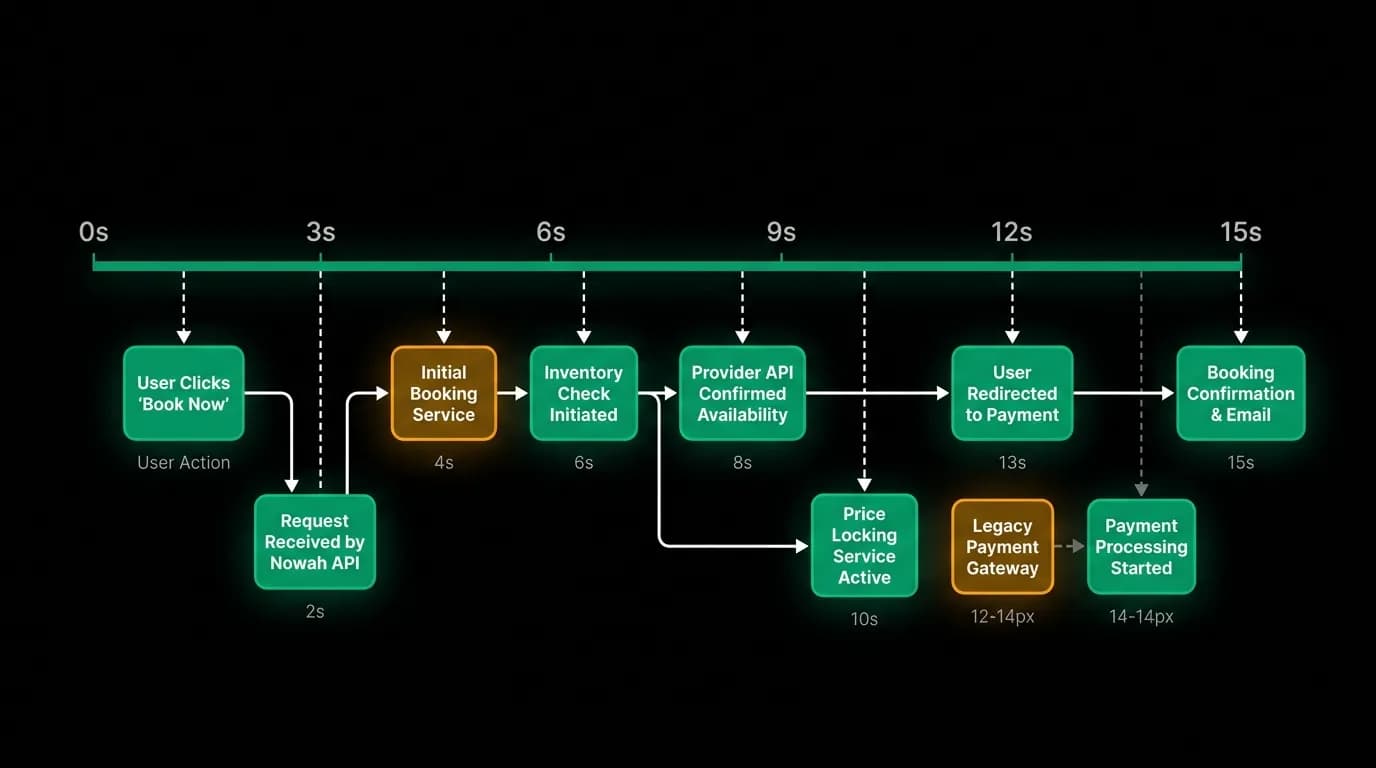
The traveler taps send. The mobile app takes the message text and prepares an HTTP request. Before it goes anywhere, the API client attaches two things: a signed session tokens token from the auth session (proving who this person is) and a cross-site request forgery token (proving this request came from our app, not a malicious third party).
The request hits our API. The first layer is rate limiting. We allow 30 messages per minute per user for the chat endpoint. This limit exists because every message triggers AI inference, which costs real money. A runaway client or a bad actor spamming messages could rack up significant costs. The rate limiter checks the user's recent message count, confirms they're within budget, and passes the request through.
Next is authentication middleware. The signed session tokens token gets verified. We extract the user ID, check that the token hasn't expired, and confirm the user's account is in good standing. This happens on every request, but it's fast because signed session tokens verification is a local cryptographic operation. No database call required.
Seconds 0-1: the AI agent receives the query
The request reaches the agent endpoint. This is where the AI agent takes over.
The agent doesn't just see "Book me a flight to Tokyo next Thursday." It sees that message in context. The agentic memory system provides the traveler's profile: preferred airlines, seat preferences, home airport, passport details, past trip history. If this conversation has prior messages, the agent has that context too. "Next Thursday" gets resolved to an actual date based on the current date. "Tokyo" gets disambiguated (Narita or Haneda? The agent checks the traveler's history or asks if it's ambiguous).
The agent then enters its reasoning loop. It determines that this is a booking request, which means it needs to search for flights, present options, and eventually process a booking. The reasoning step takes a fraction of a second because the intent is clear.
Seconds 1-5: tool calls and live search
This is where the agent starts calling tools. Our agent has access to a comprehensive suite of tools, and a booking query typically triggers three to eight of them.
First, it calls the flight search tool. This reaches out to our travel data provider's API with the parsed parameters: origin airport, destination airport, date, passenger count, cabin class preference. The search returns live inventory with real-time pricing. This API call typically takes one to three seconds, which is the slowest part of the process and entirely outside our control.
While waiting for results, the agent has already started streaming. The traveler sees a status message: "Searching for flights to Tokyo..." This streams over server streaming to the client, so the traveler knows something is happening.
When results come back, the agent might call additional tools. It might check seat availability on the top options. It might look up airport information to provide context about layovers. It might check the traveler's calendar for conflicts if they've connected it.
Each tool call is instrumented. We track which tools were called, how long each took, and whether they succeeded. This data feeds our monitoring dashboards and helps us identify when external APIs are degrading.
Seconds 3-8: streaming the response
As the agent reasons through the results, it starts generating its response. This streams to the traveler in real time over server streaming.
First come status events as the agent works through the data. Then content tokens start streaming as the agent composes its natural language response. Mid-stream, structured tool result events deliver the flight offers as typed JSON payloads. The client renders these as interactive flight cards inline in the conversation.
The traveler sees something like: "I found several great options for Tokyo next Thursday. Here are the best flights:" followed by a set of flight cards showing departure times, airlines, prices, and stop counts. Below the cards, the agent continues with its analysis: "The 10:15 AM direct flight is the best value. It arrives at 2:30 PM local time, giving you the whole evening..."
All of this appears progressively. The traveler can start looking at flight cards while the agent is still composing its analysis text.
The traveler says "book the direct one"
Now the booking flow begins. This is where things get serious because money is about to change hands.
The agent identifies which flight the traveler selected. It confirms the details: "I'll book the direct flight on March 20th, departing at 10:15 AM, arriving at 2:30 PM Tokyo time. The fare is $847. Should I proceed?"
The traveler confirms. The agent initiates the booking.
Seconds 0-3 of booking: payment intent
The booking endpoint receives the request with the selected offer, traveler details, and a client-generated attempt id. This attempt ID is the first layer of idempotency. If the request gets retried due to a network hiccup, the same attempt ID ensures we don't create duplicate bookings.
A payment intent gets created with the fare amount. This is a pre-authorization, not a charge. The payment processor validates the traveler's saved payment method and holds the amount. If 3D Secure verification is required, the client handles that challenge and returns the confirmed intent.
The payment intent includes an idempotency key at the payment processor level. This is the second layer of idempotency. Even if our system sends the same intent creation request twice, the processor returns the same intent rather than creating a new one.
Seconds 3-5 of booking: travel data provider confirmation
With payment authorized, we confirm the booking with the travel data provider. This is the moment where a seat actually gets reserved. The provider returns a booking reference, PNR, and confirmed itinerary details.
This confirmation call includes deduplication at the provider level. Same offer ID, same passenger details? Same booking. That's the third layer of idempotency.
If the provider confirmation fails (fare expired, seat no longer available), we void the payment authorization and tell the traveler. No charge. The agent suggests alternatives.
If it succeeds, we capture the payment (convert the authorization into an actual charge) and record the booking in our database.
Seconds 5-10: the confirmation
The traveler sees "Booked!" in the chat with a confirmation card showing their itinerary, booking reference, and payment amount. This appears within seconds of the booking completing.
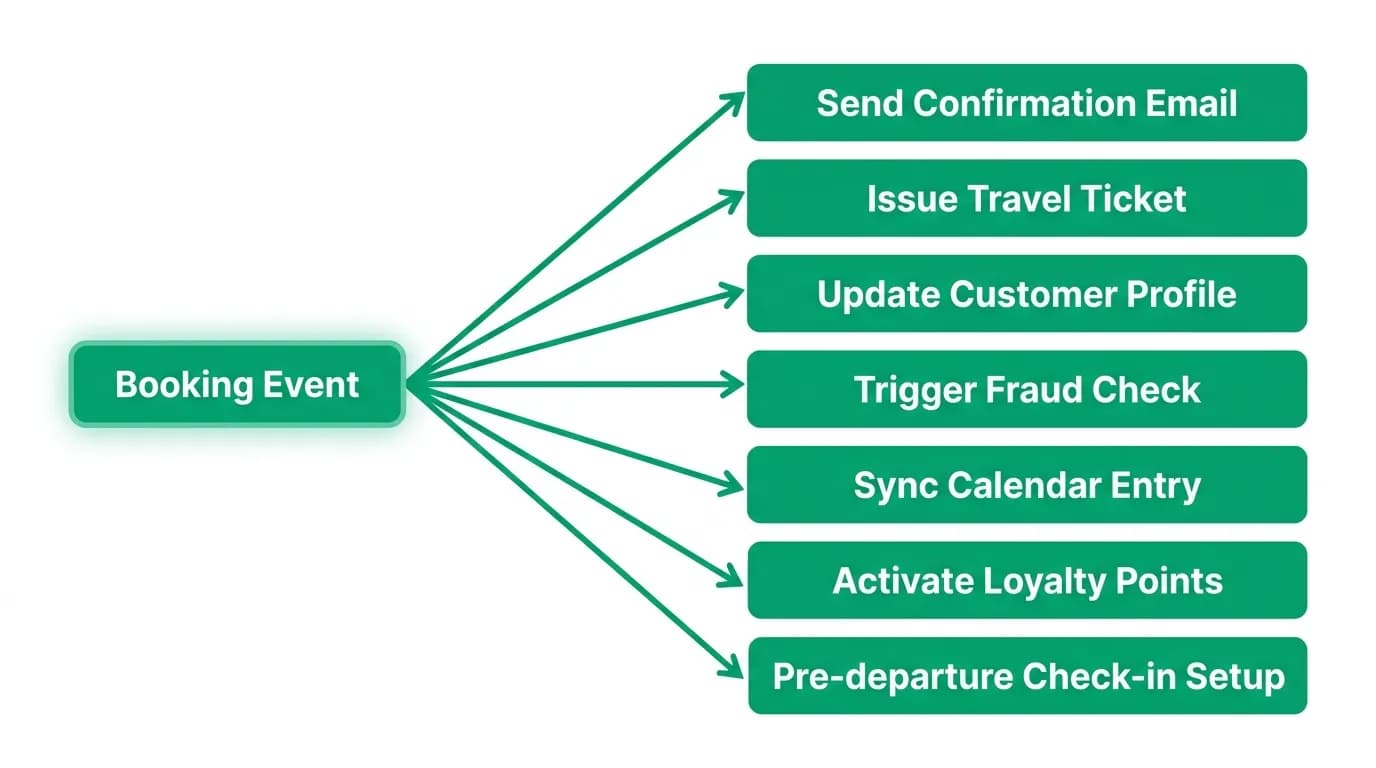
Behind the scenes, a cascade of background jobs fires:
Confirmation email gets queued. The email worker assembles the booking data, renders a rich HTML email using our component-based template system, and sends it through our email delivery service. Target: in the traveler's inbox within 30 seconds.
[Push notification](/blog/push-notification-travel-alerts) fires to all registered devices. "Your flight to Tokyo is confirmed! Booking ref: ABC123."
Trip sync creates or updates the trip in the traveler's trip list, attaching the new booking with all its details.
Document generation creates a PDF itinerary that the traveler can access offline.
Analytics events record the booking for our internal metrics: revenue, booking completion rate, agent performance.
Each of these jobs runs independently in separate queues with their own retry logic. If the email service is temporarily down, the email will retry with exponential backoff. The traveler already has their confirmation in the chat, so a delayed email is an inconvenience, not a crisis.
The full system map
Let me lay out every service this single sentence touched:
- API Gateway -- rate limiting, request routing
- Authentication -- signed session tokens verification, user identity
- AI Agent -- intent parsing, reasoning, tool orchestration
- Travel Data Service -- flight search, availability, booking confirmation
- Payment Service -- intent creation, authorization, capture
- Streaming Pipeline -- server streaming delivery of response and cards
- Job Queue -- background job scheduling and execution
- Email Service -- confirmation email assembly and delivery
- Push Service -- notification delivery to mobile devices
- Document Service -- PDF itinerary generation
- Trip Service -- trip record management
- Analytics Pipeline -- event recording and processing
Twelve services for seven words. That might sound like overengineering, but each service exists because it has a different reliability requirement, scaling pattern, and failure mode. The payment service needs to be absolutely bulletproof. The analytics pipeline can tolerate some delay. The email service can retry for minutes. Separating them means each can be built, monitored, and scaled for its specific requirements.
What to monitor
If I had to pick five metrics to watch across this entire flow, they would be:
End-to-end booking time. From "book it" to confirmed reservation. Target: under 5 seconds.
AI tool call latency. How long each external API call takes. This is the biggest source of user-facing latency and is mostly outside our control.
Payment success rate. What percentage of payment intents successfully capture. Target: above 99.5%.
Background job completion rate. Are the post-booking jobs finishing? A backed-up queue means travelers aren't getting their confirmation emails.
Stream completion rate. Did the traveler receive the full AI response, including the booking confirmation card? If streams are failing, the traveler might not know their booking succeeded.
That's the anatomy of an AI travel query. Seven words in, twelve services touched, one confirmed booking out. Every system matters. Every failure mode is accounted for. And the traveler sees "Booked!" in under five seconds.
Nowah is an AI travel agent that searches and books real flights and hotels through conversation — no filters, no thirty open tabs. Plan your next trip.