The Business Model for AI-Native Travel
Commissions, subscriptions, or hybrid? AI travel agents monetize differently from OTAs — and the economics are surprisingly favorable.

The OTA business model worked for two decades. Aggregate inventory, drive traffic through marketing spend, earn commissions on bookings. But the unit economics are deteriorating. Customer acquisition costs exceed $40-60 per booking. Commission rates face downward pressure from suppliers. Users shop across multiple OTAs for every trip, destroying loyalty.
AI-native travel has a fundamentally different economic model. The product creates loyalty through personalization and memory. The AI interaction replaces expensive human support. The conversion rate is higher because conversation bridges the gap between browsing and buying.
The question is how to capture value from this structurally better position. There are three models, and the right answer is probably a hybrid.
Commission-based AI
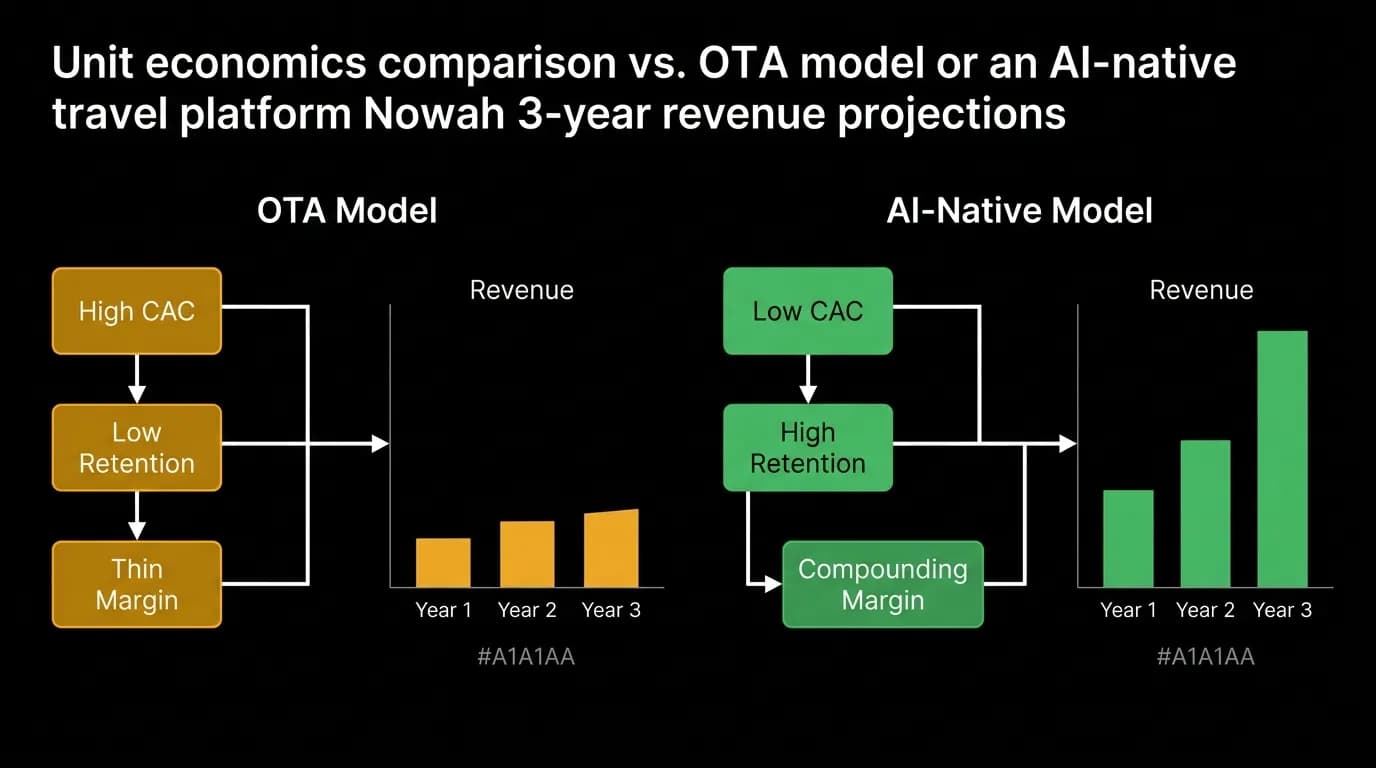
The simplest model: the AI agent earns a commission on every booking it facilitates. This mirrors the OTA model but with better unit economics.
Why it works better for AI-native: The customer acquisition cost is dramatically lower. AI-native platforms report CAC 3-5x lower than traditional OTAs. The reason: a product that genuinely helps users plan and book travel generates word-of-mouth and organic retention. Users do not shop around every time because their preference history and trust relationship with the agent create switching costs.
The commission model also aligns incentives well. The agent earns when the user books. The user only books when the recommendation is good. So the agent is directly incentivized to make good recommendations.
The numbers: Average booking value on AI-assisted trips is 15-20% higher than on traditional OTAs. Users who receive personalized recommendations tend to book slightly more expensive options because the options genuinely match their preferences. They are not upsold; they are better served.
Subscription model
A subscription model treats the AI agent as a trusted advisor that users pay for directly. Monthly or annual fee for access to the full agent capability, including unlimited searches, personalized recommendations, booking execution, and ongoing trip management.
Why it makes sense: The relationship between a user and their AI travel agent is more like the relationship with a personal assistant than with a search engine. Personal assistants charge fees. The value is not just the individual transaction; it is the ongoing intelligence, the accumulated preferences, the proactive management.
The challenge: Subscription requires the user to commit upfront, before they have experienced the value. This is a harder sell than free-to-use commission models. The activation energy is higher.
A subscription also changes the incentive alignment. A commission-based agent is incentivized to book as much as possible. A subscription-based agent is incentivized to keep the user happy and retained, even if that means recommending against an unnecessary trip. "Based on your schedule, this might not be the best week for a trip" is something a subscription agent might say. A commission agent probably would not.
The hybrid approach
I think the winning model combines both:
Free tier: Basic search and recommendations. The user can ask questions, explore destinations, and see flight and hotel options. No cost. This is the acquisition funnel.
Commission on booking: When the user books through the agent, a commission is earned. This is the primary revenue for casual users who book 1-2 trips per year.
Premium subscription: For frequent travelers, a subscription unlocks advanced features: proactive price monitoring, automatic rebooking during disruptions, expense management, priority support, and deeper personalization. This captures recurring revenue from high-value users.
The hybrid model serves both segments. Casual travelers use the free tier and pay through commissions. Frequent travelers pay for the subscription because the ongoing value justifies it.
The retention advantage
Here is the economic insight that makes AI-native travel fundamentally better than OTAs: memory creates switching costs.
Every interaction with the agent builds the user's preference profile. After five trips, the agent knows their seat preference, their hotel style, their budget range, their dietary restrictions, their airline loyalty programs, their preferred airports, and dozens of other preferences. Switching to a competitor means starting from zero. No preferences. No history. No personalization. This is not a lock-in through contract or penalty. It is a lock-in through value. The product is genuinely better for the user who stays. Their next booking is easier, faster, and more personalized than it would be on a new platform.
Retention compounds. The longer a user stays, the more preferences accumulate, the better the recommendations, the more likely they stay. OTAs have none of this. Every OTA interaction is stateless. Users have zero switching cost. AI-native travel breaks this pattern.
Revenue per user potential
The most exciting economic property of AI-native travel is the potential to expand revenue per user over time.
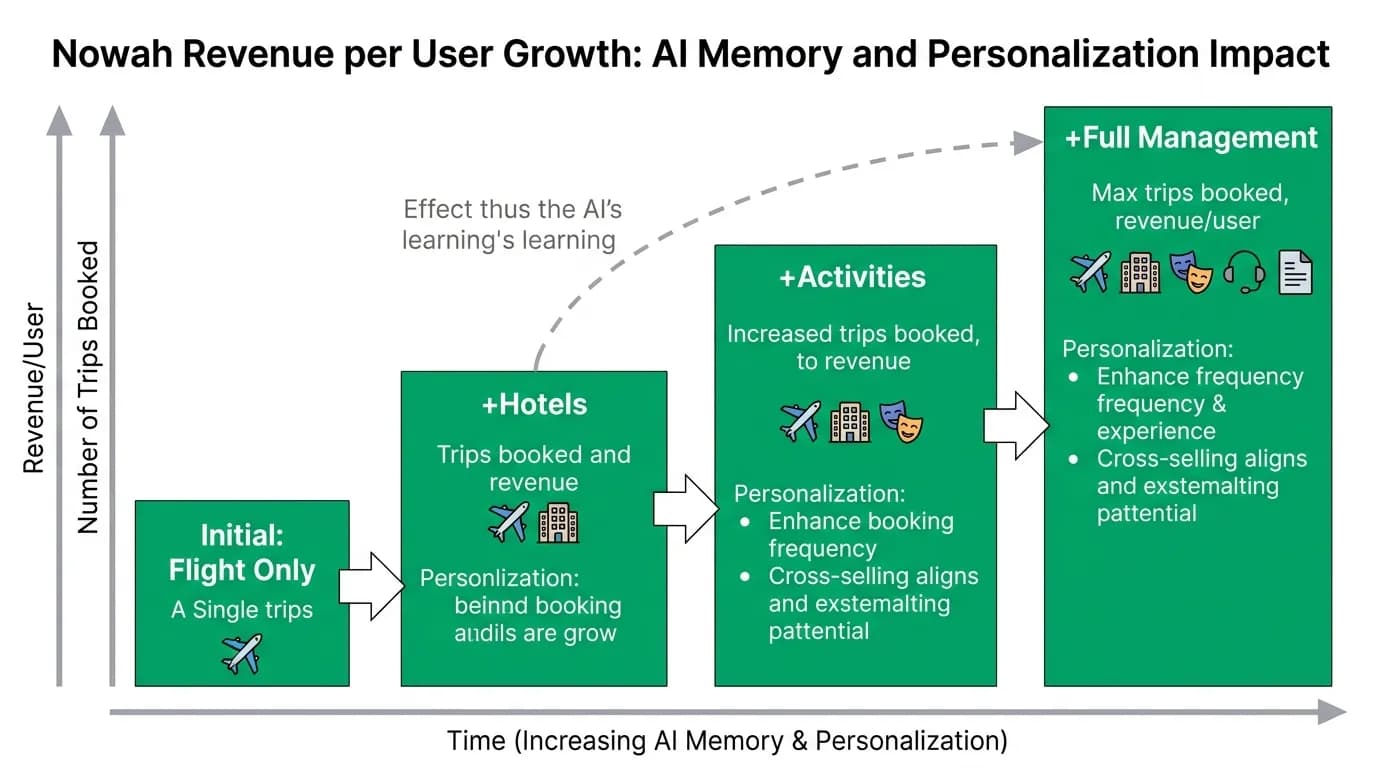
A new user books a flight. Revenue: one booking commission.
Over time, that user starts booking hotels through the agent. Then activities. Then ground transport. Then travel insurance. Each category adds revenue per trip.
Eventually, the user subscribes for ongoing travel management. Revenue shifts from per-transaction to recurring. The agent manages their entire travel life: monitoring prices, tracking loyalty programs, managing documents, handling disruptions.
The journey from single booking to comprehensive travel management represents a 10-20x increase in revenue per user. The AI agent, through accumulated trust and demonstrated competence, naturally facilitates this expansion. Higher conversion rates in conversational AI travel booking, combined with lower CAC, higher retention, and expanding revenue per user, produce unit economics that are structurally superior to the OTA model. The best travel app is not just a better product. It is a better business.
Nowah is an AI travel agent that searches and books real flights and hotels through conversation — no filters, no thirty open tabs. Plan your next trip.