Building Proactive Trip Management: When the AI Agent Acts Without Being Asked
Ambient travel management — proactive rebooking on delays, price monitoring with auto-suggestions, weather-based adjustments, and the trust model for autonomy.
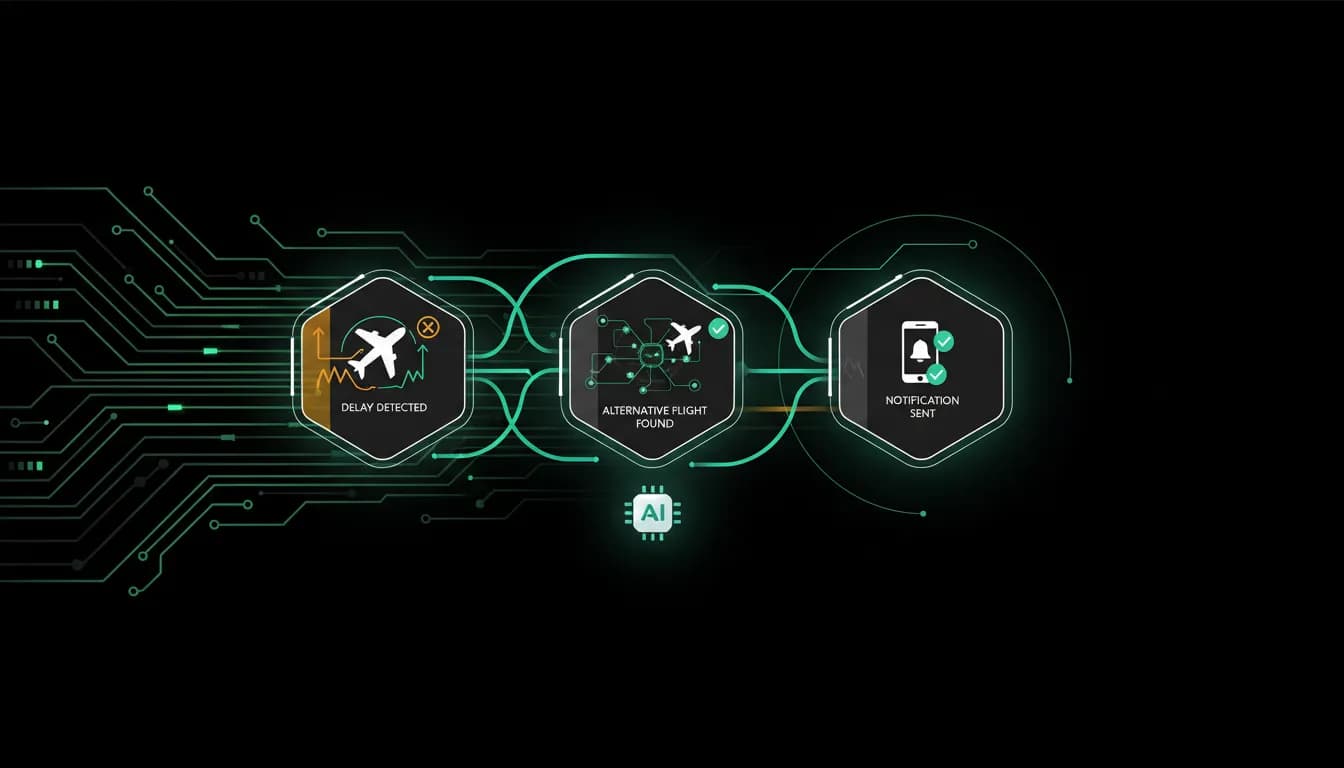
The vision is this: your flight is delayed by three hours. Before you even check the departure board, your AI agent has already found two alternative flights, compared the options, and sent you a notification with a recommendation. You tap "rebook" and the entire process, cancellation, rebooking, payment adjustment, and updated itinerary, completes in seconds.
This is proactive trip management: the AI agent acting on your behalf without waiting for you to ask. It is also the most trust-intensive feature we have ever built, because an agent that acts without being asked must earn the right to do so.
Proactive capabilities
Proactive trip management covers four categories of autonomous action.
Delay detection and rebooking. The agent monitors booked flights for status changes. When a delay is detected, the agent automatically searches for alternative flights, evaluates whether any alternative is meaningfully better than waiting, and presents options to the traveler. For travelers who have opted into full autonomy, the agent can rebook without waiting for approval if the alternative meets defined criteria.
Price monitoring. After a booking is made, the agent watches for price drops on the same route. If a significantly cheaper option appears, the agent calculates whether the rebooking fee and hassle are worth the savings, and notifies the traveler with a recommendation. For monitored but unbooked routes, the agent tracks prices over time and alerts the traveler when prices hit a target threshold.
Weather-based itinerary adjustment. The agent monitors weather forecasts for upcoming trip destinations. If severe weather is expected during the trip, the agent suggests itinerary modifications: indoor activities instead of outdoor ones, adjusted departure times to avoid storms, or alternative transportation for weather-affected routes.
Document and status management. The agent proactively retrieves updated boarding passes, checks in when check-in windows open, and ensures all trip documents are current. These are low-risk autonomous actions that save travelers repetitive administrative tasks.
The trust ladder
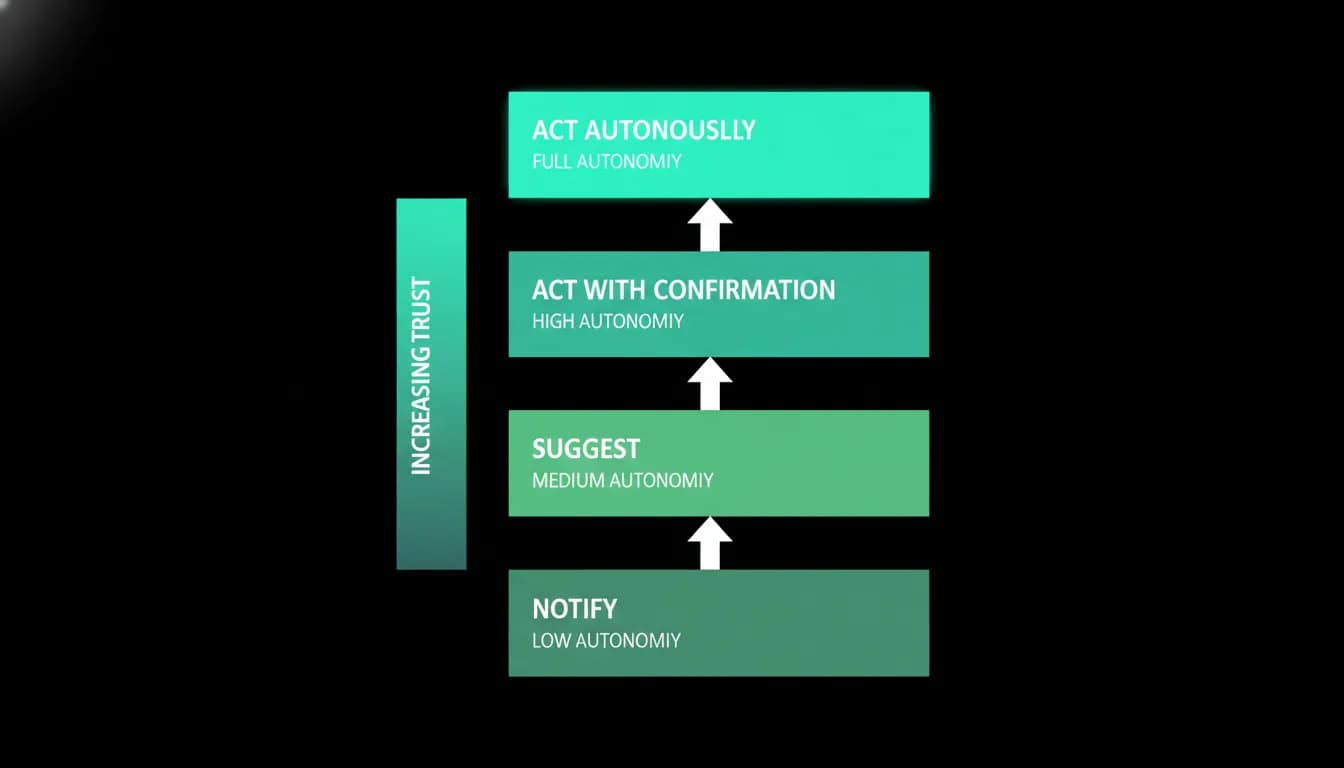
Not every traveler is comfortable with an AI agent taking action on their behalf. Some want full autonomy from day one. Others want the agent to inform but never act. The trust ladder accommodates both extremes and everything in between.
Level one: notify. The agent monitors trips and sends notifications when something changes. No suggestions, no actions. Just information. "Your flight is delayed by 90 minutes." The traveler decides what to do with that information.
Level two: suggest. The agent monitors and suggests specific actions. "Your flight is delayed. Here are two alternatives that arrive earlier. Would you like me to rebook?" The traveler must explicitly approve every action.
Level three: act with confirmation. The agent takes preliminary action, like searching for alternatives and reserving a seat, but requires confirmation before completing the change. "I found a better flight and reserved a seat for you. Confirm to complete the rebooking, or I will release the reservation in 30 minutes."
Level four: act autonomously. The agent takes action without waiting for approval, within defined guardrails. The traveler is notified after the action is taken. "Your delayed flight has been rebooked. Here are your updated details. If you prefer the original flight, I can switch back."
Travelers choose their comfort level during setup and can change it at any time. The default is level one. Autonomy is never imposed. It is always earned through demonstrated reliability and explicitly granted by the traveler.
Background monitoring architecture
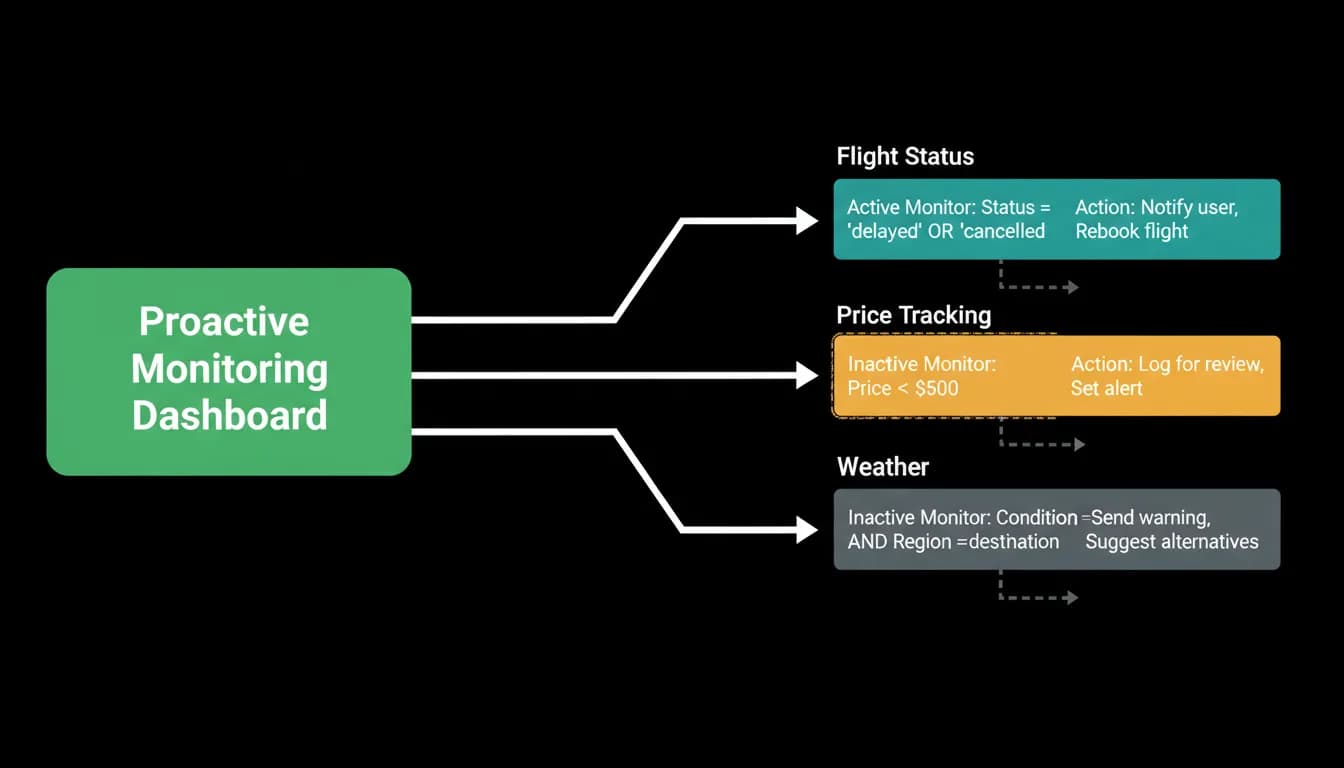
Proactive features require background monitoring that runs independently of active traveler conversations. The architecture extends our existing background job system with dedicated workers for trip monitoring.
Flight status workers poll flight data at regular intervals for all booked flights. The polling frequency increases as departure approaches: daily polling for flights more than a week away, hourly for flights within the next day, and every few minutes for flights within hours of departure.
Price monitoring workers track fares for watched routes. These workers batch multiple travelers' watched routes into efficient search queries to minimize upstream API costs. When a price change triggers a notification, the worker creates a personalized alert with the traveler's specific context: their original price, the new price, and a recommendation.
Weather workers check forecasts for upcoming trip destinations on a daily basis. Severe weather alerts trigger an immediate review of affected itineraries and proactive suggestions.
All monitoring workers feed into a notification dispatch system that respects the traveler's trust level and notification preferences. A traveler who has opted for level-one monitoring receives information. A traveler at level four receives a notification that action has already been taken.
The confirmation spectrum
Different proactive actions have different risk profiles, and the confirmation requirement should match the risk.
Low-risk actions can be autonomous even at moderate trust levels. Checking in for a flight, downloading an updated boarding pass, and refreshing trip status are safe, reversible, and universally beneficial. These actions can be autonomous by default with an opt-out for travelers who prefer manual control.
Medium-risk actions require confirmation at most trust levels. Rebooking a flight, changing a hotel reservation, or adjusting an itinerary involves financial transactions and scheduling changes. The cost of a mistake is material. These actions should require explicit confirmation unless the traveler has granted level-four autonomy.
High-risk actions always require confirmation regardless of trust level. Cancelling a booking, making a purchase above a spending threshold, or changing travel dates are irreversible or high-stakes decisions. Even at the highest autonomy level, the agent pauses for confirmation on these actions.
Safety guardrails
Autonomous agent actions need hard limits that cannot be overridden, even by the traveler's trust settings.
Spending limits cap the financial impact of any autonomous action. If a rebooking costs more than the original flight, the price difference must be below a defined threshold for the agent to act autonomously. Above the threshold, confirmation is required regardless of trust level.
Change frequency limits prevent the agent from making multiple changes in rapid succession. If the agent detects a series of status changes and starts making multiple rebookings, the frequency limit triggers a pause and a summary notification instead of individual actions.
Always-confirm categories define action types that are never autonomous. International rebookings that change the destination country, bookings that involve different travelers than the original, and actions that would result in significant itinerary changes all require human confirmation.
These guardrails exist because proactive features amplify both the agent's helpfulness and its potential for harm. A proactive agent that saves you from a delayed flight is delightful. A proactive agent that rebooks you onto a more expensive flight you did not want is infuriating. The guardrails ensure that the agent's autonomy stays within the bounds of what is genuinely helpful.
Measuring proactive value
Proactive features must justify the trust investment by delivering measurable value. We track three metrics.
Money saved through proactive rebookings and price monitoring. When the agent finds a cheaper alternative or catches a price drop, the savings are concrete and attributable. Cumulative savings across all travelers provides a clear measure of the feature's financial value.
Time saved through proactive document management and automated check-ins. Each administrative task the agent handles autonomously is time the traveler did not spend on logistics. We estimate time saved per action and aggregate across the user base.
Trips improved through weather-based adjustments and delay mitigation. When the agent suggests an itinerary change that avoids bad weather, or rebooks around a delay so the traveler arrives on time for their meeting, the trip outcome is measurably better than it would have been without the proactive intervention.
Proactive trip management is the feature that transforms the agent from a booking tool into a travel companion. A booking tool helps you when you ask. A travel companion helps you before you need to ask. Building that transition requires not just technology but trust, and trust is built one reliable proactive action at a time.
Nowah is an AI travel agent that searches and books real flights and hotels through conversation — no filters, no thirty open tabs. Plan your next trip.