Content Marketing for Travel AI: SEO Strategy We Are Building Toward
Using content to drive organic discovery — keyword research for travel intent, the content-product loop, and why AI travel needs different SEO than traditional sites.

A single blog post ranks for "best travel app" and sends two hundred visitors per day straight to the chat interface. Those visitors arrive with high intent because they searched for a solution, found our content, and followed the path from article to product. No ad spend. No influencer partnership. Just a well-structured piece of content that answers the question a traveler was already asking.
That blog post took a few hours to write and generates more sustained traffic than any paid campaign we have run. Content marketing for AI travel products is not about volume. It is about precision: the right content, targeting the right intent, connected to the right product experience.
Keyword research for travel AI
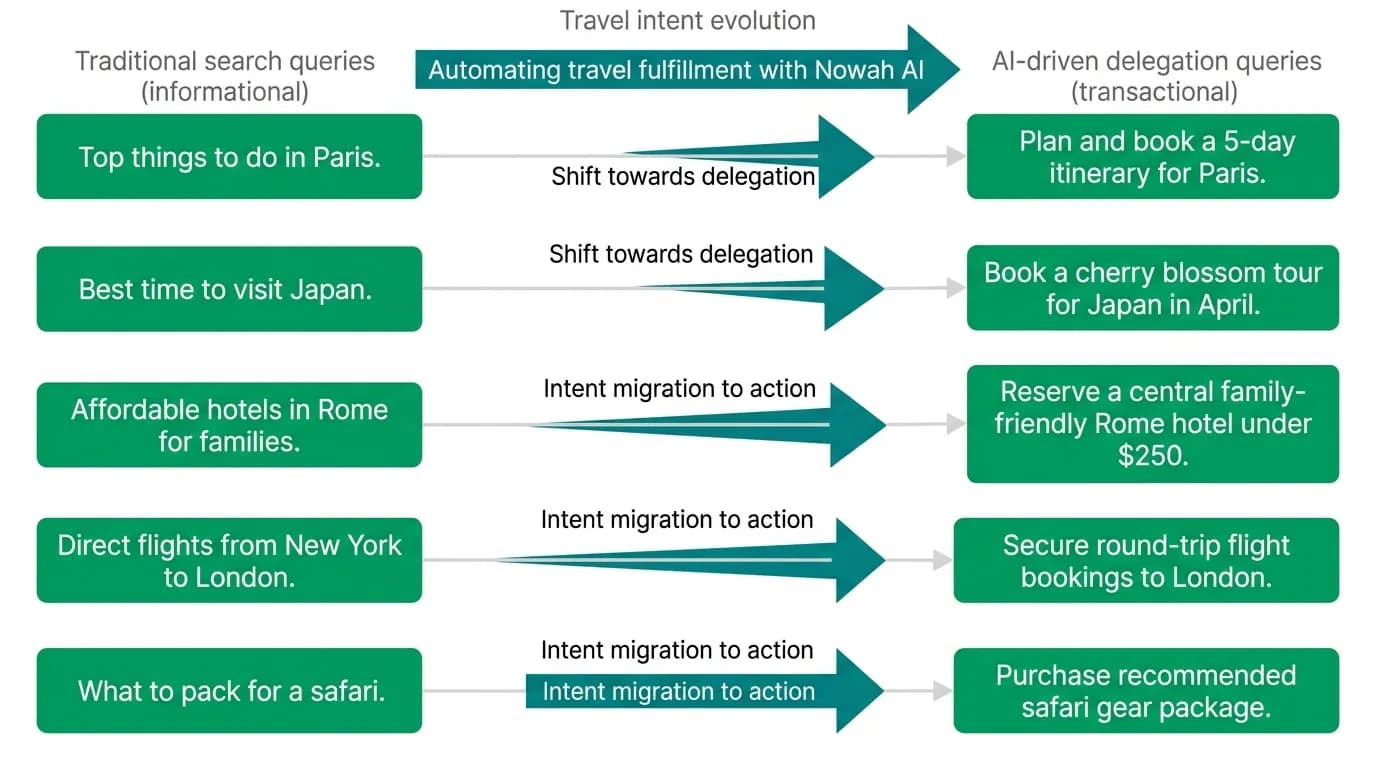
Keyword research for an AI travel product requires understanding a fundamental shift in search intent. Traditional travel sites target informational queries: "best time to visit Tokyo," "cheapest flights to London," "hotel reviews in Barcelona." These queries have massive volume but low conversion because the searcher is gathering information, not ready to act.
AI travel searches reflect delegation intent. The searcher does not want to research options. They want someone, or something, to handle it for them. Queries like "AI travel booking," "book flights with AI," and "AI trip planner" have lower volume but dramatically higher conversion because the searcher is ready to delegate.
We target a mix of both. Informational keywords bring volume and brand awareness. Delegation keywords bring users who are ready to try the product. The content strategy differs for each: informational content answers questions and establishes expertise, while delegation content demonstrates the product's capability and links directly to the booking interface.
The global online travel market represents hundreds of billions of dollars annually. Even capturing a fraction of the organic search traffic in this space produces meaningful user acquisition. The key is differentiation: our content cannot compete with established travel sites on pure information volume. It competes by offering a fundamentally different proposition. Not "here is information to help you decide" but "here is an AI that handles the entire process for you."
The content-product loop
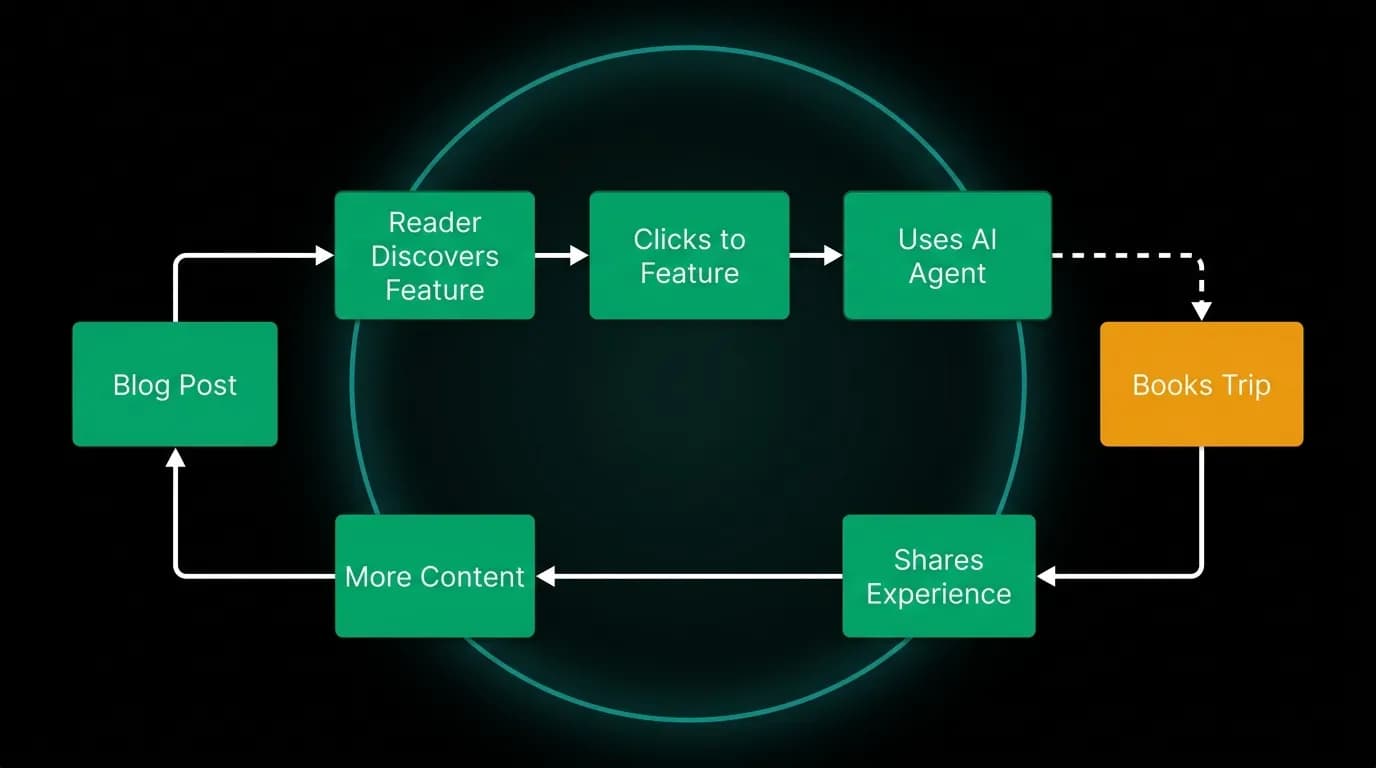
The most effective content marketing creates a loop between content and product. A blog post demonstrates a capability. The reader clicks through to experience that capability. The experience drives a booking. The booking creates a satisfied traveler who shares the experience. That share generates more content opportunities.
Our content-product loop works because every article connects to a specific product feature. An article about finding cheap flights links to the AI agent's search capability. An article about managing complex itineraries links to the trip management tools. An article about splitting travel expenses links to the bill splitter in the tools hub. The content is not abstract. It is a guided path from curiosity to usage.
This loop compounds over time. Each piece of content that ranks continues to drive traffic indefinitely. Each traveler who converts from content becomes a potential source of user stories and testimonials that fuel more content. The loop is self-reinforcing in a way that paid acquisition is not.
Why AI travel SEO differs
Traditional travel SEO optimizes for information delivery. The goal is to answer the searcher's question so thoroughly that they stay on the page, consume the content, and perhaps click on affiliate links or ads. The content is the product.
AI travel SEO optimizes for product adoption. The goal is to answer the searcher's question well enough to establish credibility, then demonstrate that the AI agent can handle the underlying task better than the searcher can handle it manually. The content is the bridge to the product.
This difference changes everything about content structure. Traditional travel content is comprehensive and self-contained. AI travel content is compelling but intentionally incomplete. It shows enough of the product's capability to make the reader want to try it. An article about finding the best flight deals does not list the ten best flight search strategies. It shows how the AI agent found a deal that manual searching would have missed, and invites the reader to try it themselves.
The call to action is different too. Traditional travel content says "now you know what to do." AI travel content says "now let the agent do it for you." This reframe is the foundation of every piece of content we publish.
Standalone tools as SEO entry points
The tools hub, which includes a currency converter, tip calculator, and bill splitter, serves a dual purpose. For existing users, these tools add utility to the platform. For organic search, they are high-intent landing pages.
A traveler searching for "currency converter" or "tip calculator for Japan" finds our tool, uses it, and discovers the broader platform. The tool is genuinely useful on its own, which builds trust. The surrounding context introduces the AI travel agent, which builds interest. The conversion path from utility tool to AI booking platform is natural because the traveler is already in a travel planning mindset.
These tools rank well for specific queries because they are server-rendered, fast-loading, and genuinely useful. Search engines reward pages that satisfy user intent quickly, and a functional tool satisfies intent faster than a thousand-word article about tipping customs. The article about tipping customs links to the tool. The tool links to the agent. The agent books the trip.
Technical SEO for a modern web framework platform
Our web application is built with a framework that supports server-side rendering natively. This is critical for SEO because search engine crawlers need to see fully rendered content without executing JavaScript. Server-rendered pages are indexed faster and more reliably than client-rendered alternatives.
We implement structured data for travel content: flight search schemas, hotel review schemas, and FAQ schemas that help search engines understand our content's purpose and display it with rich snippets. Rich snippets increase click-through rates from search results, which increases traffic from the same ranking positions.
Page speed optimization matters more for travel content than most categories because travelers often search on mobile devices with variable network quality. We optimize images, minimize JavaScript bundles, and implement aggressive caching. Every hundred milliseconds of load time improvement translates to measurable conversion improvements.
Mobile-first design is non-negotiable. More than half of travel searches happen on mobile devices. Our content renders perfectly on small screens, with tools that are fully functional on touch interfaces. The experience from search result to product usage is seamless on any device.
Measuring content ROI
Content marketing ROI is harder to measure than paid acquisition ROI because the attribution path is longer and more complex. A traveler might read three articles over two weeks before signing up. Which article gets credit?
We measure the full funnel: organic impressions, click-through rate, page engagement time, conversion to signup, conversion to first search, and conversion to first booking. Each stage has a metric, and we track the cohort behavior of travelers who entered through organic content versus other channels.
Content-originated travelers have different behavior patterns than paid-acquisition travelers. They tend to explore the product more thoroughly before booking because they arrived with informed expectations. Their retention rates are higher because their expectations were set by honest content rather than optimized ad copy. Their lifetime value is higher because they were attracted by the product's genuine capabilities rather than a promotional offer.
We invest in content that produces sustained organic traffic over content that produces viral spikes. A viral post generates excitement for a week and then fades. A well-optimized article generates consistent daily traffic for months or years. The compounding nature of organic content makes it the most cost-effective acquisition channel at scale, even though it is the slowest to produce results initially.
The blog post that sends two hundred daily visitors started with zero traffic. It took weeks to climb the rankings. But it has been generating traffic every day since, with no ongoing cost. That is the power of content marketing done right: patient investment in quality content that compounds over time.
Nowah is an AI travel agent that searches and books real flights and hotels through conversation — no filters, no thirty open tabs. Plan your next trip.