The Cost of Intelligence — LLM Economics at Scale
Running an AI agent costs real money per query. Here is the honest breakdown — and why travel's unit economics make it work.
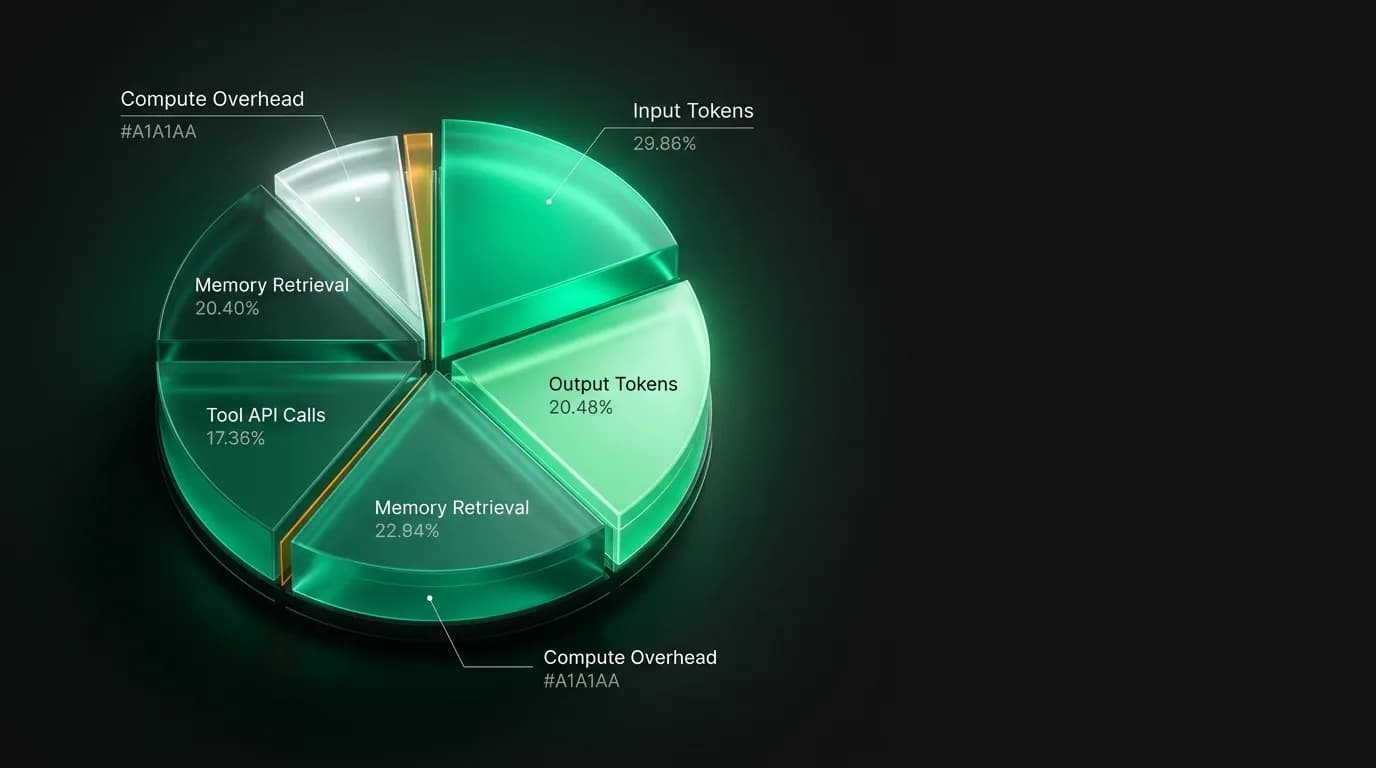
Nobody in the AI industry likes to talk about costs honestly. Providers quote per-million-token prices that sound cheap until you realize a single complex conversation can consume tens of thousands of tokens across multiple inference calls. Startups hand-wave about "scale efficiencies" without showing the math. And AI travel booking products in particular face a cost structure that most consumer apps never encounter: every user interaction triggers real API calls to external data providers that charge real money.
I want to lay out the actual economics. Not the theoretical ones. The real, per-query, fully-loaded cost of running an AI travel agent at consumer scale.
The honest cost picture
Let me walk through what happens when a user asks our agent: "Find me flights from San Francisco to Tokyo in the first two weeks of April, preferably direct, under $1,200."
Input tokens. The model receives the model instructions (~2,000 tokens), the conversation history (~500 tokens for a fresh conversation, up to 8,000 for a long one), retrieved memory context about this user's preferences (~1,000 tokens), and the user's message (~50 tokens). Total input: roughly 3,500 tokens minimum.
First inference call. The model reads the input, decides to call the flight search tool, and generates the function call. Output: ~100 tokens. But we are paying for the full input context.
Tool execution. The flight search API returns results. This is not an LLM cost; it is a data provider cost. Each search costs a fraction of a cent to a few cents depending on the provider and the complexity of the search.
Second inference call. The model receives the search results (~2,000 tokens of structured flight data), processes them, ranks them against the user's preferences, and generates a response with three curated options and explanations. Output: ~800 tokens. Input is now the original context plus tool results: ~5,500 tokens.
Memory update. The agent stores new context about this user's search. This involves a vector embedding computation and a database write. Small cost, but non-zero.
Total for this single turn: two inference calls, one external API search, one memory operation. Fully loaded, this costs somewhere between $0.01 and $0.05 depending on your model choice and negotiated API rates.
If the user follows up with "what about hotels near Shinjuku?" that is another two inference calls (tool selection plus response generation), another external API search, and more tokens of context. The conversation grows, and so does the per-turn cost as the context window fills.
A typical booking conversation runs 8-15 turns. The fully loaded cost of a complete conversation that ends in a booking is in the range of $0.15-0.50.
Travel's economic advantage
Here is why those numbers work for travel and not for most consumer AI products.
The average flight booking on our platform is over $500. Hotels add another $200-800 depending on trip length. A typical trip booking generates $700-1,500 in gross transaction value. Even at the high end of our per-conversation cost, the AI cost is well under 1% of the transaction value.
Compare this to a general-purpose AI chatbot. If a user has a ten-turn conversation about recipe ideas, the inference cost might be $0.05-0.10. The revenue from that interaction? Maybe a fraction of a cent from ads, or nothing at all. The unit economics do not close.
Travel's high transaction values create room for genuinely good AI. We can afford to use frontier models for complex queries. We can afford to call external APIs for real-time data. We can afford to maintain a rich memory system. The revenue per booking justifies the cost per conversation.
This is not an accident. It is a structural advantage of building AI agents in high-value transaction domains. Insurance, real estate, financial services, and healthcare share similar characteristics. The AI cost is a small fraction of the value created.
Optimization strategies that actually matter
We have tried every optimization in the book. Some saved meaningful money. Others were engineering effort that yielded negligible results. Here is what actually moves the needle.
Smart model routing. I have written about this separately, but it bears repeating in economic terms. Routing 60% of queries to a model that costs 10-20x less per token reduces our blended inference cost by 40-50%. The simple queries that dominate conversation volume do not need frontier reasoning.
Caching repeated searches. When three different users search for SFO to NRT in April within an hour, we do not need three separate API calls. A warm cache serves the second and third requests instantly at zero marginal data cost. For popular routes, caching handles 30-40% of search queries. This is a significant savings because external API calls are often the largest per-query cost component.
Token efficiency in prompts. Our model instructions went through five revisions focused purely on token count. We reduced it from ~4,000 tokens to ~2,000 tokens while maintaining the same instruction quality. Since the model instructions is included in every inference call, this cut our per-call input cost by a measurable percentage across millions of calls.
Context window management. Long conversations accumulate tokens. A 20-turn conversation with full history can push 15,000+ input tokens per turn. We implemented intelligent summarization that condenses older conversation turns into compact summaries, keeping the context window manageable without losing important information.
Batch processing for background tasks. Price monitoring, notification generation, and analytics do not need real-time inference. We batch these into off-peak processing windows where we can use cheaper models and take advantage of batch pricing discounts.
The 10x cost curve
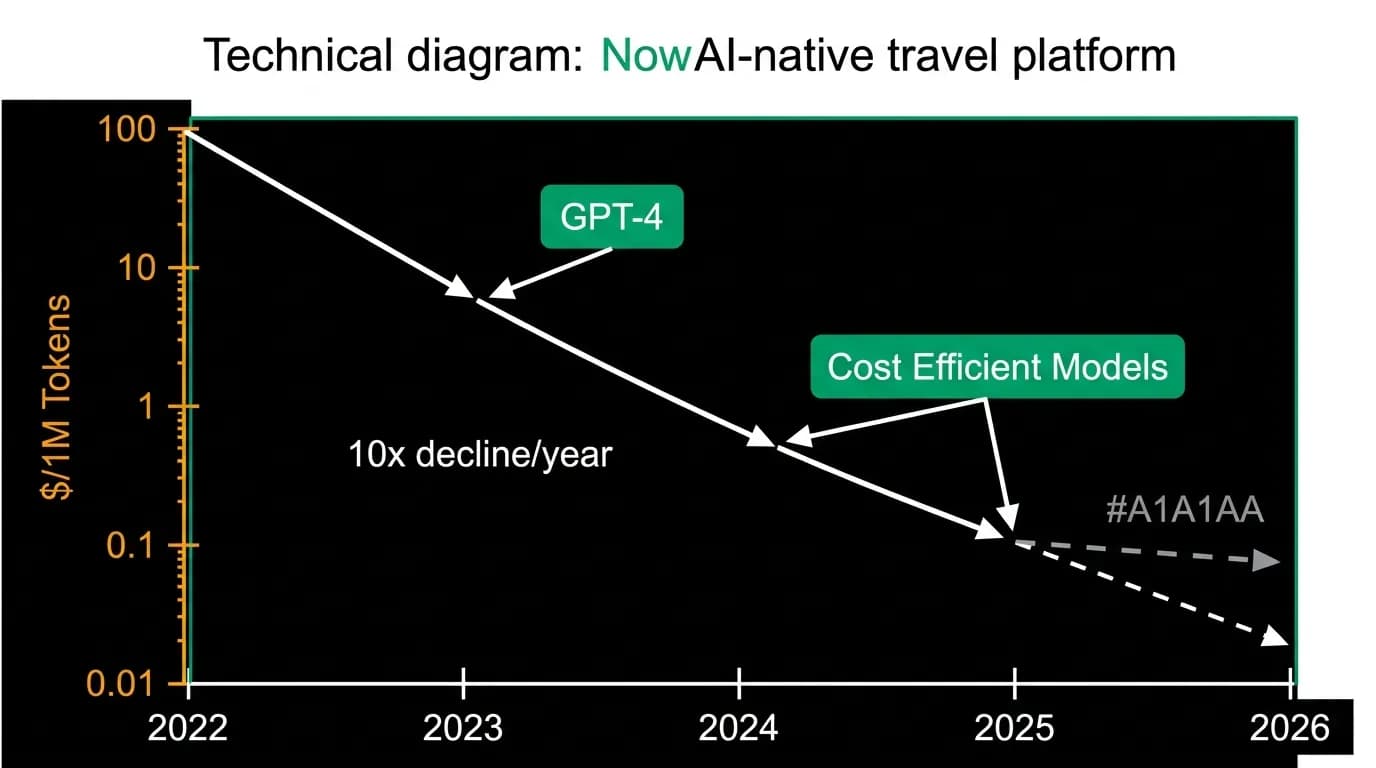
The most important economic trend in AI is the rate of inference cost decline. Since 2023, the cost per million tokens has dropped roughly 10x per year. This is driven by model architecture improvements, inference optimization, hardware advances, and competitive pressure among providers. To put this in perspective: a complex conversation that cost $5.00 in inference in early 2023 cost about $0.50 in early 2024, about $0.05 in early 2025, and costs under $0.01 in early 2026. The same quality of reasoning, at a fraction of the price.
This trend has profound implications for product feasibility. Features that were economically impractical two years ago are cheap today. Proactive monitoring, where the agent continuously watches for price drops on your saved trips, was too expensive to run at scale in 2024. In 2026, the inference cost of checking a dozen routes daily is negligible.
The cost curve also means that optimization work has diminishing returns. An engineering effort that saves $0.01 per query today will be saving $0.001 per query next year as baseline costs drop. We have learned to focus optimization on the largest cost components (external API calls and caching) and let the model cost decline handle the rest.
Cost comparison: AI agent vs. human agent vs. OTA
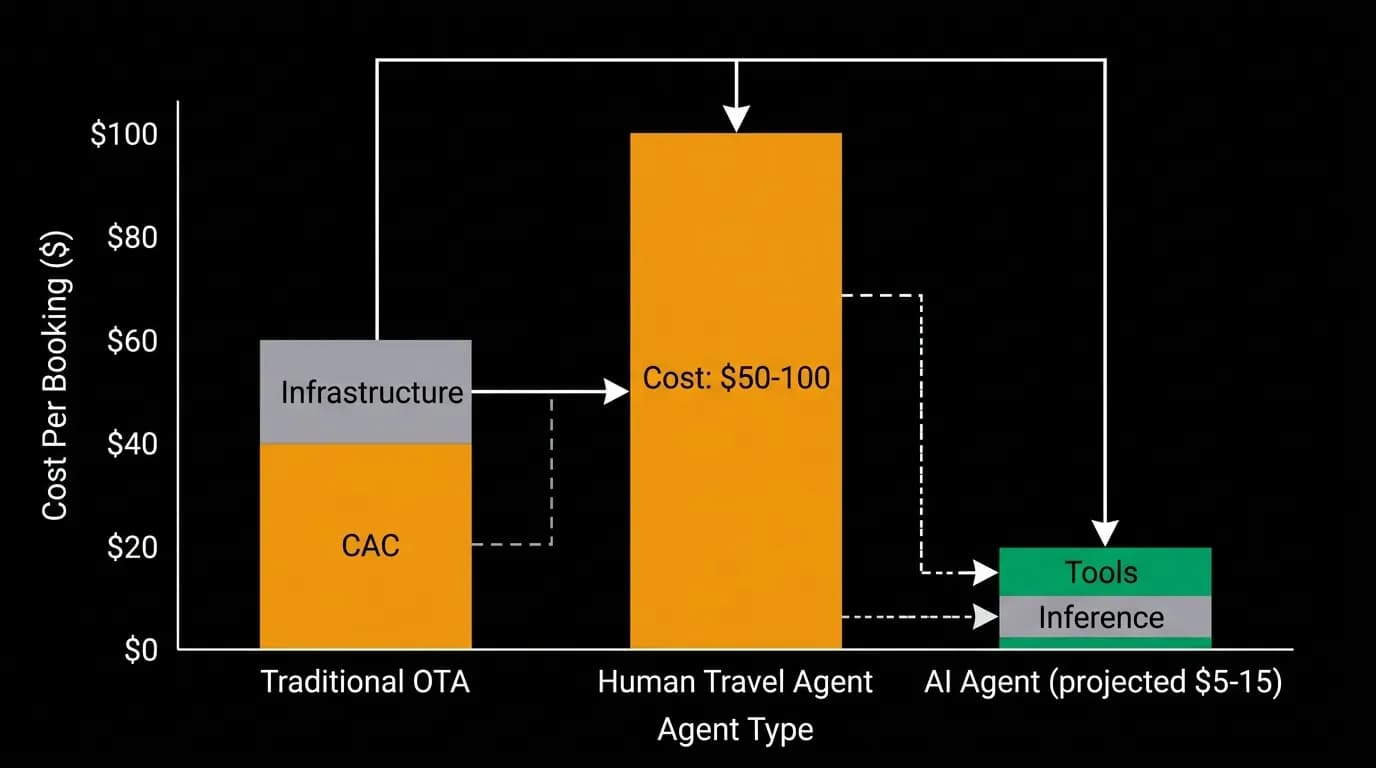
The traditional travel industry has well-understood per-booking economics. A human travel agent costs $50-100 per booking in labor alone, more for complex itineraries. They can handle maybe 5-10 bookings per day.
An online travel agency (OTA) spends $40-60 per booking in customer acquisition cost (advertising, SEO, brand marketing). Their actual technology cost per booking is small, but the marketing spend dwarfs it.
An AI travel agent has a per-booking cost of roughly $0.15-0.50 for the AI interaction, plus customer acquisition. But here is the key difference: the acquisition economics are fundamentally different. A product that is genuinely better to use generates word-of-mouth and organic retention. AI-native travel platforms report customer acquisition costs 3-5x lower than traditional OTAs because the product itself is the marketing.
The fully loaded per-booking cost for AI agents is already lower than human agents and trending toward being lower than OTAs as acquisition becomes more organic.
When AI agents become cheaper than customer support
There is a crossover point that I think most travel companies are underestimating. Today, when a user has an issue with a booking, they call or chat with a human support agent. That interaction costs the company $8-25 depending on complexity and geography.
An AI agent that can handle rebooking, cancellation, modification, and disruption recovery automates the most expensive part of travel operations. Not all issues can be resolved by AI today, but the fraction that can is growing rapidly. We estimate that 70-80% of post-booking support interactions are automatable with current AI capabilities.
At current economics, the AI cost to handle a support interaction is under $0.10. Even accounting for the cases that need human escalation, the blended cost is dramatically lower than a fully human support operation.
Revenue per AI dollar
The metric I care about most is revenue per AI dollar: for every dollar we spend on inference, API calls, and AI infrastructure, how much revenue does the product generate?
This is the metric that determines whether your AI business is viable at scale. If you spend $1 on AI and generate $100 in booking revenue, your ratio is 100:1. That is healthy. If the ratio is 10:1, it is workable but tight. Below 5:1, you have a unit economics problem.
For travel AI specifically, the high transaction values and relatively low per-interaction costs put the ratio in a very comfortable range. This is why I believe travel is one of the best domains for AI agents. The economics are not just viable. They are favorable.
The honest assessment is this: AI agents cost real money to run. The cost is not zero and probably never will be. But in domains where the transaction value supports it, the cost is easily justified by the value created. Travel is one of those domains. And the cost is getting lower every month.
Book flights with an AI agent today and the economics are already working. In two years, they will look like a bargain.
Nowah is an AI travel agent that searches and books real flights and hotels through conversation — no filters, no thirty open tabs. Plan your next trip.