How travel creators can test a Nowah partner call to action
Compare two truthful Nowah partner invitations with a clear test brief, consistent context and observations kept separate from qualifying earnings.
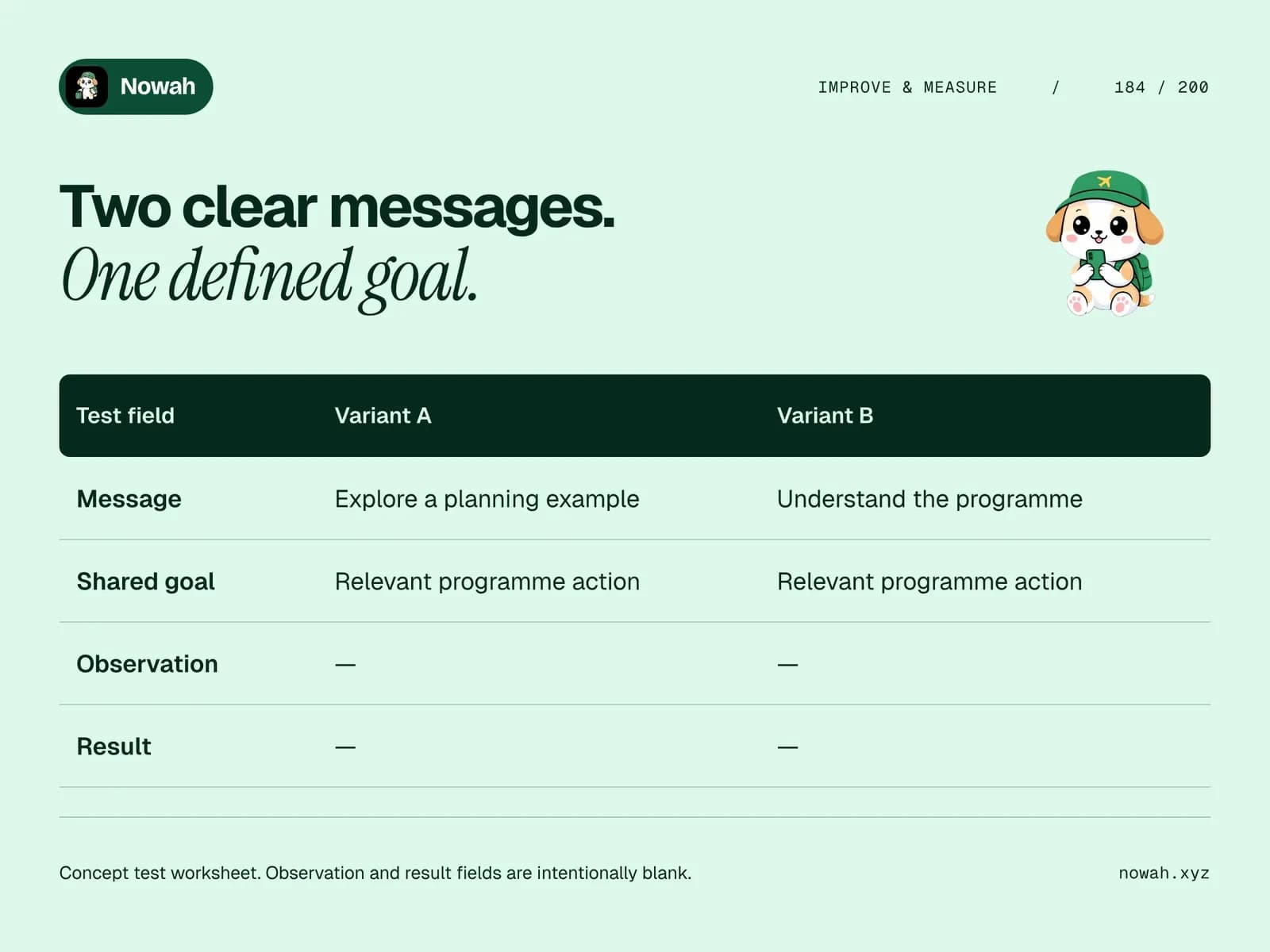
A useful travel recommendation needs a next step that readers understand. If you are an approved Nowah partner, that step might invite someone to explore their own trip through your active partner link. Testing the wording can help you learn whether the invitation is clear, but a button click is only one event in the earning journey.
The Nowah Partner Program gives that journey a defined commercial model: the partner share is 35% of Nowah net revenue from qualifying referred bookings. A controlled call-to-action test should preserve that explanation and your disclosure. It should compare two truthful invitations while keeping the surrounding content and intended destination consistent.
This guide provides a test brief for creators who have a reliable way to observe the selected action. It does not assume Nowah provides a particular analytics dashboard, or that a short experiment can predict your income.
Choose the action before choosing the wording
Write down what you want the reader to do. A traveller continuing a planning task and another creator exploring a partner application are different audiences. Select one journey for the test so the result has a coherent meaning.
For a traveller-facing guide, you might study whether readers use the invitation to continue planning through the appropriate partner route. For a creator-facing resource, the action might be visiting the program overview. Neither event establishes that an eligible account or approved application resulted.
The creator-versus-traveller journey guide helps separate those goals. Define your chosen action in plain language before deciding what counts as an observation.
Compare two truthful labels
Start with a small wording difference. For the same traveller-facing destination, one label might say “Explore your trip in Nowah.” Another might say “Continue this planning question in Nowah.” Both should accurately describe the destination you are providing.
Keep the explanation of your commercial relationship visible in both versions. Do not test a clear disclosure against a hidden one, or a qualified program statement against an unsupported earnings promise. The comparison should improve communication while preserving accurate information.
Make sure each label fits the article. If the content concerns a hotel-area decision, a next step about continuing that decision is easier to interpret than a generic invitation unrelated to the example. The wording should connect the useful content to a relevant Nowah action.
Keep the destination and context consistent
Use the same intended destination when testing the label. Changing the destination, page position, illustration and wording together makes it difficult to understand which change affected the observations.
For an approved traveller referral, preserve your active partner link as provided. Do not invent tracking parameters or modify the link in a way that could affect attribution. The measurement approach on your own content should be something you have actually configured and can explain.
Keep the surrounding promise consistent too. A comparison between a detailed hotel-area guide and a short destination montage is a comparison of much more than the CTA wording. You may learn something from those pieces, but describe the observations honestly instead of presenting them as an isolated label test.
Write a compact test brief
Before publishing either version, complete the following brief:
Field | Record before the test |
|---|---|
Reader task | The travel decision your content addresses |
Intended action | The single action you want to observe |
Variant A | The complete truthful label and placement |
Variant B | The one wording change being compared |
Constant information | Destination, disclosure and explanation preserved in both |
Observation source | The actual tool or record available to you |
Review limits | What the recorded event cannot establish |
Add a date and a short note about how you will review the observations. Keep both versions with the brief. If you later change the travel example or move the invitation, record that change so you do not accidentally compare different content as though it were the same test.
Verify that the selected event is observable
Check what your existing tools actually record. A platform's post views may not reveal clicks on a separate destination. Your own website may record an outbound action, but the definition could differ from unique readers taking that action. Learn the available record before using it as a metric.
Rehearse both versions before collecting public observations. Read the content on the devices you expect viewers to use, follow the available link surface and check the destination. Note broken links or confusing redirects as setup issues to resolve first. Where your measurement setup allows it, distinguish your own preview activity from audience observations. Test the explanation and destination without creating artificial referrals. This rehearsal helps you avoid interpreting a publishing mistake or your own repeated checking as evidence about which invitation readers prefer.
If you cannot reliably distinguish the variants, you can still review the wording qualitatively. Ask readers what they expect the destination to contain, or inspect genuine questions about the next step. Describe this as a clarity review rather than reporting an unmeasured conversion improvement.
Do not claim access to application approvals, account attribution or booking results simply because you can see an earlier click. Those later stages require their own appropriate records. The complete-journey measurement guide covers that separate question.
A hypothetical result that remains a limited observation
Imagine a fictional creator testing two labels beneath the same planning guide. Their configured records show six clicks for one version and eight for the other, with 100 recorded page views for each. These numbers are illustrative and do not describe a real creator campaign.
The arithmetic gives six versus eight recorded clicks per 100 views. It does not tell you that six or eight percent of distinct people applied, created an attributed account or booked. Repeated views, the recording method and differences in the audience can affect interpretation.
The creator should inspect whether the destination was clear and whether the observations were gathered consistently. Such a small hypothetical difference is not a basis for forecasting commission. If the context changed between versions, document that limitation rather than labelling one phrase a universal winner.
Use the brief to decide the next useful question. You might need a clearer explanation before the link, a better-matched destination or more dependable observation records. Each calls for a different change.
Give Nowah a clear role before the invitation
CTA wording cannot repair an unrelated recommendation. Show the planning task your viewer came to understand: a meaningful constraint, a useful Nowah demonstration and the questions that still require their own research.
A creator discussing arrival-day pacing can explain why the itinerary changes when the traveller arrives late. The next action then invites an interested viewer to continue with their own constraints. That is a coherent reason to use Nowah, rather than a commercial link added after an otherwise disconnected article.
The focused demonstration guide provides a production card for this step. The older discussion of hotel-card clarity offers additional background on explaining travel information so readers can understand the choice in front of them.
Keep the earning conditions attached to the journey
Under the Nowah program terms, a valid introduction must lead to a new eligible traveller account within 30 days, with tracking successfully reaching Nowah. Existing accounts and self-referrals do not create eligible new attributions.
After valid account attribution, later qualifying bookings may also generate earnings for that account's lifetime. That continuing relationship is a meaningful reason to create useful recommendations. It does not guarantee that either CTA version will produce a signup, a booking or repeat income.
The share is calculated from Nowah net revenue rather than booking spend. Completion, supplier settlement, the applicable hold and payout conditions affect the later earning stages. Keep those stages distinct when someone asks whether the version with more clicks made more money.
Review the explanation alongside the numbers
Read each label with the paragraph immediately before it. Is the intended audience clear? Does the wording match the destination? Does the disclosure remain easy to find? Can a new reader explain what they would do after clicking?
Use genuine feedback to improve the next version. If someone expected a booking confirmation but reached a planning explanation, the promise needs attention regardless of the click count. If the destination answers the original question, preserve that coherence while testing a small wording improvement.
Keep the original brief, observations and interpretation together. They should allow you to explain what changed, what you observed and what remains unknown without relying on a dramatic percentage headline.
Build a recommendation worth continuing
The strongest starting point is a useful travel decision and a relevant Nowah workflow. A controlled CTA test can then help you improve the invitation while keeping your explanation truthful and your observations properly defined.
If you want to build this kind of creator business, apply to Nowah Partners. Describe the useful content you intend to make, then develop a clear first recommendation. Treat each test as a way to learn how your audience understands that recommendation, with qualifying earnings assessed through the appropriate later records.




