How travel creators can choose an audience for Nowah referrals
Choose a useful travel audience for Nowah referrals. Build an audience-fit worksheet, demonstrate a planning task and explain the earning journey.
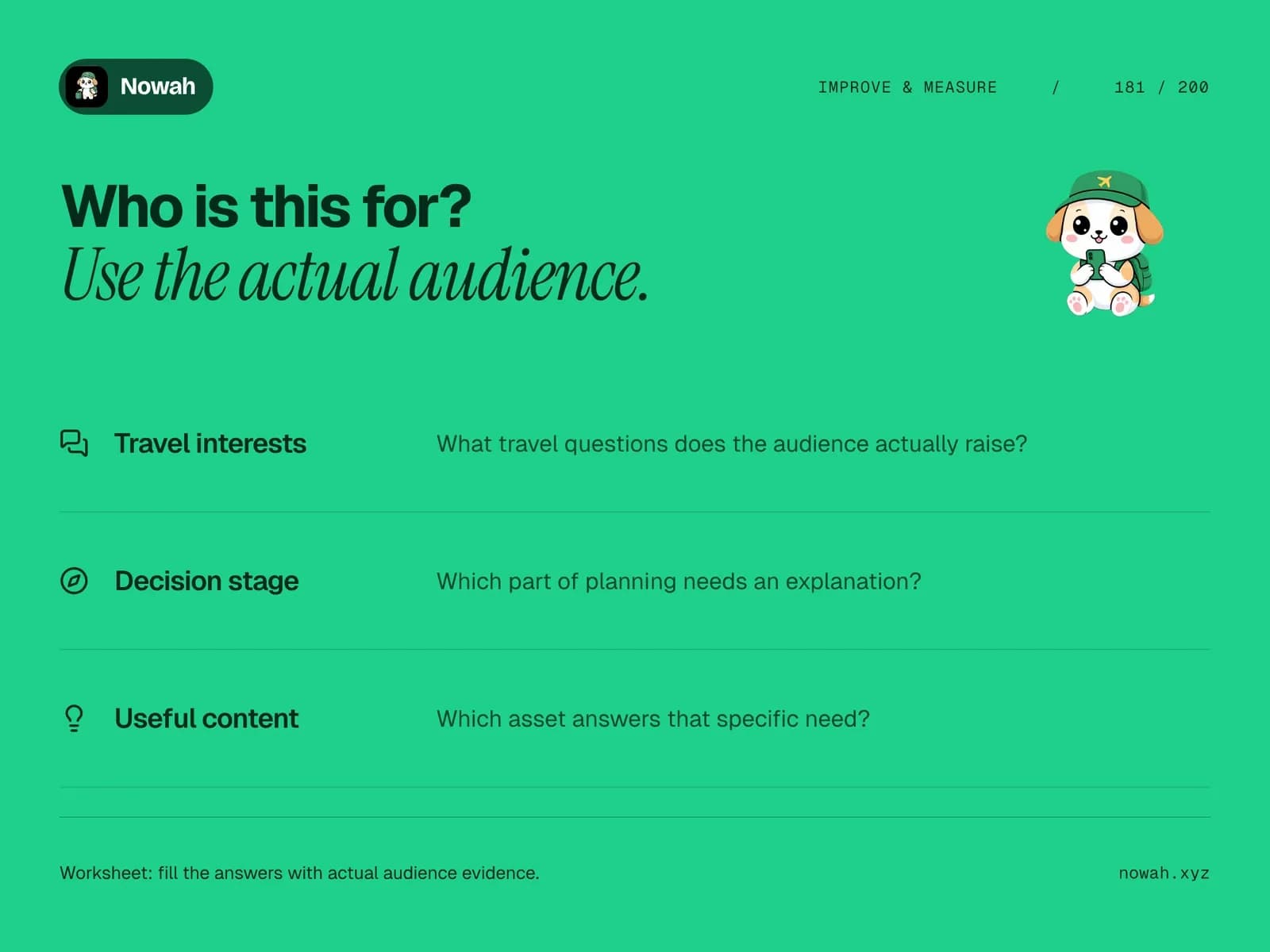
A travel recommendation has a stronger commercial purpose when you know which decision it helps someone make. For a creator earning through Nowah Partners, that decision might concern a hotel's location, a family rooming requirement or the shape of a short trip. “People who like travel” is a starting description, but it does not tell you what to demonstrate or why a follower should continue through Nowah.
The opportunity is to connect useful travel content with a valid new traveller relationship. Approved partners can earn 35% of Nowah net revenue from qualifying referred bookings, including possible later qualifying bookings by the same attributed account. The Nowah Partner Program overview explains the offer. Your audience-fit worksheet helps you decide where that offer belongs in your content, without inventing a demographic profile or forecasting income.
Start with decisions your audience actually faces
Look at the questions people have genuinely asked you. A follower asking whether a hotel area works for an early departure has expressed a different need from someone asking which camera produced your room-tour footage. Both questions are legitimate; only one directly opens a travel-planning demonstration.
Collect a small set of relevant questions in a working document. Record the wording, the content that prompted it and the decision that remains unresolved. Remove names and unnecessary personal details. You need to understand the planning task, rather than build a file about individual followers.
Avoid treating a content category as evidence of intent. Someone enjoying a luxury-hotel video may be researching a trip, saving inspiration or appreciating the architecture. Your next piece should make a useful planning question visible so interested travellers can recognise themselves. For examples, read luxury content that answers booking questions.
Distinguish interest from an immediate commercial action
A useful audience description can include people at different stages. Some are exploring a destination. Others have dates but need help comparing bases. A smaller group may be checking actual flights or accommodation. Those stages suggest different explanations and next steps.
Use a simple evidence label beside each question: inspiration, planning or current booking research. These are editorial labels for the task, not verified stages in a sales funnel. A comment cannot establish whether someone has money available, will book or qualifies as a newly attributed Nowah traveller.
This distinction makes your recommendation clearer. A planning example can invite someone to explore their own constraints in Nowah. A video built around inspiration may need a useful follow-up resource before the same invitation feels relevant. You can explain that progression without assigning invented conversion probabilities to it.
Build the four-column worksheet
Create four columns headed travel interest, specific decision, useful content and evidence limit. Complete one row for each genuine question you want to answer.
- Travel interest: describe the actual subject, such as a short food trip or a family stay.
- Specific decision: state what the traveller is trying to choose, compare or investigate.
- Useful content: name the explanation, demonstration or worksheet you can provide.
- Evidence limit: identify what you know and what requires current traveller or supplier information.
The row should point to something you can make. “Affluent travellers aged 30–45” does not provide a script. “Choosing between a quieter base and a central food district for three nights” gives you a concrete comparison. Only include demographic information when it is genuinely available, relevant and appropriately used; do not manufacture it to make the worksheet look complete.
Use the completed row as a creative brief. Draft a headline that names the decision, identify the visual that will explain it and write the invitation you would make after the demonstration. For the food-trip row, that might be a simple two-area diagram followed by a Nowah example using the same dates and pace. Reading those three elements together helps you check that the content, product demonstration and next action all serve the same traveller question.
A hypothetical audience-fit example
Imagine a fictional creator publishes neighbourhood walks and small-hotel reviews. Their teaching example includes three questions: where to stay for a compact food trip, whether to change hotels during a short break, and which microphone they use. These are invented questions for this illustration, not reported audience feedback.
The first row becomes a hotel-area comparison. The second becomes a single-base versus two-base explanation. The equipment question belongs in a separate production resource. The creator chooses the hotel-area row for a Nowah demonstration because the connection between the audience's question and the travel-planning task is clear.
Their fictional brief specifies three nights, a late arrival and a preference for food-focused outings. They show how those constraints affect the itinerary and the questions they would investigate about each area. A relevant next step invites interested viewers to explore their own trip through a disclosed active partner link. No booking, signup or earnings outcome is assumed.
The worksheet has done its job: it has produced a coherent recommendation with a useful next action. It has not certified that this audience is profitable.
Show why Nowah belongs in the answer
Make the Nowah segment answer the same question as the rest of the content. If you discuss a compact itinerary, demonstrate how the brief changes when arrival or departure constraints change. Explain which hotel-area questions remain open. Show a meaningful revision rather than placing an unrelated product endorsement after the conclusion.
This is a practical advantage of using Nowah in creator content: you can connect an observed travel detail to the wider trip the follower is trying to arrange. The demonstration gives your recommendation context. It also makes the invitation more understandable than a bare affiliate link beneath an attractive photograph.
Keep the example narrow enough to follow. The one-question demonstration guide explains how to turn the selected worksheet row into a focused piece of content. If you discuss hotel choices, the older anatomy of a hotel recommendation offers useful background for explaining the reasoning.
Keep two audiences separate
Your article or video may attract both travellers and other creators. They need different destinations. A traveller interested in planning a trip should understand your disclosed referral recommendation. A creator interested in earning through the program needs the program explanation and application process.
Label those actions clearly. Do not describe the application portal as the place a follower should book a holiday, or treat your own application as evidence that a traveller has been attributed. The creator-versus-traveller journey guide provides a separate worksheet for that distinction.
You also do not need a large audience to make a relevant application: Nowah states that there is no minimum follower count. Applications are reviewed, and other participation and payout requirements remain. A clear account of your content and audience can support an honest application without an invented reach figure.
Understand where earnings can arise
Audience fit helps you choose useful content; eligibility comes from the program rules. The Nowah Partner Program terms require a valid introduction followed by a new eligible traveller account within 30 days. Existing accounts and self-referrals do not create eligible new attributions. Tracking must succeed.
After valid account attribution, possible later qualifying bookings can also generate earnings for that account's lifetime. This makes a helpful first recommendation commercially meaningful beyond one trip, but it does not guarantee repeat bookings. The listed eligible categories are hotels, flights and paid eSIMs under the terms.
Keep the calculation base explicit. An illustrative $60 of Nowah net revenue produces a $21 partner share at 35%. That is hypothetical arithmetic, not an estimate of what your chosen audience will earn. Completion, supplier settlement, the applicable hold and payout conditions still separate a booking event from eligible earnings.
Review the worksheet using actual questions
After publishing, return to the selected row. Did new questions reveal that the brief was too broad? Did people understand the difference between the two areas? Did the destination explain what the content promised?
Record those observations without converting them into invented bookings or earnings. A follower asking about room occupancy may suggest your next useful guide. A high play count alone does not tell you whether the original travel decision was answered or whether a valid new account was established.
Retire rows that no longer reflect your audience or your available evidence. Refresh supplier-specific claims when you reuse a recommendation. The worksheet should remain a small editorial tool you can explain, rather than a complicated scoring system that hides uncertain assumptions.
Turn a clear audience task into a first campaign
Choose one worksheet row with a real planning question, enough evidence to explain the tradeoff and a relevant Nowah demonstration. Prepare a truthful disclosure and make the intended next action clear. That gives your first campaign a purpose you can assess before expanding the series.
If this approach fits your content, apply to Nowah Partners. Describe the useful recommendations you intend to create and the travel decisions they support. Nowah's continuing account attribution and defined net-revenue share provide a compelling reason to build helpful introductions; your audience-fit work makes those introductions more relevant from the start.




