How luxury travel creators can earn with Nowah by answering booking questions
Turn luxury travel reviews into useful Nowah recommendations with a map of room, location and actual rate questions that followers need answered.
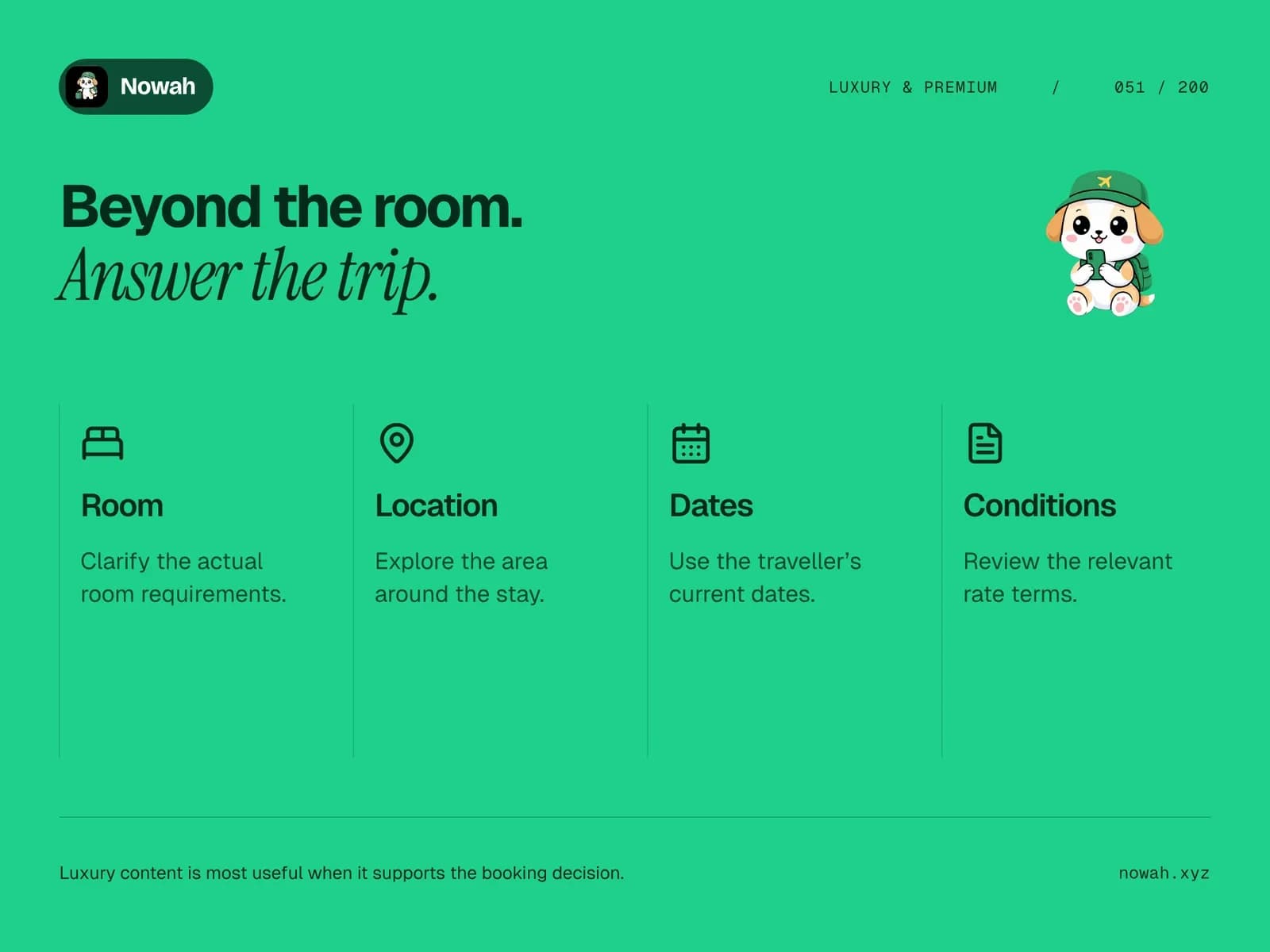
Luxury travel content becomes more useful when it helps a viewer investigate their own stay, rather than only admire someone else's. A room tour can inspire the trip, but followers still need to understand rooming, location and actual rate conditions. Those practical questions create a natural place to demonstrate Nowah and explain its Partner Program.
The Nowah Partner Program offers approved creators 35% of Nowah net revenue from qualifying bookings by eligible attributed accounts. Attribution continues for those accounts' lifetimes and can apply to later qualifying travel. That continuity is a meaningful opportunity for luxury creators who build a useful relationship with their audience.
This guide provides a booking-question map for turning an attractive review into practical planning content. It does not promise premium perks, guaranteed availability or larger earnings simply because a property looks expensive.
Begin with the question the review leaves open
A viewer may love the design of a hotel while needing a different room arrangement, travel date or location priority. The useful next question is what they need to investigate for their own trip.
Look for actual questions in the audience discussion or identify a clearly stated editorial hypothesis. Do not invent demand, private traveller details or a successful conversion story to justify the topic. A proposed content idea can be useful without pretending its results have been measured.
For luxury content, the unanswered question often concerns the difference between a beautiful observed detail and an actual bookable offer. The room you filmed, the arrangement you experienced and the rate another traveller can investigate may differ.
The luxury room-tour evidence guide helps organize the information behind that distinction before it becomes a recommendation.
Map room, location and rate questions separately
Use three columns for the stay decision. The room column covers the actual rooming needs and category questions. The location column covers the traveller's priorities and fixed commitments. The rate column covers the conditions attached to the current offer.
Do not let one attractive feature answer all three. A large-looking room does not establish occupancy. A striking lobby does not prove the location fits an evening arrival. A displayed price does not establish inclusions or cancellation conditions.
Your creator expertise lies in explaining these differences clearly. A useful Nowah demonstration can organize the brief and identify the next facts to investigate, while current supplier evidence supports the actual room and rate conditions.
The full travel-decision guide provides a focused resource for bringing dates, rooming, location and conditions back into the same discussion.
Work through a fictional luxury-stay brief
Imagine two adults planning a four-night celebration trip. They prefer one main base and a manageable daily pace. They have not requested an upgrade, an exclusive rate or an invented VIP arrangement. The example is fictional and contains no actual creator earning result.
A Nowah demonstration can show how you would describe those priorities and compare two directions: a location-led stay and a facilities-led stay. Explain the tradeoff rather than declaring one option universally best.
Then identify the next checks. Actual room configuration, availability, included services, fees and cancellation conditions need current provider-specific evidence. A planning output is not a certificate that those conditions are met.
The recommendation becomes commercially relevant because the viewer has seen a practical reason to continue in Nowah. The earning explanation supports the useful planning task rather than appearing as a detached paragraph after the review.
Build a booking-question map
For each question, record the source, evidence status, useful explanation and appropriate next action. Keep personal observations, supplier-stated facts and fictional teaching inputs in separate fields.
A room question may need the actual category and occupancy information. A location question may need a clearer brief and current transport research. A rate question may need the exact offer conditions rather than a general property description.
Add a final field naming where Nowah helps the reader continue. That could be organizing the current brief or exploring how a changed priority affects the trip. It should not promise a guaranteed supplier outcome.
Use the map to choose the article's or video's main demonstration. If every question leads to the same generic slogan, the content needs a more specific practical task.
Turn the map into a useful content sequence
Choose one observed detail to introduce the question, then move into the labelled planning example. If the detail concerns room space, explain why the fictional party still needs the actual category and occupancy information. If it concerns the surrounding area, explain which location priority the reader should investigate rather than promising a fixed journey time.
End the sequence with the specific next question, not a universal verdict about the hotel. This gives the viewer a decision process they can adapt and a clear reason to continue the investigation in Nowah. It also makes a shorter extract easier to understand when shared outside the full review.
Use your own experience honestly
If you personally stayed at the property, identify the relevant context and date. One visit can support a useful observation without establishing how every room or season will feel. Do not turn a hosted arrangement or upgrade into a standard benefit for followers.
If you are researching an option rather than reporting a stay, say so. A creator can teach an evidence-led process without pretending to have visited every property mentioned. Generated diagrams should remain distinct from real travel photography.
The first-hand review versus researched example comparison provides a useful evidence check. The existing hotel review and star-rating discussion offers broader context for why a simple score or luxurious image may leave important questions unanswered.
Clear evidence makes the Nowah demonstration easier to trust because the viewer can see what the content actually establishes.
Explain the earning base precisely
Approved Nowah partners receive 35% of Nowah net revenue from qualifying hotel, flight and paid eSIM bookings by eligible attributed accounts. The current terms define permitted direct deductions and exclude general overhead, salaries and general marketing from that list.
The traveller's full retail booking price is not the base. As hypothetical arithmetic, a qualifying booking producing $60 of Nowah net revenue would generate a $21 partner share. This does not predict the value of the fictional celebration trip or establish a premium earning rate for luxury content.
A more expensive room does not automatically reveal higher net revenue. The recommendation should favour suitability and clear evidence rather than the appearance of a larger commission opportunity.
The luxury-versus-budget earning definition guide explains why the same commercial definition applies across audience categories.
Describe the continuing account relationship
For a luxury recommendation to establish the described Nowah relationship, the eligible new traveller needs the active partner route, successful tracking and a new account created within 30 days of the valid introduction. Existing accounts, self-referrals and artificial accounts do not qualify.
Once established, attribution continues for the traveller account's lifetime and can apply to later qualifying bookings. That continuity is a substantial reason to consider Nowah for useful evergreen guides rather than only a single property campaign.
It remains conditional. A traveller may not book, may choose an ineligible purchase or may not return. Lifetime attribution is not guaranteed repeat income or a fixed monetary value assigned to every follower.
The repeat account-attribution guide helps explain the relationship separately from the evidence for one actual booking.
Make the next step match the audience
A traveller watching the review needs a clear explanation of the planning task they can continue through the appropriate active partner route once you are approved. Another creator reading an educational article may instead need the program overview and application.
Keep those destinations distinct. A button promising help with a stay should not unexpectedly open a creator application process. Disclose the partner relationship alongside the recommendation and check the actual link surface available on your publishing channel.
The clear-next-step guide provides a practical review for the promise, destination and action. A useful handoff helps the reader understand why Nowah appears in the content.
Review evidence before discussing results
After publication, record actual questions and available program events with clear definitions. A comment about a suite does not establish an eligible account. A link interaction does not prove a qualifying booking or bank payment.
Nowah earnings require completion, supplier settlement and the hold after the later event, followed by the relevant monthly payout conditions. Refunds or corrected supplier statements can affect earnings. A pending amount is not money already received.
Nowah gives luxury creators a compelling earning model when useful recommendations introduce eligible new travellers and qualifying travel follows. Choose one booking question, complete the map and prepare a labelled demonstration. If the model fits your audience, apply to Nowah Partners. Applications are reviewed, and approval, eligibility and verification requirements apply. Let the room imagery inspire interest, then use clear planning help to make the recommendation worth following.




