Turn Travel-Content Attention into a Useful Nowah Next Step
Move from travel-content attention to a useful Nowah next step by clarifying the audience question, product relevance and disclosed destination.
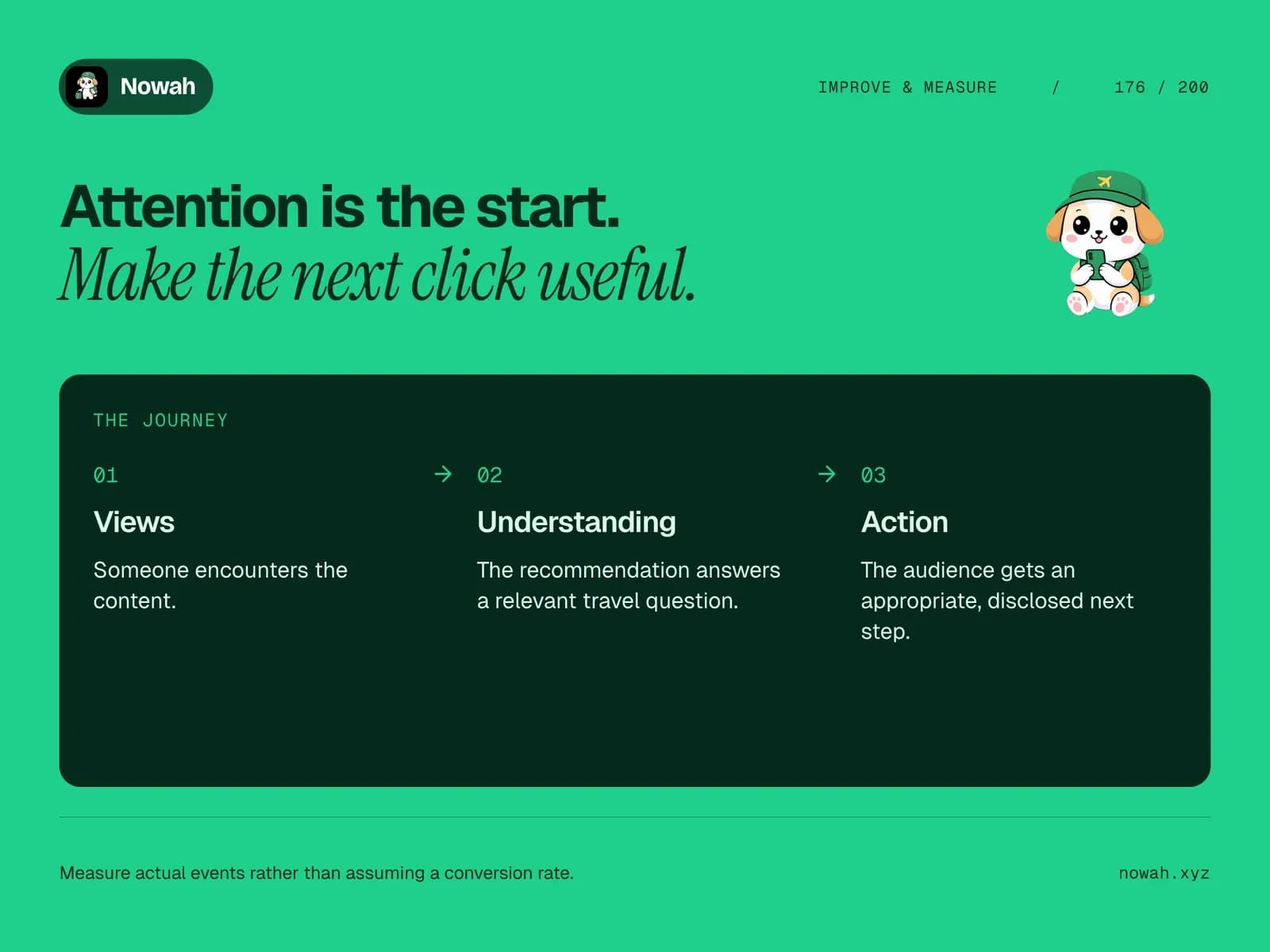
Attention gives a creator a chance to explain something useful. It does not tell you whether the audience understood the recommendation or knew what to do next.
For Nowah content, the next step should grow from a practical travel question. A hotel-area explanation, an arrival-day example or a trip-structure comparison can show why the product is relevant before a viewer encounters a commercial action.
Approved Nowah partners can earn 35% of Nowah net revenue from qualifying bookings by eligible new accounts they introduce. The opportunity is worth explaining clearly, but no number of views guarantees clicks, attributed accounts, bookings or income.
Identify what caught the audience's attention
Begin with the content's promise. Did the opening raise a useful question, show an observed detail or present an attractive image?
Those entry points can lead to different expectations. A viewer who arrived for a hotel-room observation may need more context before a planning recommendation makes sense. A reader searching for partner-program information may already be considering an application.
Do not assume the audience knows why Nowah belongs in the piece. State the connection between the question and the product task.
If the attention comes from an image or example, keep its evidence role honest. A generated diagram is not a real stay photograph, and a fictional brief is not a follower testimonial.
The first useful transition is from noticing the content to understanding the decision it addresses.
Explain one traveller decision
Choose a question narrow enough to answer. A short break with an early departure, a hotel-move tradeoff or a rooming requirement can give the explanation a clear purpose.
Describe the relevant inputs and the priority that shapes the answer. Do not turn every post into a promise to plan every aspect of a holiday.
Then explain why a Nowah demonstration helps investigate that decision. The audience should see a practical role, rather than a brand name added after unrelated travel footage.
The one-question demonstration guide provides a useful method for reducing an overbroad content idea.
A specific lesson can remain useful even when someone decides not to take the commercial next step. That is a helpful test of the content's audience value.
Make the recommendation understandable
Write the recommendation in plain language. It should describe the task a reader or viewer can investigate next and why that task follows from the explanation.
Avoid an unsupported promise such as a guaranteed lowest price or a universal best hotel. A useful next step can be an investigation, a comparison or a clearer brief.
If you show Nowah, verify the current product behaviour. Do not invent a creator dashboard, a referral notification or a completed booking to make the sequence feel more persuasive.
Keep supplier questions separate from planning. A day structure does not establish availability, room conditions or a transport arrangement.
Nowah's article about the anatomy of a hotel recommendation offers background for connecting facts to requirements. Your content still needs to explain its particular decision.
Choose a relevant disclosed action
Tell the audience that you are a Nowah partner and may earn commission from qualifying referrals. Keep that relationship understandable with the recommendation.
For travellers, use the active route supplied after approval and onboarding. Do not invent a referral address or imply that the ordinary creator application page attributes traveller bookings.
For prospective creators, the official overview and application portal are appropriate next steps. Describe the reviewed application rather than promising automatic approval.
Check the actual linking tools on the account and format you are using. The instruction should describe a route the audience can find, not one copied from another creator's setup.
The relevant destination guide helps match that action to the promise in the content.
Build a recommendation-understanding worksheet
Record:
- The audience question that earns attention.
- The useful explanation the content provides.
- The specific role of Nowah.
- The evidence behind important claims.
- The next task and intended audience.
- The actual destination and route.
- The partner relationship statement.
- The observation that would reveal confusion.
- The outcomes that remain unmeasured.
This is a creator-maintained editorial tool, not a claimed Nowah analytics interface.
Complete the product-role and destination fields before writing a polished call to action. If either remains vague, more promotional language will not make the recommendation clearer.
Keep the outcomes field honest. You can plan to examine understanding without inventing a future conversion rate.
A fictional video revision
Imagine a creator making a video about a short city break with a fixed evening event. This is a hypothetical editorial example, not a reported improvement in campaign performance.
The first draft contains attractive travel footage and a closing invitation to use Nowah, but it does not explain why the product matters to the scenario.
The creator revises the piece around one question: how does a late arrival affect the first day's plan? A clearly fictional brief introduces the constraint.
A verified Nowah demonstration investigates a lighter day structure, while the creator explains the reasoning and identifies the supplier questions still needing current evidence.
The closing instruction describes a relevant next task and the actual route available on the publishing account. The partner relationship is clear.
The revision creates a more coherent explanation. It does not establish that more people will click, create accounts or book.
Review understanding before claiming performance
Read or watch the content as someone encountering Nowah for the first time. Can you identify the question, the useful finding and the intended next action?
If another person helps review it, ask what they think the destination will let them do. Treat confusion as an editorial issue to investigate, not evidence that a particular algorithm or tracking system has failed.
Use genuine audience questions where available. Do not manufacture replies or present a fictional review exercise as real customer feedback.
A viewer may understand the content and still choose not to act. That possibility does not make the explanation unsuccessful at its educational task.
The value-review guide without forecasts develops a way to describe what has been observed while keeping commercial outcomes separate.
Keep attention, attribution and booking distinct
The Nowah terms require an eligible traveller to follow an active partner link and create a new account within 30 days of introduction, with successful tracking.
Existing accounts and self-referrals do not qualify. Valid account attribution can support earnings from later qualifying hotel, flight and paid eSIM bookings for the account's lifetime, but future travel is not guaranteed.
The 35% share applies to Nowah net revenue, not the traveller's total booking spend. Completion, supplier settlement and the applicable hold and payout conditions remain necessary.
A content view or a clear next step does not establish those later events. Use actual program records for what they document.
This lets you explain the genuine opportunity without treating an intermediate interaction as paid commission.
Keep any test focused and truthful
If you compare different next-action wording, preserve the same underlying facts and commercial relationship. Do not make one version more exciting by adding an unsupported saving or income promise.
Choose the question the review will answer before looking for a result. You may be evaluating whether the destination task is understandable, rather than claiming a revenue effect.
Keep records of what actually happened and what remains unknown. Do not turn a small anecdote into a universal rule about the best call to action.
If the audience's question changes, revise the content proposition rather than only changing the button or closing phrase.
The useful sequence is attention, understanding and a relevant action. Each part needs its own evidence.
Record the promise before making changes
Save the actual wording of the audience question and next action in your worksheet. A vague note that a post promoted Nowah will not help you understand what the viewer was being asked to do.
When you revise the content, record the reason: perhaps the destination task was unclear, a constraint was missing or the commercial explanation needed a better position. Keep that editorial observation separate from any later programme result.
This makes the review useful even before commercial outcomes are known. You can explain what changed and why without claiming that the change caused a booking, improved a conversion rate or generated earnings that the evidence does not establish.
Maintain the promise after publication
Review the destination and changeable claims when you reuse the content. An accurate recommendation can become confusing if the route or page purpose changes.
Keep fictional examples labelled and supplier facts supported. Do not add a pretend booking or payment screenshot to create a stronger story.
For the next piece, choose another decision the audience genuinely needs help with. A rooming checklist and an arrival-day explanation can offer different useful outputs without repeating the same generic pitch.
If this fits your work, apply to Nowah Partners. Build a recommendation worth understanding, then give the audience a truthful next task. That is a stronger foundation for earning opportunities than assuming that attention alone will produce them.




