Beach resort vs city base: help luxury travellers compare the trip structure with Nowah
Compare a beach-resort direction and city base with a Nowah route outline that explains daily rhythm, movements and actual supplier questions.
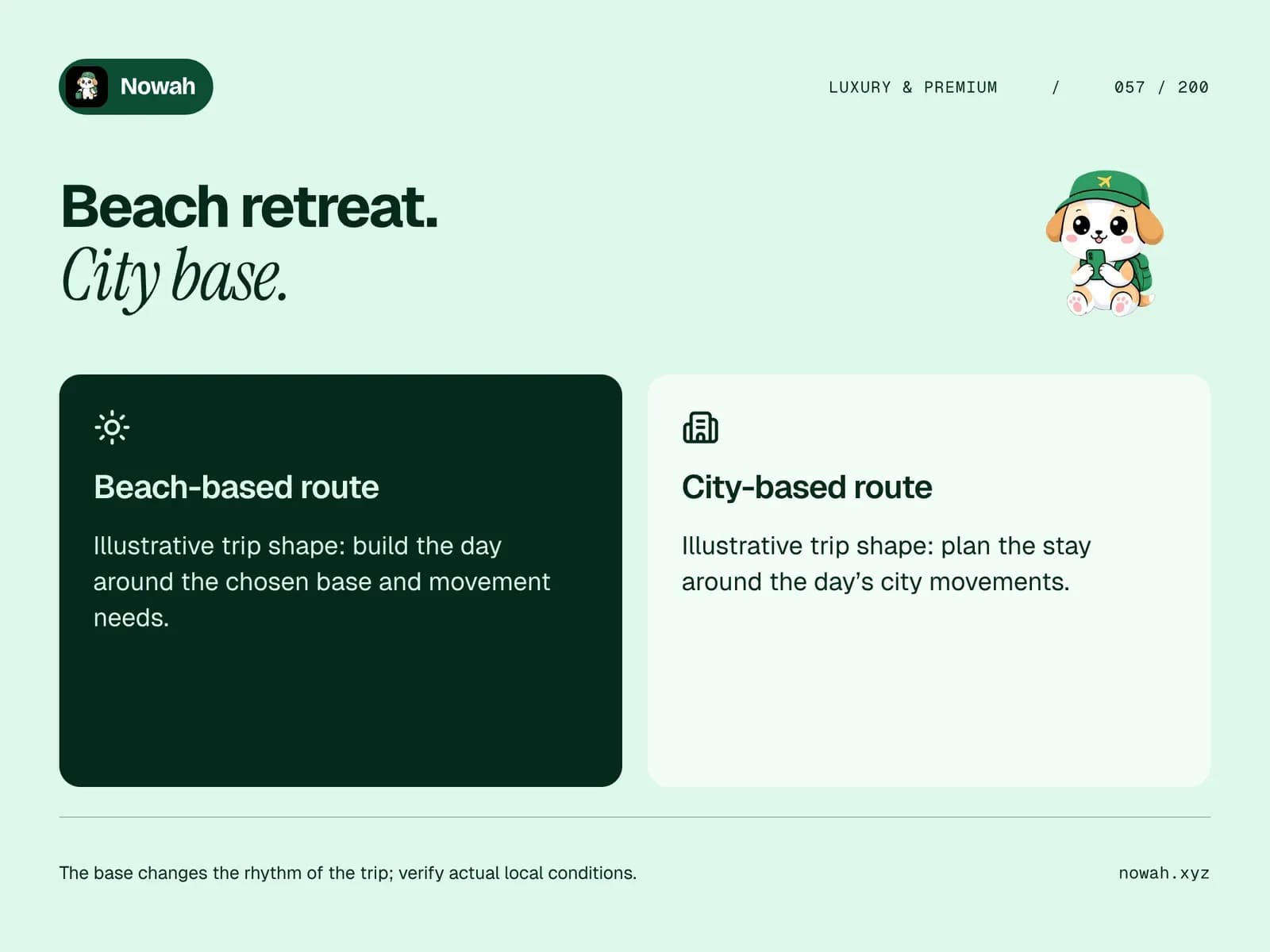
A beach-resort direction and a city-base direction can create different travel rhythms, but neither label tells the whole story. A beach property may be closely connected with a city, and a city stay may still allow substantial time on site. A useful creator comparison explains the actual trip structure rather than relying on scenery alone.
The Nowah Partner Program offers approved creators 35% of Nowah net revenue from qualifying bookings by eligible attributed accounts. Its continuing account attribution gives useful luxury travel explanations a meaningful earning opportunity without a universal claim that one holiday style is better or more profitable.
This guide provides a two-direction route outline for a labelled Nowah demonstration. It helps you compare pace, movements and requirements while keeping actual hotel, transport and offer information subject to current verification.
Define what the traveller wants from the break
Start with the priorities actually stated. A traveller may want substantial time at one property, several fixed commitments away from the hotel or room to choose between both. Do not infer the answer from a celebration label or an attractive resort photograph.
Use a current brief with dates, party, rooming questions, budget scope and fixed anchors. If the example is fictional, say so and explain why those inputs were chosen for teaching.
The purpose is to identify which decisions the comparison should resolve. A reader asking about daily movement needs a different explanation from one asking about actual meal inclusions or a specific room arrangement.
The personalisation-versus-assumptions guide helps build that brief before you choose two visually different stay directions.
Treat beach and city as research directions
Do not assume every beach property provides the same facilities, access arrangements or level of quiet. Do not assume every city base is convenient for the traveller's actual commitments. Verify the concrete facts that matter to the brief.
A location or map pin can support investigation, but it does not certify actual journey times, access or transport conditions. A photograph of a beach or pool does not establish what the traveller's rate includes or what is available during the proposed stay.
Explain which property and route information is established and which remains a question. A polished comparison should reveal those limits rather than replace them with broad claims about relaxation or convenience.
The location-versus-facilities guide is a useful supporting resource when the apparent destination choice is really a question about how the traveller expects to use the hotel.
Work through a fictional two-direction brief
Imagine two adults planning a four-night break with one main base. They want a manageable pace and have not decided how much time to spend away from the property. The example is fictional and includes no named hotel's actual rates or availability.
The creator prepares a beach-base direction and a city-base direction as options to research. Each uses the same party and broad travel scope, while identifying different movement and supplier questions.
A Nowah demonstration can show how those priorities organize the brief. The beach-base outline might emphasize questions about time on site and access arrangements; the city-base outline might emphasize the relationship between the hotel and fixed commitments. Neither description is a guarantee about a real property.
The useful output is a comparison of trip rhythms. It does not establish that one direction is universally quieter, cheaper, safer or more likely to generate creator earnings.
Draw the first and last day as well as the middle
A stay comparison should not ignore arrival and departure. The first night and final morning can change how useful a base is to the actual trip. Identify the relevant timing questions rather than filling a map with unverified journey estimates.
For the fictional brief, mark the arrival window, the first full day, any fixed commitment and the departure requirements. Keep unknown actual transport and supplier arrangements as questions for current research.
This makes the Nowah segment practical. The viewer can see why a base decision involves more than an appealing property image. The demonstration should explain the reasoning, not simply display a finished-looking itinerary.
The late-arrival luxury-stay guide provides a focused next resource if the arrival constraint becomes the main decision.
Build a two-direction route outline
Use one column for each research direction and matching rows for the traveller's priorities. Include rooming, intended daily rhythm, movements to investigate, relevant on-site questions, actual offer conditions and unresolved information.
Match the dates and party before comparing any sourced prices. Keep the inclusion basis and material restrictions visible. Do not treat two offers as equivalent if one contains a feature or flexibility condition the other does not.
Add a sentence describing the meaningful tradeoff. If the only difference you can explain is that one image has a beach and the other has buildings, the comparison needs more practical reasoning.
The matched-scope resort guide helps preserve the actual offer basis when the two directions lead to different supplier research.
Use the outline to structure the explanation
Choose one day from each illustrative direction and describe the decision it raises. For a day focused on time at the property, identify the facility or inclusion question the traveller needs answered. For a day involving a fixed commitment elsewhere, identify the location and movement information required.
Keep the party and dates constant so the viewer can see which priority changed. A creator does not need a packed itinerary or an invented travel-time estimate to teach this distinction. The useful lesson is how the actual rhythm of a day changes the next question to investigate in Nowah.
Show how the brief changes the investigation
A useful Nowah demonstration can revise one input and explain the consequence. If the fictional traveller adds a fixed commitment away from the property, identify which location question needs more attention. If they decide to spend more time on site, identify which facility facts require current evidence.
Do not imply that one changed output proves the previous direction was wrong. Different priorities can lead to different useful investigations. The provider's actual ability to meet a request remains something to verify.
The one-question demonstration guide helps keep the segment focused. A clear explanation of one relationship can be more useful than a long list of generic destination features.
The existing hotel booking with AI guide provides broader context for the travel task, while the fictional route outline remains a teaching aid rather than a live offer.
Keep the earning base separate from the scenery
The beach-versus-city decision does not change the Nowah earning definition: approved partners receive 35% of Nowah net revenue on qualifying bookings by eligible attributed accounts. Retail trip spending is a different amount. The permitted direct deductions exclude general overhead, salaries and general marketing, regardless of which base direction the traveller investigates.
For hypothetical arithmetic, a qualifying booking producing $60 of Nowah net revenue would generate a $21 partner share. This does not forecast the earning value of either fictional base direction or establish that a resort image implies a higher margin.
The recommendation should follow the brief and evidence. The independent-judgement guide helps keep the commission opportunity separate from suitability and the traveller's actual priorities.
Describe the account relationship accurately
The useful comparison does not by itself establish attribution. The eligible new traveller needs the active partner route, successful tracking and a new account created within 30 days of the valid introduction. Existing accounts, self-referrals and artificial accounts do not qualify.
Once established, attribution continues for the traveller account's lifetime and can apply to later qualifying hotel, flight and paid eSIM bookings. That continuity is a meaningful Nowah strength for useful evergreen luxury content, without guaranteed repeat income.
Actual earnings also require completion, supplier settlement, the hold after the later event and relevant payout conditions. A pending amount is not money already received. Keep those stages distinct if you later discuss the content's commercial results.
Review the comparison before distribution
Open the finished resource as a first-time reader. Can they identify the actual priorities, the difference in trip rhythm and the supplier question that could change the choice? Does the visual distinguish illustrative routes from current verified facts?
Check that the link destination matches the content promise and disclose the partner relationship beside the recommendation. Another creator may need the program application, while an approved traveller recommendation needs the appropriate active partner route.
Do not promise a particular outcome from the published comparison. Use actual questions and available evidence to decide what needs a clearer explanation next, rather than inventing a conversion improvement.
Nowah gives luxury creators a compelling opportunity when useful trip advice introduces eligible new accounts and qualifying travel follows. Choose one base question, complete the outline and apply to Nowah Partners if the model fits your audience. Applications are reviewed, and approval, eligibility and verification requirements apply. Let the traveller's planned rhythm shape the investigation, keep the evidence visible and make the recommendation useful enough to follow.




