How Luxury Travel Creators Can Explain Late Arrivals and Earn Through Nowah
Explain late arrivals with accurate dates, hotel questions and a useful Nowah workflow for luxury travel followers.
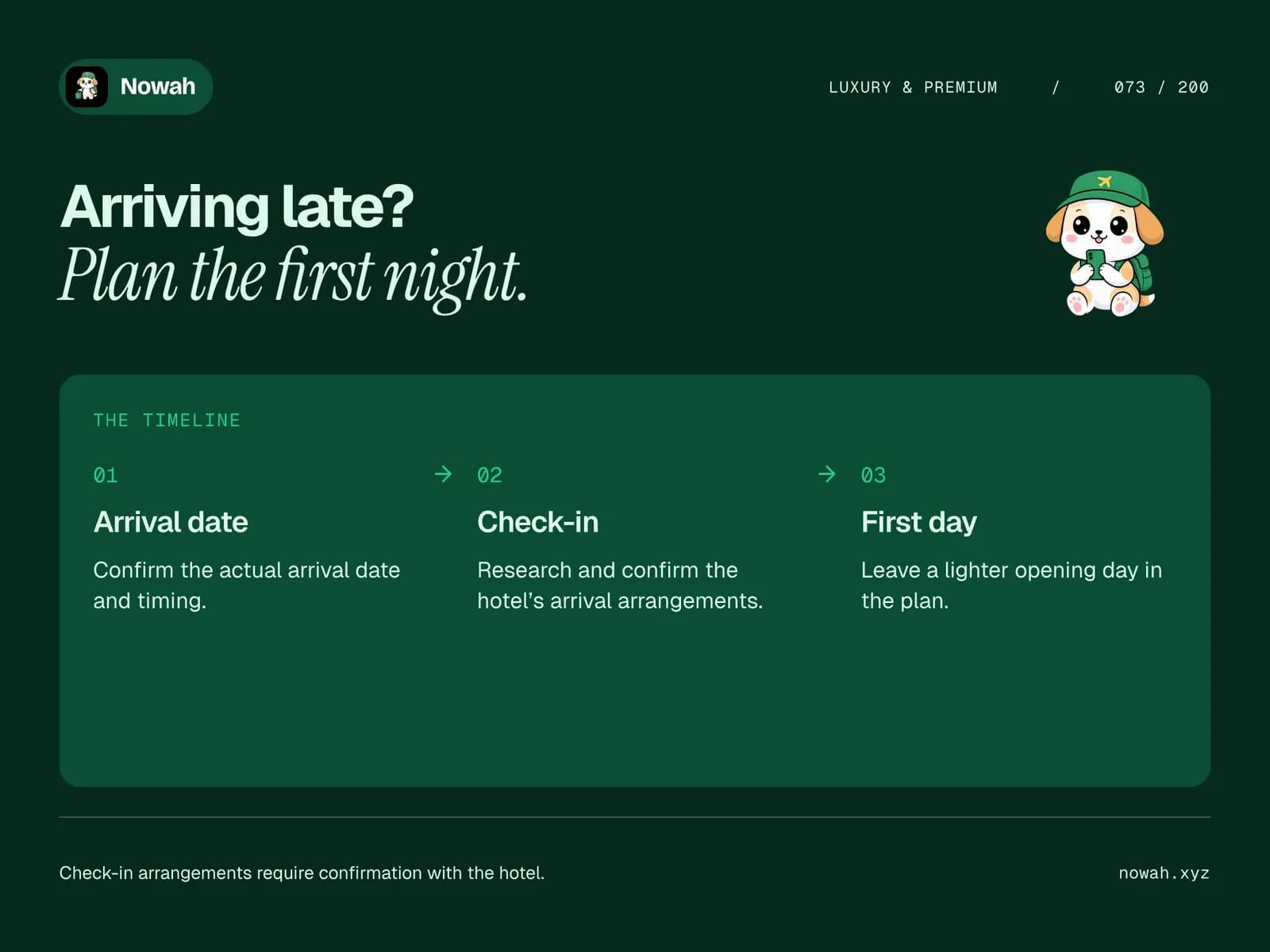
A late arrival can change which accommodation questions matter most. The hotel imagery may still look appealing, but the traveller needs to understand the actual arrival date, the relevant check-in conditions and how the first part of the trip should be structured. An approved Nowah partner can turn that practical explanation into a useful recommendation, a disclosed referral and potential earnings from qualifying bookings by newly attributed travellers.
Nowah fits this content when you show how an arrival boundary changes a current travel brief. Use it to explore the flight and stay context, review the proposed first day and make the remaining supplier questions explicit. That is a credible reason to recommend the service without promising a late check-in arrangement or a benefit that has not been confirmed.
The commercial opportunity follows valid attribution and qualifying travel. A late flight, a premium room or a complicated arrival does not establish a particular commission. The partner share is 35% of Nowah net revenue, not a percentage of the traveller's total booking spend.
Establish the actual arrival date first
Begin with the arrival information, not the date the traveller leaves home. If a real flight crosses dates, investigate the actual local arrival date and how it relates to the intended accommodation nights. Do not assume that a departure date, arrival date and hotel night mean the same thing.
Use a fictional example for a general creator demonstration. Imagine a traveller investigating an arrival late in the evening, followed by a short premium stay. Say which inputs are hypothetical and which details would need current flight and supplier evidence before booking.
Avoid universal instructions about which accommodation night to purchase. The appropriate arrangement depends on actual dates and provider conditions. Your content should teach the traveller what to establish and confirm, rather than offer a blanket rule that could misrepresent the trip.
Separate flight information from hotel arrangements
An actual flight arrival does not establish the traveller's arrival time at the accommodation. Movement, the relevant arrival process and other conditions can matter. Do not invent a precise hotel-arrival time merely to make the itinerary look complete.
The accommodation also has its own relevant conditions. Explain which arrangements the traveller needs to check for the exact offer and party. A property operating in a premium category does not by itself guarantee a particular check-in arrangement, room access or service.
Keep evidence and status together. If the provider has acknowledged a question, record that accurately. Do not treat an acknowledgement as confirmation that the requested arrangement is available. The VIP language guide provides a broader method for preserving that distinction in luxury travel content.
Demonstrate a late-arrival brief in Nowah
Use Nowah to explore a brief that includes the actual arrival boundary, the intended stay dates and the traveller's preferred first-day pace. Explain the question you are testing: whether the proposed accommodation direction and itinerary respect that boundary.
Review the suggested plan. If it treats the arrival day as a full destination day or places a demanding commitment early the next morning, identify that assumption. Revise the outline to reflect the stated preference rather than presenting a busy schedule as evidence of a better trip.
This demonstration should make Nowah's role visible in the reasoning. It helps the creator organise a travel problem and explain a revision. It does not replace provider confirmation of an arrival arrangement or certify that every component is available.
For a reader evaluating a very short stay, link to premium short-break planning. That supporting article explains why a trip's actual usable window can matter more than the number of nights in the headline.
Give followers a late-arrival confirmation sheet
A useful sheet should expose the information needed before the traveller relies on the plan. Include these fields:
- Actual flight arrival location and local date.
- Intended accommodation dates and relevant rooming requirements.
- The accommodation arrival question that needs a direct answer.
- The source and date of any provider information.
- The arrangement's actual status: unresolved, acknowledged or confirmed.
- The first-day planning implication if an assumption changes.
Keep the sheet proportionate and use fictional information in public examples. Do not display real reservation references or private traveller details to make the demonstration appear more authentic.
Show the audience one unresolved field and explain why it matters. For example, if the accommodation arrangement remains unconfirmed, the creator should not present the whole arrival sequence as settled. The sheet gives followers a concrete way to continue their own checks.
Compare first-day structures rather than promising recovery
In the fictional example, compare two first-day outlines after the late arrival. Direction A preserves open time and one optional interest. Direction B includes a fixed commitment that places more dependence on the actual arrival arrangements.
Explain which assumptions each outline introduces. Do not promise that the lighter version will deliver a particular health, sleep or emotional outcome. It is a planning choice based on the traveller's stated preference, not a guarantee of how they will feel.
Use Nowah to revise the day outline once the relevant information is clearer. Keep the same trip duration and travelling party in both directions. A comparison is less useful if the preferred version quietly acquires an extra night or a confirmed benefit that the other version lacks.
The wellness-stay content guide expands the distinction between travel preferences and medical claims. Linking to it helps a creator explain a slower pace without making unsupported promises about the stay.
Make the accommodation offer visible
If the traveller compares two rates or properties, identify the actual room, occupancy and conditions being investigated. Do not assume meals, transfers, flexible cancellation or a particular arrival benefit is included because the property appears luxurious.
A creator can explain that a certain accommodation direction deserves research while leaving the final offer provisional. Current supplier information should determine the claim, not the desired ending of the video.
A companion article can hold the detailed confirmation sheet while a short video introduces the main question. Preserve the important unresolved condition in the shorter format as well. A viewer should not need to find a hidden footnote to learn that the arrival arrangement was never confirmed.
Place the partner link beside the useful next action
Disclose that you are a Nowah partner and may receive commission from qualifying referred bookings when recommending that the traveller continue the relevant research through an active link. Keep the disclosure beside the recommendation so the audience understands your relationship before acting.
The Nowah program terms require an eligible traveller to follow an active partner link and create a new account within 30 days of the introduction. Existing accounts, self-referrals and artificial accounts do not qualify. Tracking must reach Nowah successfully; a link click does not establish attribution by itself.
Once valid attribution is established, it can persist for the lifetime of that traveller account, including qualifying later bookings. That makes a useful arrival guide potentially relevant beyond the first trip, but it does not guarantee repeat bookings or creator income.
Separate the application journey for a fellow creator from the traveller referral journey. Someone investigating this arrival plan needs a relevant planning next step, while someone wanting to earn through the program needs the application destination.
If you show a confirmation example, label fictional text clearly and remove private information from any real evidence you are authorised to discuss. The audience needs to understand the type of answer that resolves the question, not see a traveller’s actual reservation details. Keep the confirmation tied to the specific arrangement rather than using it as a general promise about every future stay. That distinction matters particularly when a short clip circulates separately from the full arrival guide.
Explain commission without pricing the hypothetical arrival
Nowah's listed qualifying categories are hotels, flights and paid eSIMs. A separately arranged service mentioned in an arrival guide is not automatically commissionable. Keep the recommendation tied to supported travel products and the actual program terms.
The partner share is 35% of Nowah net revenue after the direct deductions defined in the terms. The traveller's full booking price is not the base. A clearly hypothetical $60 of qualifying Nowah net revenue would produce $21 in partner earnings; that does not estimate the return from a late-arrival hotel booking.
Earnings depend on completion, supplier settlement and the applicable hold and payout conditions. A useful planning demonstration, a new attributed account, a pending booking and eligible earnings are different stages. Treat them that way in the article and any performance discussion.
The older Nowah article on the anatomy of a hotel recommendation provides background for choosing accommodation around actual requirements. To participate commercially, apply to Nowah Partners. Applying is free, applications are reviewed and there is no minimum follower count. Start with accurate arrival inputs, demonstrate the useful Nowah revision and help followers resolve the questions that determine whether their first night works.




