How Travel Creators Can Explain Cancellation Flexibility Through Nowah
Explain cancellation-flexibility tradeoffs using current offer evidence and a transparent Nowah partner recommendation.
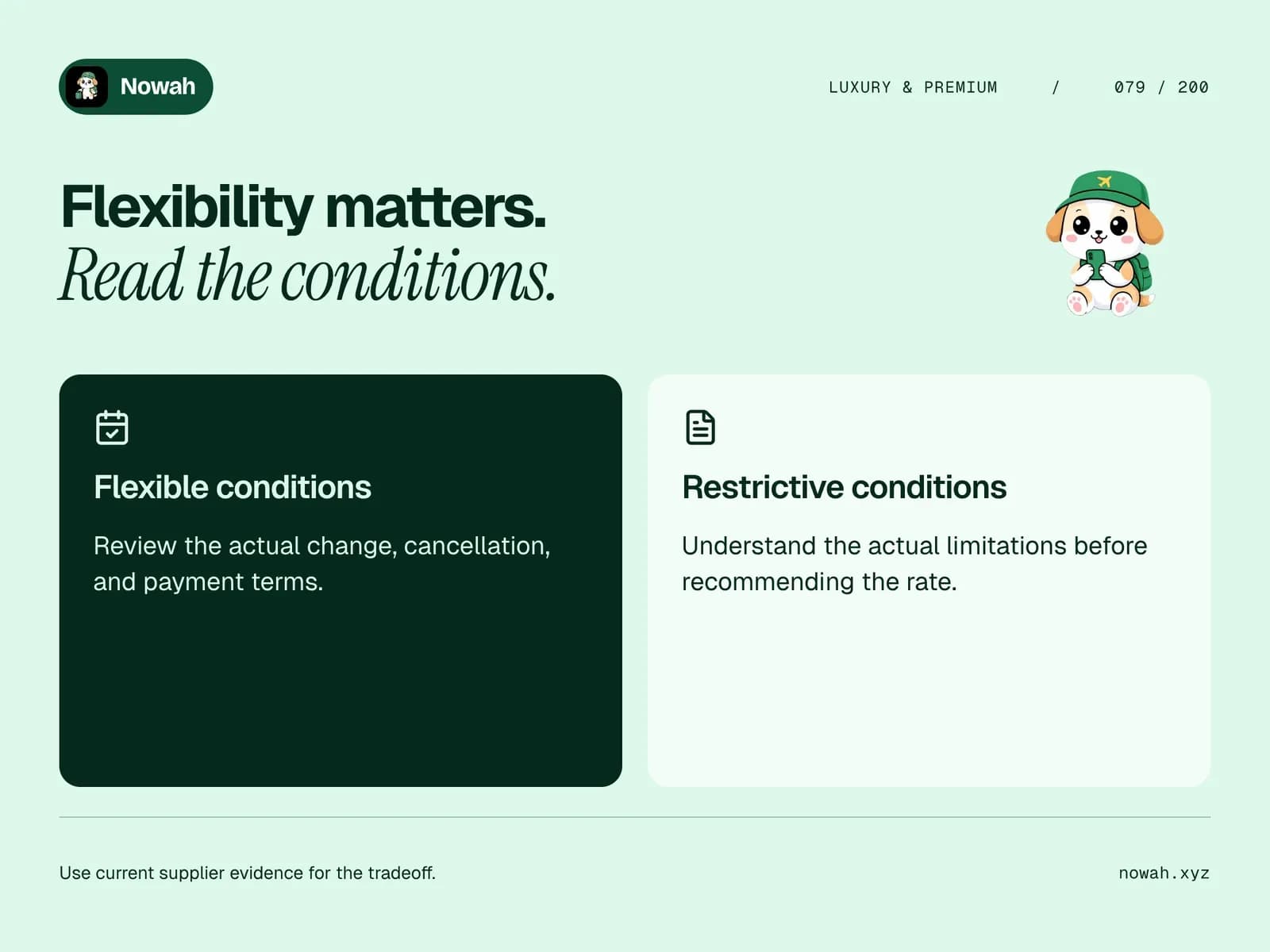
Cancellation flexibility can change a premium travel decision, but the label alone is not enough to recommend an offer. A useful creator guide explains the actual conditions, the traveller's uncertainty and the tradeoff between the options being investigated. Approved Nowah partners can connect that explanation to disclosed referrals and potential earnings from qualifying bookings by newly attributed travellers.
Nowah is a good place to demonstrate how flexibility belongs in a current travel brief. Show which plans are settled, what may change and which offer questions need evidence. The recommendation then helps a follower research a decision instead of treating a reassuring word or a lower visible amount as a complete answer.
The creator's earning calculation is separate. The partner share is 35% of Nowah net revenue from qualifying bookings, not a percentage of the traveller's full booking price. A more expensive rate does not establish a larger partner earning, and the commercial relationship should not determine which conditions fit the traveller.
Identify the uncertainty behind the question
Ask what the traveller is uncertain about. Dates, the travelling party, a fixed commitment or the sequence of a wider trip may still be under discussion. Different uncertainties create different questions for the actual offer.
Use a fictional brief for a public demonstration. Imagine two adults investigating a four-night stay while one important trip commitment remains unresolved. Say that the example explains a decision method; it does not describe a real cancellation event or certify the conditions of an actual property.
Avoid assuming that every traveller values flexibility equally. Someone with settled dates and a different set of priorities may investigate a different direction. Your role is to explain the relationship between the brief and the conditions, not declare one broad rate category universally best.
Read the actual condition before using a label
Terms such as flexible or restrictive should lead to the current offer evidence. What does the condition actually say? Which part is relevant to the traveller's question? What information remains unclear?
Do not invent a cancellation deadline, penalty or refund entitlement to make the comparison feel complete. Use the current supplier information for the specific offer and keep any unresolved question visible. A hotel name or general property description does not establish the terms of every rate.
If the conditions refer to timing, preserve the relevant detail accurately rather than translating it into a casual summary that changes its meaning. When a point is unclear, the next step is to obtain an appropriate answer, not to fill the gap with a universal rule.
The premium rate-inclusions guide provides a broader comparison card for rooming, meals, charges and conditions. It helps followers see cancellation as one part of an actual offer rather than an isolated promise.
Demonstrate the flexibility requirement in Nowah
Use Nowah to explore the fictional brief with the unresolved commitment clearly stated. Explain that you are investigating which accommodation direction merits research and which rate questions would determine the decision.
Review the proposed plan against that uncertainty. If a suggestion assumes a settled date or a particular flexibility arrangement without evidence, identify the assumption and revise the brief. Show the audience why the change matters instead of letting the initial output imply confirmation.
Nowah's value is the clearer planning conversation. It does not remove the need to check the current offer conditions or establish an entitlement that the supplier evidence has not confirmed.
A useful demonstration can stop at a well-defined next question. You can explain why one direction is worth investigating without inventing a final rate, cancellation outcome or booking guarantee to give the video a neat ending.
Create a change-scenario worksheet
Give readers a worksheet that separates the traveller's concern from the offer's actual conditions. Suggested fields include:
- The travel detail that might change.
- What is known about that uncertainty today.
- The exact offer being investigated.
- The relevant documented condition and source.
- The question that still needs an answer.
- The effect of that answer on the planning decision.
Keep the worksheet specific. “We might change something” is less useful than identifying whether dates or party composition remain unresolved. Equally, do not suggest that one documented condition covers every possible future change.
The worksheet is an editorial asset a follower can adapt. It helps the creator show the decision logic while keeping private traveller details out of a public demonstration.
Compare two directions with consistent inputs
In the fictional four-night case, imagine one research direction prioritises a documented flexibility condition relevant to the unresolved commitment. Another direction involves more restrictive conditions but may serve a different priority once the actual offer is understood.
Keep the dates, rooming requirements and relevant inclusion scope consistent. Do not claim that the restrictive direction is cheaper without current matched evidence, or assign a value to flexibility without explaining the traveller's priorities.
Ask what would change the recommendation. If the commitment becomes settled, the brief may change. If the evidence reveals that an apparently flexible offer does not address the actual uncertainty, the label should not carry the conclusion.
The independent-judgement guide supports this approach: a reasoned recommendation follows the traveller's priorities and evidence, while the commission remains a separately disclosed relationship.
Keep uncertainty visible in short content
A simplified visual can accidentally turn conditional information into a promise. If the article says a cancellation point remains unresolved, the carousel should not display an unconditional flexibility badge for the same option.
Use the caption or on-screen explanation to identify the condition the audience needs to investigate. A companion article can hold the fuller worksheet, but the short version should retain the fact that could change the decision.
If you refresh an older guide, revisit the actual supplier evidence before repeating a specific condition. Do not assume that a rate you discussed previously still exists on the same terms for a new travel date or party.
For creators presenting several accommodation directions, the luxury shortlist guide helps keep each tradeoff clear without declaring a universally best hotel or offer.
Connect the useful explanation to a disclosed referral
When recommending that a follower continue the relevant research in Nowah through your active partner link, explain that you may receive commission from qualifying referred bookings. Place the relationship beside the action so the audience understands why the link is relevant and how you could benefit.
The Nowah terms require an eligible traveller to follow an active partner link and create a new account within 30 days of the introduction. Existing accounts, self-referrals and artificial accounts do not qualify. Tracking must reach Nowah successfully; a link click is not itself evidence of attribution.
Once valid attribution is established, it can persist for the lifetime of that traveller account, including qualifying later bookings. That opportunity does not guarantee repeat travel or income. A creator application is also a different action from a traveller referral, so give each audience the appropriate destination.
Give the fictional traveller a concrete question they could use when the offer wording is unclear: which documented condition applies to the particular change they are considering? The answer should relate to the exact offer and circumstances, rather than a broad reassurance that the accommodation is flexible. Keep the source and response status beside that question in the worksheet.
This is also a useful editing check for the creator. If the video’s conclusion would change when that answer changes, the unresolved point belongs in the main explanation. Do not let a confident soundtrack, a green badge or an attractive room image communicate certainty that the underlying evidence does not support.
Explain earnings without ignoring later corrections
Qualifying hotels, flights and paid eSIMs are the listed Nowah partner categories. The partner receives 35% of Nowah net revenue after the direct deductions defined in the terms. The traveller's booking total is not the commission base.
A labelled hypothetical calculation can show $60 of Nowah net revenue producing $21 in partner earnings. It does not predict the return from either rate direction or mean the creator should recommend a particular cancellation condition to increase revenue.
Completion, supplier settlement, the hold and payout conditions matter before earnings become eligible. Refunds and corrected statements can affect earnings under the program terms. Do not treat an initial booking, a pending balance and a completed payout as the same outcome.
The older Nowah article on the anatomy of a hotel recommendation offers background for keeping requirements and evidence in the decision. Your flexibility guide adds a specific tool for investigating what the traveller's uncertainty means for the actual offer.
To participate commercially, apply to Nowah Partners. Applying is free, applications are reviewed and there is no minimum follower count. Start with one real uncertainty, demonstrate the relevant Nowah brief and give followers a transparent way to investigate conditions before relying on a recommendation.




