Disclose Your Nowah Partner Relationship Clearly
Explain your Nowah partner relationship clearly with the recommendation, using understandable wording and format-specific placement.
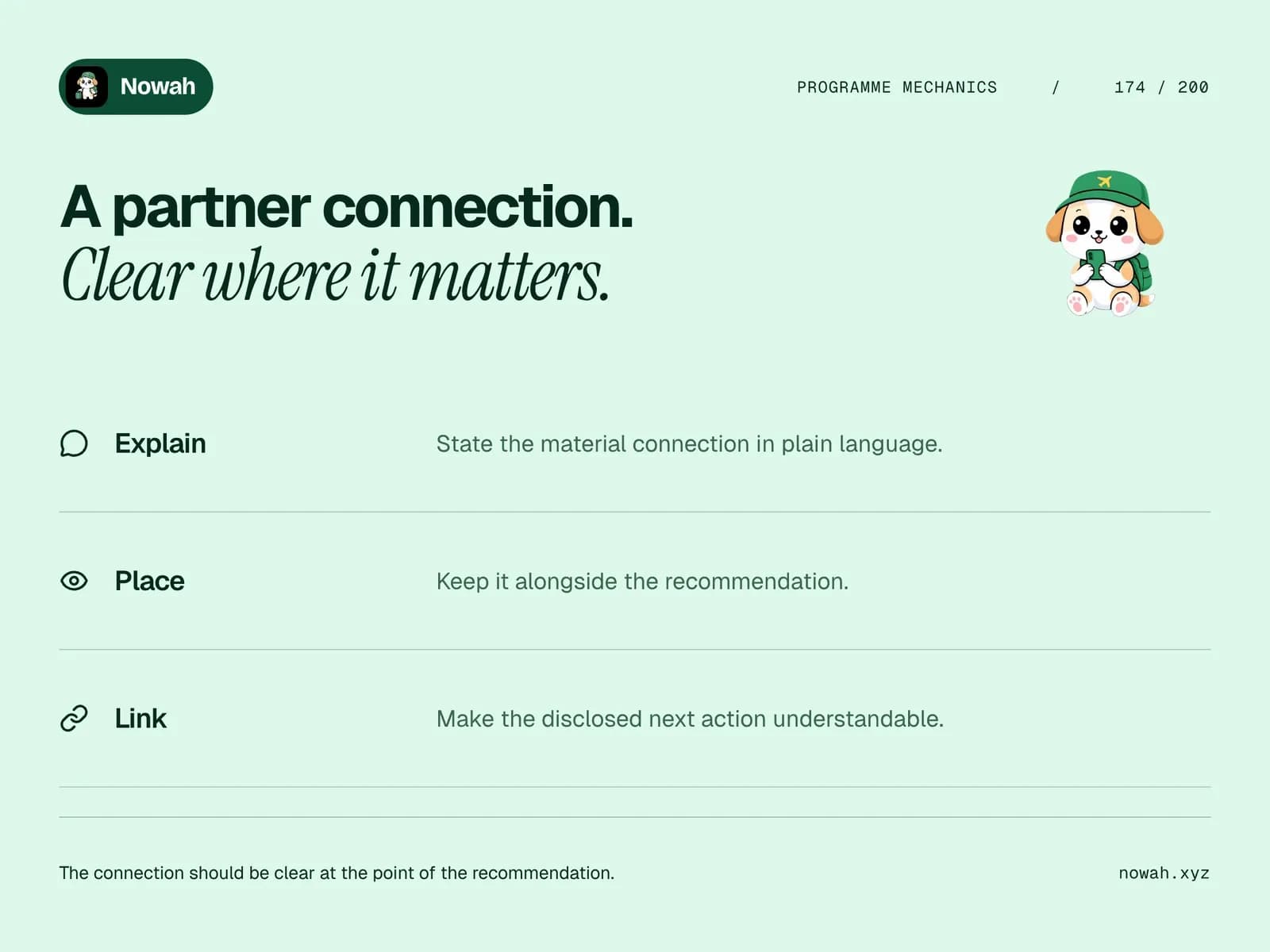
A useful travel recommendation should explain both the planning task and the commercial relationship behind the recommendation. If you are a Nowah partner and may earn commission, make that connection understandable where the audience evaluates your advice.
The Nowah terms require clear disclosure and prohibit misleading promotion. Approved partners can earn 35% of Nowah net revenue from qualifying bookings by eligible new accounts they introduce, as described in the program overview.
Disclosure is not a substitute for a useful explanation or accurate claim. It gives the audience relevant context while they decide whether the recommendation fits their needs.
Describe the relationship you actually have
Before choosing the wording, write down the real arrangement. Are you an approved Nowah partner, a creator discussing a prospective application or someone with another commercial connection affecting the content?
Do not describe an application as approval. Do not imply that a hotel supplied a stay through Nowah unless evidence establishes that relationship.
A referral commission is also different from a fixed sponsorship fee, a hosted stay or a content-licensing agreement. Several relationships can exist around one piece of content, but they should not be merged into one misleading label.
The hosted-stay disclosure guide develops that separate-relationship question.
An accurate description of the arrangement is the foundation. A polished disclosure cannot fix a relationship statement that is false or incomplete.
Use wording the audience can understand
For an active partner recommendation, a plain draft can explain that you are a Nowah partner and may earn commission from qualifying referrals.
For example, a creator might write: “I’m a Nowah partner and may earn commission from qualifying bookings by eligible new travellers I refer.” This is sample wording to review in context, not a claim that one sentence is sufficient for every format or jurisdiction.
Avoid relying on an unexplained abbreviation or a vague relationship label that leaves the financial connection unclear.
The FTC's influencer guidance emphasises noticeable, understandable disclosure with the endorsement. Its guidance is relevant to endorsements affecting US consumers; other applicable requirements can also depend on the audience and circumstances.
Keep the relationship explanation in the language and context the audience can actually understand.
Place the explanation with the recommendation
A disclosure on an unrelated profile or distant page may not help someone encountering the commercial recommendation now.
Check where the audience first receives the endorsement and what explanation is available there. A blog paragraph, a short video and an image resource need different presentation decisions.
For video, the FTC guidance addresses disclosure in the video itself rather than only the accompanying description. Its endorsement questions and answers also examine placement, readability and clarity.
Use that principle in the editorial review: the audience should not have to reconstruct a missing commercial context from another piece of content.
The relationship explanation should remain understandable when a relevant excerpt is encountered on its own.
Use platform tools without outsourcing the explanation
Check the current disclosure tools and rules for the platform and account where you publish. They can be part of the process, but do not assume that a tool label automatically answers every disclosure question.
The FTC's guidance cautions against relying on a platform tool alone. Keep your own explanation clear and review how the actual content appears to the audience.
Do not invent universal account settings or copy an outdated button sequence. If your content includes TikTok, the commercial-content guide addresses the current source-backed requirement separately.
A platform setting also does not validate the surrounding travel or earning claims. Those need their own evidence.
The aim is an understandable recommendation in its actual format, rather than a checkbox treated as proof that every statement is sound.
Build a relationship-and-placement worksheet
Record:
- The actual commercial arrangement.
- The audience and practical task.
- The point where the recommendation appears.
- The wording explaining the relationship.
- The visual or spoken placement in that format.
- The relevant current platform tools checked.
- The destination and its purpose.
- Any claim needing separate evidence.
This is a creator-maintained editorial tool, not a claimed Nowah compliance dashboard.
Use the worksheet before finishing the design. It is harder to make a relationship understandable if it is added only after every available space has been filled.
Keep sensitive account information out of the worksheet. Its purpose is to review the public explanation, not collect identity documents or payout credentials.
A fictional planning-video example
Imagine a creator explaining a hotel-move tradeoff using a fictional short-break brief. This is an illustrative editorial scenario, not a real traveller story or a reported campaign result.
The video first explains the decision and shows a verified Nowah planning task. The creator identifies what the example teaches and which supplier questions remain unresolved.
The partner relationship is explained with the recommendation, using wording the audience can understand in the video and relevant supporting material. Applicable current platform tools are checked separately.
The destination instruction matches the viewer's task. Travellers are not unexpectedly sent to an unexplained creator application, and the active partner route is not invented.
The example does not add a fake booking confirmation or earnings notification. Disclosure supplies commercial context; it does not turn hypothetical planning into a real success story.
Keep traveller and creator actions distinct
An approved partner recommending travel uses the active route supplied through approval and onboarding. Do not imply that a general application address attributes traveller accounts.
Prospective creators need the official overview and application portal. Explain the reviewed application rather than promising automatic acceptance.
If a piece of content addresses both groups, label the purposes clearly. A vague “get started” instruction may leave the reader unsure whether they are planning a trip or applying to a program.
The creator-versus-traveller journey guide provides a useful framework for separating those goals.
A clear disclosure should work alongside a relevant destination, not compensate for one that serves the wrong task.
Check claims independently from disclosure
Read the travel and earning statements without the commercial label. Are they supported?
Do not invent guaranteed savings, room availability, upgrades or income. A clear affiliate statement does not make those claims accurate.
Keep observed evidence separate from supplier facts and fictional planning. A generated illustration cannot establish a real stay, and a planning output cannot confirm a booking.
Nowah's article about the hotel-review problem beyond star ratings offers background for thinking about evidence and interpretation.
The disclosure tells the audience how you may benefit. The evidence tells them what the recommendation can fairly establish. Both are needed for a credible explanation.
Preserve the earning conditions
The Nowah share is 35% of Nowah net revenue, not the traveller's full booking spend. Eligible attribution requires an active-link introduction and a new account within 30 days, with successful tracking.
Existing accounts and self-referrals do not qualify. Later qualifying hotel, flight and paid eSIM bookings may generate earnings for a validly attributed account's lifetime, but no future travel or income is guaranteed.
Completion, supplier settlement and the applicable hold and payout conditions remain part of the process. A view, click or pending plan is not paid commission.
You do not need to repeat every term in every short format. You do need to keep the actual claim accurate and provide an appropriate route to fuller information.
An exciting headline should not imply a simpler earning model than the explanation supports.
Check the meaning of a shortened edit
Imagine that an editor reduces a longer recommendation to a small graphic. The original explanation identified a fictional brief, a partner relationship and an assumed earning calculation. The extract now contains only a percentage and a first-person success phrase.
That edit has changed the meaning, even if a commercial label remains elsewhere. Restore the relevant context or choose a narrower claim the format can explain accurately. The audience should be able to distinguish the relationship, the illustrative input and the event actually established.
Use the same review for an audio excerpt or a paragraph copied into a newsletter. The format may need different presentation, but shortening should not manufacture a real experience, a guaranteed result or a different earning base. Keep the public explanation faithful to what the evidence and actual arrangement support.
Review each format before reuse
Check the actual blog page, video, image or audio segment rather than only the source script. Ask whether the relationship can be noticed and understood in the way the audience encounters it.
Review a shortened extract separately. A disclosure that worked in a longer piece may not travel with the excerpt automatically.
Keep current source notes and platform checks with the worksheet. If the relationship or destination changes, review the public explanation again.
For the next recommendation, start with another useful travel question rather than repeating a generic promotional paragraph.
If this fits your content, apply to Nowah Partners. Build the audience value first, explain the real relationship clearly and keep each claim tied to evidence. That gives the Nowah recommendation context a reader or viewer can evaluate fairly.




