How to Disclose Nowah Partner Content Clearly on TikTok
Disclose Nowah promotions clearly on TikTok, combining the platform's commercial-content setting with wording viewers can understand.
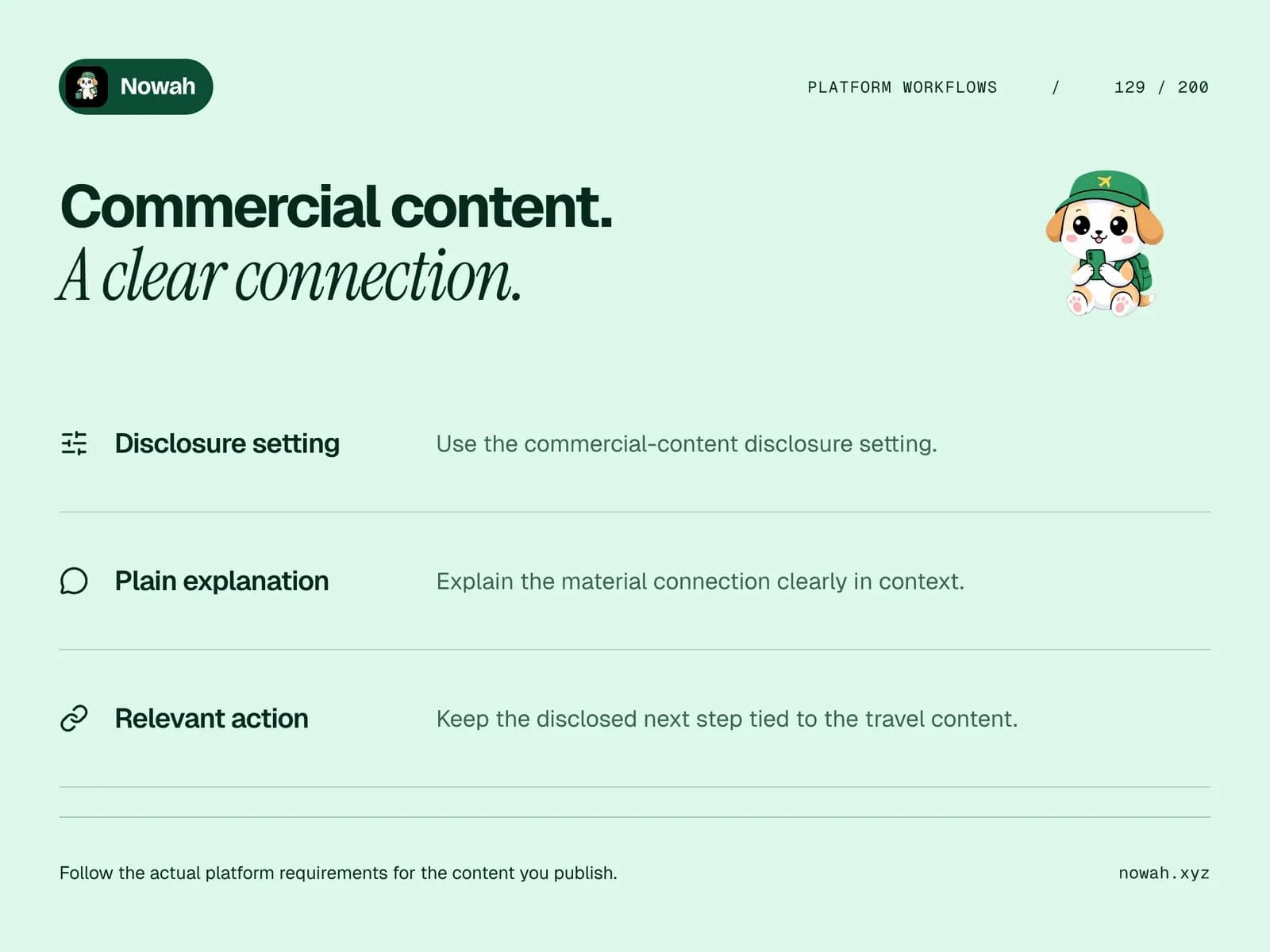
If you recommend Nowah on TikTok and may earn commission, explain that relationship where viewers encounter the recommendation. Clear disclosure helps the audience understand your commercial interest while they evaluate the practical travel advice.
Nowah gives creators a specific offer to explain: approved partners can earn 35% of Nowah net revenue from qualifying bookings by eligible new accounts they introduce. The official program overview describes the opportunity. Your content can make a confident case for joining or using Nowah without suggesting that a useful demonstration is an independent recommendation with no commercial connection.
Disclosure involves both the platform's tools and the explanation viewers receive. Plan them together while writing the video, rather than treating disclosure as a final caption adjustment.
Understand the two explanations viewers need
One explanation concerns the travel task. Why does the Nowah demonstration help someone investigate a hotel area, a day structure or an arrival constraint?
The other concerns your relationship. You are a Nowah partner and may earn commission from qualifying referrals. The audience needs that context alongside the recommendation, rather than discovering it only after navigating to unrelated profile material.
These explanations support each other. A clear commercial statement does not make the travel reasoning less useful. It gives the viewer a more complete basis for deciding how to interpret it.
Choose wording that describes the actual arrangement. A reviewed partner application is different from an active approved link. An affiliate commission relationship is different from a separate brand paying a fixed production fee or a hotel providing a stay. Do not merge those arrangements into one vague claim.
The broader partner-disclosure guide examines that relationship wording beyond TikTok.
Use TikTok's commercial-content setting
TikTok's official disclosure instructions state that posts promoting a brand, product or service require its commercial-content disclosure setting.
The current documented publishing route includes the content-disclosure controls and a choice describing whether the promotion concerns your own brand or branded content. Check the current interface on the account and publishing surface you use, and select the classification that accurately reflects the arrangement.
Do not assume that disclosure is unnecessary because the payment depends on a future qualifying referral rather than a fixed upfront fee. The audience still needs to understand the commercial relationship.
Keep a record of the setting you checked for the publication. This is an editorial production record, not a claim that the platform has approved every statement in your video or that every legal requirement is automatically satisfied.
Account interfaces and publishing contexts can differ. If the current controls do not match an old tutorial, use the official guidance and what you can verify on your own account instead of reproducing outdated instructions.
Make your own explanation understandable
Write one plain sentence describing the relationship. A working draft might say that you are a Nowah partner and may earn commission from qualifying referrals. Adapt the wording to the actual recommendation and arrangement.
Check it in the format viewers will see. Can someone understand the sentence while watching the relevant segment? Does the on-screen explanation remain readable? Does the caption reinforce the same relationship rather than introducing a contradictory claim?
For content affecting US consumers, the FTC's influencer guidance explains that disclosures should be easy to notice and understand with the endorsement. Its guidance also addresses disclosure within video and cautions against assuming that a platform tool alone supplies a sufficient explanation.
Other applicable requirements can depend on the audience and circumstances. The practical production lesson is to make the relationship clear at the point of recommendation instead of hiding it in a distant location.
Use a disclosure production card
Create a production card for each commercial video. It can be a simple document with the following fields:
- The travel question the video answers.
- The audience being addressed.
- The commercial arrangement being described.
- The sentence explaining that arrangement.
- The places viewers encounter the recommendation.
- The relevant platform controls checked before publication.
- Any travel or earning claim needing evidence.
- The next destination and its purpose.
Fill out the arrangement field before writing the disclosure sentence. If you cannot describe the relationship accurately in your own notes, a polished label will not resolve the underlying uncertainty.
The claim-evidence field is important. A clearly disclosed video can still contain an unsupported promise about a rate, hotel benefit or future earning. Review those claims independently.
The TikTok click-route audit complements this card by examining whether the destination instruction actually works.
A fictional hotel-area video
Imagine a creator preparing a video about choosing an area for a short city break. The creator uses a fictional brief and a Nowah demonstration to explain how a late arrival affects the first evening. This is an editorial example, not a real follower result.
The opening establishes the planning question. The demonstration shows how the creator would investigate a lighter arrival-day structure and identifies the hotel and transport details still requiring current evidence.
The creator explains the Nowah partner relationship with the recommendation and uses the appropriate current TikTok disclosure setting. The destination instruction points to a route actually available on the publishing account, rather than a link surface assumed from another creator's profile.
The closing invitation is to explore the viewer's own trip requirements. It does not promise that they will obtain a particular price, confirm a room or earn money themselves by clicking a traveller referral.
This combination keeps the commercial purpose visible without turning the entire video into an abstract terms summary. The practical travel lesson remains the reason the recommendation is relevant.
Separate illustrations from experience claims
Generated diagrams can make a planning decision easier to understand. They cannot establish that you stayed at a property or that a follower completed a booking.
Label a fictional planning brief according to its role. If you show actual room footage, state only what your evidence supports. A single observed room should not become a promise about every category or future date.
Do not add fabricated testimonials or earnings notifications to make the commercial story more persuasive. A useful explanation does not require invented results.
If a separate hosted-stay arrangement is relevant, describe that connection independently from the Nowah relationship. Do not imply that Nowah supplied a complimentary stay, upgrade or special rate without evidence.
The hotel-room research workflow offers a detailed evidence-ledger approach that can also inform a TikTok room explanation, even though the publishing format differs.
Check the earning statement itself
Disclosure tells viewers about your interest. The earning claim still has to be correct.
Nowah's partner terms describe a 35% share of Nowah net revenue from qualifying bookings. That percentage is not applied to the traveller's total booking spend. A larger-looking holiday does not, by itself, establish a larger partner payment.
A traveller must follow an active partner link and create an eligible new account within 30 days of introduction, with successful tracking. Existing accounts and self-referrals do not qualify. Once valid attribution exists, later qualifying bookings may generate earnings for that account's lifetime; future travel and income are not guaranteed.
Completion, supplier settlement, the hold and payout conditions also remain relevant. Do not compress the process into a claim that viewers' clicks or pending bookings produce immediate cash.
When the video's main purpose is teaching creators about the program, give those distinctions room. When the main purpose is a travel demonstration, avoid wording that contradicts them and provide a relevant route to the full explanation.
Review the complete viewing experience
Before publishing, watch the video without relying on your knowledge of the script. Identify the first point where the recommendation becomes commercial and check what explanation is available there.
Read the caption separately. If someone encounters the written description first, does it identify the same relationship and task? Check that artwork, spoken words and destination instructions agree.
Ask whether any sentence would become misleading if it were separated from an earlier screen. Short-form content can be encountered in fragments, so a crucial qualification should not depend on an unrelated piece of content being seen first.
Keep the review focused on real evidence. The production card should record what was checked, not declare that a label guarantees reach, legal compliance or future commission.
Nowah's article about trust in AI-assisted travel booking provides background for why accurate explanations matter throughout the traveller journey.
Build the recommendation around usefulness
The strongest commercial video gives the audience a practical reason to consider Nowah. Explain a genuine travel decision, show verified product behaviour and offer a relevant next step with a clear relationship statement.
After publication, maintain the destination and review changeable claims when you reuse the content. Correct confusing wording rather than relying on an old disclosure setting as evidence that the whole recommendation remains current.
If this is how you want to monetise useful travel content, apply to Nowah Partners. Prepare a clear account of your audience and the planning questions you intend to help them answer. Transparent promotion and specific demonstrations give your partner recommendations a stronger foundation than unsupported earnings promises.




