Why Nowah Partner Earnings Need Completion and Supplier Settlement
Understand why Nowah partner earnings need both booking completion and verified supplier settlement before the hold and payout conditions can be met.
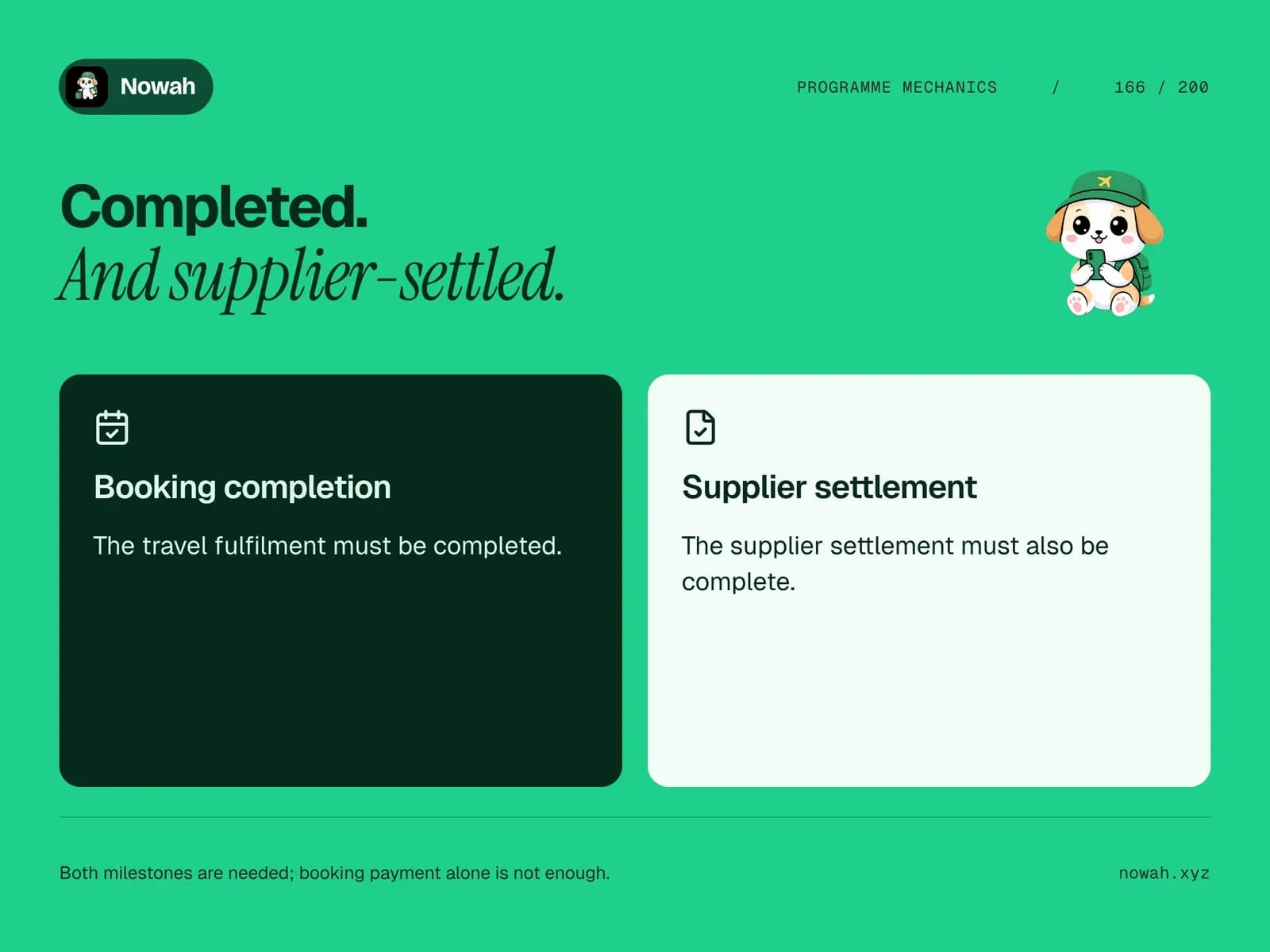
A traveller finishing a trip and a supplier settling the relevant booking are different events. The Nowah Partner Program requires both before the later hold and payout conditions can be met.
That distinction matters when you explain the earning opportunity to creators. Approved Nowah partners can earn 35% of Nowah net revenue from qualifying bookings by eligible newly attributed accounts. A qualifying booking can create an earning opportunity without making the amount immediately available for transfer.
The program terms describe completed bookings and verified supplier settlement as necessary. This guide helps you organise those conditions accurately rather than guessing payment from a traveller's itinerary or a pending booking.
Treat the two events as separate questions
Completion concerns the booking's travel outcome under the relevant records. Supplier settlement concerns the verified settlement evidence associated with the booking.
Do not treat one as automatic proof of the other. A trip date appearing in the past does not, by itself, establish every program condition.
Likewise, do not assume that a settlement-related event means the traveller has completed the booking. Both questions need the appropriate evidence.
This is why a single vague “referral date” is not enough for an earning-timing explanation. Introduction, signup, booking, completion, settlement and payment are distinct stages.
A useful review keeps each stage separate so the creator can identify what is actually known and which question remains unresolved.
Keep qualifying attribution in the background
Before completion and settlement become relevant to partner earnings, the account and booking must qualify.
An eligible traveller follows an active partner link and creates a new account within 30 days of introduction, with successful tracking. Existing accounts and self-referrals are excluded.
Once valid attribution exists, later qualifying hotel, flight and paid eSIM bookings may generate earnings throughout the account's lifetime. Future travel and income are not guaranteed.
The 35% share applies to Nowah net revenue, not the traveller's full booking spend. A correct attribution relationship does not establish the net-revenue amount or the later release conditions on its own.
The eligible-new-account guide explains that earlier stage. This article focuses on the separate evidence needed after a qualifying booking.
Use a two-evidence checklist
Create an explanatory checklist with distinct fields for completion and supplier settlement. Include:
- The relevant booking or statement reference for a real enquiry.
- Whether the scenario is hypothetical or based on an actual record.
- The evidence establishing completion.
- The evidence establishing verified supplier settlement.
- Which event happened later, where known.
- The remaining hold and payout conditions.
- The precise question that needs review.
This is a creator-maintained worksheet, not a claim that Nowah displays a particular status screen.
Do not fill an unknown field with an assumption merely because the other field is complete. The checklist should preserve uncertainty instead of making an apparently finished record.
For teaching content, use fictional cases so the rule can be explained without exposing another person's booking or identity information.
Fictional case: completion happens first
Imagine a qualifying hotel booking whose completion is established before the relevant supplier settlement is verified. This is a hypothetical event sequence, not a real booking or payment forecast.
The creator knows that one required event has occurred. They cannot infer that the second event has happened merely because the traveller's stay has ended.
When the settlement condition is also established, the later event is the one relevant to the hold's starting point under the terms.
The example does not promise how long supplier settlement takes or give a fixed bank arrival date. Those details are not established by the fact that completion occurred first.
The useful conclusion is specific: completed travel alone does not satisfy both conditions.
Fictional case: settlement evidence precedes completion
Now imagine a hypothetical qualifying booking where the relevant settlement evidence is established before the booking's completion.
The order is different, but the requirement remains the same. The program needs both completion and verified supplier settlement.
The creator should not treat the earlier settlement-related event as proof that the booking has already completed or that an amount is ready for payout.
Once completion is established, the later event determines the hold's starting point in this assumed sequence. Further conditions still remain.
The 30-day hold guide examines that later-event rule in more detail.
These cases demonstrate the logic of the terms, not a prediction of how any individual supplier or booking will behave.
Fictional case: one event is unknown
Imagine that a creator has a statement reference and a general understanding that the traveller's trip was planned for an earlier date, but no evidence resolving both required events.
The correct next step is to identify the missing information. A trip plan or an anecdote is not a substitute for the relevant program record.
Do not label the amount released, delayed or incorrectly withheld based solely on that incomplete picture. State what is known and which condition needs clarification.
For a real question, use the official support route with the relevant reference and a concise description of the issue. Do not post private booking data in a public discussion.
A general article can explain the conditions without deciding the individual's actual earning status.
Understand what happens after both events
The terms state that a 30-day hold begins after the later of completion and settlement. The hold is therefore a separate condition following the required event pair.
Monthly processing then depends on the per-currency threshold and the other requirements, including relevant Stripe verification and available settlement funds.
A transfer to the connected Stripe account is different from a bank payout and its arrival timing. Satisfying the two events does not establish that money has reached the creator's bank.
The monthly payout-eligibility guide develops that later checklist.
Keep each explanation tied to the stage it describes. Completion, settlement, hold, transfer and bank arrival should not become interchangeable labels.
Keep corrections and real records in view
Refunds, disputes and corrected supplier statements can affect earnings according to the terms. A previous calculation or payout-related record does not mean that no documented correction can occur.
For a real discrepancy, identify the statement entry and the question you want reviewed. Keep the distinction between an estimated explanation and an actual program record clear.
Do not use a hypothetical case from an article as evidence that another booking must follow the same timing or amount.
The refund-corrections guide explains that separate process, including why a negative adjustment is not the same thing as an automatic bank debit.
A precise enquiry gives the official review process something concrete to examine without inventing a conclusion from incomplete information.
Explain timing honestly in creator content
A video or article about making money with Nowah should not suggest that a click, signup or pending booking immediately produces cash.
You can describe the opportunity positively: useful recommendations can lead to eligible new accounts and qualifying travel, with the partner share calculated from Nowah net revenue.
Keep the conditions near the earning explanation and provide a relevant route to the full terms. A short graphic should not imply a different process from the longer article.
Nowah's article about trust in AI-assisted travel booking offers background for why clear stages matter to an audience evaluating a recommendation.
Disclose that you are a Nowah partner and may earn commission from qualifying referrals. A clear relationship statement and accurate timing claims need separate checks.
Turn an unclear status into a precise question
A useful enquiry can state the reference, the event you believe is established and the condition you cannot resolve. For example, a creator might ask whether the available record establishes both completion and verified supplier settlement, and which later event is relevant to the hold. This is an illustrative wording example, not an enquiry sent on anyone's behalf.
Avoid beginning with an assumed payment date and treating every earlier condition as already satisfied. Ask about the stage the evidence can clarify. Do not include bank credentials or identity documents by ordinary email, and keep another traveller's private details out of public posts.
The program-question evidence guide develops that process more fully. A precise question helps separate a genuine record issue from a misunderstanding of the earning sequence.
Keep the recommendation useful before any earning event
The earning conditions do not replace the audience's travel question. Explain why Nowah helps investigate a brief, a hotel-area choice or a day-structure constraint.
Verify the product behaviour and keep supplier-dependent facts separate from fictional demonstrations. Do not add a pretend commission notification or completed-booking screen to make the story feel more persuasive.
For prospective creators, the official partner portal is the relevant application destination. Traveller recommendations need the active route supplied after approval and onboarding.
If useful travel explanations fit your work, read the program offer and apply with a clear content proposition. Understanding completion and settlement helps you describe the commercial opportunity accurately while letting the practical value of your recommendation lead.




