The Trust Equation: Getting Users to Let AI Book Their Flights
Would you let a robot spend $3,000 of your money? Earning that trust is our core product challenge — and every design decision flows from it.

Would you hand your credit card to an algorithm and let it spend three thousand dollars?
Most people, when asked directly, say no. They want to see the options. They want to compare. They want to feel in control. Trusting an AI with a restaurant recommendation is one thing. Trusting it with a flight that determines whether you make your daughter's graduation is another.
This is our core product challenge. Not search accuracy. Not speed. Not price comparison. Trust. Everything else flows from it.
Why trust is the real product
You can build the smartest AI travel agent in the world, one that finds the perfect flight every time at the best price, and it will fail if users do not trust it enough to click "book."
Trust in AI-powered travel is different from trust in other AI applications. The stakes are high and the consequences of failure are tangible. A wrong song recommendation wastes three minutes. A wrong flight recommendation wastes three thousand dollars and potentially ruins a trip you have been planning for months.
We learned early that trust is not something you can claim. You have to earn it through every interaction, and you can lose it with a single bad experience. A single failed booking can lose a user forever. That sentence should keep every travel AI company up at night.
The five mechanisms
We build trust through five specific design decisions, not through marketing copy.
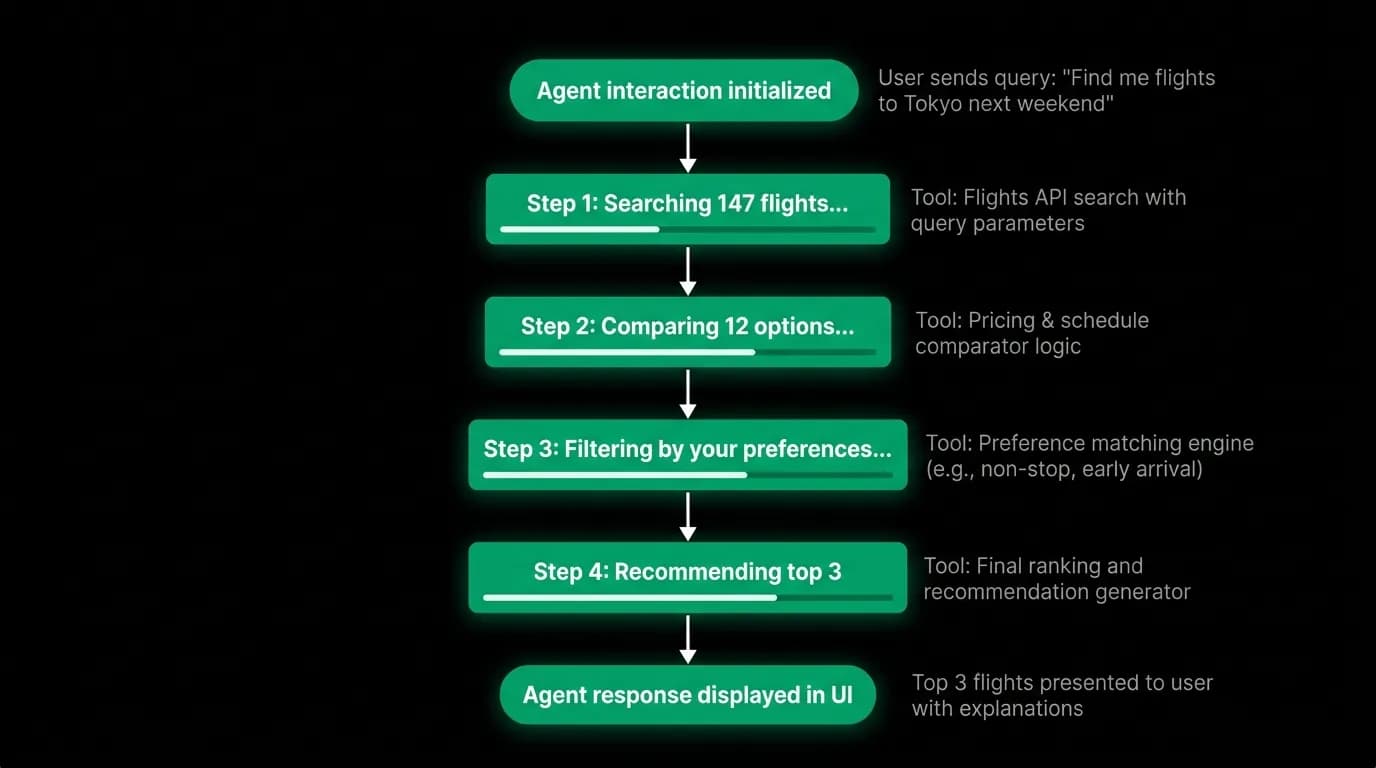
Streaming transparency. When you send a message, you see the agent working in real time. "Searching 147 flights..." "Comparing 12 options on your route..." "Recommending top 3 based on your preferences..." This is not cosmetic. It is the most important trust-building feature in the product. You watch the agent think. You see it doing work on your behalf. The reasoning is visible, not hidden behind a loading spinner.
Explicit confirmations. No money changes hands without your explicit approval. The agent recommends. You review every detail: the airline, the times, the price, the policies. You confirm. Then and only then does the booking execute. The agent cannot autonomously spend your money. That constraint is absolute.
Memory-based personalization. Trust builds when the agent demonstrates that it knows you. After three conversations, it should remember that you prefer aisle seats, morning departures, and hotels with a gym. When it proactively accounts for these preferences without you repeating them, trust deepens. It stops feeling like a random algorithm and starts feeling like a knowledgeable assistant.
Honest uncertainty. When the agent is not sure about something, it says so. If a price seems unusually low, it flags the possibility that conditions might differ. If availability is limited, it mentions the risk. This counterintuitive approach, admitting what you do not know, builds more trust than projecting false confidence.
Graceful failure recovery. Things go wrong. Prices change between search and booking. Seats get taken. Payment processing has hiccups. The system is designed with three layers of protection to ensure that no matter what fails, the user never ends up in a "did it book or not?" state. If something goes wrong, the system recovers clearly and communicates exactly what happened.
The trust pyramid
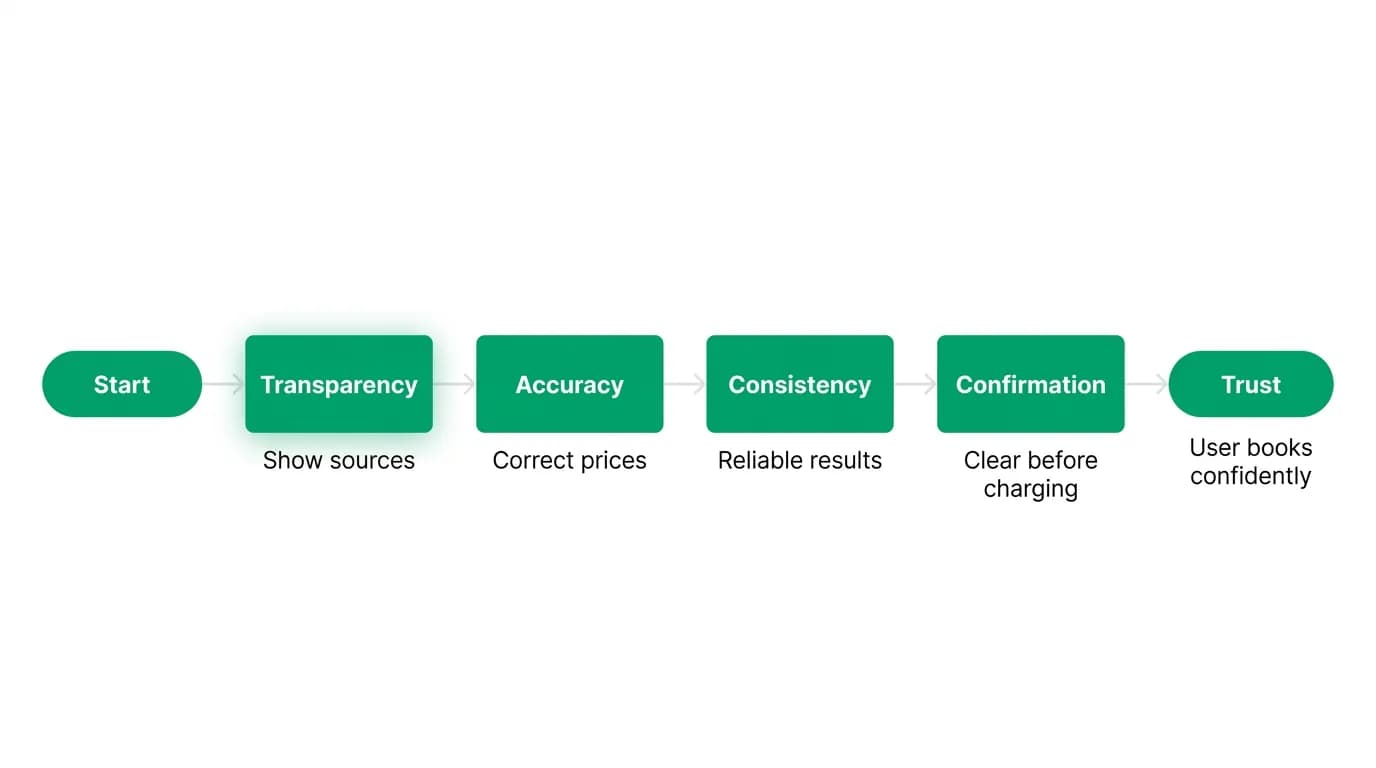
Trust does not happen in one moment. It builds across a progression.
At the base is the first impression. The app loads quickly. The conversation feels natural. The interface is clean and clear. This takes seconds to form and is nearly impossible to rebuild if lost.
Next is the interaction layer. The agent responds intelligently to your first message. It asks relevant follow-up questions. It does not feel scripted or rigid. You start to believe this might actually work.
Then comes the information layer. The agent presents real options with real prices. The data looks accurate. The recommendations make sense. You trust the information it provides.
The recommendation layer follows. The agent not only shows you options but explains why one might be better for your specific situation. "This flight is fifty dollars more but saves you a three-hour layover in a connecting airport." You trust its judgment, not just its data.
At the apex is booking trust. You click confirm. Money moves. A real flight or hotel is reserved in your name. This is the moment everything else has been building toward.
Users progress through this pyramid over multiple interactions. Some move fast, booking on their first conversation. Others need three or four sessions before they are ready. Both are valid. The product supports both.
What users taught us
User feedback on trust has been the most actionable data we collect.
The number one thing that builds trust: seeing the agent search in real time. When users watch the agent checking prices across multiple airlines, they feel confident the comparison is genuine.
The number one thing that breaks trust: unexpected prices. If the booking price differs from the price shown in the recommendation, trust evaporates immediately. We have invested heavily in ensuring price accuracy between search and booking precisely for this reason.
The most surprising trust signal: memory. When a returning user sees that the agent remembers their preferences from a previous conversation, the trust increase is dramatic. It transforms the interaction from "talking to a tool" to "working with someone who knows me."
The journey from skepticism to reliance
We have watched users progress through a predictable pattern. First conversation: cautious, testing, asking questions they already know the answers to. Second conversation: more open, willing to describe a real trip. Third conversation: starting to rely on the agent's judgment. Fifth conversation: saying things like "just book whatever you think is best" for smaller decisions.
This progression mirrors how people build trust with human travel agents. It takes time. It requires consistency. And it can be undone by a single bad experience.
Start small
If you are curious but cautious, that is exactly right. You should be cautious about trusting AI with significant purchases. Start with something small. Ask the agent about a weekend trip. See how it handles the search. Review the options. Check the prices against what you would find manually.
Build your own trust pyramid. Let the product earn it.
We designed Nowah with the assumption that trust is not a feature you add. It is the foundation everything else is built on. Every design decision, from streaming to confirmations to memory to honest uncertainty, exists because earning your trust is the only thing that matters.
Nowah is an AI travel agent that searches and books real flights and hotels through conversation — no filters, no thirty open tabs. Plan your next trip.