How Nowah's First Valid Introduction Determines Partner Attribution
Understand Nowah's first valid recorded introduction rule, persistent account attribution and why an attributed account cannot be reassigned.
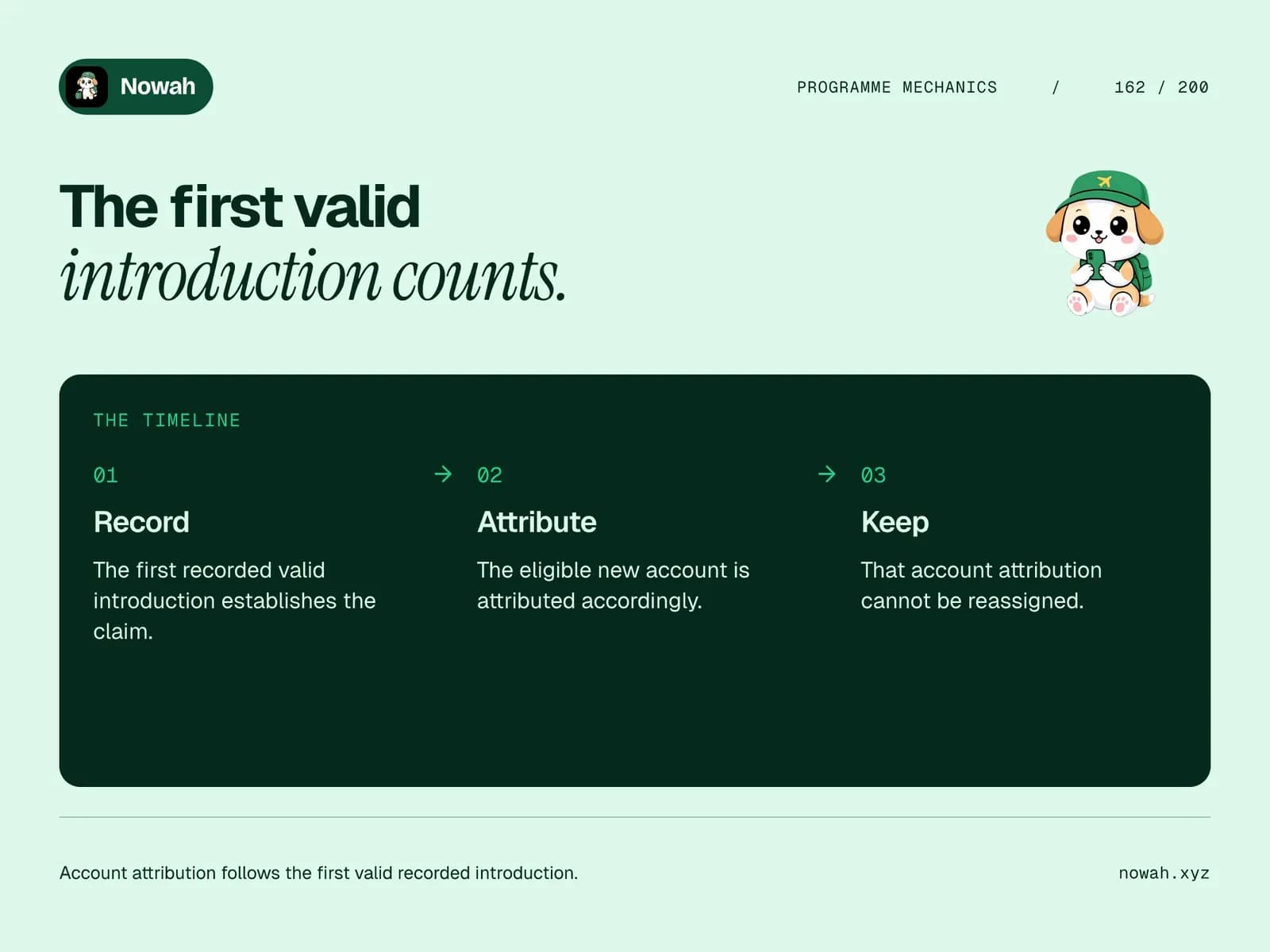
A traveller may encounter several useful recommendations before deciding how to investigate a trip. The Nowah Partner Program does not describe attribution as a reward for the most recent video they watched or the last creator they happened to mention.
The program terms use the first valid recorded introduction. Once an eligible traveller account is attributed, that account cannot be reassigned. This rule matters to creators explaining the continuing relationship behind the offer.
Approved Nowah partners can earn 35% of Nowah net revenue from qualifying bookings by eligible accounts they introduce. Understanding the introduction rule keeps that opportunity accurate without treating every click or later interaction as a new attribution event.
Read each part of the rule
“First” describes the priority used by the program. “Valid” means the introduction must satisfy the relevant conditions. “Recorded” matters because tracking must successfully reach Nowah.
Do not remove those qualifications and describe any public interaction as an introduction. A saved post, video view or comment is not the same thing as a valid recorded partner event.
The traveller must follow an active partner link and create a new eligible account within 30 days of introduction. Existing accounts, self-referrals, artificial accounts and fraudulent introductions are excluded.
An ordinary creator application URL is not a substitute for the active traveller route supplied after approval and onboarding.
The eligible-new-account guide develops those account conditions separately from the question of which valid introduction has priority.
Separate content discovery from attribution
A traveller can find your content useful without becoming a newly attributed account. They may already use Nowah, may not create an account or may not follow the active route required by the terms.
Likewise, a person may mention another creator after an account has already been validly attributed. That later conversation does not establish account reassignment.
Do not infer the recorded event from what is most visible in public. A comment under a video may tell you what the person chose to discuss, not the complete sequence of their account introduction.
This distinction helps you answer attribution questions without blaming the traveller or inventing a tracking conclusion.
The content should remain useful on its own. Its value to the audience is not limited to the interactions that can qualify for a new partner attribution.
Understand persistence after valid attribution
Once the account is validly attributed, the relationship remains for that traveller account's lifetime under the terms. Later qualifying bookings may therefore generate earnings for the attributed partner.
The rule does not mean that a traveller will book again, that every future purchase qualifies or that income is guaranteed. Booking and payout conditions remain necessary.
It also does not mean that a later creator can move the account by sharing a new link. The terms state that an attributed account cannot be reassigned.
Present the continuity as a documented feature of the offer when it fits your content model. A useful initial recommendation can matter beyond one immediate trip, while the actual commercial outcomes remain uncertain.
The lifetime-attribution guide examines that continuing relationship in more detail.
Build an introduction-event timeline
For a teaching example or an actual record question, use a timeline with clear fields:
- The event being described.
- Whether the scenario is hypothetical or based on an actual record.
- The active-link route relevant to the introduction.
- The account-creation event and timing.
- The evidence establishing what was recorded.
- Any eligibility exclusion.
- The status that remains unknown.
- The specific question requiring review.
This is an explanatory worksheet you maintain, not a claim that Nowah provides a particular timeline interface.
Avoid filling unknown fields with assumptions. A creator who knows that a link was shared does not automatically know that tracking reached Nowah or that an eligible account was created.
Keep private account details out of public teaching material. Fictional timelines can explain the rule without exposing another person's identity or travel history.
Fictional timeline: two recommendations
Imagine a traveller encountering content from two approved creators. This is a hypothetical example, not a real attribution decision.
Assume that the first creator's active-link introduction is validly recorded and that the traveller creates an eligible new account within the required window. Under those stated assumptions, that recorded introduction establishes attribution.
The traveller later reads another creator's article and follows another recommendation. The later interaction does not reassign the already attributed account.
The example does not establish which creator's content was more persuasive, useful or responsible for a later travel idea. It illustrates the program's account-attribution rule, not a judgement about creative merit.
Do not turn the scenario into advice for manipulating account creation or competing to overwrite attribution. The relevant question is whether the actual conditions were validly recorded.
Fictional timeline: an incomplete introduction
Now imagine that a creator knows only that a viewer opened a shared destination. The viewer says they were interested, but the creator has no evidence establishing an eligible new-account attribution.
The correct conclusion is limited: the observed interaction does not resolve every condition. It is not proof that attribution succeeded, failed or belongs to another partner.
The timeline can record the known event and the unanswered question. It should not invent a status based on how many times the viewer interacted with content.
For a real discrepancy, the creator can use the appropriate official support process with relevant references. A general blog article cannot certify the individual's account status from a public comment.
The clicks-versus-attributed-accounts guide develops that evidence distinction.
Do not substitute a content publication date for the introduction event. A video uploaded earlier may be discovered later, and the visible age of an article does not establish when a particular traveller followed an active partner route. Keep the timeline tied to the recorded event relevant to the terms. This is another reason to avoid deciding an individual attribution dispute from public posts alone. The useful worksheet identifies the event whose evidence is needed; it does not create that evidence by arranging assumptions in chronological order.
Keep the signup window separate from later bookings
The 30-day requirement concerns creation of the eligible new account after introduction. It is not a deadline for every future qualifying booking after valid attribution.
When building a timeline, give the account event and each booking event separate entries. Do not combine them into one vague “referral date.”
A later booking still needs to qualify under the program. The documented categories are hotels, flights and paid eSIMs, with complimentary flight-perk eSIMs excluded.
The 35% share applies to Nowah net revenue, not the traveller's full booking spend. Completion, supplier settlement and the applicable hold and payout conditions remain relevant.
This is why the introduction rule cannot by itself establish earnings. It identifies the account relationship, while later records establish the travel and payment stages.
Give the original recommendation a useful purpose
The attribution model should not become a reason to publish an empty or misleading link pitch. Explain a travel decision that the audience can actually use.
A fictional Nowah brief might help investigate a hotel-area choice or show how a fixed event changes the day structure. Verify the product behaviour before describing it, and keep supplier-dependent questions visible.
Do not invent a creator dashboard, a guaranteed travel benefit or a fake follower outcome to make the sequence sound more complete.
Nowah's article about the trust involved in AI-assisted travel booking offers background for thinking about clear explanations. Your content should still show a specific reason the recommendation helps.
Explain that you are a Nowah partner and may earn commission from qualifying referrals. Check the actual destination and linking tools before publishing an instruction.
Use the official review route for real questions
If an introduction or attribution looks wrong, identify the relevant reference and the event you want reviewed. Distinguish what the record says from what you assumed would happen.
Do not try to resolve the question by advising an existing user to create an artificial duplicate or by claiming that another link can reassign the account.
Use the secure processes appropriate to the information involved. Bank credentials and identity documents should not be sent by ordinary email or posted in a public discussion.
Keep any public explanation general and evidence-led. An individual attribution enquiry needs the actual recorded facts, not a hypothetical timeline from an article.
A precise question is more useful than an unsupported allegation based on a visible content interaction.
Explain the model accurately when you promote it
The first-valid-introduction rule gives creators a clear way to understand the beginning of a continuing account relationship. Keep the eligibility, recording and timing conditions connected to that explanation.
Do not promise recurring income or present a later content view as a new account transfer. The program's strength is the documented continuity after a valid eligible introduction, not a guarantee of future travel.
If useful recommendations fit your audience, apply to Nowah Partners. Describe the planning decisions your content can clarify. After approval, use the supplied active route, explain the relationship clearly and let actual program records establish the events they document.




