Turn useful follower questions into stronger Nowah recommendations
Use genuine follower questions to improve Nowah travel recommendations, choose a useful next resource and distinguish engagement from qualifying earnings.
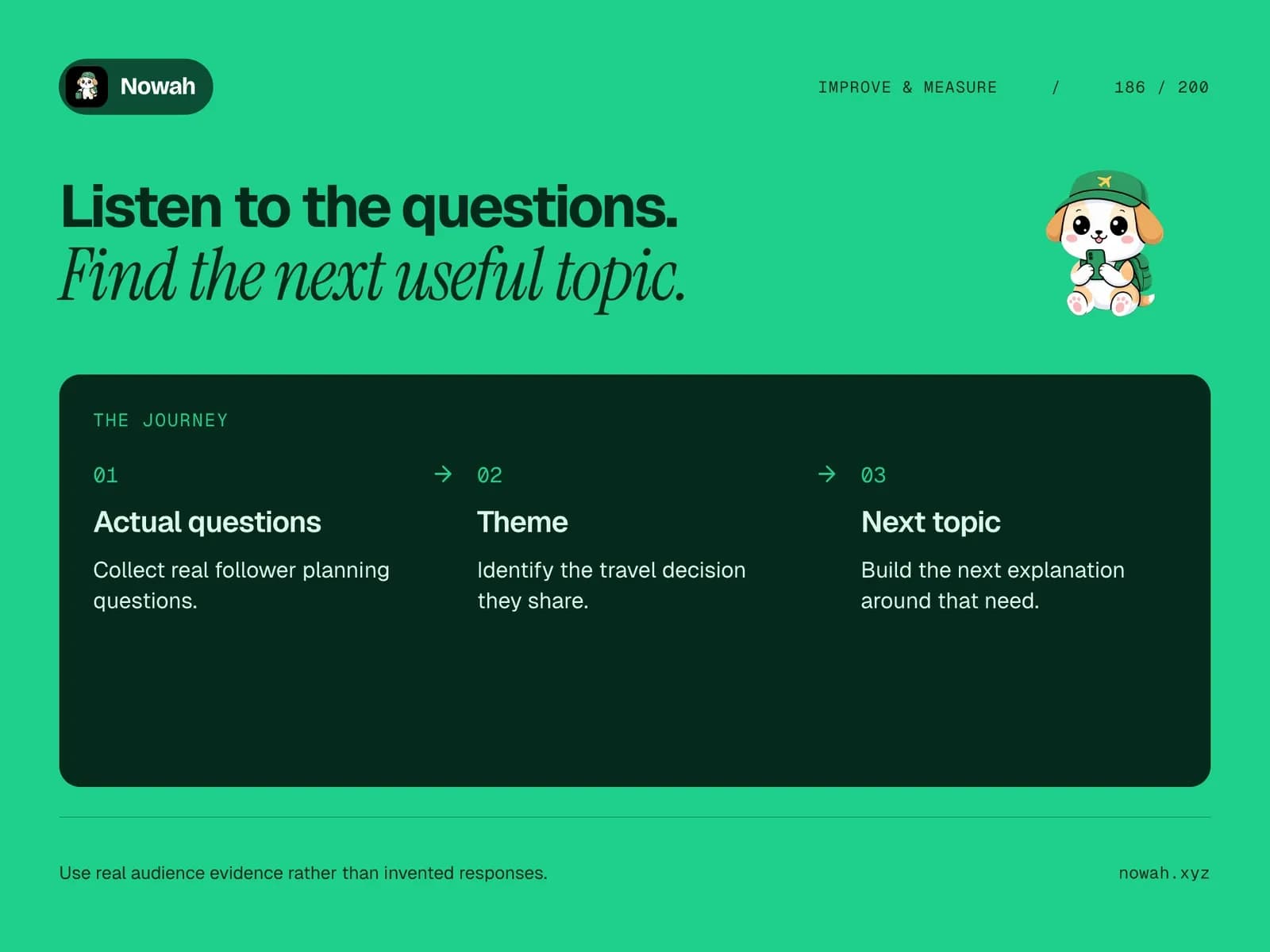
A follower's question can show you what a travel recommendation has left unresolved. Someone asking about room occupancy needs a different answer from someone asking how the Nowah Partner Program works. Treating those questions carefully helps you improve the resource and offer a relevant next step, instead of replying with the same link to everyone.
For creators earning through Nowah Partners, this is useful editorial work. A clearer recommendation can explain why Nowah belongs in a traveller's planning task. A valid introduction may then establish a new eligible account relationship, with possible earnings from qualifying bookings. The question itself does not prove that any of those later events happened.
This guide provides a response-to-resource log for reviewing questions after publication. Its purpose is to improve the explanation, identify the next useful resource and keep the commercial action relevant.
Record the question before interpreting it
Keep the wording of a genuine question in your own editorial notes, removing names and unnecessary personal details. Add the article or piece of content that prompted it. This gives you context when you decide whether the explanation needs clarification.
Separate what the person actually said from your interpretation. “Does that room work for four people?” establishes a question about rooming. It does not establish travel dates, a confirmed party, booking intent or the person's Nowah account status.
Avoid turning a single question into an invented audience profile. If you need to reconsider the broader audience for your content, the audience-fit worksheet covers that earlier planning task. Here, focus on what this question reveals about the resource already in front of the reader.
Sort the question by the help it needs
Most follow-up questions require one of four responses. A missing assumption may call for a correction to the current explanation. A new travel constraint may deserve a separate example. A factual supplier question needs current evidence. A question about joining Nowah Partners belongs in the creator-program journey.
Use these categories as editorial aids, not labels for people. The same reader can ask different kinds of questions at different times. Your job is to identify the useful response to the current question.
If the request is outside the scope of your evidence, say what needs checking and point to an appropriate resource. A thoughtful recommendation can identify the next research question without pretending you have verified an answer.
Build a response-to-resource log
Create a log with five columns: observed question, missing information, response type, useful resource and evidence boundary. Complete a row before deciding whether the question needs a new article or a short clarification.
Column | What to record |
|---|---|
Observed question | The genuine wording, with identifying details removed |
Missing information | The assumption, constraint or fact the reader needs |
Response type | Clarify, correct, link or develop a separate resource |
Useful resource | The explanation that actually answers the next task |
Evidence boundary | What you have established and what remains unverified |
Keep the log in an ordinary editorial document. It is not a claim about a Nowah creator CRM or a tool for inspecting followers' private accounts. Review the rows together when choosing the next improvement to your content.
A hypothetical rooming question
Imagine a fictional creator publishes a hotel-area guide using a labelled example for two adults. A follow-up question asks whether the same recommendation works for two adults and two children. This is an illustrative teaching scenario, not a report of an actual follower conversation.
The useful response starts by identifying what changed. The original example did not establish occupancy for a family party. The creator can clarify that a hotel's area and a particular room's permitted occupancy are separate questions, then explain which details the traveller should verify for their actual offer.
A suitable reply might say: “The guide's planning example used two adults. For a different party, check the room's actual occupancy and offer conditions before relying on it. You can use Nowah to explore the trip with your own rooming requirements, while verifying the relevant supplier information.”
That response preserves the value of the original guide and identifies a useful Nowah task. It does not invent connecting rooms, a family rate or availability. The creator can then decide whether the missing assumption needs a clearer note in the original resource or a separate family-rooming guide.
Demonstrate the changed constraint in Nowah
When a question deserves a follow-up example, show the relevant change in the brief. Keep other assumptions stable enough for the viewer to understand its effect. If the party composition changes, explain which rooming questions now need attention rather than quietly changing the destination, dates and budget too.
Use a fictional demonstration when appropriate and label it clearly. Explain how Nowah helps organise the revised travel question and what you would investigate next. The product recommendation then continues the reader's actual task.
The focused demonstration guide gives you a production card for keeping that example narrow. A useful follow-up can be shorter than the original piece if it resolves one missing assumption clearly.
Send creator questions to the creator journey
A question such as “How do I join the program?” has a different purpose from a question about a holiday. Direct the person to the official program explanation and the Nowah Partners application portal, with an accurate account of the next step.
Applying is free and there is no minimum follower count, but applications are reviewed and participation requirements remain. Explain the useful travel recommendations you believe the program supports, rather than presenting approval or earnings as automatic.
The creator-versus-traveller guide explains the two journeys in more detail. Keeping them distinct prevents a helpful reply from sending someone into a process that does not answer their question.
Treat earning questions as questions about defined events
If someone says they followed a link, that statement does not establish valid account attribution or a qualifying booking. The Nowah terms require a new eligible traveller account within 30 days of the valid introduction, with tracking successfully reaching Nowah. Existing accounts and self-referrals are excluded from eligible new attributions.
After valid attribution, possible later qualifying bookings can generate earnings for that account's lifetime. The partner share is 35% of Nowah net revenue, not the traveller's booking total. Completion, supplier settlement and the applicable hold and payout conditions remain relevant to later earnings.
Use the appropriate statement or support process for a specific account or payout issue. Do not request private account evidence in a public comment thread, or infer a financial outcome from a friendly reply. The program questions and evidence guide covers the supporting information for those cases.
Improve the current resource before multiplying pages
Some questions reveal a sentence that needs clarification rather than a whole new topic. If several readers miss the party assumption, make that assumption easier to see. If a link label creates the wrong expectation, improve the handoff. If a supplier fact has changed, correct the statement and its evidence.
Create a separate resource when the next task requires a meaningfully different explanation or practical output. A rooming worksheet can deserve its own page; repeating the same hotel-area article with a slightly different opening may not help the reader.
The older Nowah discussion of early feedback signals offers background on using questions to choose useful work. Treat feedback as a way to identify what needs attention, rather than as proof that a commercial result has already occurred.
Keep a dated record of the response
Save the resource you provided and the reason it matched the question. Note any correction you made to the original content. This makes later reviews more concrete: you can see which assumption changed and which source supported the new wording.
Avoid treating every public reply as a fresh promotion opportunity. Answer the relevant question, disclose the commercial relationship when recommending Nowah and respect the context of the conversation. A useful resource should resolve the next task rather than make the reader repeat their question through another channel.
Build the next recommendation from what remains unresolved
Review the log for questions you can answer with a useful, evidence-based example. Choose one, prepare a clear Nowah demonstration and link to the resource that supports the reader's next decision. Keep observations about questions separate from attribution, bookings and earnings.
If you want to develop this kind of creator practice, apply to Nowah Partners. The commercial opportunity comes from qualifying bookings by validly attributed accounts; your editorial work makes the initial recommendation relevant. A clear response and an appropriate next resource give your recommendation a practical purpose beyond simply repeating a partner link.




