Hotel-only content vs whole-trip context: create a more useful Nowah recommendation
Use a context ladder to connect hotel content with arrival, day-plan and connectivity questions through a useful Nowah demonstration.
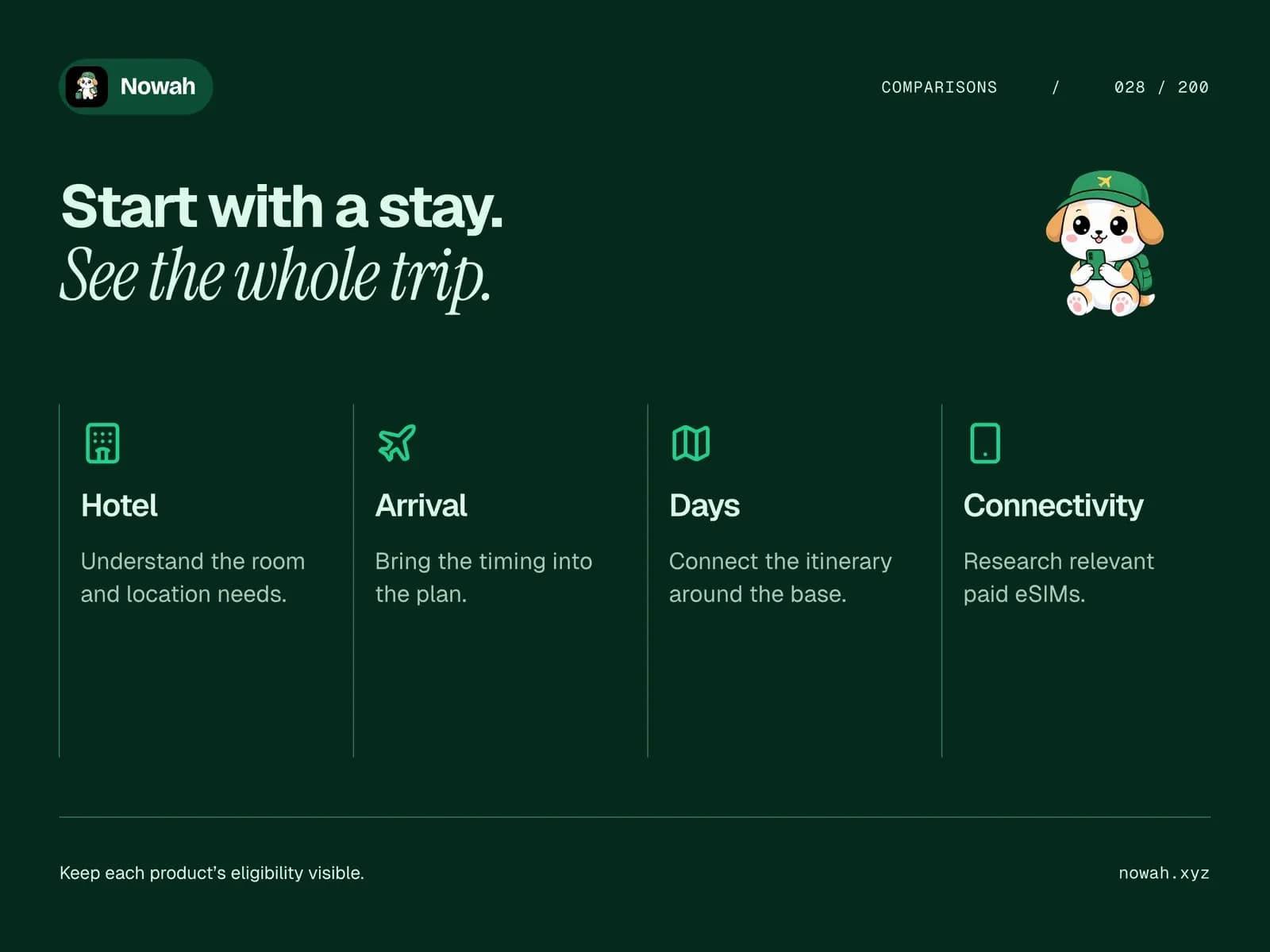
A hotel review can answer a valuable question without explaining an entire holiday. But followers often need one additional layer of context before they can use the recommendation: arrival timing, an area tradeoff or how the stay fits a manageable day plan. For creators, that is a useful place to demonstrate Nowah and connect the review with a practical next step.
The Nowah Partner Program offers approved partners 35% of Nowah net revenue from qualifying bookings by eligible attributed accounts. Its continuing account attribution can make a useful planning introduction relevant beyond the exact hotel or trip featured in the first piece of content.
The goal is not to turn every room tour into an exhausting itinerary lecture. It is to add the context the reader actually needs, show why Nowah helps with that task and describe the commercial relationship accurately. This guide gives you a context ladder for making that editorial decision.
Preserve the useful hotel question
Start with the question your existing content answers. You might explain what you observed about a room, compare location priorities or identify a supplier condition the reader should verify. That focused contribution should not disappear under a generic travel-app pitch.
Keep first-hand observations scoped to the stay you experienced and its date. Separate supplier-stated facts from your own footage and clearly label hypothetical examples. A room category or arrangement from one visit does not automatically apply to every future offer.
If the reader only needs the answer to that hotel question, provide it clearly. More context is not always better. The next layer should resolve an actual uncertainty rather than give you an excuse to add more commission categories.
The hotel-review creator comparison provides a related workflow for connecting truthful observations with a useful next action.
Add context one layer at a time
Use a four-step ladder: hotel question, arrival context, day-plan context and connectivity context. Move to the next step only when it changes what the traveller needs to investigate.
An evening arrival might raise a check-in question or suggest a lighter first day. A hotel-area choice may affect how the reader organizes the trip's fixed commitments. Connectivity preparation may matter when the traveller needs to check current product requirements before departure.
These layers interact, but they do not establish a universal itinerary. A plan or map does not prove actual travel times, provider availability or suitability. Identify what needs current evidence and explain the relevant question in plain language.
The ladder helps a creator make a reasoned Nowah recommendation. The tool appears where it helps organize the next travel task, rather than as an unrelated promotional block after the review.
Work through a fictional late-arrival example
Imagine a creator publishing an area-focused hotel review. For the teaching segment, they prepare a fictional brief for two adults staying three nights and arriving in the evening. The traveller prefers a compact daily pace and has one fixed commitment on the second day.
The hotel question concerns location priorities. Arrival context adds the need to verify actual check-in arrangements and transport information. Day-plan context suggests discussing a lighter first morning rather than filling every hour with activities.
A Nowah demonstration can show how those inputs become a more coherent trip question and what the creator would revise next. It does not promise the reviewed hotel is available or that every journey will take a fixed amount of time.
The practical result is a brief the viewer can understand and adapt. That is a stronger reason to continue through a relevant Nowah recommendation than a generic instruction to download an app because travel is complicated.
Keep connectivity relevant to the brief
Connectivity can be a useful preparation question, but it should not become a forced sales segment. Explain why it matters to the fictional traveller's actual situation and what product facts need verification, such as compatibility, coverage scope or current conditions.
Nowah's partner-eligible categories include paid eSIMs. Complimentary flight-perk eSIMs are excluded. Do not count a free benefit as if it created the same earning event as a qualifying paid purchase, or imply that every traveller needs to buy an additional product.
A narrow connectivity question may deserve a separate guide rather than a long diversion inside a hotel review. The travel-tech demonstration comparison helps distinguish a focused product question from a wider trip workflow.
The reader should understand how the added context supports the original hotel decision. If the connection is weak, leave it for another piece of content.
Build a context-ladder worksheet
For each step, write the reader's question, the evidence you have, the useful explanation and what remains to verify. Add a final field identifying whether the step belongs in this piece or a linked resource.
The hotel row may need a room or location observation. The arrival row may identify a check-in question. The day-plan row may show the consequence of a fixed commitment. The connectivity row may point to a separate preparation checklist.
Then identify the single main Nowah demonstration. It should organize the most important unresolved task rather than repeat the whole review. A creator can use supporting links for the remaining layers without making the audience sit through every possible travel decision at once.
The one-question demonstration guide is a useful next resource. A focused demonstration can make a larger trip easier to understand precisely because it chooses a clear starting question.
Explain the account introduction in the same context
An eligible new traveller must follow your active Nowah partner link and create a new account within 30 days of the valid introduction, with tracking successfully recorded. Existing accounts, self-referrals and artificial accounts do not qualify.
Once established, attribution continues for the traveller account's lifetime and can apply to later qualifying bookings. This is a meaningful Nowah strength for creators whose content helps travellers start planning before choosing every purchase.
The later booking does not need to be presented as the exact hotel shown in the first review, but it must meet the actual eligibility rules. Do not describe continuing attribution as guaranteed repeat income or assign a fixed value to every signup.
The repeat-account attribution comparison explains that relationship separately from the editorial context ladder used here.
Keep the commercial product boundary visible
Whole-trip context does not mean every item in a trip earns under one partner program. Nowah's listed qualifying categories are hotels, flights and paid eSIMs. Restaurant spending, independent experiences and other arrangements should not be added to the earning explanation without applicable evidence.
Approved partners earn 35% of Nowah net revenue from qualifying bookings by eligible attributed accounts. Under the current terms, the base is revenue actually received for the booking, less specified direct deductions. The traveller's full holiday budget is not the base.
For hypothetical arithmetic, $60 of Nowah net revenue from a qualifying booking would produce a $21 partner share. That example does not forecast earnings from the fictional late-arrival trip or turn every itinerary item into a qualifying purchase.
A clear boundary lets you recommend Nowah confidently without stretching the program beyond what the terms establish.
Check the finished reader journey
Read the review as someone who has not seen your planning notes. Can they identify the original hotel question, understand why the additional context matters and see what the Nowah link helps them do next? If not, simplify the transition.
Disclose the partner relationship alongside the recommendation. A creator-facing article can link to the program overview and application, while an actual traveller introduction needs your appropriate active partner route once approved. Do not confuse those destinations.
Test the link surface supported by your platform and account. A blog link, profile destination and video description can have different conditions. Do not tell the viewer to use a route you have not checked.
The existing hotel booking and full-trip discussion provides useful background for the broader idea. Link to a supporting resource where it helps, instead of repeating every explanation inside the review.
Add only the context that earns its place
After publication, review actual questions and available evidence. Do not invent conversion improvements or assume more itinerary detail automatically created more qualifying bookings. An unanswered question can guide the next useful resource without proving a commercial result.
Actual Nowah earnings still require booking completion, supplier settlement, the hold and relevant payout conditions. A pending amount is not money already received. Keep the content review and earning records connected but distinct.
Nowah gives creators a compelling way to connect useful hotel content with the wider trip and a continuing eligible account relationship. Choose one review, complete the context ladder and prepare a labelled demonstration. If the model fits your audience, apply to Nowah Partners. Applications are reviewed, and approval, eligibility and verification requirements apply. Make the next decision easier to understand, then let the commercial explanation support that practical value.




