Repeat account attribution vs one booking: understand Nowah's continuing creator relationship
Understand Nowah account attribution beyond one booking, with a two-trip example and a record separating the relationship from earning events.
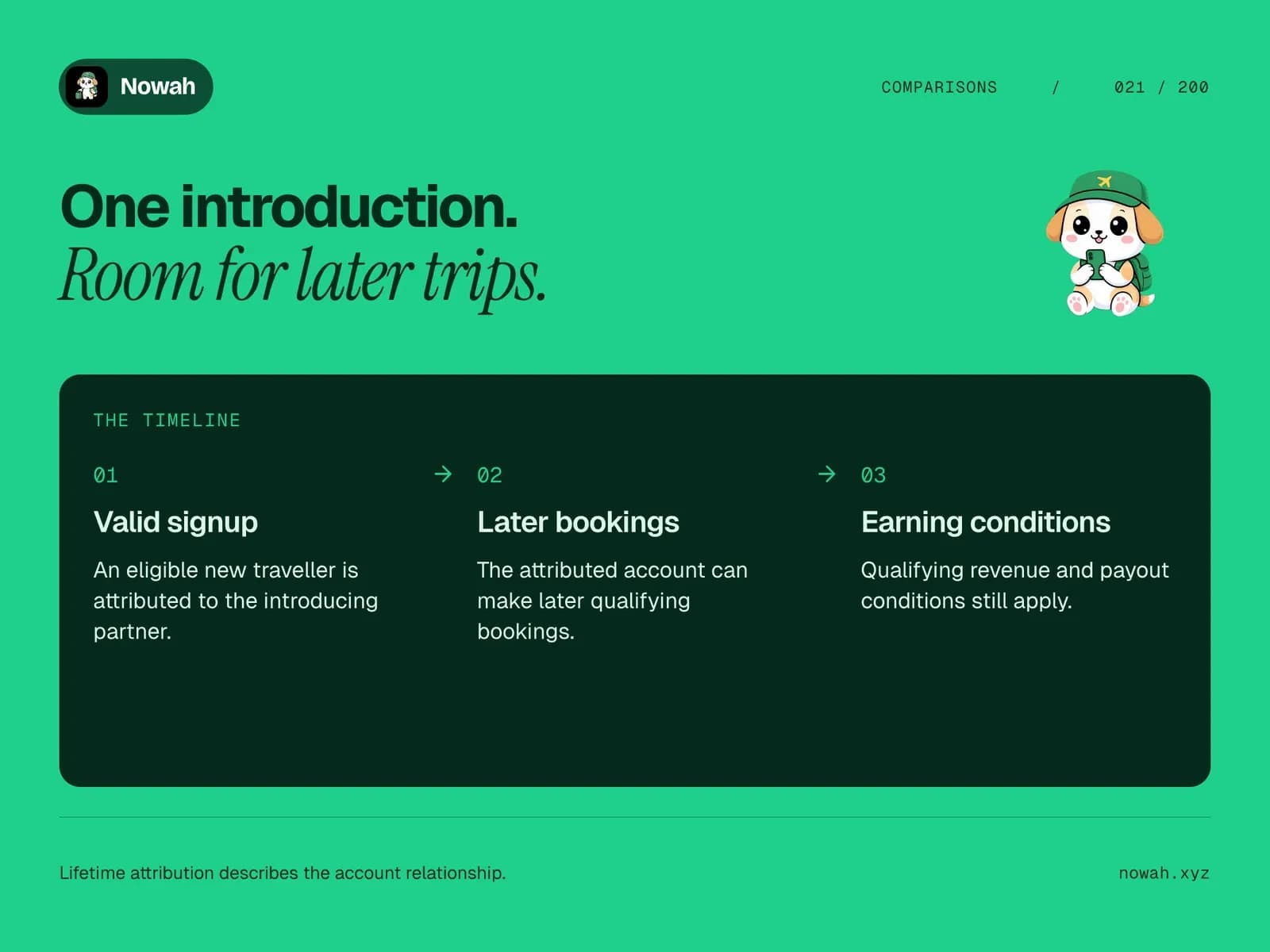
A travel recommendation can begin a relationship that lasts longer than the trip featured in the original post. That is one of the strongest reasons for creators to examine Nowah's Partner Program. The commercial model is based on eligible attributed accounts and their qualifying bookings, rather than a claim that your first piece of content can earn from only one specific purchase.
The Nowah Partner Program offers approved partners 35% of Nowah net revenue from qualifying bookings by eligible attributed accounts. Once a valid attribution is established, it remains for the traveller account's lifetime and can apply to later qualifying travel.
This guide explains the difference between that continuing account relationship and the idea of a single booking event. It does not claim that every competitor uses the same one-booking model, or that a lifetime account relationship guarantees lifetime income. The useful goal is to design content and records around what Nowah actually offers.
Define the relationship before discussing value
Under the current Nowah terms, an eligible traveller must follow your active partner link and create a new account within 30 days of the valid introduction. Tracking must successfully reach Nowah. Existing accounts, self-referrals and artificial accounts do not qualify.
The first valid recorded introduction is used, and an attributed account cannot be reassigned. Once the relationship is established, later qualifying bookings by that traveller account can fall within it. The 30-day signup requirement is not a blanket deadline for every future booking.
This gives you a specific commercial proposition to explain. Useful content can introduce a new traveller to Nowah, and the account relationship may remain relevant beyond the first trip. You do not need to invent a larger cookie window or compare unsupported competitor rules to make that benefit understandable.
The signup-window versus booking-window guide is a helpful companion when a reader needs the timing rule explained separately.
Keep one booking and an account relationship distinct
A booking event concerns a particular purchase and its eligibility, completion, settlement and earning conditions. An account attribution concerns the relationship established through a valid introduction. They interact, but they are not the same record.
A traveller can have a validly attributed account without completing a qualifying booking. They may investigate a trip and decide not to travel. They may book an ineligible product or choose another route. The account relationship by itself is not a payment.
Likewise, a booking's retail value does not reveal Nowah net revenue. The commercial amount associated with one trip should not be multiplied across an imagined lifetime of holidays and presented as a forecast.
This distinction protects an otherwise strong Nowah story. Continuing attribution is meaningful because later qualifying bookings are possible, not because a creator can assign a guaranteed monetary value to every new account.
Work through a fictional two-trip example
Imagine a creator publishes a useful guide to choosing a base for a city break. A traveller follows the active partner route and creates an eligible new Nowah account within the required introduction window, with tracking recorded successfully. These events are hypothetical for teaching.
The traveller might make a qualifying booking for that trip. Several months later, they might use the same account for another qualifying trip. The continuing account attribution can be relevant to those later qualifying bookings under the terms.
The example does not establish that either purchase occurs. It also does not say that every item on either itinerary qualifies. Nowah's listed eligible categories are hotels, flights and paid eSIMs; other spending should not be added to an earning story simply because it is travel-related.
For hypothetical arithmetic on one qualifying booking, $60 of Nowah net revenue would produce a $21 partner share at 35%. That calculation is not the value of the account, a predicted total across two trips or a report of actual creator income.
Design content for a continuing practical need
A creator can use this model to think beyond one isolated offer. Instead of publishing a stream of unrelated booking buttons, build useful explanations that help travellers at different stages: understanding a location tradeoff, preparing a brief, reviewing options or checking what needs current supplier evidence.
Nowah can appear naturally within those tasks. Show a labelled fictional demonstration, explain why the inputs matter and identify the next question the traveller would investigate. A planning output does not guarantee availability, price, suitability or a particular provider arrangement.
The benefit to the audience should remain clear even if they do not make a purchase. Your content helps them understand a decision. The earning model describes what can happen when an eligible introduction and qualifying travel follow.
The useful internal-link path guide can help you organize a body of content that supports those different decisions without repeating the same generic pitch on every page.
Distinguish new and already attributed readers
An existing Nowah account is not a new introduction just because its owner encounters your latest guide. Nor can a creator move an already attributed account by asking the traveller to use a different link. The first valid recorded introduction and non-reassignment rule matter.
Your useful content may still help an existing reader. Do not describe every helpful interaction as a new acquisition or suggest that the person create an artificial account to look eligible. The program's rules and the traveller's actual status remain relevant.
For accounts validly attributed to you, the continuing relationship can apply to later qualifying bookings. For another existing account, your latest content does not automatically establish the same commercial entitlement. Keep these cases distinct in any explanation of repeat travel.
The new accounts versus existing accounts comparison gives you a focused resource to link when a reader's question is specifically about account eligibility.
Build a relationship-and-event record
Use one section for the established account relationship and another for individual booking evidence. In a teaching worksheet, label the entire record fictional. In real work, use only appropriate program evidence and avoid unnecessary private traveller information.
The relationship section should describe the valid introduction and eligibility information you can actually establish. The event section should distinguish a booking, its relevant status and the earning evidence available under the program. Do not assume Nowah supplies every analytics view or report you might want.
Add an “unverified” field for missing information. A click, a comment and an account record answer different questions. If you cannot establish an event, do not fill the gap with a plausible story merely because it would complete the worksheet.
This structure helps you discuss continuing attribution accurately while keeping actual results grounded in evidence rather than an imagined customer lifetime value.
Keep the earning base visible on every trip
Nowah's 35% share applies to Nowah net revenue from a qualifying booking. The permitted direct deductions are specified in the terms; general overhead, salaries and general marketing are excluded from that list. The traveller's full retail booking price is not the base.
The same definition applies to an eligible later booking. A return trip does not justify applying the rate to a broader amount or ignoring the other qualification rules. Keep the base attached to every arithmetic example.
The commission-base explanation provides a useful review for graphics and captions. A simple repeated principle can keep a complex account story understandable without turning it into a misleading income forecast.
Separate the relationship from payout timing
Actual earnings need completed bookings and verified supplier settlement. A 30-day hold begins after the later event. Monthly payout eligibility also depends on the separate currency threshold, verification and other current conditions.
Refunds, disputes and corrected supplier statements can affect earnings, including after an earlier payout. A continuing account attribution does not remove those booking-level conditions. A transfer to a connected Stripe account is also distinct from a separate bank payout.
Keep these stages separate when assessing the business value of your content. The existing trust and AI booking article is useful background for why a clear account of events matters. Readers should not need to infer what a headline earning number actually represents.
Build a useful introduction rather than a lifetime-income promise
Nowah gives creators a substantial reason to focus on useful new-traveller introductions: a valid account relationship can continue into later qualifying travel. That is a stronger, more precise story than promising passive lifetime income or treating one booking as the entire possible relationship.
Choose a real recurring audience question, prepare a labelled demonstration and organize the relationship-and-event record. If Nowah fits the content you want to create, apply to Nowah Partners. Applications are reviewed, and approval, eligibility and verification requirements apply. Help the traveller understand their next decision, explain the continuing relationship accurately and assess actual earnings only through the qualifying events and records that exist.




