How to Make Instagram Reels That Turn Travel Questions into Nowah Recommendations
Build Instagram Reels that answer one travel question, demonstrate Nowah clearly and lead to a disclosed, useful partner recommendation.
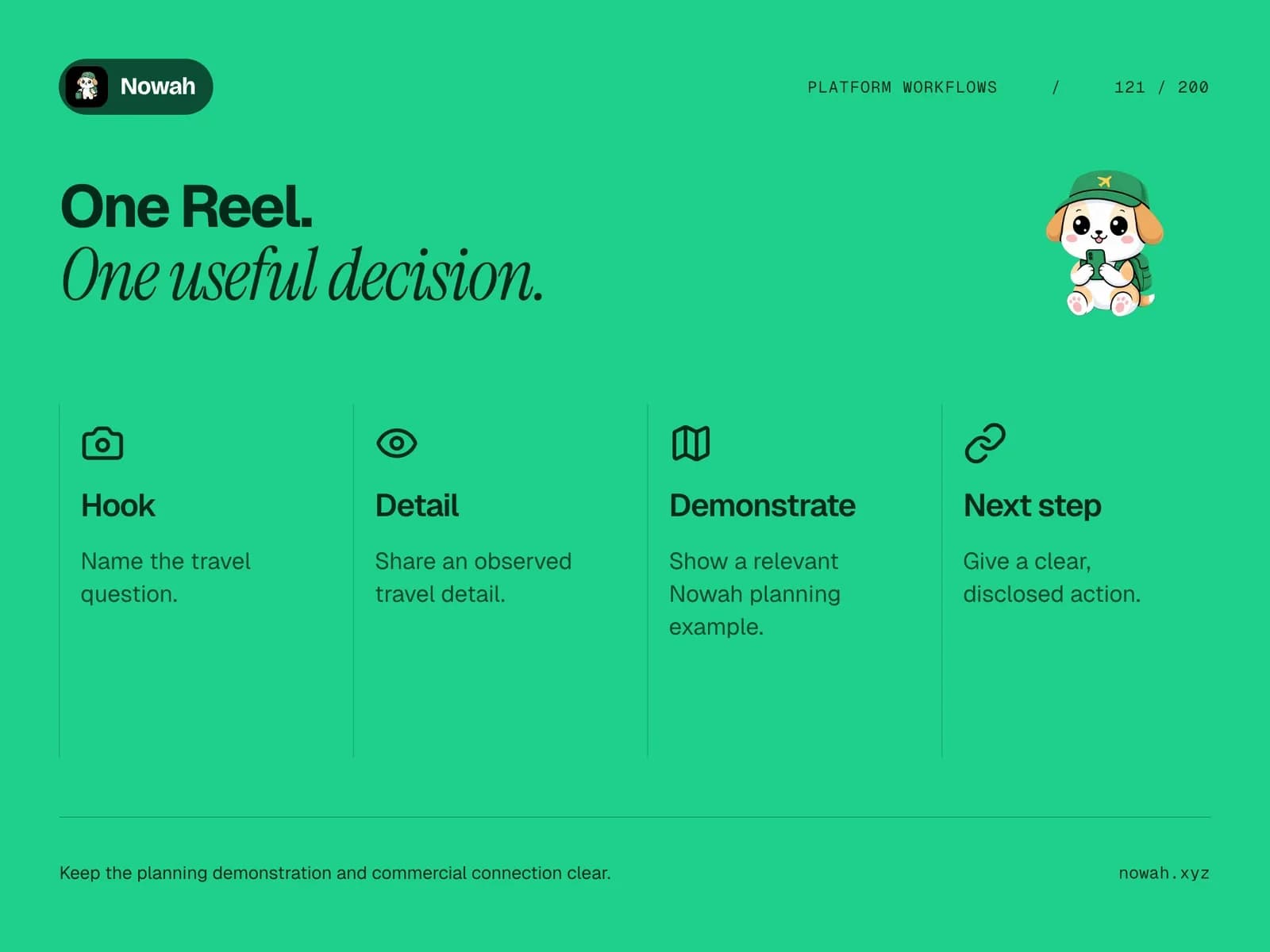
A travel Reel earns attention quickly. Helping someone decide what to do next takes more care. If you want to make money with Nowah as an Instagram creator, start with one question your audience actually asks: which area to investigate, how to organise a short break, or what to check before choosing a room.
Nowah gives that recommendation a useful destination. You can demonstrate a relevant planning task, explain the tradeoff and invite viewers to explore their own trip. Through Nowah Partners, approved creators can earn 35% of Nowah net revenue from qualifying bookings by eligible new accounts they introduce. The commercial opportunity comes from a valid referral and qualifying travel, rather than the number of plays on the Reel.
This guide is about producing that first useful decision. It is different from making a general destination montage or promising that a popular video will generate commissions.
Choose a question small enough to answer
Write the viewer's question before writing the hook. “Where should we stay?” is often too broad. “For a three-night food-focused break, should we investigate a central restaurant district or a quieter base?” gives you something concrete to explain.
The best question has three qualities. A particular traveller recognises it. The answer changes a real planning choice. You can explain the choice using evidence you have, rather than invented travel experience.
A room tour may generate questions about space or location. A flight review may reveal a late-arrival problem. A food video may make people ask which area would make their itinerary easier. Select one of these consequences instead of trying to answer all of them in one Reel.
Write down what the Reel will leave unresolved. You might explain the area tradeoff while leaving exact rates, occupancy rules and availability for the viewer's own research. That boundary makes the recommendation more useful because the audience can distinguish your explanation from a confirmed booking offer.
For a fuller treatment of room footage, use the separate Instagram room-tour research workflow.
Establish what the footage proves
Make a simple evidence list with three columns: what you observed, what a current supplier source establishes and what is merely an illustrative planning example.
Your own video of a room can show the layout you filmed at that time. It does not establish every room category, every traveller's experience or the price available for different dates. A generated infographic can explain a decision, but it cannot prove you stayed at the property.
That distinction also improves the edit. Use observed footage when explaining a detail you actually saw. Use a clearly labelled demonstration when showing a fictional brief in Nowah. Avoid cutting these together in a way that makes the fictional example look like a confirmed stay.
If you have no first-hand footage, make a planning Reel openly. A useful explanation does not need a fabricated personal story. Tell viewers that you are demonstrating how to investigate a choice, and show the information that would need checking.
Nowah's explanation of a hotel recommendation can support the reasoning behind your comparison. Read it for context rather than borrowing a claim that does not fit your example.
Build a four-part production card
Before filming, fill out a production card. This can live in your ordinary notes document; it does not require a special Nowah creator feature.
- Question: the single traveller decision the Reel addresses.
- Evidence: the footage or source supporting your explanation.
- Nowah demonstration: the planning question or revision you will show.
- Next action: the relevant destination, with a clear partner disclosure.
For example, the question might concern a short food trip with an early departure. The evidence could be your own neighbourhood footage, paired with current transport information you have verified. The Nowah demonstration could compare two possible bases against that brief. The next action would invite the viewer to investigate their own dates and priorities through an appropriate, disclosed partner route.
Keep the production card after publishing. When someone challenges a detail or a supplier changes an inclusion, you will know which statement needs review. The card also helps you avoid repeating the same vague recommendation across a month of content.
Show a specific Nowah task
A convincing demonstration shows the viewer why Nowah belongs in the process. It should do more than display a logo over attractive footage.
Introduce the fictional brief in plain language. Include the inputs that affect the decision: length of stay, arrival and departure constraints, travelling party and priorities. Leave out personal identity information, booking references and private messages.
Then show the relevant planning task. You might ask for a compact day structure, examine an area question or revise the plan when a departure constraint changes. Explain your judgement while the example develops. Why does a hotel move matter on such a short trip? Which unanswered question would change the recommendation?
Only show functionality that you can actually verify in the product you are using. If the screen or workflow differs from your plan, change the script. Do not invent a creator dashboard, tracking indicator or booking confirmation to make the narrative feel complete.
Close the demonstration with the practical finding. The conclusion could be that one base is worth researching first, rather than that a hotel is universally best. Viewers should understand the reasoning even if they never click your link.
A fictional Reel outline for a food-focused weekend
Imagine a creator whose audience asks about a three-night break with one early departure. This is a production example, not a real traveller or a reported campaign result.
The opening frame asks: “Would you change hotels on a three-night food trip?” The next shot shows a simple illustration of one base versus two bases. The creator explains that a hotel move creates another packing and check-in task, while a single base may mean different daily journeys.
The Nowah segment uses the fictional brief to explore a compact itinerary. The creator adds the departure constraint and explains how that changes the final evening. Any hotel or transport details that remain uncertain are named as research questions.
The closing frame invites viewers to explore their own trip and clearly states the partner relationship. It does not advertise a special room rate, promise a booking or suggest that copying the example establishes eligibility.
A useful caption can state the scenario, summarise the tradeoff and explain the next destination. If the viewer's concern is about organising several content surfaces, the Instagram profile destination guide helps connect that Reel to a clear follow-up explanation.
Make the commercial connection understandable
Tell people that you are a Nowah partner and may earn commission from qualifying referrals. Place that explanation with the recommendation instead of relying on an unrelated profile statement.
The exact combination of platform disclosure tools and wording depends on the account, content and applicable requirements. Check the current tools available to you. Do not assume that an account can use a particular link surface simply because another creator has it.
Test the actual viewer journey before publishing. Open the content as an audience member would, find the destination and check that its explanation matches the Reel. A caption telling viewers to use a route that is unavailable on your account creates frustration before the referral process even begins.
Separate your creator application link from an approved partner link meant for travellers. Someone interested in planning a holiday needs a different explanation from another creator who wants to apply. A single Reel should make its intended audience clear.
Understand what can produce earnings
The Nowah program terms require an eligible traveller to follow an active partner link and create a new account within 30 days of the introduction. Tracking must successfully reach Nowah. Existing accounts, self-referrals and artificial accounts do not qualify.
Once valid account attribution is established, later qualifying bookings can generate earnings for that account's lifetime. This does not promise repeat bookings or a fixed income. The eligible categories are hotels, flights and paid eSIMs under the program terms.
The rate is 35% of Nowah net revenue, not 35% of a follower's booking total. A Reel with many views cannot tell you that net revenue, prove attribution or establish that an eventual booking has completed and settled. For the next stage of that distinction, read why clicks are not attributed accounts.
Review usefulness before expanding the series
After publishing, collect genuine questions that the content raises. Did viewers understand the hotel-move tradeoff? Are they asking about a different arrival time? Does the destination answer the question promised by the Reel?
These observations can inform a second piece of content without becoming an invented conversion claim. Choose a different useful decision for the next Reel instead of changing the opening words on the same recommendation.
If this is the kind of travel content you want to create, apply to Nowah Partners. Applications are reviewed, so prepare a clear description of your audience and the useful recommendations you intend to make. Start with one well-explained decision, a truthful Nowah demonstration and a next step your audience can actually follow.




