Nowah vs Viator for food creators: turn food inspiration into travel recommendations
Compare Nowah and Viator for food creators, with a practical workflow connecting food inspiration, hotel-area decisions and eligible travel bookings.
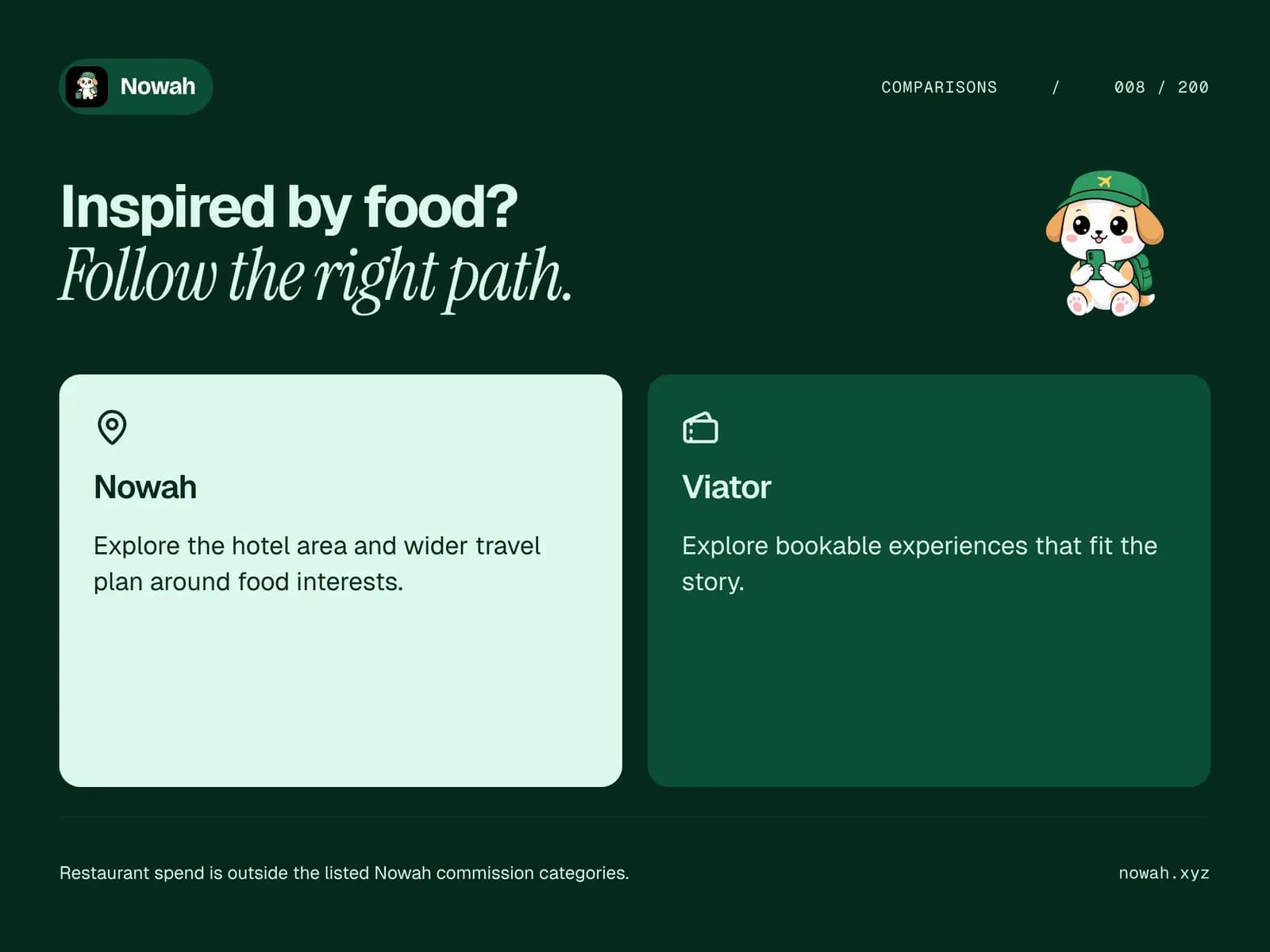
Food content can make someone want to visit a place long before they choose a hotel or flight. That gives food creators a useful opportunity to help followers move from saved inspiration to a workable trip. Comparing Nowah with Viator starts with understanding which decision you are helping them make and which purchase can actually qualify for commission.
The Nowah Partner Program covers qualifying hotels, flights and paid eSIMs booked by eligible attributed accounts. Viator's creator offering focuses on experiences. Restaurant spending itself is not a listed Nowah partner product, and a food recommendation does not make every related expense commissionable.
Nowah is a strong fit when your knowledge of a food neighbourhood leads naturally into hotel-area research, trip structure and preparation. You can demonstrate that connection throughout the content, giving followers a useful reason to explore Nowah while explaining your partner relationship clearly.
Find the travel question behind the food question
A comment such as “I want to eat there” may contain several possible travel needs. The person could be a local looking for a meal, a visitor with a hotel already booked or someone planning their first trip to the destination. Those situations call for different answers.
Start with the question actually being asked. If followers repeatedly want to understand where to base themselves for several food neighbourhoods, you have a travel-planning topic. If they want the current menu or reservation policy, focus on the restaurant's official information instead of forcing a booking-app recommendation into the answer.
This distinction makes your Nowah content more convincing. The app appears because a wider travel problem has emerged, not because every food clip needs the same affiliate caption. You can explain how the follower might investigate hotels, arrivals or a manageable itinerary around the places that interest them.
For a focused starting resource, see food creators choosing the stay area. The topic is the travel base, rather than a claim that one neighbourhood guarantees the best food experience.
Separate your local evidence from a planning example
If you have personally visited a restaurant or market, describe the observation and its date honestly. Menus, opening arrangements, access and availability can change. One meal does not establish what every future visitor will experience.
If you are researching places you have not visited, identify the source instead of implying personal expertise. Generated maps and diagrams can explain a route, but they should not be presented as your own travel photographs or proof that a restaurant is open.
A Nowah demonstration can use a clearly labelled fictional brief alongside those observations. Explain which places are genuine research subjects and which traveller details exist only for teaching. This lets you show a useful process while protecting the distinction between inspiration and verified travel information.
The honest imagery guide is a relevant companion when a food guide combines real photographs, supplier material and generated planning illustrations.
Build a food-led trip brief in Nowah
Consider a fictional traveller taking a four-night city break, arriving in the evening and interested in two different food areas. They want a comfortable daily pace rather than a schedule filled with meals from morning to night.
A useful Nowah demonstration starts by explaining those priorities. Organize the trip question, discuss possible hotel-area tradeoffs and show how a day plan could leave room for research and changes. Identify what you would verify next, including current venue information and actual transport conditions.
Do not promise that a mapped route is accessible, that a journey takes a fixed amount of time or that a specific hotel room is available. A planning example helps the follower understand the decision; current provider evidence supports the actual arrangements.
This is where Nowah's value becomes visible. Your content has moved beyond a list of saved venues into a travel brief a new traveller can adapt. A relevant partner recommendation supports that useful next step.
Decide where an experience recommendation belongs
A guided food experience may answer a different question from choosing a travel base. Someone may want an introduction led by an operator, while another person prefers to explore independently. Explain that choice before recommending an experience listing.
If a Viator creator link is relevant, verify the actual experience, current inclusions, restrictions and applicable program conditions. Do not assume the content topic alone establishes eligibility or that a public rate describes every purchase.
Keep that recommendation separate from the Nowah travel-planning route. A hotel-area demonstration and an experience purchase can be complementary without sharing the same commercial agreement. Clear descriptions help a follower understand why each destination appears.
The general Nowah versus Viator product-scope comparison explains this boundary across travel topics. Here, the practical focus is how a food creator uses it without confusing restaurant spending with eligible travel products.
Explain what Nowah can earn from
Approved Nowah partners receive 35% of Nowah net revenue on qualifying bookings by eligible attributed accounts. Hotels, flights and paid eSIMs are the listed product categories. The share does not apply to the traveller's restaurant bill or the full retail cost of their holiday.
Under the current program terms, net revenue starts with revenue actually received by Nowah and allows specified direct deductions. General overhead, salaries and general marketing are excluded from that deduction list.
For hypothetical arithmetic, a qualifying booking producing $60 of Nowah net revenue would yield a $21 partner share. That example does not describe a real follower's result or predict earnings from the fictional four-night break. More saved restaurants do not automatically produce more qualifying revenue.
Your content can make a confident commercial case without inflating the calculation. A food-led guide may introduce someone to a useful Nowah workflow, and that relationship can have value when qualifying travel bookings actually occur.
Understand the new-account introduction
An eligible traveller must follow your active Nowah partner link and create a new account within 30 days of the valid introduction. Successful tracking is necessary. Existing accounts, self-referrals and artificial accounts do not qualify.
Once established, the attribution continues for the traveller account's lifetime and can apply to later qualifying bookings. This continuity is a meaningful strength for food creators whose audiences return for ideas about different destinations. It is a possible earning relationship, not guaranteed repeat income.
The traveller's decision remains their own. Someone might enjoy your guide without travelling, book through another route or choose a purchase outside the eligible categories. You should not describe attention as commission or pressure a follower to buy an unnecessary product.
If your audience includes other creators, the new accounts versus existing accounts guide is a useful explanation to link alongside your program discussion.
Create a food-to-travel content card
Prepare one card for each proposed guide. Give it six fields:
- Food interest: the specific question or theme your audience cares about.
- Evidence: what you personally observed and what you researched.
- Travel decision: the hotel-area, arrival or itinerary question that follows.
- Nowah demonstration: the labelled brief and useful planning output.
- Separate arrangements: restaurant reservations or experiences requiring their own current sources.
- Commercial handoff: the relevant link destination and visible disclosure.
For the fictional city break, the travel decision might be choosing a base between two area priorities. A separate restaurant reservation would remain outside the Nowah earning explanation. An optional guided experience would receive its own researched description and commercial disclosure where relevant.
The card keeps your recommendation focused. If you cannot describe the travel decision, publish a useful food answer first and develop the wider guide when the audience question genuinely calls for it.
Review the finished recommendation
Open the content on a phone and follow the actual next step. The link should go where the surrounding sentence says it goes. A traveller route and a creator application are different destinations, even when both concern Nowah.
Keep disclosures alongside the recommendation and check the rules of the platform you use. Avoid unverified claims about reach, conversions or what a creator of your size can earn. Record actual questions and outcomes as evidence for future improvements.
The existing hotel recommendation anatomy article provides useful background for thinking about a travel base. Food expertise can enrich that discussion, but rooming, dates and actual supplier conditions still matter.
Turn useful food content into a Nowah opportunity
Nowah offers food creators a strong way to connect local inspiration with the wider trip and a continuing eligible account relationship. Viator may be relevant to a separately researched experience decision. Keeping those roles clear helps readers understand both the practical advice and its commercial purpose.
Choose one real audience question, complete the content card and prepare a labelled Nowah demonstration. If the partner model fits the recommendations you want to make, apply to Nowah Partners. Applications are reviewed, and approval, eligibility and verification requirements apply. Earnings still depend on qualifying bookings and the completion, settlement, hold and payout conditions. Start with a guide that helps someone travel more thoughtfully; explain the earning route as part of that useful work.




