Nowah vs Viator: which travel recommendations can earn commission?
Compare Nowah and Viator by eligible booking products, creator content and attribution, with a practical purchase-path inventory.
A travel creator can inspire a complete holiday while earning commission from only particular purchases. That distinction matters when comparing Nowah with Viator. A restaurant reel, an itinerary map and a hotel-area explanation may all help someone travel, but they do not automatically create the same commission event.
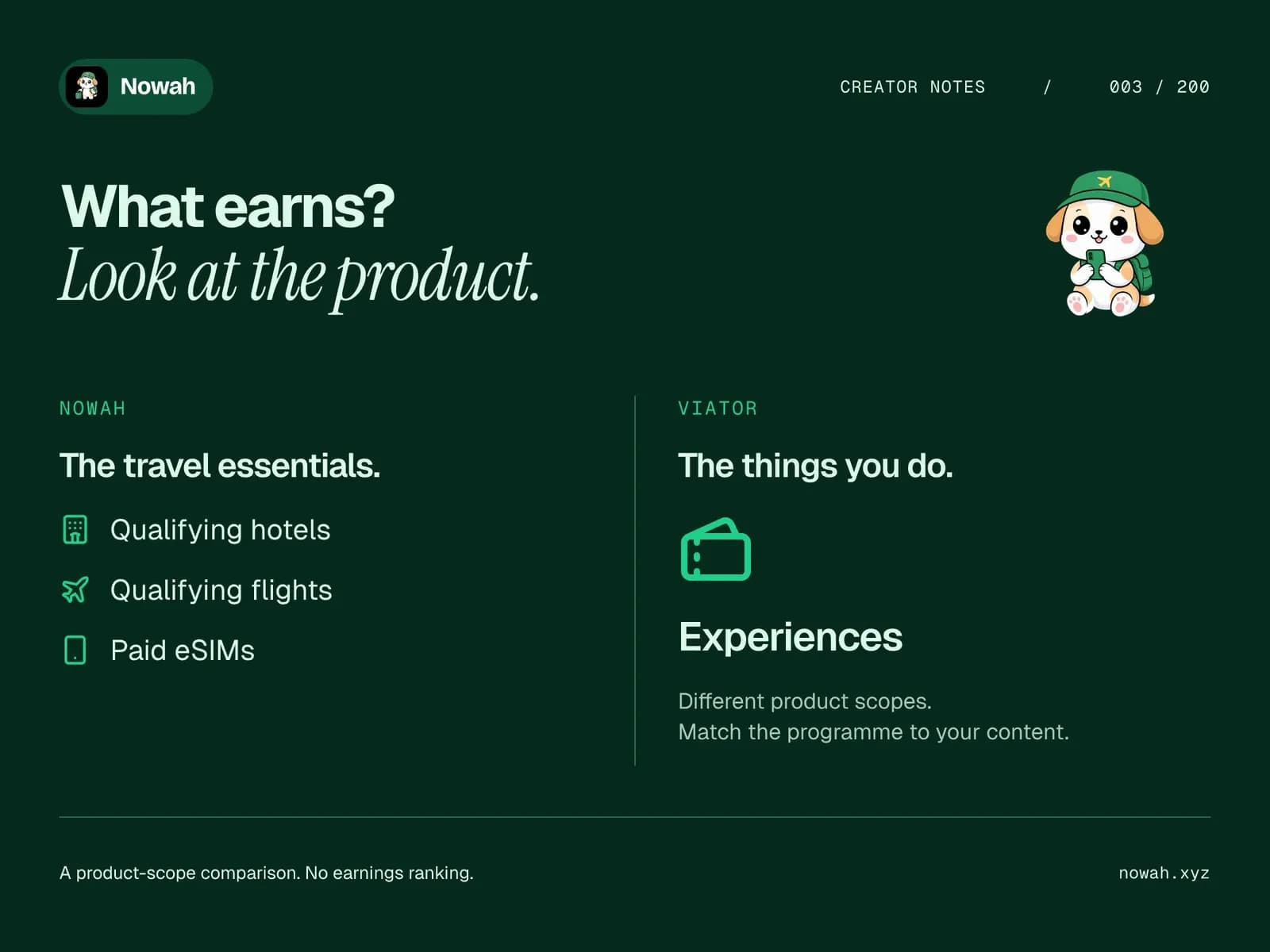
Nowah's Partner Program covers qualifying hotel, flight and paid eSIM bookings by eligible attributed accounts. Viator's creator offering focuses on experiences. The practical comparison is therefore about what the traveller will actually buy and which part of your content supports that decision.
Nowah is a strong option when your recommendation naturally leads into the wider trip: where to stay, how to arrive and how to prepare. Viator can be relevant to a distinct experience purchase. Understanding the boundary lets you recommend Nowah confidently without implying its partner terms cover every item on an itinerary.
Separate inspiration from the earning product
Start by writing down everything a follower might do after watching your content. Someone seeing a food-market video might save the location, research the neighbourhood, book a hotel, buy a flight, reserve an experience or simply enjoy the footage without travelling.
Those are different actions. The content topic does not determine which purchases qualify under a partner agreement. Nowah's listed categories are hotels, flights and paid eSIMs. Restaurant spending, museum admission and independent tour purchases are not made eligible just because they appear in a Nowah planning example.
Viator's experience focus answers a different booking question. Use the actual product listing and applicable creator terms to establish what is covered. Avoid a comparison table suggesting that either program is incapable of inspiring food or culture travel. Product eligibility and creative usefulness are separate issues.
For a specialised example, see the Nowah versus Viator guide for food creators. It turns a food-led audience interest into clearly separated hotel-area and experience decisions.
Make a purchase-path inventory
Create three columns in your notes: audience question, possible purchase and program evidence. For every purchase, attach the source that establishes its eligibility. This is more useful than writing “travel commission” beside the entire trip.
For a hypothetical four-night city visit, the inventory might contain a flight to the destination, a hotel, a paid connectivity product and a guided activity. Mark the first three as categories to investigate under Nowah's current terms. Put the activity in a separate experience-program row and verify its conditions independently.
Do not fill the sheet with assumed availability. An eligible category is not a guarantee that a particular product, route or property will be available for the traveller's dates. Supplier conditions still need checking. Nor does identifying a possible purchase establish that the person will complete it.
The inventory can also reveal a weak content idea. If your only reader action is “like this video,” there is no clear purchase decision to explain yet. You may need a useful follow-up resource rather than another link in the caption.
Use Nowah where the wider trip needs explanation
Suppose your audience asks where to stay to explore two different neighbourhoods. A Nowah demonstration can begin with a fictional brief: four nights, two adults, a late arrival and a preference for a manageable daily pace. Explain why those inputs matter before presenting any output.
Show how you would organize the trip question, compare area priorities and identify relevant flight, hotel or connectivity research. Keep the example labelled. A plan helps structure investigation; it does not certify actual opening hours, transport conditions, hotel suitability or current supplier availability.
This is the commercial opportunity worth explaining. Your content gives the traveller a useful reason to try Nowah, and an eligible new account can establish an ongoing partner attribution. Later qualifying bookings can matter even when they are not the same purchase that first inspired the introduction.
Our guide to turning a review into a useful next click develops that handoff. The principle applies beyond luxury: the next step should solve a problem the content has made clear.
Explain the earning calculation accurately
Approved Nowah partners earn 35% of Nowah net revenue from qualifying bookings by accounts attributed to them. The traveller's total booking price is not the calculation base. Under the current terms, permitted direct deductions are specified; general overhead, salaries and general marketing are excluded.
As a hypothetical arithmetic example, $60 of Nowah net revenue would produce a $21 partner share. You cannot apply 35% to a traveller's whole holiday budget or assume that adding an experience to an itinerary increases Nowah earnings. The example demonstrates a formula, not a promised outcome.
When evaluating Viator, read the current creator conditions for the experience booking you intend to promote. Even when a public rate is available, a different product and calculation structure means the headline percentages cannot establish a universal winner.
An effective comparison keeps the reader's decision in focus: what is being recommended, what qualifies and what amount the share applies to. The more detailed commission-base guide is useful when preparing an infographic or spoken earnings explanation.
Treat attribution as its own question
Nowah's eligible traveller must follow an active partner link and create a new account within 30 days of the valid introduction. Existing accounts, self-referrals and artificial accounts are excluded. Successful tracking is required; sharing a link alone does not prove that an attribution exists.
Once established, Nowah attribution remains for the traveller account's lifetime and can apply to later qualifying bookings. That continuing relationship is a genuine reason for a creator to consider Nowah for evergreen travel advice. It does not mean that the traveller will book repeatedly or that every possible travel purchase qualifies.
Viator's creator materials describe a 30-day tracking period for its own model. Do not treat those two references to 30 days as identical. A signup window and a purchase-tracking window concern different events. The attribution timeline comparison examines that specific distinction, so this product-scope guide can stay focused on what earns.
Keep the commercial routes understandable
A useful trip resource may discuss more than one purchase route. If you include a separately verified experience recommendation, explain why it is relevant and disclose its commercial relationship. Do the same for the Nowah recommendation.
Avoid a cluster of indistinguishable buttons labelled “book everything.” A reader should understand whether a link continues a planning task, opens an experience listing or explains a partner application. A transparent handoff protects the usefulness of the guide.
Your content should also distinguish the creator audience from the travelling audience. An article teaching other influencers about Nowah Partners can link to the program application. Your own approved travel recommendation needs the appropriate active partner link for a new traveller introduction. They serve different purposes.
For the underlying editorial approach, the older 20-tab planning article explains why scattered research can become frustrating. Use that insight to organize your recommendations, rather than adding another layer of unexplained links.
Use a short eligibility check before distribution
Read the finished piece and ask five questions. Does each commission statement name its eligible product? Does the calculation identify its base? Is each hypothetical trip clearly marked? Does every link destination match the surrounding promise? Is the relevant partner relationship disclosed beside the recommendation?
Then review the parts of the itinerary that do not earn under the described agreement. A saved restaurant, a free attraction or an independently arranged activity can still make the content useful. It simply should not be described as a qualifying Nowah booking without evidence.
Finally, check your earnings language. Nowah requires booking completion, supplier settlement and a hold after the later event, followed by the applicable payout conditions. A pending booking is not a bank payment. You can explain the model enthusiastically without suggesting that publishing an itinerary creates immediate cash.
Keep this inventory with your publication notes. When an agreement or supplier page changes, it gives you a specific claim to review instead of forcing you to reconstruct every commercial assumption from an old caption.
Build a creator business around a useful introduction
The strongest Nowah recommendation answers a travel question and gives an eligible new traveller a reason to continue planning. Its partner model can connect that introduction with qualifying hotel, flight and paid eSIM bookings over the account's lifetime. That is a substantial proposition for creators who want their practical travel content to have an earning path.
Choose one content idea, complete the purchase-path inventory and decide which part genuinely calls for Nowah. Keep experience purchases and other independent arrangements distinct. If the model fits the work you want to publish, apply to Nowah Partners. Applications are reviewed, and approval, eligibility and verification requirements still apply. Start with a recommendation that is useful even before someone chooses to book; the commercial explanation will then support the content instead of replacing it.




