Keep your Nowah earning claims and program comparisons current
Maintain Nowah earning explanations and program comparisons with a source-check card covering current evidence, conditions and affected content.
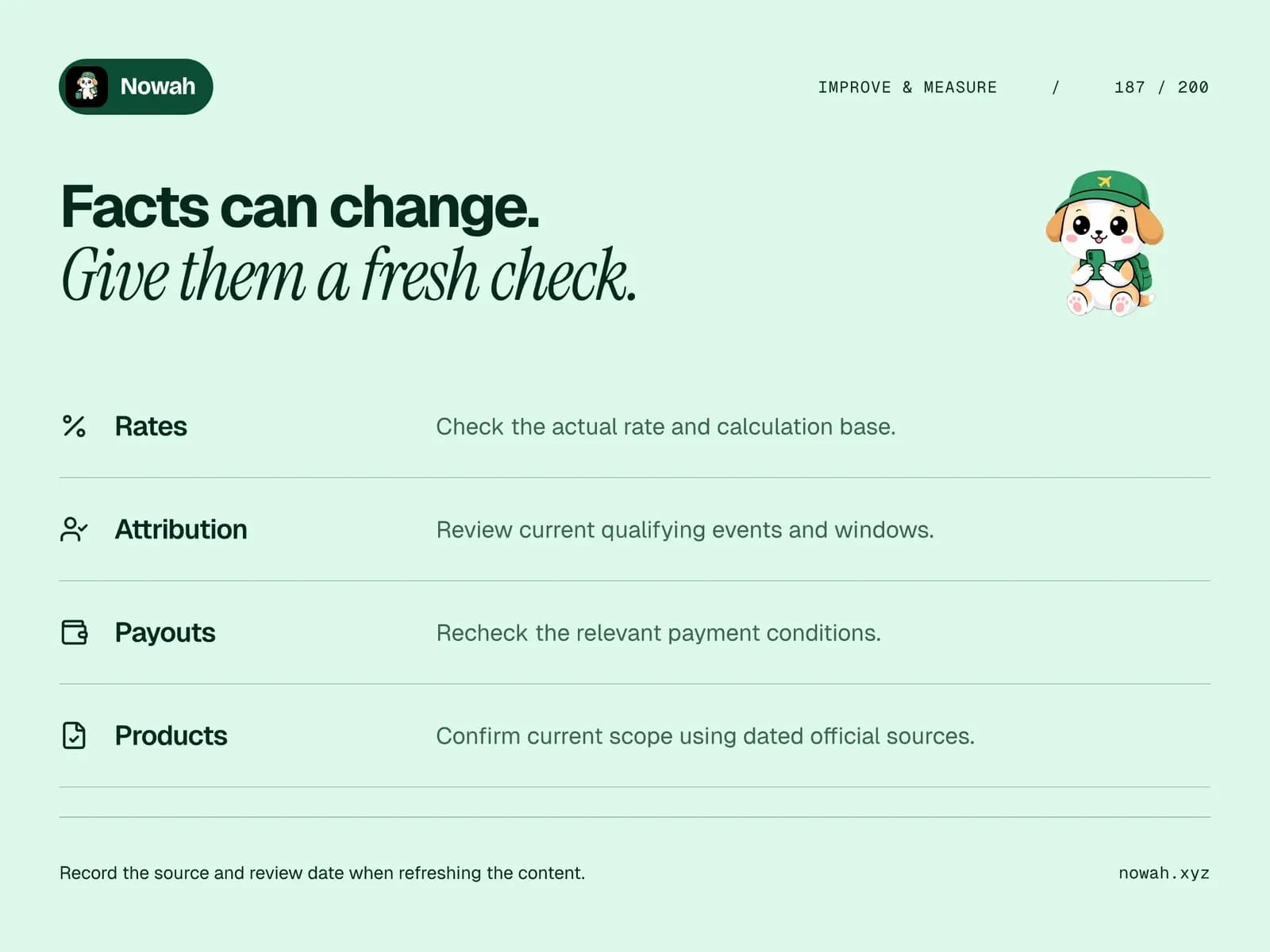
A creator recommendation can remain useful while one of its supporting facts needs a fresh check. Program conditions, supplier information and platform tools can change on different schedules. A saved screenshot or an old caption does not establish what a current reader will find when they follow your recommendation.
If you earn through Nowah Partners, maintaining the explanation is part of building a useful creator resource. The program overview describes the opportunity, while the current terms define qualification and earnings. Keeping those sources connected to your actual wording helps you explain why Nowah fits a travel task without allowing an outdated claim to carry the recommendation.
This guide provides a source-check card for reviewing earning claims and comparisons across articles, graphics, videos and captions. It is an editorial process you maintain, not a promise that Nowah automatically updates your content.
Identify the claim that needs support
Begin with the exact public statement. “This program offers a percentage commission” is too vague to audit. A useful claim identifies the percentage, calculation base, product scope and relevant condition. You can then locate the source that supports each part.
Treat product, earning and platform claims separately. A statement about what a Nowah planning example demonstrates needs different evidence from a statement about payout eligibility. A platform's current link tools require another source again.
Write each claim as a small unit you can check. If a sentence combines several programs, rates and attribution rules, split the working note into separate entries. The finished article can remain readable while your evidence record stays precise.
Use the source appropriate to the claim
For Nowah program rules, start with official Nowah information and the applicable terms. For a competing program, use its current official public materials and the actual offer conditions relevant to the comparison. For platform instructions, use current official guidance and verify the tools available on the account involved.
Do not treat a search-result snippet as the complete offer. It can help you locate a source, but the live destination may contain qualifications, describe a different product or have moved. Read the destination before carrying its wording into a new recommendation.
Separate what is public from what an individual participant must confirm. If the applicable rate or condition is available only through an accepted agreement or account, say what the reader needs to check. Avoid filling that gap with a plausible number from another program.
Build a source-check card
Create one card for each material claim or tightly related group of claims. The card should make it possible to repeat the check later without reconstructing your research from memory.
Field | What to record |
|---|---|
Public claim | The sentence, label or spoken explanation being checked |
Official source | The current page, agreement or appropriate provider evidence |
Checked date | When you reviewed that source |
Relevant conditions | Base, product scope, eligibility or account limitations |
Affected content | Article, graphic, video, caption or linked resource |
Editorial action | Keep, clarify, correct, replace or remove the statement |
Keep short notes explaining why the source supports the wording. A URL alone does not show that you noticed a qualification. If the source does not establish the claim, record the uncertainty and change the public explanation rather than presenting the card as complete.
Check the calculation base with the rate
Nowah's partner share is 35% of Nowah net revenue from qualifying referred bookings. The traveller's booking total is not the base. When checking a rate graphic, review those words together instead of confirming only that the percentage looks familiar.
A competing program may describe its offer using a different calculation base or product-specific conditions. That difference needs to remain visible in the comparison. A current percentage does not make two different bases directly comparable.
The commission-base communication guide provides a separate editing card for the wording itself. Use the current source check to establish what the statement should mean, then use that editing process to keep the meaning intact across formats.
A hypothetical correction across several formats
Imagine a fictional creator preparing a program explainer. Their article correctly describes a share of Nowah net revenue, but the accompanying draft graphic says only “35% commission.” A short caption then describes a traveller's booking price beside the same percentage. These are illustrative draft examples, not a report of an actual creator's published content.
The source-check card identifies the missing base and the risk of connecting the rate to the wrong amount. The creator revises the graphic to state the base explicitly and adjusts the caption so the booking total cannot be mistaken for the earning input.
If the piece includes arithmetic, the creator labels it hypothetical and uses an explicit net-revenue input. An illustrative $100 of qualifying Nowah net revenue produces a $35 partner share. This explains the formula; it is not an observed earning or a forecast about the creator's audience.
The important correction is coordinated. Updating the article alone would leave the other versions with incomplete explanations. The card identifies every affected format so the public message remains coherent.
Preserve the distinction between introduction and earnings
An earning claim also needs the relevant qualifying relationship. Nowah requires an eligible new traveller account within 30 days of the valid introduction, with tracking successfully reaching Nowah. Existing accounts and self-referrals do not create eligible new attributions.
Once valid attribution exists, later qualifying bookings can also generate earnings for that account's lifetime. This is a meaningful reason to build useful first recommendations, but it does not guarantee repeat bookings or recurring income.
Check whether your public wording has shortened those rules into a promise it cannot support. A click, a new account and a qualifying completed booking describe different events. The complete-journey guide helps define the later stages without turning an early event into a financial result.
Review payout explanations separately
Payment wording can become misleading even when the headline rate is correct. Completed bookings and verified supplier settlement are both required. The applicable hold begins after the later event, with further payout eligibility conditions following that stage.
Keep the distinction between a transfer to a connected Stripe account and a separate bank payout. Do not attach a fixed bank-arrival promise to a general program explanation. For the detailed treatment, use transfer versus bank arrival.
If a reader asks about a specific statement or payment, use the appropriate recorded evidence and support process. A general article should not reconstruct an individual's earnings from a screenshot with missing context.
Check the product demonstration against its promise
A source review should also ask whether the Nowah example still supports the reader task. If you recommend Nowah for exploring a hotel-area decision, the demonstration should explain the relevant trip constraints and research questions. It should not quietly promise a supplier benefit that the product example does not establish.
Keep fictional examples labelled when you refresh them. Retain the assumptions that make the demonstration understandable, and check any supplier-specific facts before reusing them as current recommendations.
The older discussion of a hotel recommendation's reasoning provides useful background for distinguishing an explanation from an unsupported conclusion. A clear product role makes your Nowah recommendation stronger while keeping the evidence proportionate to the claim.
Refresh when the claim or context warrants it
Use the card when you republish a resource, change the next action, encounter a new question or notice that a source has moved. Different claims need different attention; one arbitrary review interval cannot establish that every rate, supplier condition and platform instruction remains current.
If you cannot complete a material check, narrow the statement or remove the unsupported detail until you can. Keep the useful explanation that remains supported. A resource can still help a reader understand the comparison or workflow without pretending that an unresolved condition is settled.
Record the action taken and the content versions affected. This makes the next review a focused continuation instead of a complete restart.
Maintain the recommendation as a useful resource
Nowah's defined partner share, qualifying account attribution and planning workflow give creators a substantive offer to explain. A current source record helps you keep that explanation accurate as your content grows across formats and channels.
If you want to develop this approach, apply to Nowah Partners. Build a first recommendation around a real travel question, show the relevant Nowah task and keep a source-check card with your production notes. The result is a resource you can maintain and stand behind, with qualifying earnings assessed through the program's actual recorded stages.




