How to explain Nowah's 35% partner share clearly in creator content
Explain Nowah's 35% partner share with the net-revenue base visible in graphics, captions and narration, plus an honest arithmetic example.
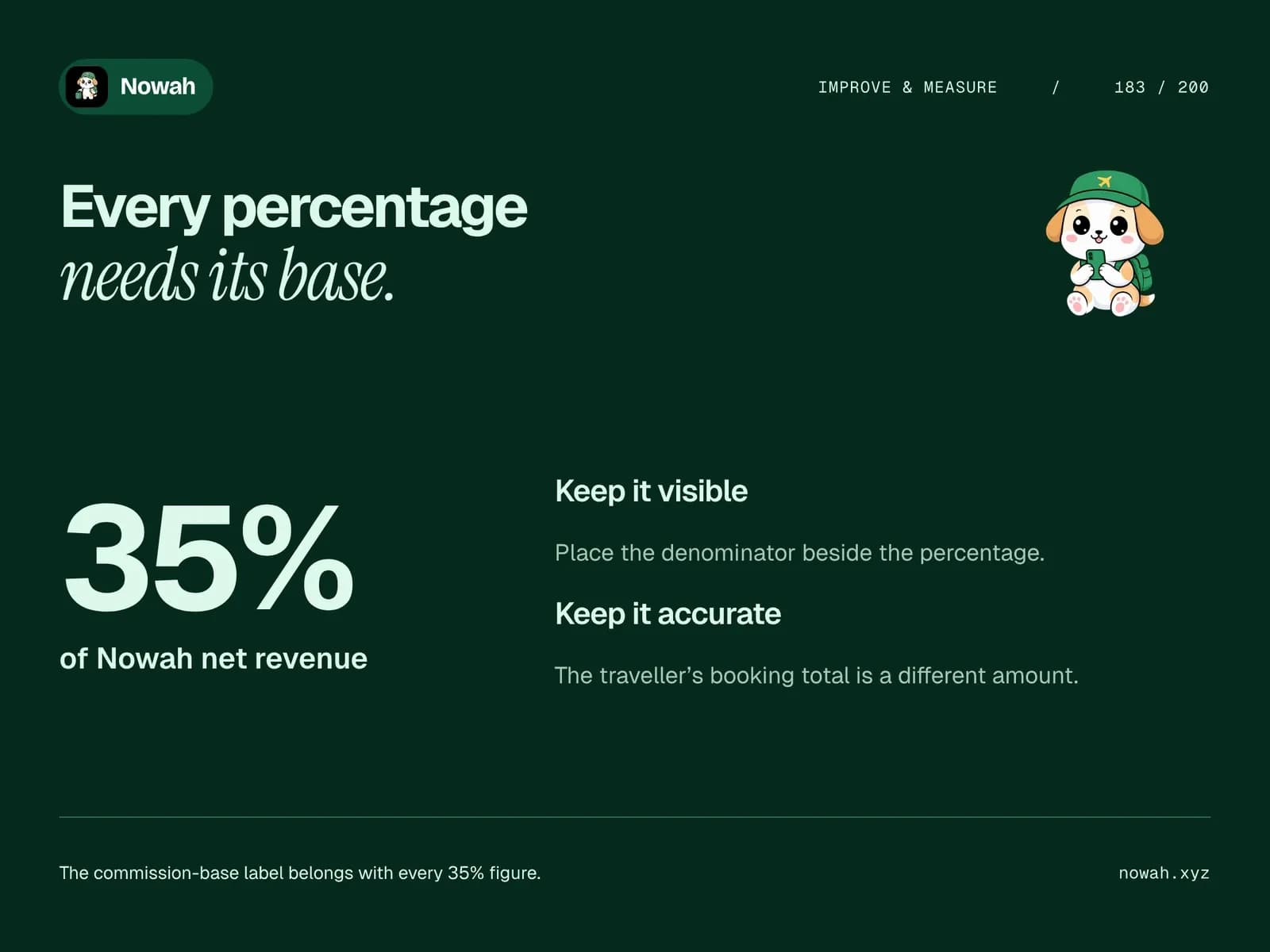
Nowah's partner offer gives travel creators a strong commercial story: approved partners earn 35% of Nowah net revenue from qualifying referred bookings. The words after the percentage are essential. Removing them changes the meaning of the offer and can make an otherwise useful recommendation confusing.
If you create content about earning with Nowah, keep the calculation base visible in the headline explanation, graphic, spoken message and caption. A reader should understand what the percentage applies to even when they encounter only one part of your content. This guide provides a commission-message card you can use before publishing, with a hypothetical arithmetic example and a practical review process.
Start with the Nowah Partner Program overview, then use the current program terms for the definition and qualifying conditions. The purpose of your content is to make the opportunity understandable while showing why Nowah fits your audience's travel needs.
Write the complete earning statement first
Begin your notes with one complete statement: approved partners can earn 35% of Nowah net revenue from qualifying referred bookings. Keep the subject, percentage and base together. That gives you a reliable starting point when adapting the explanation for different formats.
Distinguish the program description from your own earning result. Saying that the partner share is 35% explains a rate. It does not establish that you have earned anything, that a particular follower qualifies or that a future campaign will produce bookings.
Your content can still be confident. Nowah's defined share and continuing attribution for eligible new accounts are meaningful reasons to consider the program. Explain those strengths through a relevant creator workflow, then keep the conditions close enough for the audience to interpret the offer correctly.
Explain the base in ordinary language
Nowah net revenue starts with revenue Nowah actually receives for the booking. The terms then allow specified direct deductions, including payment fees, refunded Nowah revenue, Nowah-funded discounts and applicable transaction taxes. Salaries, overhead and general marketing are excluded from those deductions.
The traveller's total booking price is a different amount. A hotel bill or flight purchase does not reveal Nowah's revenue from that transaction. You cannot calculate a partner earning simply by multiplying the visible booking total by 35%.
You also should not invent a margin to fill the gap. When a hypothetical example needs a net-revenue input, label that input as illustrative. When discussing an actual earning, use the relevant recorded information and current terms. For more detail about the definition itself, use what net revenue means.
Build a commission-message card
Create a small working card with five entries. It can be an ordinary document you use during production; it does not require a special creator feature in Nowah.
Entry | What to write |
|---|---|
Rate | The partner share is 35% |
Base | Nowah net revenue from the qualifying booking |
Example label | Hypothetical arithmetic, if using invented inputs |
Qualifying relationship | An eligible newly attributed traveller account |
Next action | The relevant program explanation or application |
Read the entries together before turning them into a visual. If the graphic displays the rate but leaves the base only in your production notes, the audience will not have the same information you do. Keep the public explanation complete in the actual format people will encounter.
Use a labelled arithmetic example
Suppose a hypothetical qualifying booking produces $80 of Nowah net revenue. At a 35% partner share, the calculation is $80 multiplied by 0.35, which equals $28. The $80 is an illustrative input; the $28 explains the formula.
Do not attach that result to an actual hotel rate unless you have the information needed to support the complete calculation. A booking with a similar retail price may have a different revenue structure, and a luxury label does not determine the net-revenue base.
Write the example label where the calculation appears. If a short video shows the $80 and $28 as a graphic, a hypothetical label in an unrelated long article will not help a viewer who sees only the video. The guide to recording assumptions provides a separate method for documenting more complex examples.
Adapt the statement without losing its meaning
Different formats create different editing pressures. A small graphic may tempt you to enlarge “35%” and remove the surrounding words. A short voiceover may omit the base because it feels repetitive. A headline may put the qualification somewhere the reader never reaches.
Plan for those pressures before editing. In the graphic, reserve space for the base. In narration, say the complete phrase at the point where you explain the offer. In a caption, keep the rate and definition in the same explanation so a reader does not have to reconstruct the claim from several disconnected posts.
Use straightforward words rather than dense abbreviations. Your goal is for a prospective partner to understand the calculation, not to make the largest possible percentage dominate the design. A clear explanation gives the reader a stronger basis for deciding whether the program fits their content.
For a hypothetical approved creator, an explanatory caption could say: “I use Nowah to explore the trip-planning question shown here. As a Nowah partner, I may earn a share from qualifying referred bookings. The partner share is 35% of Nowah net revenue.” Adapt the recommendation to the actual content and relationship. Place the relevant link beside an explanation of its destination. The sample connects product use, commercial relationship and calculation base without turning a booking total into an assumed earning.
Connect the economics to a useful Nowah workflow
The commission statement should support a practical recommendation. For example, a creator making hotel-area guides can demonstrate how a traveller's dates, arrival constraints and preferred pace affect the wider trip brief in Nowah. That gives the product a clear role in the content.
After the demonstration, explain the disclosed referral action and where qualifying earnings may arise. The audience can see both sides of the recommendation: the useful travel-planning task and the creator's commercial relationship. Avoid letting the percentage become the only reason you offer for using the product.
The older article on the 20-tab planning problem gives background for discussing fragmented travel research. Use that context to explain the practical problem your Nowah example addresses, rather than assuming every viewer already understands the product.
Distinguish attribution from the calculation
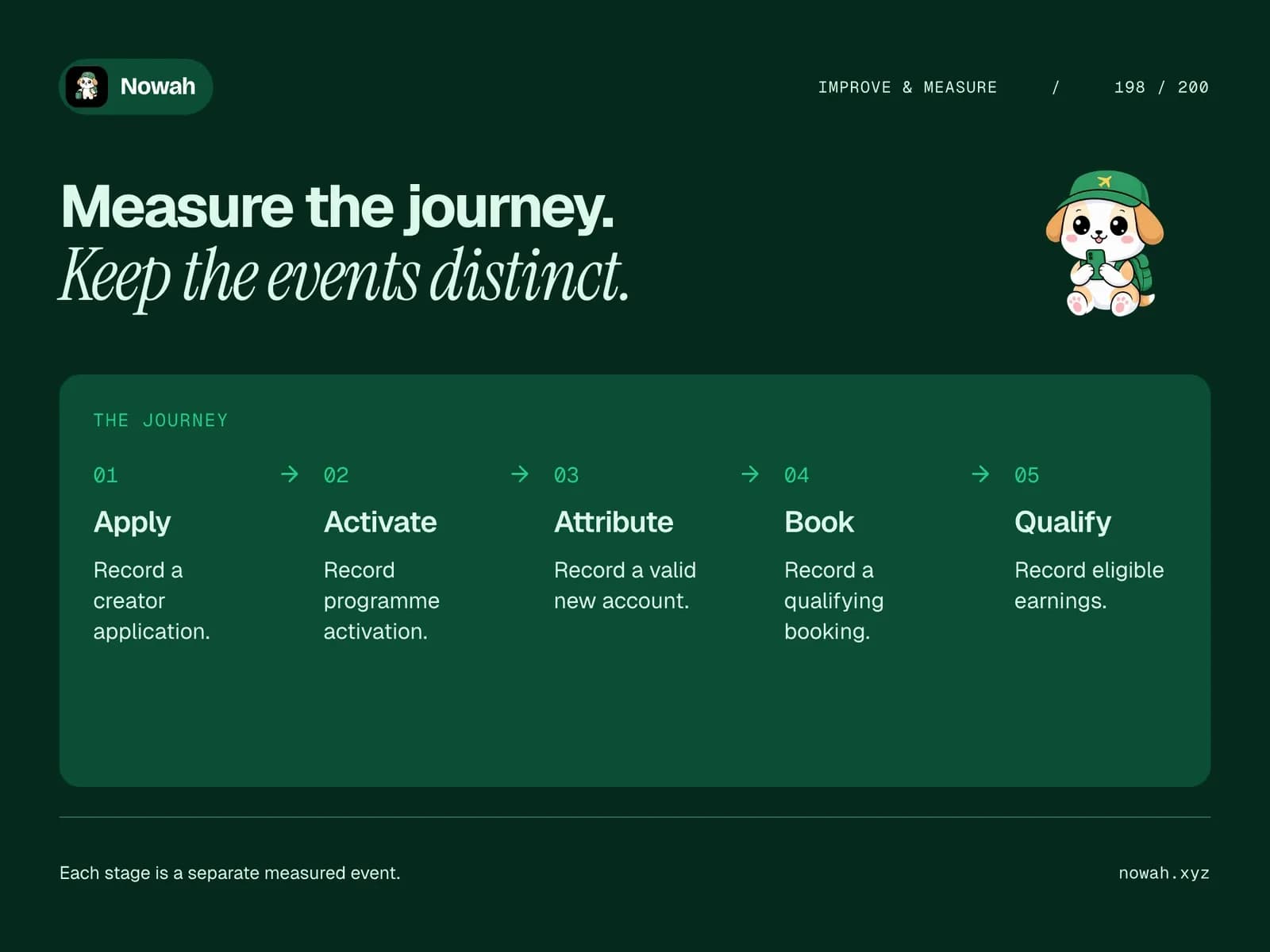
A calculation example does not establish a valid referral. Under Nowah's terms, a new eligible traveller account must be created within 30 days of the valid introduction, with tracking successfully reaching Nowah. Existing accounts and self-referrals are excluded from eligible new attributions.
Once valid account attribution exists, later qualifying bookings can also generate earnings for that account's lifetime. That is a substantial feature of the partner model, but it does not guarantee later bookings or a recurring income. Keep the explanation specific to the account relationship.
If a reader needs the introduction rules, direct them to eligible new traveller accounts. You can keep the current article focused on wording the commission statement while providing a useful next resource for the separate attribution question.
Keep payment stages out of the headline arithmetic
The hypothetical $28 calculation describes a share of an illustrative revenue base. It does not say that $28 has reached a bank account. Completed bookings, verified supplier settlement, the applicable hold and payout conditions determine the later earning and payment stages.
Refunds or corrections can also affect recorded earnings. If your content discusses actual balances, distinguish pending, eligible and transferred amounts using the relevant statement evidence. Do not replace those stages with a single screenshot labelled as money received.
For the dedicated workflow, use pending earnings versus eligible earnings. Giving that topic its own explanation helps this message card stay focused and readable.
Review what a reader can actually see
Check the finished version rather than relying only on the draft. Read the graphic at a realistic size. Listen to the spoken explanation without the caption. Read the caption without the video. Each version should retain enough context to avoid a misleading interpretation.
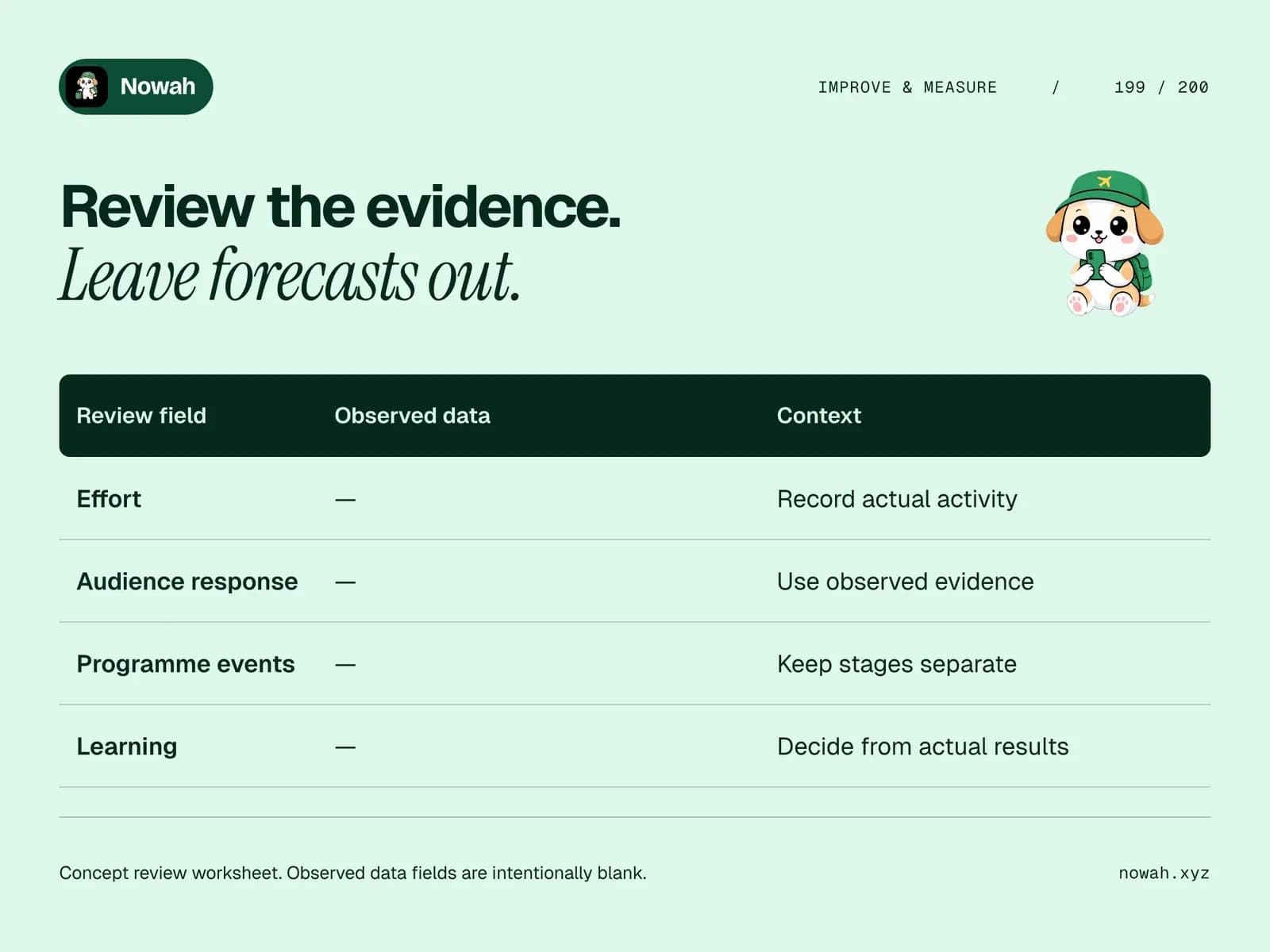
Ask a reviewer to identify the base and explain the hypothetical calculation in their own words. If they multiply a traveller's booking price by 35%, find the part of the presentation that encouraged that reading. Improve the wording or layout before publishing.
Keep the message card with your content notes so you can review reused clips and refreshed articles consistently. When program terms change, update the source check and the affected explanations together.
Make the earning opportunity clear enough to act on
A precise explanation strengthens Nowah's case for creators whose audiences need useful travel recommendations. The partner share, qualifying account relationship and relevant product demonstration can work together as a coherent commercial story.
If that approach suits your content, apply to Nowah Partners. Use the commission-message card to prepare an accurate explanation from the start. Keep the rate attached to Nowah net revenue, show a useful travel task and give your audience a clearly disclosed, relevant next step.