How Solo Creators With Small Audiences Can Start Earning Through Nowah
Start a useful small-audience solo travel recommendation with Nowah, reviewed partner eligibility and transparent next steps.
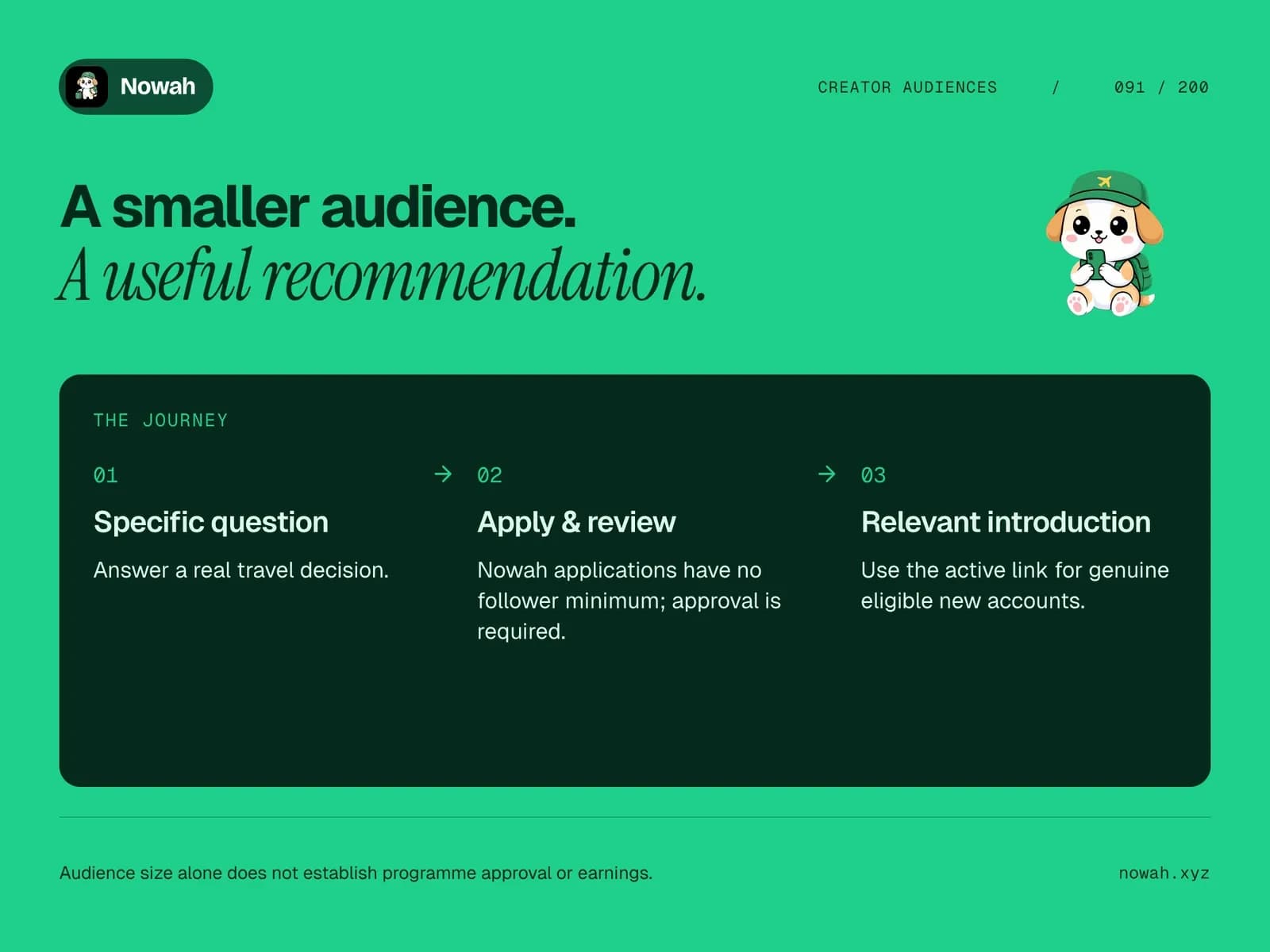
A small solo-travel audience can still ask specific, useful questions. A creator who answers one of those questions clearly may have a stronger starting point than someone publishing broad income promises to a larger audience. Nowah Partners has no minimum follower count, and approved partners can potentially earn from qualifying bookings by newly attributed travellers.
That does not make approval or income automatic. The useful opportunity is to build a recommendation around an actual audience need, demonstrate how Nowah helps investigate it and give the viewer a clearly disclosed next step. The quality of the explanation matters more than inventing a follower threshold that the program does not require.
Start with one focused resource rather than a large campaign. A short article, video or planning example can show why the recommendation is relevant and what the audience should do next. Keep creator application, traveller attribution and qualifying earnings as separate stages of the process.
Choose a question your audience genuinely asks
Use actual questions as editorial evidence when you have them. Do not manufacture comments, testimonials or a story about followers booking because of your content. A fictional example is fine when it is labelled as a teaching case.
A useful question might concern how to turn a saved destination idea into a current trip brief, which accommodation conditions need checking or how to compare two itinerary directions. Choose the task you can explain well rather than trying to answer every solo-travel concern at once.
Avoid treating solo travellers as one uniform audience. Origin, dates, budget scope and current priorities can differ. The current solo-brief guide provides a structure for keeping those inputs visible without making universal safety or suitability claims.
Build one recommendation asset
Give the resource a concrete output. It could be a current-brief card, a small comparison worksheet or a record of the supplier question that changes the planning decision. The audience should leave with something it can use, not only a statement that Nowah is worth trying.
Use honest evidence labels. Your own travel observations, current supplier facts and fictional planning inputs play different roles. A generated illustration can explain the method, but it does not establish that you visited a place or experienced a particular stay.
Keep the first asset manageable. If the question concerns the rooming requirement, do not expand it into an unsupported ranking of every destination or hotel. A focused resource gives a small audience a clear reason to understand and share the recommendation.
Show the relevant Nowah task
Use Nowah to explore the chosen fictional brief or appropriately shareable real example. Explain what you are asking and why the input matters. Review the proposed direction and show a meaningful revision when an assumption does not fit.
If a suggestion adds movements that conflict with the traveller's current priority, revise the brief. If an arrangement or inclusion remains unverified, keep it as a question rather than treating the planning output as confirmation.
This is the practical case for recommending Nowah. The viewer sees how the service helps organise a travel question, while current availability, room conditions and provider arrangements still need appropriate evidence. You do not need a fabricated booking result to make the demonstration useful.
The review-to-next-click guide offers a transferable method for connecting an observation, a planning demonstration and a relevant next action. Adapt the task to your audience rather than implying that solo travellers need a luxury travel style.
Understand what no minimum follower count means
The program advertises no minimum follower count, but applications are reviewed. The Nowah terms also include adult eligibility, accurate application information and approval before promoting an active partner link. Payout eligibility depends on supported-country capabilities and successful Stripe identity and bank verification.
Those conditions should remain visible in a small-audience article. Do not describe the program as automatically available to every account in every country, or suggest that an application submission alone establishes an active partner relationship.
The no-minimum-follower-count guide examines eligibility separately. Linking to it lets this article focus on the actual content workflow rather than repeating every onboarding detail.
Applying is free. That is different from a promise that every possible content-production expense will be recovered. Do not attach a spending recommendation or a return-on-investment forecast to the absence of an application fee.
Keep two audience journeys separate
A traveller interested in the example needs the relevant disclosed referral route through an approved partner's active link. Another creator interested in participating needs the program explanation and application.
Do not combine both actions into a vague invitation that leaves the reader unsure whether a destination begins trip planning or partner onboarding. A clear next step is particularly valuable when your audience is small and the content is answering a specific personal question.
When recommending Nowah through an active partner link, explain that you may receive commission from qualifying referred bookings. Put the relationship alongside the recommendation instead of assuming every viewer has read your profile or an earlier post.
The resource can remain friendly and direct while being clear about the commercial connection. A useful answer and a transparent incentive can coexist.
Explain a hypothetical attribution sequence
For a labelled teaching example, imagine an eligible new traveller follows an active partner link on an illustrative first day and creates a new account twelve days later. That falls within the program's 30-day introduction-to-signup window, assuming the required tracking and other eligibility conditions are satisfied.
This fictional sequence does not predict how quickly your audience will act or prove that a particular link recorded an attribution. Existing accounts, self-referrals and artificial accounts do not qualify. Tracking must successfully reach Nowah; sharing a link alone does not establish the relationship.
Once valid attribution is established, it can remain for the lifetime of the traveller account, including qualifying later bookings. Future purchases and income are still not guaranteed. Keep the signup window distinct from the timing of later qualifying travel rather than implying that every booking must occur during those first 30 days.
Discuss earnings without using audience size as a forecast
Nowah lists qualifying hotels, flights and paid eSIMs as eligible categories. Other purchases discussed in solo-travel content are not automatically commissionable because they appear in the itinerary.
The partner receives 35% of Nowah net revenue from qualifying attributed bookings after the direct deductions defined in the terms. The traveller's full booking expenditure is not the base. A large audience does not establish net revenue, and a small audience does not establish that a particular question will generate a booking.
Completion, supplier settlement, the applicable hold and payout conditions matter before earnings become eligible. Views, useful questions, link clicks, valid new accounts and completed payouts are different outcomes. Discuss only the event your actual evidence supports rather than filling the gaps with an optimistic story.
Before expanding the campaign, review the first asset as if the fictional audience member had encountered it alone. Can they identify the travel question, the Nowah demonstration and the condition that remains unresolved? Can they distinguish your partner relationship from a personal travel story? If the resource needs several earlier posts to explain its purpose, make the opening and next action clearer.
This review does not need an invented conversion target. You can improve the explanation before claiming any commercial result. For example, if a reader might confuse the creator application with a traveller referral, revise the action labels. If the example suggests a room arrangement is confirmed when it is only being investigated, correct the evidence label. Those changes make a small-audience recommendation more useful while leaving actual attribution, bookings and eligible earnings to the appropriate records.
Improve the resource through real questions
After publication, note where the audience still seems confused. Do viewers understand what the Nowah demonstration helps with? Do they know which supplier facts remain unresolved? Are they clear about the difference between applying as a creator and planning a trip through a partner recommendation?
Use those questions to improve the asset. A small audience can provide focused editorial feedback, but comments are not a substitute for verified commercial outcomes. Do not label a revised resource a proven earning system without actual evidence.
The older Nowah article on how the team talks to users provides background for paying attention to genuine questions. Your creator contribution is turning a relevant question into a useful resource and a transparent next step.
To begin, apply to Nowah Partners. Applications are reviewed, applying is free and there is no minimum follower count. Build one clear recommendation, demonstrate the relevant Nowah work and let actual qualifying evidence establish results as the audience relationship develops.




