What 'Best Flight Deal' Really Means to an AI
Price is just one factor. AI weighs convenience, flexibility, preference match, and total value to find genuinely better deals than manual search.

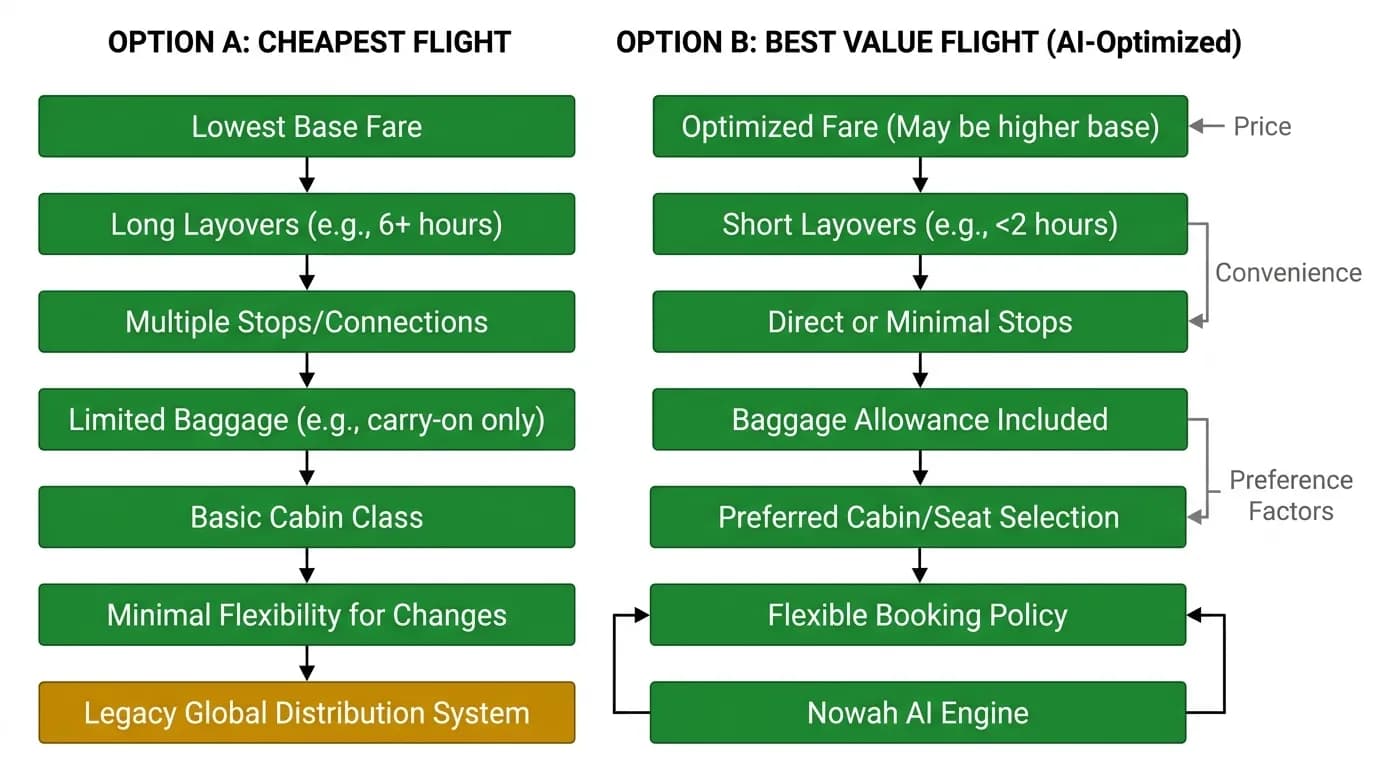
When people say they want the cheapest flight, they usually do not mean the literal cheapest flight. They mean the best value. The actual cheapest option might be a red-eye with two stops and a 7-hour layover in a city where you need to change terminals at 3 AM. Nobody wants that, even if it saves $80.
But traditional flight search does not know this. It sorts by price. The cheapest option is at the top. The "best" option, the one that balances price with everything else that matters, is buried somewhere in the middle of 300 results. Finding it is the user's job.
Our AI agent flips this. It finds the best value, not just the lowest price. Here is what that actually means from an engineering perspective.
Multi-factor scoring
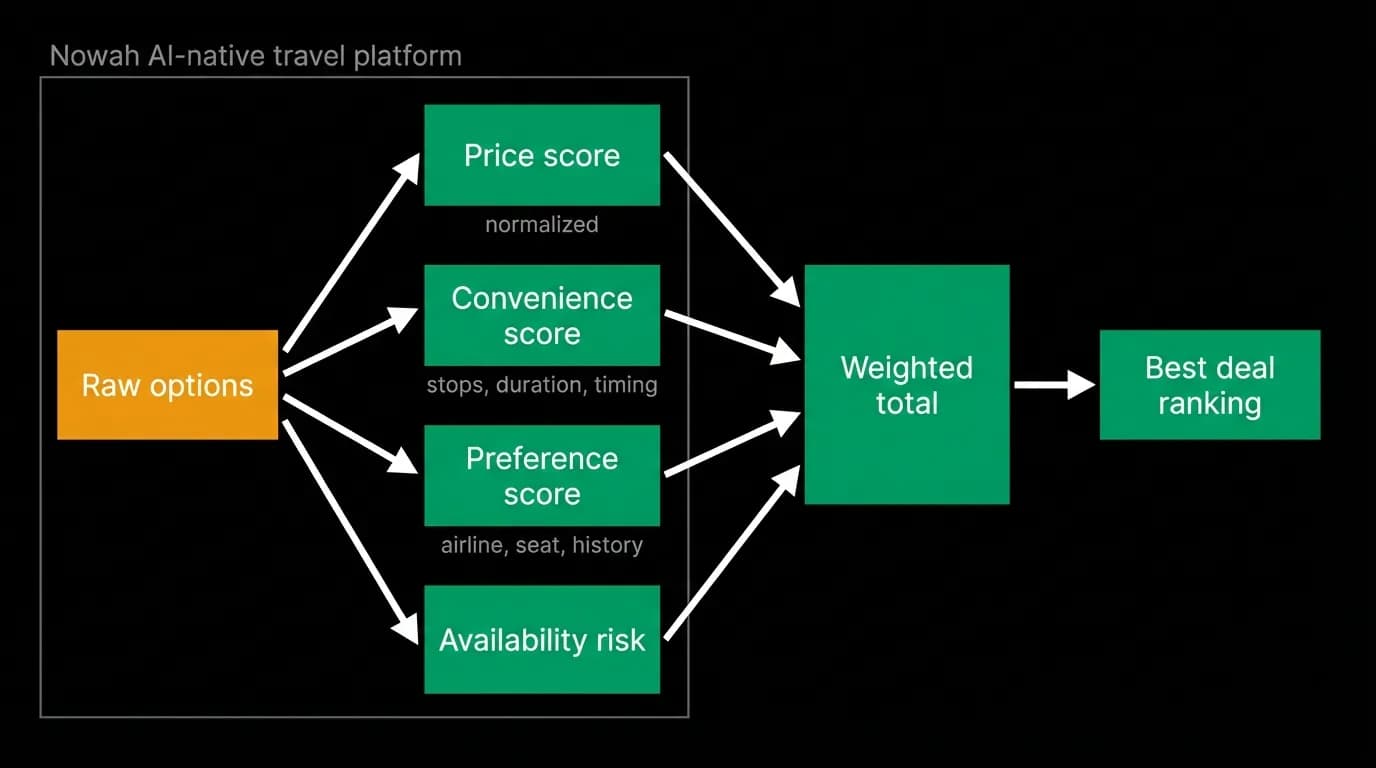
When the AI agent ranks flight options, price is one of six or seven factors weighted simultaneously.
Price is the obvious one. Lower is better, all else being equal. But all else is rarely equal.
Duration matters because a 5-hour direct flight is better than a 9-hour flight with a stop, even if the longer option is $30 cheaper. We weigh total trip time, including layovers, against the price difference.
Number of stops is related to duration but independently important. Some travelers have a hard constraint: direct flights only. Others are flexible but prefer fewer stops. The agent weights this based on the user's expressed or learned preference.
Departure time preferences vary by person. Some travelers hate early morning flights. Some prefer them because they maximize time at the destination. The agent learns this and weights accordingly.
Airline preference includes both explicit loyalty (the user has miles with a specific carrier) and implicit preference (the user has consistently chosen a particular airline in past bookings).
[Layover quality](/blog/data-behind-layover-quality) is something traditional search completely ignores. A 2-hour layover in Singapore's Changi Airport (consistently rated best in the world, with gardens, swimming pools, and excellent food) is a very different experience from a 2-hour layover in a cramped regional terminal with no restaurants. Our knowledge graph provides layover quality data that feeds into ranking.
Each factor has a weight. The weights are partially fixed (duration always matters) and partially personalized (how much the user cares about price versus convenience). For a budget traveler, price dominates. For a business traveler, schedule and comfort dominate. The agent adjusts its weighting based on what it knows about the user.
Flexible date optimization
The average flight search on a traditional OTA takes over 20 minutes. Part of this is because the user has to manually check multiple dates to find the best price. "What about Tuesday instead of Monday? What about flying back Sunday instead of Saturday?"
Our AI agent does this automatically. When the user's dates are flexible ("sometime in the first two weeks of March"), the agent explores the date range and finds the optimal combination. It might discover that flying out on a Wednesday and returning on a Tuesday saves $200 compared to the weekend-to-weekend option.
This flexible date exploration is something humans rarely do thoroughly. Manually checking every date combination for a two-week window across three airports is 100+ searches. The agent can do it in seconds (using cached data when available) and present the single best option or a few alternatives with clear tradeoffs.
The savings from flexible date optimization can be dramatic. We regularly see 15-25% price differences between the cheapest date and the most expensive date within a single week. Seasonal pricing patterns amplify this further. Flying to Europe in mid-September versus late August can save 30-40% because summer peak pricing drops off sharply after Labor Day.
Why context beats sorting
Traditional search sorts results by a single dimension: price, duration, or departure time. Pick one. If you sort by price, the convenient flights are hidden. If you sort by duration, the bargains are hidden. You cannot sort by "best for me" because the search engine does not know who you are.
Our AI agent sorts by "best for this specific user." It knows your preferences. It knows your constraints. It knows what you told it in the conversation. And it uses all of this to produce a ranking that is personalized, not generic.
85% of travelers say personalization influences their booking decisions. But personalization on traditional OTAs is limited to retargeting ads and "deals from your city." Real personalization means the search results themselves are different based on who you are and what you care about.
Here is a concrete example. Two users search for the same route: New York to London in June. User A always picks the cheapest option, prefers aisle seats, and does not care about departure time. User B is a business traveler who flies frequently, has loyalty status with a specific carrier, and needs morning arrivals.
Traditional search shows them the same 300 results. They both have to do the work of finding what matters to them.
Our agent shows User A the three cheapest options that match their aisle seat preference. It shows User B three options on their preferred carrier with morning London arrivals, prioritizing fare classes that earn loyalty points. Same route, same dates, completely different recommendations. Both users get results that feel like they were curated by a knowledgeable travel advisor.
Better hotel matching
The "best deal" concept applies even more strongly to hotels because hotel preferences are more subjective and multidimensional than flight preferences.
The cheapest hotel might be far from where you want to be. It might be in a noisy area. It might not have the amenities you care about. A slightly more expensive hotel that is walkable to your meetings, quiet at night, and has a good breakfast could be dramatically better value.
Our agent weighs location (distance from the user's stated or inferred points of interest), amenities (matching what the user cares about), reviews (weighted toward recent reviews and reviews from similar travelers), and price. A hotel that scores well on all four dimensions is a better deal than a hotel that is cheapest on price but misses on everything else.
The AI agent also understands qualitative hotel descriptions. When a user says "somewhere quiet and local, not a big chain," the agent can match this against hotel characteristics. Traditional search cannot filter by "feels local." Ours can.
Finding the best travel deal is not a math problem with one variable. It is a multi-dimensional optimization problem where the dimensions and their weights are different for every person. AI is good at this kind of problem. Search forms are not. That is why we built the product the way we did.
Nowah is an AI travel agent that searches and books real flights and hotels through conversation — no filters, no thirty open tabs. Plan your next trip.