Why Two Travelers Get Different Recommendations for the Same Route
Same JFK-CDG query, different travelers, different top-3 results. A side-by-side showing how preference data transforms identical searches into personal picks.

Two people search "JFK to Paris, October." Same origin. Same destination. Same month. They get completely different top-three recommendations. One sees a budget carrier with a connection, an afternoon nonstop, and a red-eye with premium economy. The other sees a legacy carrier nonstop in the morning, the same legacy carrier's evening option, and a direct competitor with a midday departure. Same route, same inventory pool, radically different curated results.
This is not randomness. It is personalization doing exactly what it is supposed to do. Identical searches should produce different results because the travelers are different.
Meet the two travelers
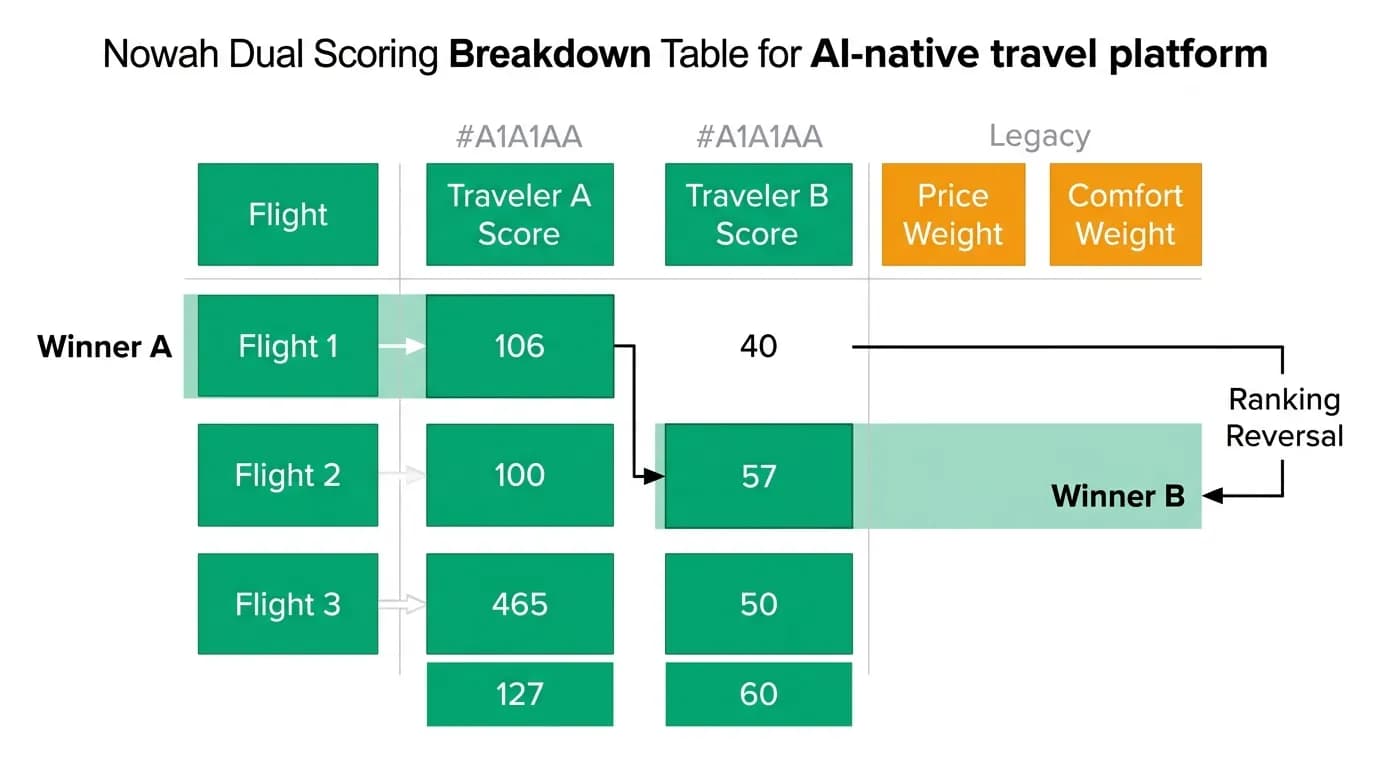
Traveler A is a budget-conscious solo backpacker with flexible dates. Their booking history shows a pattern of choosing the cheapest available option, rarely selecting seats in advance, and traveling with carry-on only. They have told the AI they do not mind connections and prefer to spend their money at the destination rather than getting there. Their date range spans an eight-day window.
Traveler B is a business traveler with loyalty status on a major airline alliance. Their history shows consistent premium economy or business class bookings, strong preference for nonstop flights, and morning departures that align with their work schedule. Their dates are fixed to specific days, and they have a corporate expense budget that prioritizes reliability and convenience over cost.
Same route. Fundamentally different travelers. The scoring model treats them accordingly.
How the same candidate pool scores differently
The AI starts with the same universe of available flights for JFK to Paris in October — typically 50 or more options across multiple carriers, connection points, and fare classes. Every option is scored across several dimensions: price relative to the route median, total travel time, layover quality (if applicable), airline quality, personal preference fit, and schedule alignment.
For Traveler A, the weight on price is high. The budget carrier with a connection through a European hub scores well because it is $300 cheaper than the cheapest nonstop. The afternoon nonstop is there as the balanced pick — reasonable price with the convenience of direct service. The red-eye with premium economy appears because the AI's diversity guarantee ensures a comfort option is always shown, and the red-eye pricing makes premium economy accessible at a lower price point.
For Traveler B, the weight shifts toward schedule alignment and airline quality. The morning nonstop on their preferred alliance carrier scores highest because it matches their loyalty program, departs at their preferred time, and arrives in time for a European business day. The evening option on the same carrier provides a fallback with different timing. The competitor's midday option appears because the diversity guarantee surfaces an alternative that is priced lower — giving the traveler the option if the budget matters more on this particular trip.
The ranking math behind each top pick
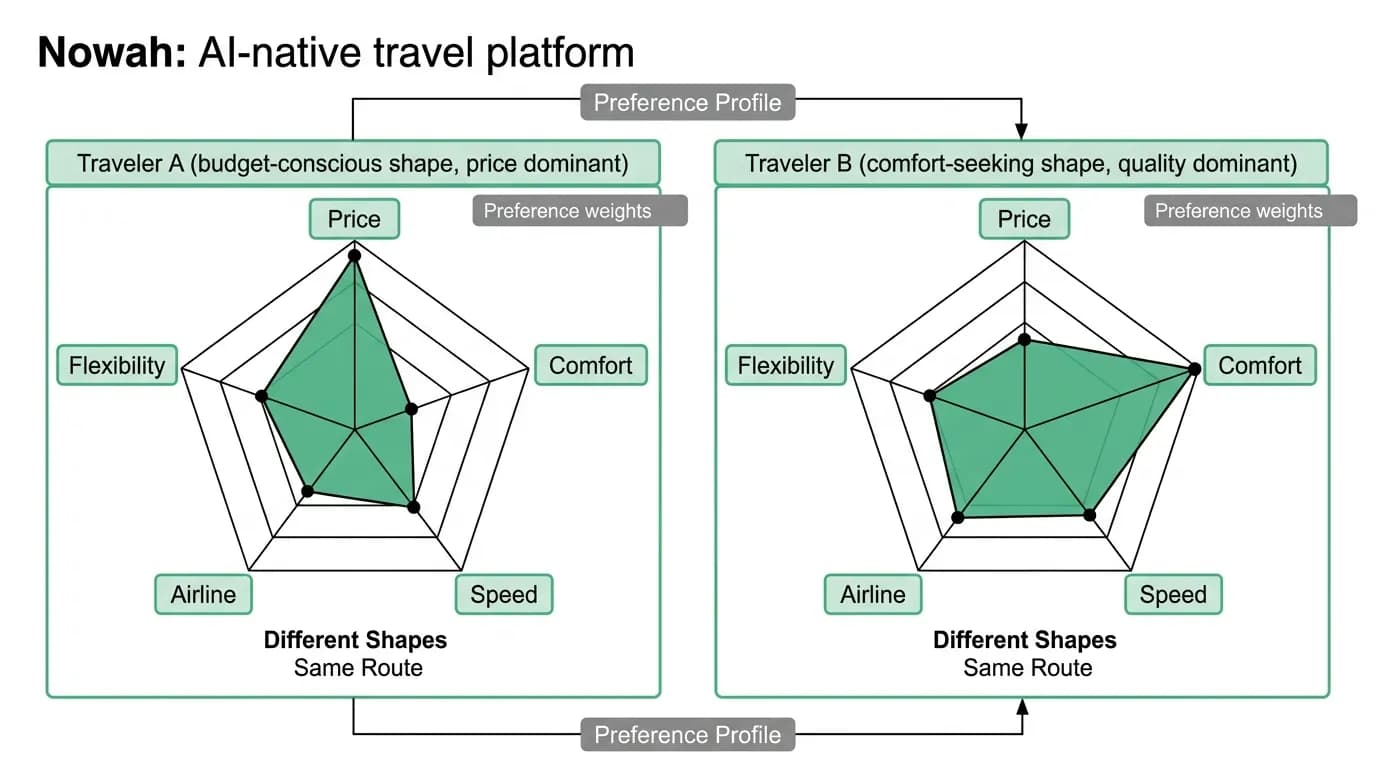
For Traveler A, the scoring breakdown on their top pick might look like: price score 95/100 (one of the cheapest available), travel time score 55/100 (the connection adds hours), airline quality score 60/100 (decent but not premium), personal fit score 85/100 (matches their carry-on-only, connection-tolerant profile), and schedule score 70/100 (reasonable timing despite the connection). The strong price score and high personal fit compensate for the lower travel time and airline quality scores.
For Traveler B, the same flight would score very differently: price score 95/100 (still cheap), but personal fit score 25/100 (mismatches their nonstop preference, loyalty program, and departure time preference). The low personal fit score would push this option well below their top three despite its strong price performance.
This divergence is the entire point. Preference weights shift rankings by two to three positions in most cases. A flight that is Traveler A's number-one pick might be Traveler B's number fifteen. The underlying inventory is identical. The ranking is individual.
Why this is the point of personalized search
The traditional travel search paradigm presents everyone with the same sorted list, usually defaulting to price or "best" (which means the platform's interpretation of best for a generic user). This forces travelers to scroll, filter, and mentally re-rank based on their own preferences. The sorting is objective. The choosing is subjective. The disconnect between the two is why traditional search feels so tedious.
Personalized ranking eliminates the disconnect by incorporating subjective preferences into the sort itself. The list you see is already sorted for you, not for a generic user. The top option is not the cheapest or the most popular — it is the best fit for how you specifically travel.
The data backs this up. Personalized results produce two to three times higher booking conversion than generic results. Not because the inventory is different, but because the presentation matches the traveler's actual decision criteria. The option they want is at the top of the list instead of buried on page two behind options that are irrelevant to them.
Build your profile on Nowah and see how your results differ from the generic search. The more the AI knows about how you travel, the less time you spend scrolling past options that were never right for you.
Nowah is an AI travel agent that searches and books real flights and hotels through conversation — no filters, no thirty open tabs. Plan your next trip.