Fare Class Intelligence: What You're Really Paying For
Basic economy, main cabin, premium economy, business, first — demystifying what each includes, the value math, and when upgrading makes real sense.

"Basic economy" sounds like economy. It is not even close. The word "basic" is doing a lot of heavy lifting, and what it is lifting away from you includes seat selection, carry-on bags, the ability to change your flight, the ability to get a refund, boarding priority, and in some cases the right to use the overhead bin. That $180 flight that looked like a steal can easily become a $280 flight once you add back the features you assumed were included.
Airlines manage 12 to 26 fare classes per route. Most travelers only see the four or five tiers presented at checkout. But understanding what each tier actually includes — and more importantly, what it is worth — is the difference between finding genuine value and paying for marketing language.
The fare class ladder
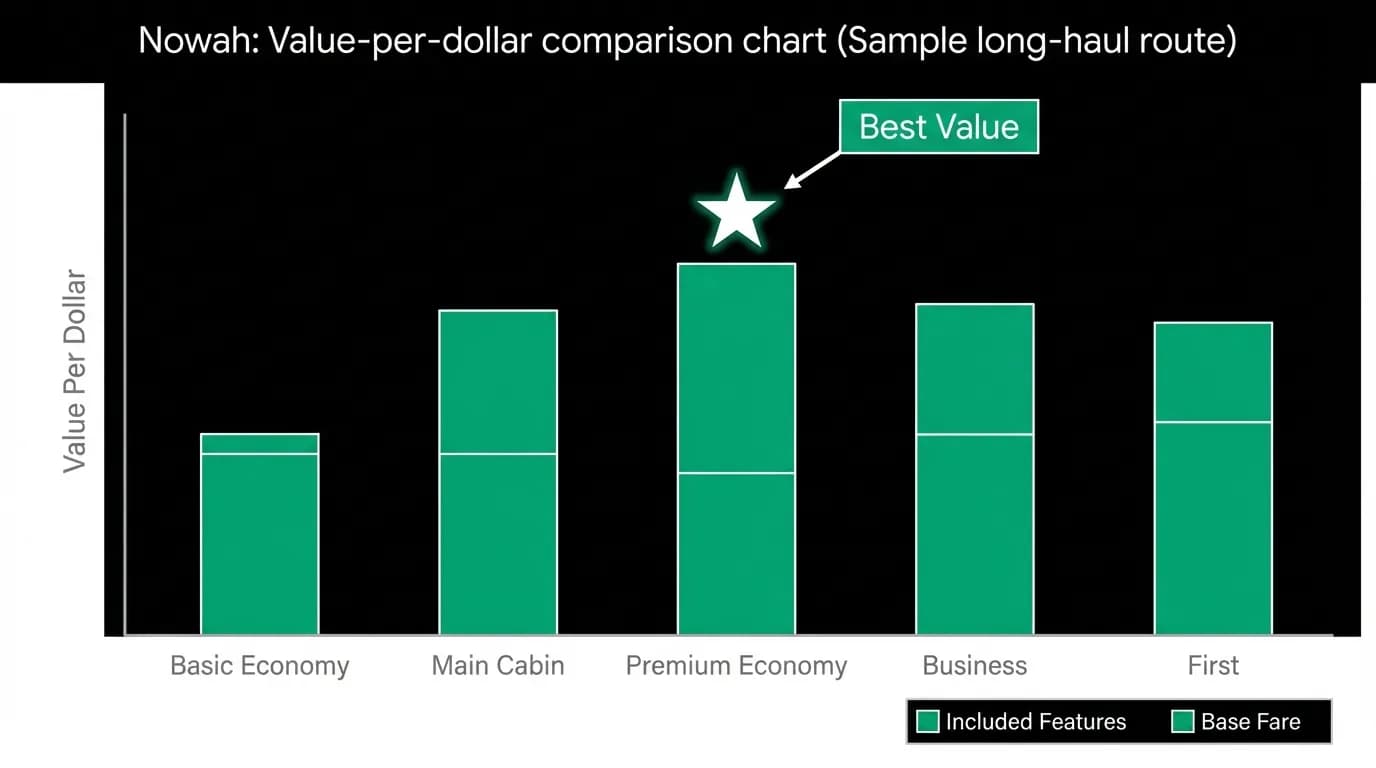
Basic economy is the lowest tier, and it was created specifically to compete with ultra-low-cost carriers. What you get: a seat on the plane and a seatbelt. What you typically do not get: seat selection (you are assigned at check-in), full-size carry-on bag rights on some carriers, the ability to change or cancel, upgrade eligibility, and sometimes even overhead bin access. Basic economy exists to put a low number in the search results. The restrictions are the product.
Main cabin economy is what most people think of when they imagine an economy ticket. You get seat selection at booking, a standard carry-on and personal item, the ability to change your flight (usually for a fee), and you are eligible for upgrades if you have status. This is the baseline for a reasonable flying experience.
Premium economy occupies the middle ground between economy and business class and is arguably the most interesting value proposition in air travel. You get a wider seat (typically 18 to 19 inches vs. 17 to 18 in standard economy), more legroom (36 to 38 inch pitch vs. 30 to 32), enhanced meal service on long-haul flights, priority boarding, and extra baggage allowance. On long-haul routes, premium economy costs 40 to 60% more than main cabin but delivers a comfort improvement that many travelers describe as two to three times better.
Business class is where the experience shifts from transportation to service. Lie-flat seats on long-haul routes, lounge access, premium dining, priority everything, and significantly more space. The price premium is typically two to five times main cabin, which makes the value math depend heavily on flight duration and personal comfort requirements.
First class where it exists is the apex tier, with private suites, dedicated crew, and an experience that has more in common with a hotel than a bus seat. Available only on select routes and carriers, first class pricing is three to eight times main cabin. The value proposition is almost entirely experiential rather than practical.
The value-per-dollar analysis
Sticker price comparison is how most travelers evaluate fares. The AI takes a different approach: value-per-dollar analysis that accounts for the total cost of each fare class including the features you would otherwise pay for separately.
Consider a hypothetical long-haul flight. Basic economy shows at $650. Main cabin at $820. Premium economy at $1,150. At face value, basic economy saves $170 over main cabin and $500 over premium economy. But add back seat selection ($45), a checked bag ($70 round trip), and a change fee insurance premium ($50 for uncertainty), and basic economy's true cost is $815 — essentially the same as main cabin, but with a worse experience.
Premium economy's additional $330 over main cabin buys you roughly 8 hours of significantly better comfort on a long-haul flight. That works out to about $41 per hour of improved experience. Whether that is worth it depends on the individual traveler, but the AI presents this math explicitly so you can make an informed decision rather than a reflexive one based on the lowest number.
Hidden costs of basic economy
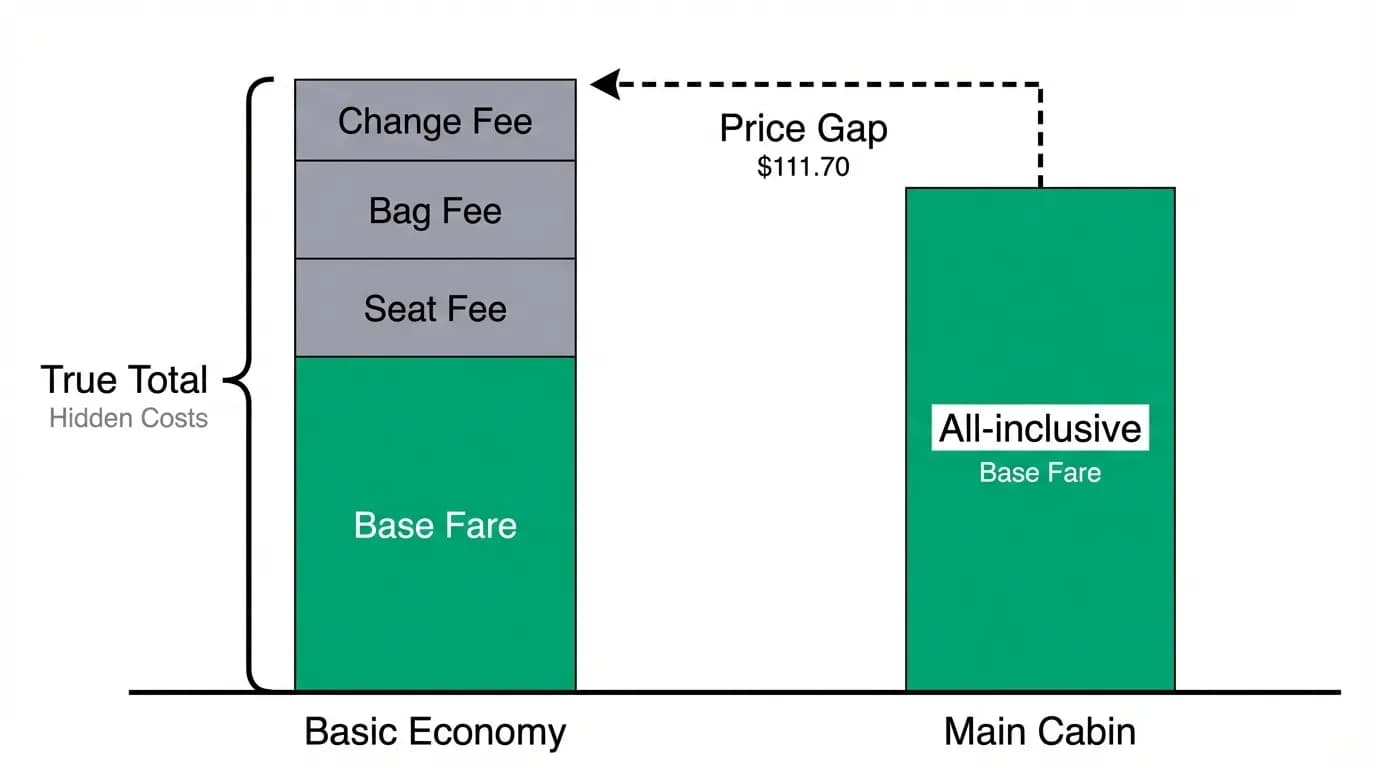
The hidden costs go beyond what you add at checkout. Basic economy travelers board last, which means overhead bin space is often full by the time they board. This can result in having your carry-on gate-checked, which adds time at arrival and risk of damage or loss. On overbooked flights, basic economy passengers are the first to be involuntarily bumped. And because basic economy tickets cannot be changed, a missed connection or schedule change from the airline's side can create logistical problems that a changeable ticket would have resolved.
The restrictions also compound for families. A family of four in basic economy with no seat selection faces a real possibility of being scattered across the cabin. Some carriers have policies to seat young children with parents, but enforcement is inconsistent and often requires gate-agent intervention that is stressful for everyone involved.
Long-haul vs. short-haul: different upgrade calculus
The duration of the flight fundamentally changes the value equation of upgrading. On a 90-minute domestic hop, the difference between basic economy and main cabin is negligible in comfort terms. You barely have time to notice the seat. The $50 to $100 savings of basic economy might genuinely be the right call if your plans are firm and you do not need a carry-on.
On a five-hour cross-country flight, the calculus shifts. More time in the seat means seat quality matters more. Legroom, recline, and the ability to choose a window or aisle start to affect your physical comfort meaningfully.
On an eight-plus hour international flight, the upgrade question becomes almost a different category of decision. Eight hours in a 30-inch pitch middle seat in basic economy is a genuinely unpleasant physical experience for most adults. Premium economy at 36-inch pitch with a wider seat and better recline transforms the same flight into something comfortable. The per-hour cost of the upgrade is at its lowest on long-haul flights because the absolute premium is spread across more hours of comfort.
How the AI factors fare class into value scoring
The AI does not just sort by base fare. It ranks by value-per-dollar, which means it considers the total cost of each option (including the features you need) relative to the comfort and flexibility it provides. For a price-sensitive solo traveler on a short flight, basic economy might rank first because the restrictions do not meaningfully affect the experience. For a family on a long-haul flight, main cabin or premium economy might rank higher because the total cost including bags and seats is comparable, and the experience is materially better.
Ask Nowah to compare fare classes on your route for honest value analysis. The AI shows you what each tier includes, what it actually costs after add-ons, and whether the upgrade makes financial sense for your specific trip.
Nowah is an AI travel agent that searches and books real flights and hotels through conversation — no filters, no thirty open tabs. Plan your next trip.