The Future of AI Trip Planning: What Gets Better Next
Longer context windows, multimodal input, and agent-to-agent booking are coming. Here is how better models will transform travel planning.

We spend most of our time at Nowah building the present: making the AI agent better at searching flights, ranking hotels, and handling bookings today. But we also keep an eye on what the next twelve to twenty-four months of AI development will unlock for travel planning. The changes coming are substantial.
Here's what we see on the horizon and how we're building to absorb it.
Longer context windows enable richer trip planning
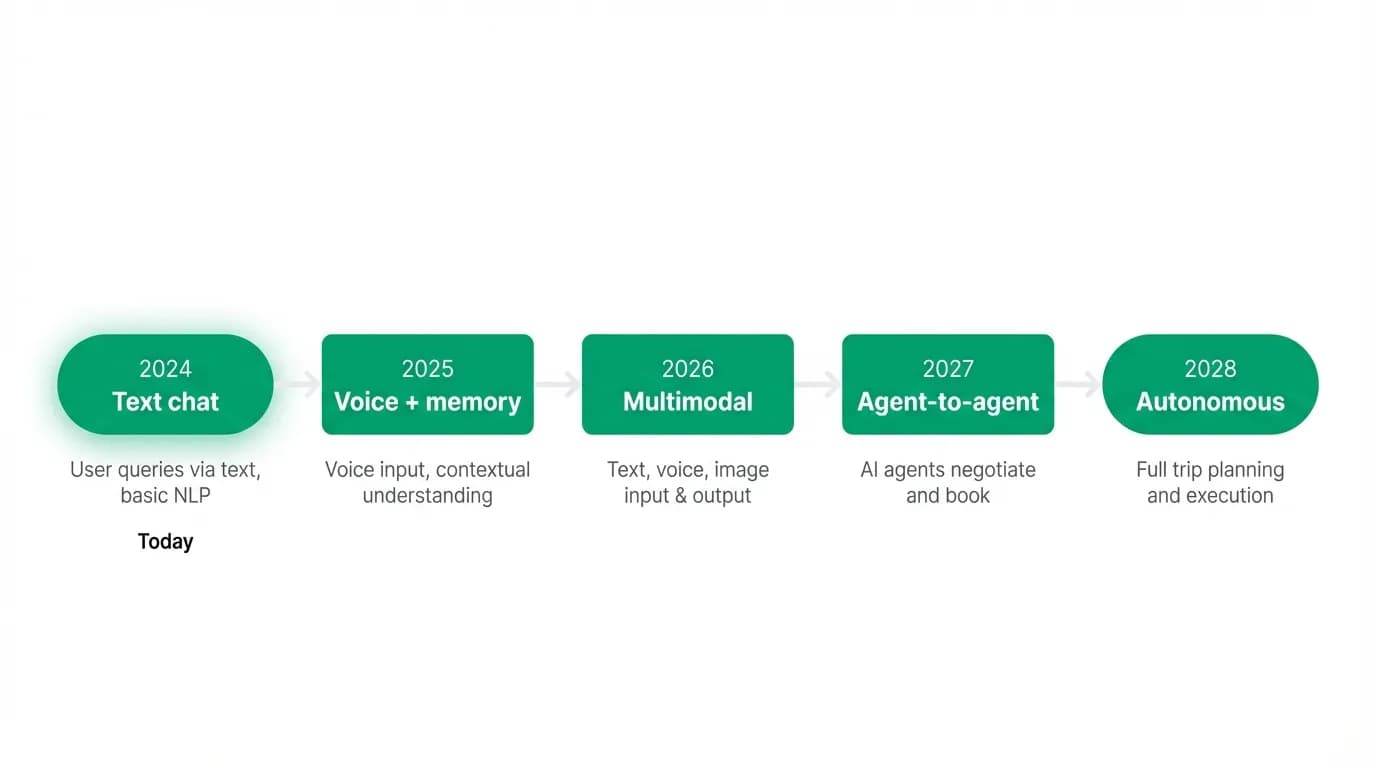
Current context windows are large but not unlimited. A complex multi-city trip with five destinations, dozens of flight and hotel options discussed, and a multi-day conversation pushes the boundaries of what fits in context.
As context windows grow (and they're growing fast), AI trip planning gets qualitatively different. Instead of summarizing older parts of a conversation, the agent can hold the entire planning history in working memory. A three-week multi-city itinerary with detailed discussions about each leg, hotel options for every stop, restaurant recommendations, activity planning, and transportation logistics could all live in a single conversation thread.
This matters because complex trips are where AI agents add the most value. A simple round-trip flight is easy to book anywhere. A multi-city trip with varied needs at each stop, connecting transportation between cities, different hotel styles for different legs, that's where traditional tools fail completely and an AI agent with rich context can do something extraordinary.
We're building our architecture to take advantage of longer context as it becomes available. Our conversation state management is designed so that expanding the context window doesn't require architectural changes, just configuration updates.
Multimodal input changes how people search
"Show me hotels that look like this." Attach a photo of a charming European courtyard hotel. The AI searches for properties with similar aesthetic qualities.
"I want to stay somewhere with this vibe." Share a screenshot from Instagram of a rooftop bar overlooking a Mediterranean sunset. The AI understands the lifestyle aspiration behind the image and searches accordingly.
Multimodal AI, models that process images and video alongside text, will transform travel search from describing what you want in words to showing what you want with images. This is a natural fit for an industry where visual appeal is a primary purchase driver. People choose hotels, restaurants, and destinations based on how they look. Being able to search by visual example instead of verbal description is a massive UX improvement.
We're watching multimodal capabilities closely. The integration into our agent architecture is straightforward: a new input type (image) that feeds into the same search and ranking pipeline. The challenge is building the visual similarity matching that converts an image into searchable property attributes.
Agent-to-agent communication
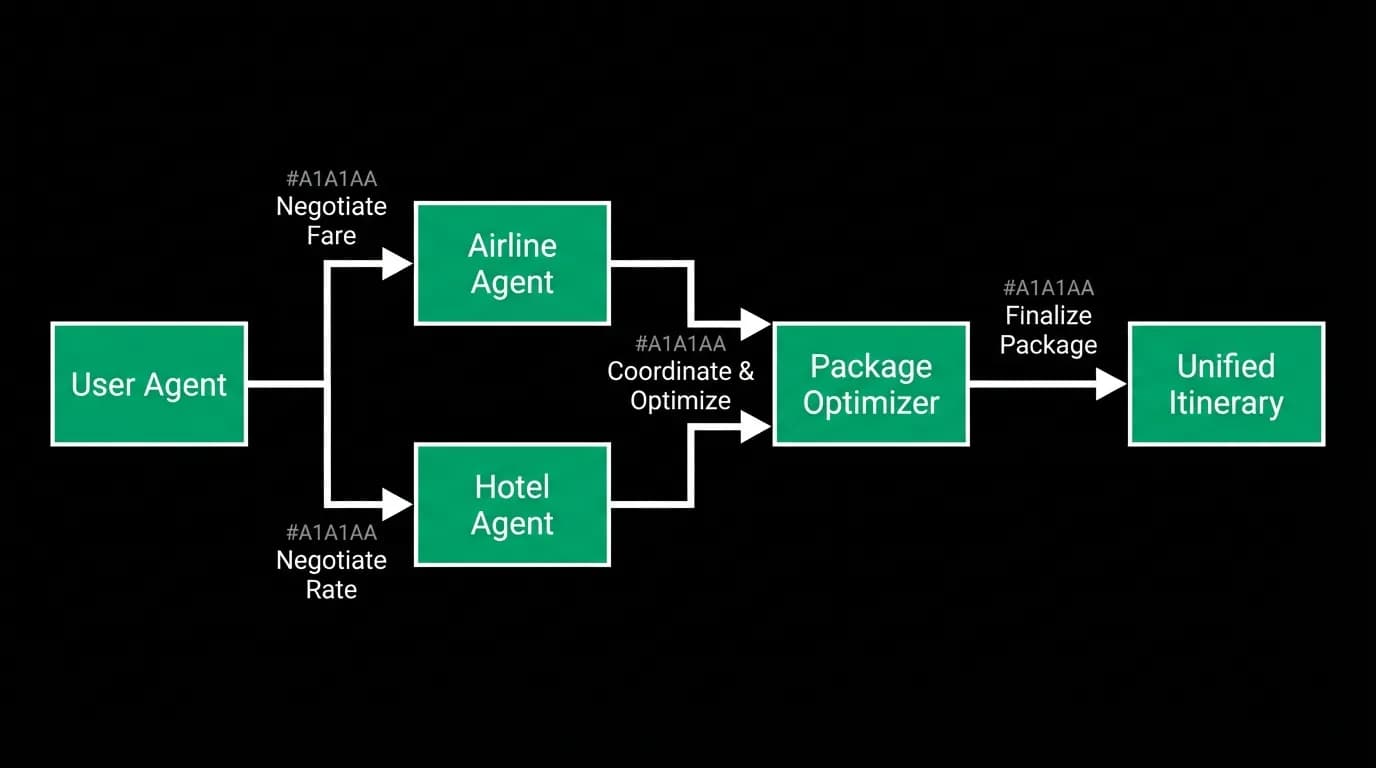
This is the change I'm most excited about. Right now, our AI agent talks to APIs. It sends structured requests and receives structured responses. The "intelligence" is all on our side.
In the near future, airlines and hotel chains will have their own AI agents. Your agent negotiates with the airline's agent for a better fare. Two AIs working the problem from both sides, each with their own context and goals.
Imagine: "I'm looking for a flight to Barcelona next Tuesday. My usual airline charges $680 but I've seen fares around $520 from competitors." Your agent communicates this to the airline's agent, which can evaluate the competitive context and respond with a personalized offer. Maybe it matches the competitor fare. Maybe it offers an upgrade at the original price. Maybe it offers a different schedule with a better deal.
This sounds speculative but the infrastructure is being built now. Major airlines are investing in AI systems. Hotel chains are building AI concierge platforms. The pieces for agent-to-agent communication are falling into place.
Travel is projected as a top-three industry for AI agent adoption by 2027. Agent-to-agent negotiation is a big reason why.
Real-time price negotiation by AI
Dynamic pricing is already how airlines operate. Fares change based on demand, competition, booking timing, and hundreds of other signals. But today, that dynamism only flows one direction: from the airline to the consumer.
AI agents will make pricing genuinely dynamic. Your agent knows your price sensitivity, your flexibility, and your alternatives. The airline's agent knows its load factor, competitive landscape, and yield targets. Negotiation between these two agents could produce personalized pricing that's better for both sides: the airline fills a seat that might go empty, and you get a fare tailored to your willingness to pay.
This isn't new in principle. Travel agents have negotiated rates with airlines and hotels for decades. AI just makes it scalable to individual consumers.
Declining inference costs change the math
LLM inference costs have dropped roughly 10x in the past eighteen months. If that trend continues (and there's no reason to think it won't), AI-intensive operations that are expensive today become trivial tomorrow.
For us, this means we can afford to do more AI reasoning per interaction. More thorough ranking analysis. More personalization layers. More proactive suggestions. More complex itinerary optimization. Today, we budget AI inference carefully because it's a meaningful per-user cost. In two years, the constraint shifts from cost to latency.
The practical effect: AI travel agents get smarter faster as inference gets cheaper. Features that would be uneconomical today (like running a full itinerary optimization across fifty possible combinations) become standard.
What this means for engineering teams today
If you're building AI-native products, the question isn't whether these capabilities will arrive. It's whether your architecture is extensible enough to absorb them.
We design for extensibility in a few specific ways.
Tool architecture. New capabilities (multimodal search, agent-to-agent negotiation, advanced itinerary planning) are additional tools in the agent's toolkit. Our tool-calling architecture supports adding new tools without modifying the orchestration layer.
Memory architecture. Longer context windows complement rather than replace our agentic memory system. Memory handles long-term personalization. Context handles in-session state. Both get better as underlying capabilities improve.
Streaming architecture. Our server streaming-based streaming infrastructure doesn't care what's being streamed. New content types (images, interactive elements, negotiation status) slot into the existing stream protocol.
Evaluation framework. New capabilities need new evals. Our eval infrastructure is designed for adding new test categories without restructuring the framework.
AI-native companies iterate faster than legacy OTAs constrained by existing architecture. That speed advantage compounds. Every new AI capability that arrives is absorbed faster by architectures designed for extensibility.
70% of travelers are open to AI-assisted trip planning. The capabilities arriving over the next two years will move AI trip planning from "interesting alternative" to "obviously superior." We want to be ready for that moment, and the way you get ready is by building extensible foundations today.
Nowah is an AI travel agent that searches and books real flights and hotels through conversation — no filters, no thirty open tabs. Plan your next trip.