Holiday Travel Booking: Why AI Agents Handle Peak Season Better
High demand, premium pricing, limited availability — holiday travel is the hardest time to book. AI agents that monitor, act fast, and adapt give you the edge.
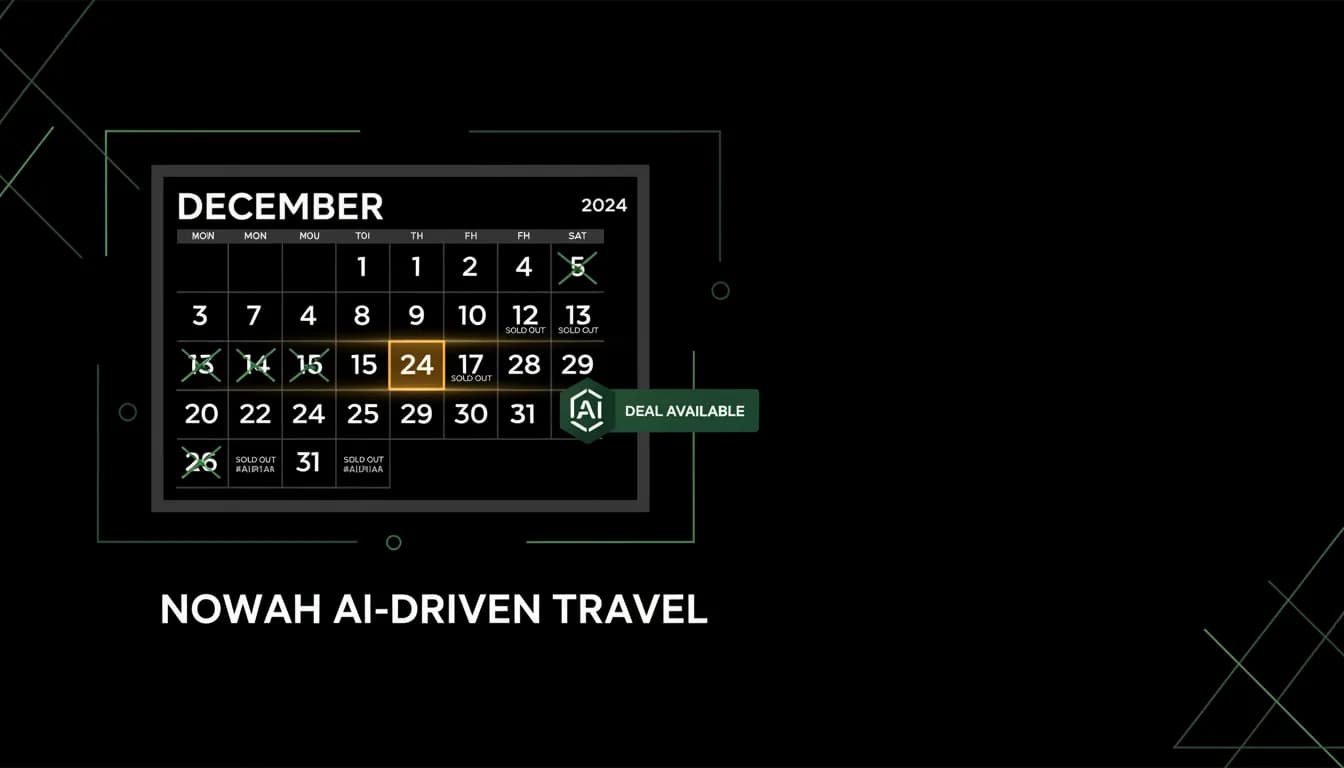
December 22nd flights are selling out. The prices have been climbing for weeks. You know you need to book, but every time you check, the numbers are higher and the options are fewer. Then your AI agent sends a message: "I found a flight option on December 21st — one day earlier — that is 40 percent cheaper with better seats. Want me to book it?"
That single-day shift saves $400 per person. For a family of four, that is $1,600 — the difference between a stressful, overpriced holiday and a comfortable one. The AI agent found it not through luck but through continuous monitoring, historical pattern analysis, and the willingness to suggest alternatives that a search form would never present.
Holiday travel is the hardest travel to book well. Demand is compressed into the same few days. Emotional stakes are high — you are not going to skip Christmas with family because the flights are expensive. Supply is fixed — airlines cannot add planes for two weeks and then remove them. Every element of the equation works against the traveler.
This is precisely the environment where AI agents provide the largest advantage.
Why holiday travel is uniquely stressful
Holiday travel combines three factors that individually make booking difficult and together make it brutal.
Compressed demand. Everyone travels during the same narrow windows. Thanksgiving in the US is a 5-day spike. Christmas and New Year's is a 2-week surge. Spring break is a 3-week rolling peak. The entire year's demand for family travel concentrates into these windows.
Emotional stakes. Missing a holiday gathering is not like missing a Tuesday meeting. The pressure to book — at any price — gives airlines and hotels pricing power they do not have during normal travel. Travelers tolerate prices they would never accept for a business trip because the alternative is not seeing family.
Family logistics. Holiday travel often involves multiple family members, multiple origins, and rigid date requirements dictated by school schedules, work holidays, and family coordination. The flexibility that saves money on normal trips — shifting dates, trying alternative airports — is constrained by factors beyond the traveler's control.
The result: holiday flight prices peak at 80 to 150 percent above normal. December 22 to 24 flights carry premiums that can double the cost of December 15 to 18 flights. And cancellation rates are twice normal due to winter weather, compounding the stress with disruption risk.
Early monitoring
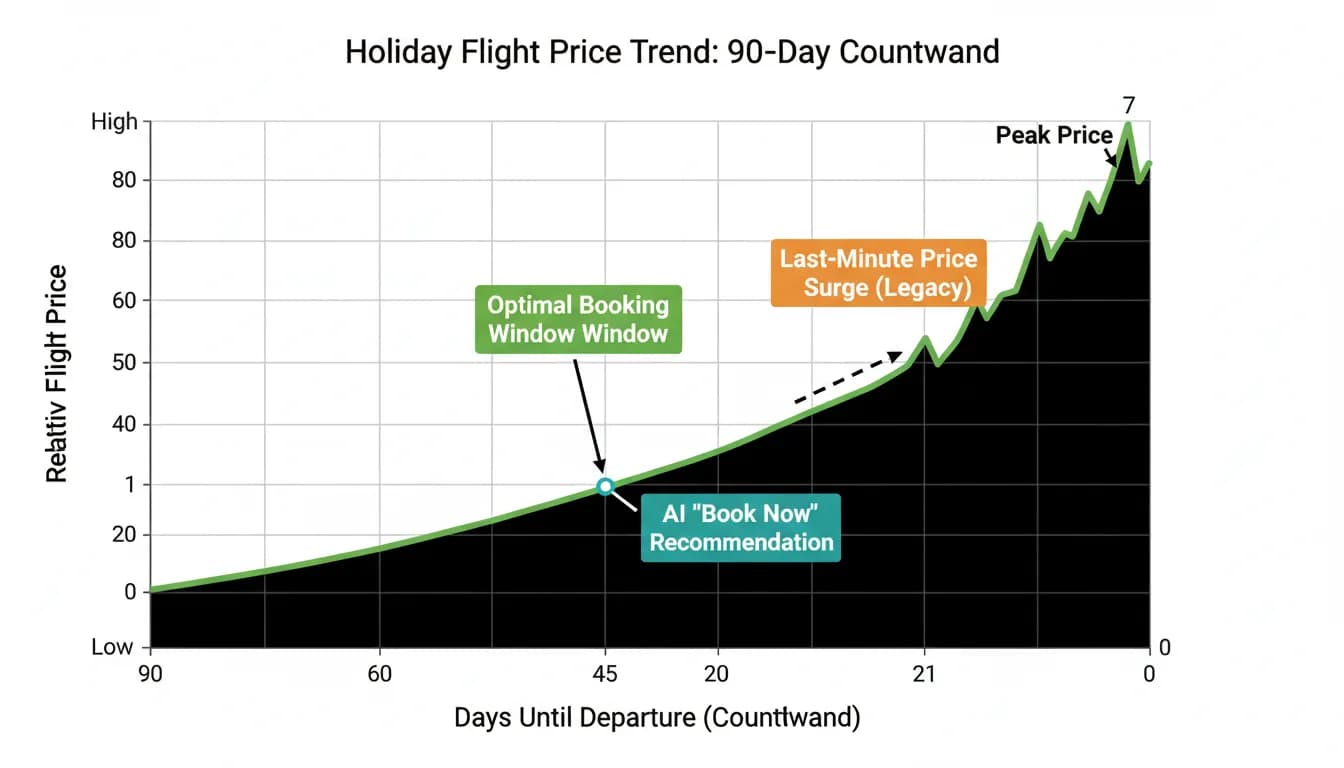
The single most effective holiday travel strategy is early monitoring, and it is the strategy that AI agents execute most effectively.
Holiday flight prices follow a predictable curve. They start relatively stable 90 or more days before the travel date, begin climbing 45 to 60 days out, accelerate 21 to 30 days out, and peak 7 to 14 days before departure. The optimal booking window — the point where prices are near their floor before the climb begins — varies by route but typically falls 45 to 75 days before travel.
AI price monitoring 90 days out captures the optimal booking window 85 percent of the time. The agent tracks your specific route, compares current pricing to historical patterns, and alerts you when the price reaches the optimal zone: "Holiday prices for your route typically start climbing in 10 days. Current price is $380, which is 8 percent below the 3-year average for this route and date. Recommend booking now."
Without monitoring, travelers typically check prices sporadically — whenever they remember or whenever the stress becomes sufficient. This leads to booking in the accelerating phase, 14 to 30 days out, when prices have already increased 20 to 40 percent from their floor.
Speed advantage
During holiday travel windows, availability shrinks by the hour on popular routes. The preferred flight times — morning departures, reasonable connection times, non-middle seats — sell out first. Travelers who wait see their options degrade from "good flights at high prices" to "bad flights at higher prices."
AI agents operate at speeds that human comparison shopping cannot match. When a favorable price appears — a fare sale, a competitor drop, a newly released fare class — the agent detects it immediately and can hold or book the fare before it sells out.
During holiday travel, this speed advantage is not marginal. It is the difference between getting a seat and not getting one. Popular holiday routes can sell out entirely 10 to 14 days before departure. The traveler who is still "thinking about it" at that point discovers there are no options left.
Flexibility intelligence
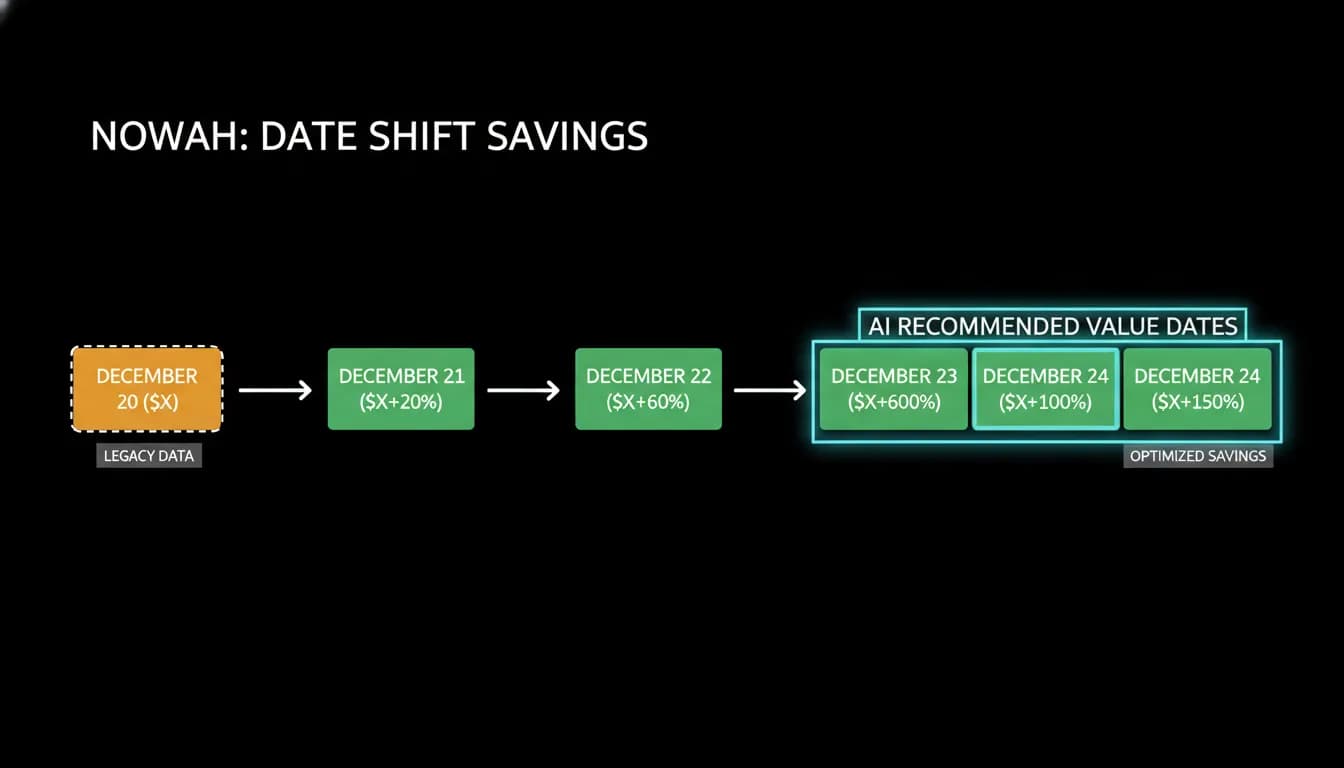
Holiday travel constrains flexibility, but it does not eliminate it. And the flexibility that remains is extremely valuable.
Date shifts. A 1-day shift during the holidays can save $200 to $500 per ticket. December 20th versus December 22nd. Returning January 2nd versus January 4th. The savings are dramatic because the demand peaks are narrow. AI agents present the date-shift savings explicitly: "Departing one day earlier saves $310 per person. You arrive Monday evening instead of Tuesday evening."
Airport alternatives. For travelers in multi-airport metro areas, the secondary airport often has lower holiday demand. The flight from the smaller airport may save enough to cover an Uber to the less convenient terminal.
Route alternatives. Nonstop flights on popular holiday routes sell out first and are priced highest. Connecting options through less obvious hubs sometimes offer significantly lower fares. AI agents evaluate all routing options and present the trade-offs: "Nonstop is $680. Connecting through Charlotte adds 2 hours but costs $420."
Departure time. Red-eye and early morning flights on holiday travel dates are less popular than midday departures. The price difference can be $100 to $200. For travelers who can sleep on planes or who do not mind an early wake-up, these off-peak times represent real savings.
Disruption resilience
Holiday weather disruptions are twice as likely as normal travel disruptions. Winter storms, ice, and reduced visibility cause cancellations and delays that cascade across the network during the busiest travel period.
AI agents provide disruption resilience through proactive monitoring and rapid rebooking. When a winter storm threatens your connection city, the agent evaluates the risk and may suggest proactive rebooking before the disruption materializes: "A winter storm is forecast in your connection city on your travel date. Risk of significant delays: 60 percent. I found a nonstop alternative on a different carrier that avoids the connection entirely. It is $80 more but eliminates the weather risk. Recommend switching."
During actual disruptions, AI agents rebook in minutes while other passengers queue for hours. Holiday disruptions are particularly acute because rebooking options are scarce — every flight is nearly full. The passengers who rebook fastest get the few remaining seats. AI speed is the critical advantage.
Start 90 days out
The actionable lesson is simple: start holiday travel planning 90 days before your target travel dates. Set up monitoring with your AI agent. Provide your dates, your flexibility parameters, and your budget.
The agent will track prices for your specific route, alert you when the optimal booking window arrives, suggest date shifts that save meaningful money, and monitor for disruption risk as the travel date approaches.
Holiday travel will always be expensive relative to off-peak travel. The demand dynamics guarantee it. But the difference between a well-timed, AI-optimized holiday booking and a panicked, last-minute one is $500 to $2,000 per family. That is money that can go toward the holiday itself rather than the inflated cost of getting there.
Nowah is an AI travel agent that searches and books real flights and hotels through conversation — no filters, no thirty open tabs. Plan your next trip.