How Airlines Price Flights (And What That Means for You)
Fare classes, yield management, demand curves, and competitive dynamics — an accessible guide to airline pricing with AI as your counter-intel.

Airlines change prices 3-5 times a day on competitive routes. That is not a typo. The price you see for a flight at 9 AM might be different at lunch and different again by dinner. Most travelers experience this as random and frustrating. But it is not random. It is the output of a sophisticated pricing system that you have been flying blind against until now.
Understanding how that system works gives you a structural advantage. And having an AI agent that understands it gives you an even bigger one.
Fare classes: the invisible inventory system
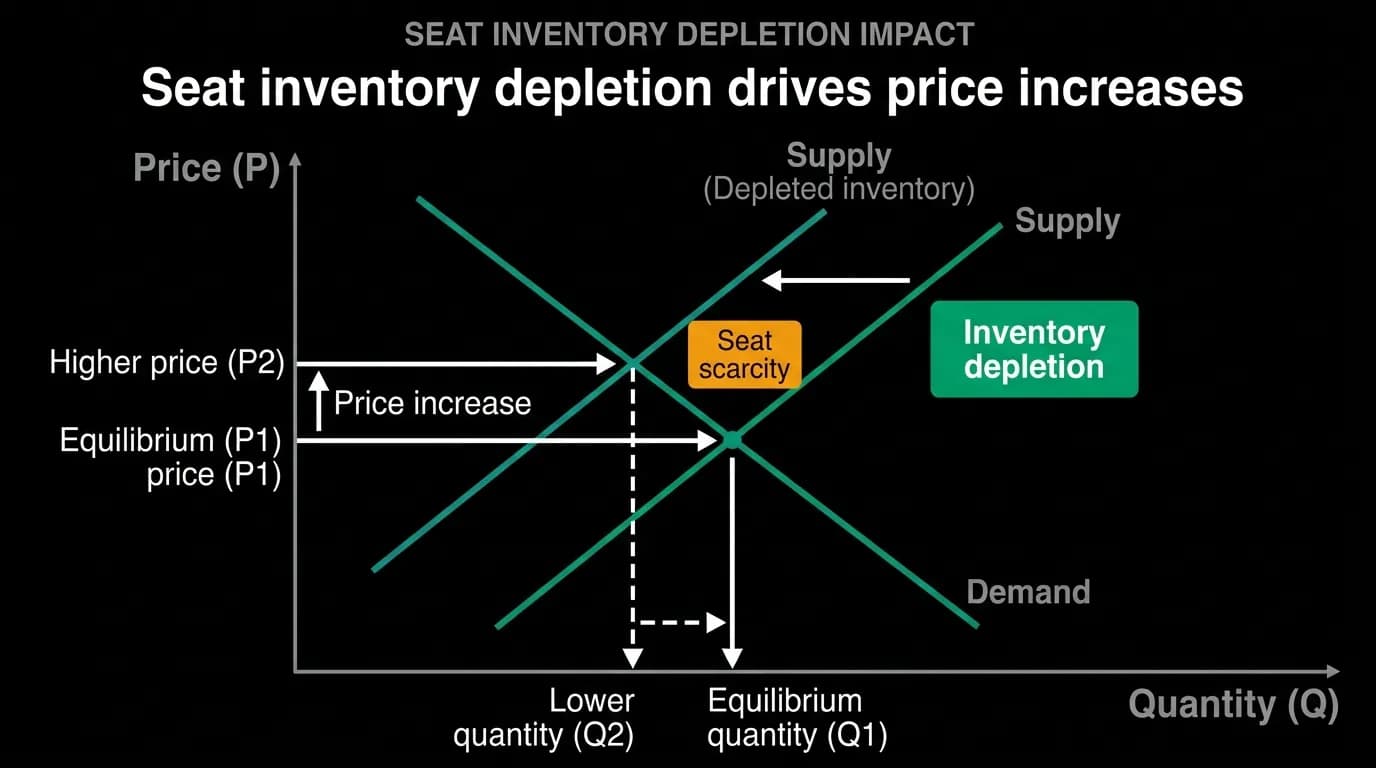
Every route has a set of fare classes, typically 12-26 per route. These are not the cabin classes you see advertised (economy, premium economy, business, first). They are sub-categories within each cabin, identified by single letters, each with a different price point and a limited number of seats.
Think of it like a concert venue with 200 identical seats, but the first 20 are sold at $50, the next 30 at $75, the next 50 at $100, and so on. The seats are the same. The prices are not. As each bucket sells out, the next buyer pays the higher price from the next bucket.
This is why two people sitting in adjacent economy seats might have paid vastly different fares. One bought a ticket from an early, cheap fare bucket. The other bought from a later, expensive one. Same seat, same service, different timing.
The cheapest buckets have the most restrictions: no changes, no refunds, no seat selection, basic carry-on only. As you move up through fare classes within the same cabin, you get more flexibility and perks. The airline is selling not just a seat but a set of terms.
Yield management: filling the plane profitably
Airlines do not want to sell every seat cheap, and they do not want the plane to depart with empty seats. Yield management is the balancing act between these two goals: maximize revenue per flight while maintaining a high load factor (percentage of seats filled).
The pricing algorithm constantly adjusts which fare buckets are open based on how fast inventory is selling relative to the expected demand curve. If a flight is selling faster than projected, the algorithm closes cheap buckets earlier and prices climb. If it is selling slower, cheap buckets stay open longer and you might see prices drop.
This means the same flight can get cheaper after getting more expensive, or vice versa. It is not a simple escalator. It is a dynamic system that responds to real-time demand signals. But the general trend is upward as the departure date approaches, because last-minute travelers (often business travelers) are less price-sensitive.
Demand-based pricing: seasons, events, and days of the week
On top of fare class management, airlines adjust base pricing levels based on demand forecasts. Routes expected to have high demand (summer transatlantic, holiday weekends, event-adjacent flights) start with higher base fares. Routes expected to be weak start lower.
Day-of-week effects are real. Midweek departures are often cheaper than Friday and Sunday on most domestic routes because of the business/leisure demand split. Airlines know that Monday morning and Friday evening travelers are more likely to be on expense accounts, so those flights command a premium.
Seasonal variance is even more significant. Domestic fares can swing substantially across a 90-day window depending on where that window falls relative to peak travel seasons.
Competitive route dynamics
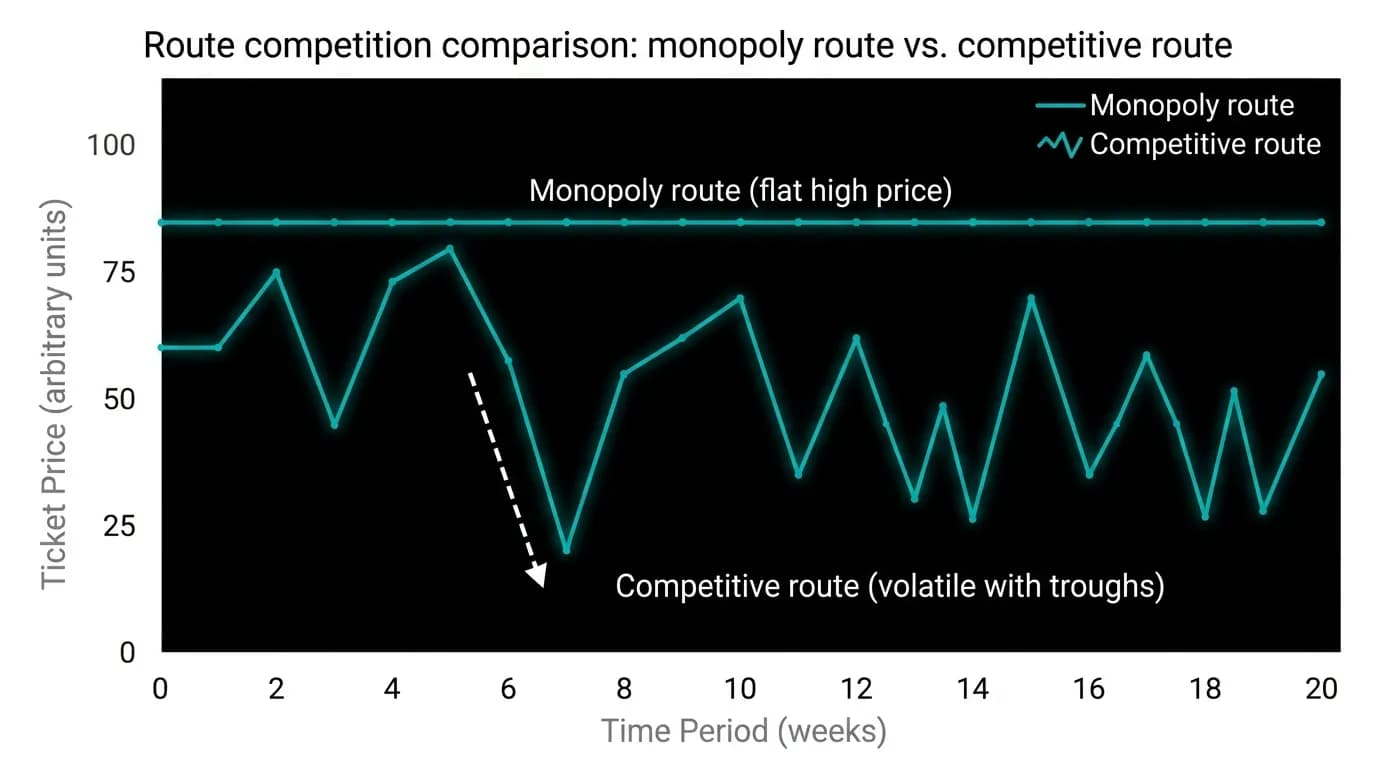
The number of carriers on a route directly affects pricing behavior. Monopoly routes, where only one airline offers service, have stable but high pricing. The carrier has no incentive to discount because there is no competition to undercut.
Duopoly and oligopoly routes (2-4 carriers) are where the most interesting pricing dynamics happen. Carriers watch each other's fares and respond in near-real-time. A price drop by one airline often triggers matching within hours. This creates fare troughs that do not last long but represent genuine savings if you catch them.
Highly competitive routes (5+ carriers) have the deepest troughs and the most volatile pricing. The fare floor is lower, but the noise is higher because prices change more frequently.
OTA commission structures also play a role. OTAs earn 10-25% on bookings, with flights at the lower end and hotels at the higher end. This creates incentive structures that influence which results get promoted, which is a different kind of pricing dynamic that affects what you see rather than what the airline charges.
AI as the traveler's counter-intelligence
Here is the thing: airlines have entire departments and sophisticated algorithms dedicated to pricing optimization. They have perfect information about their own inventory, strong signals about competitor pricing, and decades of demand data. Individual travelers have none of this. The information asymmetry is massive.
An AI travel agent rebalances this asymmetry. It can check current fares against historical data, understand where a price sits in the fare class cycle, factor in competitive dynamics for the route, and translate all of this into a plain-language assessment.
"This fare is 18% below the 90-day median. The route has three competing carriers, and prices typically rise 4-6 weeks before departure" is genuinely useful intelligence that would take you hours to assemble manually.
Use Nowah to see where your fare sits in the historical pricing curve. The airlines have had the data advantage for decades. It is time to even the playing field.
Nowah is an AI travel agent that searches and books real flights and hotels through conversation — no filters, no thirty open tabs. Plan your next trip.