Interactive Tutorials vs Static Docs: Finding the Right Mix
Interactive sandboxes teach faster but cost more to maintain. Static docs scale but bore readers. The right mix depends on learning stage, complexity, and maintenance budget.
We built an interactive tutorial with 30 steps that walked developers through every feature of our API. It was impressive. It was thorough. Nobody finished it.
The completion rate was 12%. Most developers dropped off between steps 8 and 12. They had learned enough to start building and did not want to continue a guided tour. The tutorial was optimized for comprehensiveness when it should have been optimized for the moment the developer feels confident enough to go build something.
Meanwhile, our static API reference -- plain text with code examples -- was getting ten times more page views than the interactive tutorial. Developers kept coming back to it as a reference. The tutorial was a one-time experience. The reference was a daily tool.
This taught us that the question is not "should we use interactive or static?" It is "when does each format serve the developer best?"
When interactive wins
Interactive formats excel at three things: first-time exploration, complex multi-step flows, and error debugging.
First-time exploration is the strongest case. A developer who has never used your API needs to build a mental model of how it works. Reading about it is slow. Trying it is fast. An interactive sandbox where they can run a flight search, see real results, modify parameters, and see how results change teaches more in two minutes than five pages of documentation.
Our data backs this up. Interactive tutorials show roughly 3x higher completion rates for first-time onboarding compared to text-only guides. The developer who runs a search and sees results "gets it" in a way that reading a description cannot replicate.
Complex flows are the second win. Our booking flow has five steps: search, select, create intent, authorize payment, and confirm. Reading about this flow is abstract. Walking through it interactively, where each step builds on the previous one and the developer sees the state change at each transition, makes the flow concrete.
Error debugging is the third. An interactive panel where a developer can paste their failing request and see exactly what the API returns is more useful than a page listing possible errors. The interactivity lets them experiment: change a parameter, re-run, see if the error changes.
When static wins
Static documentation wins at reference lookups, conceptual understanding, and offline reading. It also wins at scale -- static docs get ten times more visits than interactive tutorials in our analytics.
Reference lookups are the dominant use case for documentation. A developer knows which endpoint they want to call. They need the parameter list, the response schema, and maybe an error code explanation. They do not need an interactive walkthrough. They need text they can scan in 15 seconds.
Conceptual documentation -- explaining why the booking flow works the way it does, or how search ranking balances multiple signals -- is inherently a reading experience. Interactivity adds nothing to a conceptual explanation. Good writing does.
Offline reading still matters. Developers on planes, in cafes with spotty wifi, or in corporate environments with restricted network access need documentation they can access without a live connection. Static docs work everywhere. Interactive sandboxes require a running API behind them.
The hybrid model

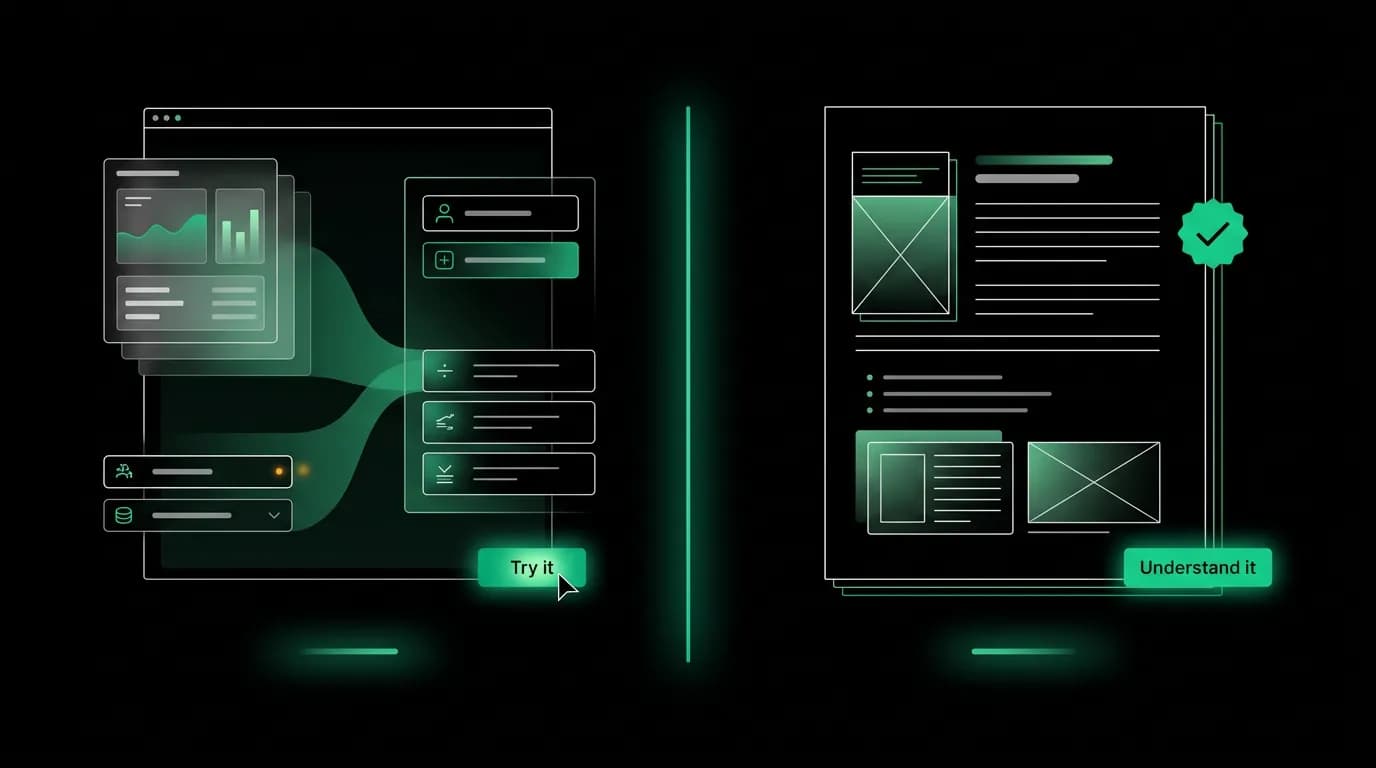
We settled on a hybrid approach: interactive for "try it," static for "understand it."
Every endpoint has both an interactive sandbox panel and a static reference page. The sandbox lets developers experiment. The reference page provides the authoritative specification. Links between them are prominent -- the sandbox links to the reference for deeper understanding, and the reference links to the sandbox for hands-on experimentation.
The quickstart is interactive. Getting a developer to their first successful API call is an action, not a reading assignment. The sandbox does this better than any written guide.
The concepts guide is static. Understanding the booking state machine, the search ranking algorithm, or the webhook reliability model is a comprehension task. Good writing with diagrams serves this better than an interactive widget.
The API reference is static with an embedded "Try it" button for each endpoint. The reference is the canonical documentation. The button launches the sandbox pre-filled with that endpoint's parameters. This gives developers the best of both worlds without forcing them into either format.
Maintenance costs
Here is the uncomfortable truth about interactive tutorials: they cost roughly three times more to maintain than static docs per page.
An interactive tutorial breaks when the API changes. A new required parameter means updating the tutorial step, the validation logic, the expected response, and the progression flow. A static doc page needs a text update and an example update.
Interactive elements also have infrastructure costs. The sandbox needs a running backend. The tutorial engine needs hosting. The state management for multi-step tutorials needs testing. None of this exists for static pages.
We are not saying interactive tutorials are not worth the cost. We are saying you should budget for it honestly and allocate interactive formats where they provide enough value to justify the maintenance overhead. First-time onboarding and complex flows justify it. Reference documentation does not.
Completion analytics reveal API friction
Tutorial completion drop-off analysis is one of the most underused signals for API design improvement.
When developers consistently drop off at step 4 of a tutorial, that step represents a friction point in your API, not just your tutorial. Maybe the parameter you ask them to provide at step 4 is confusing. Maybe the error message when they get it wrong is unhelpful. Maybe the concept introduced at that step is not well-explained.
We track completion rates per step and review them quarterly. Steps with high drop-off get investigated. Sometimes the fix is a better tutorial step. Sometimes the fix is a better error message. Sometimes the fix is a simpler API design.
The decision framework
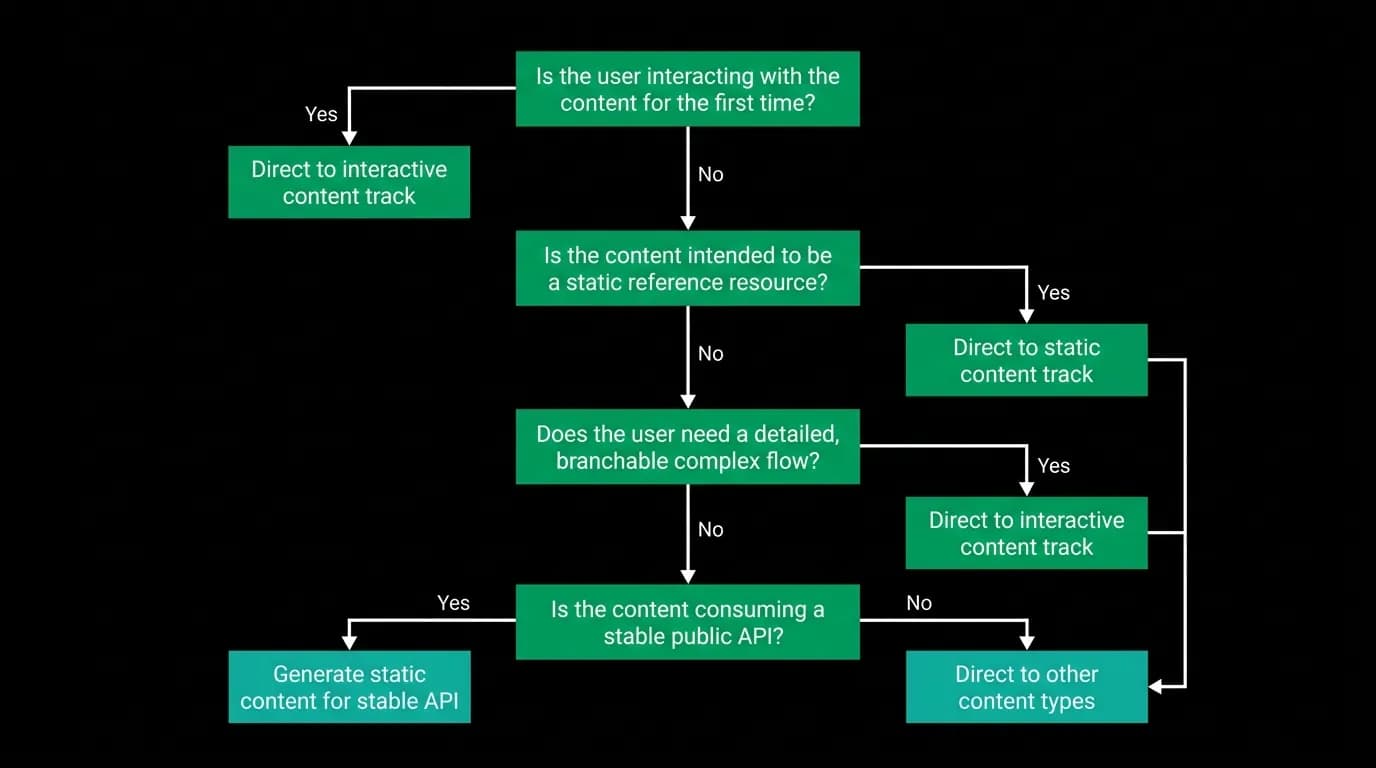
For any new documentation page, we ask four questions:
Is the developer doing this for the first time? If yes, lean interactive. First-time experiences benefit from guided exploration.
Is this a reference they will return to repeatedly? If yes, make it static. Reference documentation needs to be scannable, searchable, and fast.
Is this a multi-step flow with dependencies between steps? If yes, interactive helps developers understand the state transitions. If it is a single-step operation, static is sufficient.
Is the underlying API changing frequently? If yes, static costs less to maintain. If the endpoint is stable, interactive is a reasonable investment.
No format is universally better. The right answer depends on the developer's need at that moment. Our job is to match the format to the moment, not to pick a favorite and apply it everywhere.
Nowah is an AI travel agent that searches and books real flights and hotels through conversation — no filters, no thirty open tabs. Plan your next trip.