How Our AI Ranks Your Flights
Discover the multi-factor scoring system that turns hundreds of flight options into three curated picks tailored to your preferences and travel style.

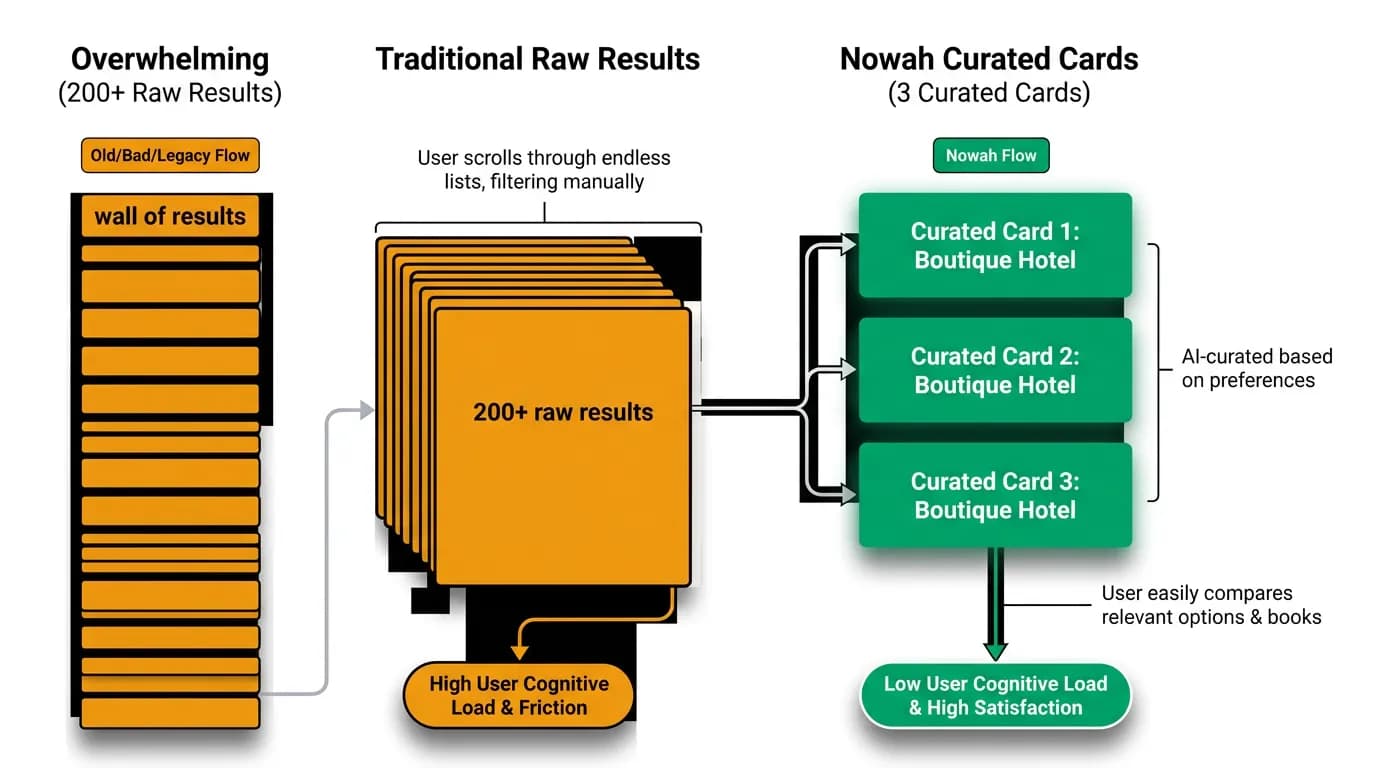
You type six words into Nowah. "Flights from JFK to Tokyo, October." In the time it takes you to read the response, our AI agent has pulled roughly 180 candidate itineraries from live inventory, scored each one across several dimensions, enforced a diversity guarantee, generated plain-language explanations for the top picks, and presented you with three options.
Three. Not thirty. Not three hundred.
That curation ratio is the whole point. Industry studies have long reported that travelers bounce across many sites before booking a single trip, and I think most of that suffering comes down to one problem: traditional search engines show you everything and help you choose nothing. We built the ranking system to do the opposite.
Signal extraction: what the AI knows before it searches
Before a single flight result loads, the ranking engine already has context. Some of it you gave explicitly, like "budget around $1,200" or "I hate long layovers." Some of it the AI recalls from previous conversations stored in your agentic memory profile. Maybe you always book aisle seats. Maybe you told us two months ago that connecting through Miami stresses you out. Maybe your last three bookings were all premium economy on long-haul routes.
These signals split into two categories. Explicit preferences are the things you say out loud in the current conversation. Recalled preferences are the things the AI already knows about you from past interactions, your traveler profile, and behavioral patterns it has picked up over time.
Both categories feed into the scoring engine. The more the AI knows about you, the sharper the ranking becomes. Your first search is good. Your tenth is eerily accurate.
Multi-factor scoring: multiple dimensions that define "best"
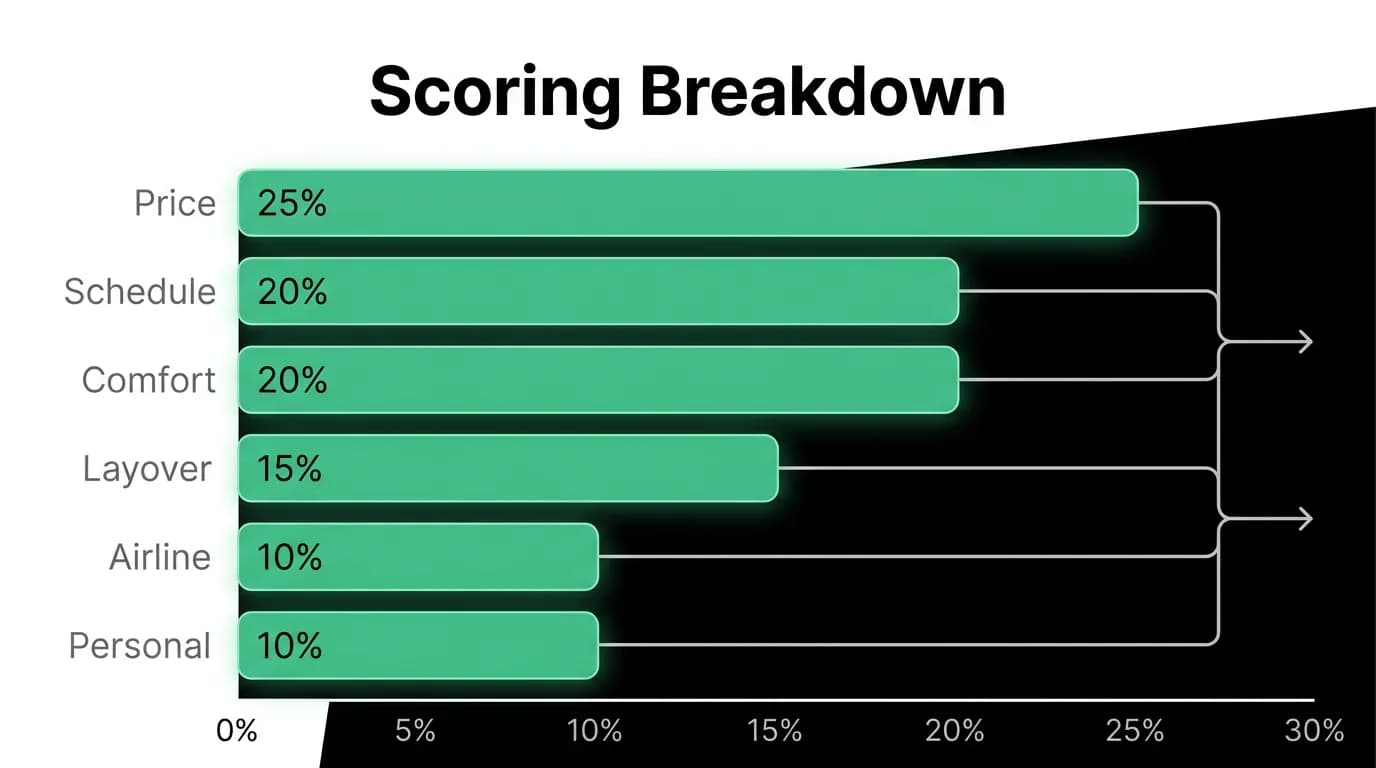
Every candidate itinerary gets scored across multiple factors. Exact weights are not the point of this post — they shift with the trip — but the ingredients are stable:
Price. Relative value against recent fares for the same route, not just the sticker price.
Schedule alignment. Departure and arrival windows that match what you asked for (or what you usually prefer).
Comfort. Nonstop versus connection, cabin, seat space — whatever “comfortable” means for this traveler.
[Layover quality](/blog/data-behind-layover-quality). Airport experience, connection risk, and transit pain — not just connection length.
Airline quality. Reliability and product fit, plus any loyalty context you care about.
Personal fit. Everything that is uniquely you: meal needs, seat position, airline aversions, and hard constraints.
The diversity guarantee
Here is something we feel strongly about: the top three should not be three variations of the same flight.
If the ranking engine just sorted by total score and took the top three, you would often get three nearly identical options. Maybe three morning departures on similar airlines at similar prices. That is not useful. You need meaningful variety to make a confident decision.
So we enforce a diversity guarantee. The final shortlist always includes at least one budget-optimized option, one comfort-optimized option, and one balanced pick. Each of the three occupies a distinct position in the price-comfort space, giving you real choices rather than subtle variations.
This is harder to implement than it sounds. Sometimes the objectively best flight dominates on every dimension, and the engine has to find genuinely different alternatives that are still worth recommending. But the decision science is clear: 2-4 meaningfully different options produce the highest booking confidence and satisfaction. One option feels like no choice. Five or more triggers paralysis.
Worked example: JFK to NRT in late October
Let me walk through a real scenario. You tell Nowah: "I need to fly from New York to Tokyo in late October. Budget around $1,200. I hate long layovers."
The AI already knows from your profile that you prefer aisle seats, you are a member of a major airline alliance, and your last two long-haul flights were premium economy.
Step one: the data layer returns roughly 180 candidate itineraries across airlines and alliances covering the date range.
Step two: hard constraints eliminate options above $1,200 and any itinerary with layovers exceeding two hours (based on your stated preference).
Step three: the remaining candidates get scored across all of those dimensions. Your alliance membership boosts flights on partner airlines. Your premium economy history increases the comfort weight slightly. Your aisle seat preference filters into personal fit.
Step four: the diversity guarantee kicks in. The engine selects three finalists that cover distinct positions.
What you see:
Option A (budget pick): A one-stop through a major Pacific hub, departing evening, arriving next afternoon. $870. "This is well below the recent average for JFK-NRT. One-stop with a 90-minute connection at a top-rated hub airport."
Option B (balanced pick): Non-stop on your alliance airline, departing afternoon, arriving next morning. $1,080. "Non-stop on your preferred alliance. Arriving before noon matches your history. Premium economy available at this fare."
Option C (comfort pick): Non-stop on a carrier known for service quality, departing morning, arriving evening. $1,190. "Highest-rated carrier on this route. Morning departure you prefer. Premium economy included."
Each recommendation comes with an explanation grounded in data and your personal preferences. You are not guessing. You are choosing.
Why explanations ship with every recommendation
I want to spend a moment on the explanations because they are not decorative. They are functional.
Traditional search engines present you with a price and a schedule and expect you to figure out whether it is a good deal. "Is $920 good for JFK to Tokyo?" You have no idea unless you have been monitoring that route for weeks. The explanation closes that gap. When we tell you a fare is meaningfully below the recent average, you can make a confident decision in seconds instead of opening six more tabs to cross-reference.
Explanations also build trust. The AI is making judgment calls on your behalf when it ranks one flight above another. You deserve to know why. If the reasoning does not match your priorities, you can tell us, and the ranking adapts. But more often, the explanation confirms something you already suspected and gives you the confidence to book.
Data backs this up. industry UX research consistently finds that small, well-explained choice sets convert better than long uncurated result lists. People do not just want fewer options. They want fewer options with reasons.
The ranking gets better over time
Everything I have described improves with use. Your first search draws on whatever you share during onboarding and what you say in the conversation. By your third or fourth trip, the AI has a rich preference profile. It knows your airline tendencies, your price tolerance, your comfort thresholds, and your scheduling quirks.
Airlines adjust prices 3-5 times per day on competitive routes. The market is noisy and fast. But your preferences are relatively stable. The ranking engine sits between those two realities, applying your stable preferences against a constantly shifting market to surface the options that are genuinely best for you.
That is what ranking intelligence means. Not sorting by price. Not showing everything and hoping you figure it out. Understanding what you want, evaluating what is available, and presenting the intersection with a clear explanation of why.
Try a search on Nowah and see your personalized ranking in action. The three options you get will be different from anyone else searching the same route, because the ranking is built around you.
Nowah is an AI travel agent that searches and books real flights and hotels through conversation — no filters, no thirty open tabs. Plan your next trip.